Thank you for visiting SNEWPapers!
Sign up free
Editorial
April 10, 1815
Kentucky Gazette
Lexington, Fayette County, Kentucky
What is this article about?
Editorial advocates for developing U.S. manufactures to achieve economic independence, reduce foreign dependency, and balance agriculture and commerce. Proposes initial 50% import duties gradually reducing to 35% for protection, highlighting benefits of machinery and risks of inaction by Congress.
Clipping
OCR Quality
95%
Excellent
Full Text
FROM THE EMPORIUM OF THE ARTS.
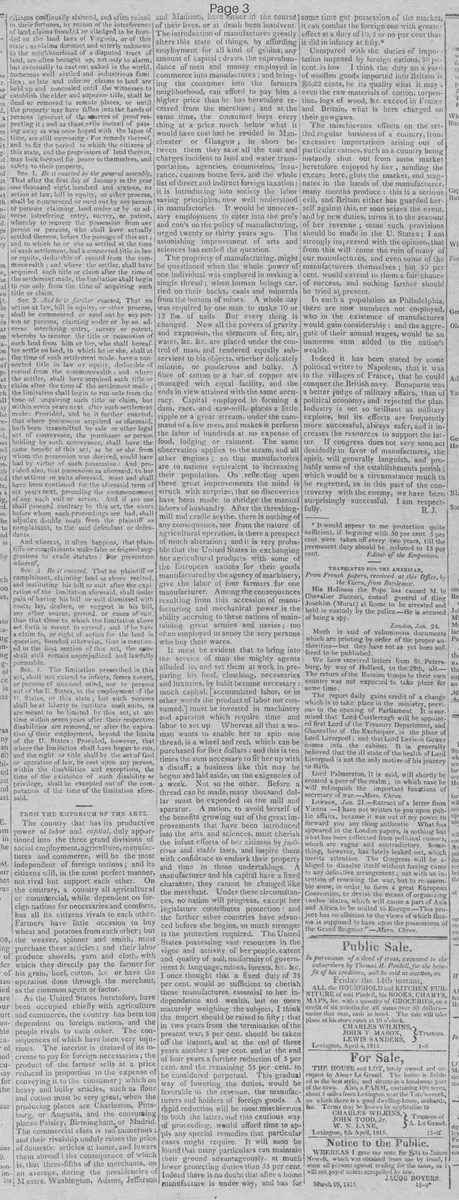
The country that has its productive power of labor and capital, duly apportioned into the three grand divisions of social employment, agriculture, manufactures and commerce, will be the most independent of foreign nations; and its citizens will, in the most perfect manner, not rival but support each other. On the contrary, a country all agricultural or commercial, while dependent on foreign nations for necessaries and comforts, has all its citizens rivals to each other. Farmers have little occasion to buy wheat and potatoes from each other; but the weaver, spinner and smith, must purchase these articles: and their labor produce shovels, yarn and cloth, with which they directly pay the farmer for his grain, beef, cotton, &c or have the operation done through the merchant, as the common agent or factor.
As the United States heretofore, have been occupied chiefly with agriculture and commerce, the country has been too dependent on foreign nations, and the people rivals to each other. The consequences of which have been very injurious. The interior is drained of its increase to pay for foreign necessaries; the product of the farmer sells at a price reduced in proportion to the expense of conveying it to the consumer; which on heavy and bulky articles, such as flour and cotton must be very great, when the producing places are Charleston, Pittsburgh, or Augusta, and the consuming places Paisley, Birmingham, or Madrid.
The commercial class is too numerous ; and their rivalship unduly raises the price of domestic articles at home, and lowers them abroad: the consequence of which is, that three-fifths of the merchants, on an average, during the presidencies of Messrs. Washington, Adams, Jefferson and Madison, have either in the course of their lives, or at death been insolvent.
The introduction of manufactures greatly alters this state of things, by affording employment for all kind of genius, any amount of capital; draws the superabundance of men and money employed in commerce into manufactures; and bringing the consumer into the farmers neighborhood, can afford to pay him a higher price than he has heretofore received from the merchant; and at the same time, the consumer buys every thing at a price much below what it would have cost had he resided in Manchester or Glasgow; in short between them they save all the cost and charges incident to land and water transportation, agencies, commission, insurance, custom house fees, and the whole list of direct and indirect foreign taxation; it is introducing into society the labor saving principles, now well understood in manufactories. It would be unnecessary employment to enter into the pro's and con's on the policy of manufacturing, urged twenty or thirty years ago. The astonishing improvement of arts and sciences has settled the question.
The propriety of manufacturing, might be questioned when the whole power of one individual was employed in making a single thread; when human beings carried on their backs, coals and minerals from the bottom of mines. A whole day was required by one man to make 10 or 12 lbs. of nails. But every thing is changed. Now all the powers of gravity and expansion, the elements of fire, air, water, &c. &c. are placed under the control of man, and rendered equally subservient to his objects, whether delicately minute, or ponderous and bulky. A fibre of cotton or a bar of copper are managed with equal facility, and the ends in view attained with the same accuracy. Capital employed in forming a dam, race, and saw-mill, places a little ripple or a great stream, under the command of a few men, and makes it perform the labor of hundreds at no expense of food, lodging or raiment. The same observation applies to the steam, and all other engines; so that manufactories are to nations equivalent to increasing their population. On reflecting upon these great improvements the mind is struck with surprize, that no discoveries have been made to abridge the manual labors of husbandry. After the threshing-mill and cradle scythe, there is nothing of any consequence, nor from the nature of agricultural operation, is there a prospect of much alteration; and it is very probable that the United States in exchanging her agricultural products with some of the European nations for their goods manufactured by the agency of machinery, give the labor of four farmers for one manufacturer. Among the consequences resulting from this accession of manufacturing and mechanical power is the ability accruing to these nations of maintaining great armies and navies; too often employed to annoy the very persons who buy their wares.
It must be evident that to bring into the service of man the mighty agents alluded to, and set them at work in preparing his food, cloathing, necessaries and luxuries, by habit become necessary : much capital, accumulated labor, or in other words the product of labor not consumed, must be invested in machinery and apparatus which require time and labor to set up. Whereas all that a woman wants to enable her to spin one thread, is a wheel and reel, which can be purchased for four dollars : and this is ten times the sum necessary to fit her up with a distaff; a business like this may be begun and laid aside, on the exigencies of a week. Not so the other. Before a thread can be made, many thousand dollars must be expended on the mill and apparatus. A nation, to avail herself of the benefits growing out of the great improvements that have been introduced into the arts and sciences, must cherish the infant efforts of her citizens by judicious and stable laws, and inspire them with confidence to embark their property and time in those undertakings. A manufacturer and his capital have a fixed character, they cannot be changed like the merchant. Under these circumstances, no nation will progress, except her Legislature contributes protection : and the farther other countries have advanced before she begins, so much stronger is the protection required. The United States possessing vast resources in the vigor and activity of her people, extent and quality of soil, uniformity of government & language, mines, forests, &c. &c. I once thought that a fixed duty of 35 per cent. would be sufficient to cherish those manufactures essential to her independence and wealth, but on more maturely weighing the subject, I think the import should be raised to fifty ; that in two years from the termination of the present war, 5 per cent. should be taken off the import, and at the end of three years another 5 per cent. and at the end of four years a further reduction of 5 per cent. and the remaining 35 per cent. to be considered perpetual. This gradual way of lowering the duties, would be favorable to the revenue, the manufacturers and holders of foreign goods. A rapid reduction will be most mischievous to both the latter, and this cautious way of proceeding, would afford time to apply any special remedies that particular cases might require. It will soon be found that many particulars can maintain their ground advantageously, at much lower protecting duties than 35 per cent. Indeed there is no doubt that after a home manufacture is under way, and has for some time got possession of the market, it can combat the foreign one with greater effect at a duty of 10, 5 or no per cent than it did in infancy at fifty.*
Compared with the duties of importation imposed by foreign nations, 50 per cent. is low. I think the duty on a yard of woollen goods imported into Britain is $6,22 cents, be its quality what it may ; even the raw materials of cotton, turpentine, logs of wood, &c. exceed in France and Britain, what is here charged on their gewgaws.
The mischievous effects on the settled regular business of a country, from excessive importations arising out of particular causes, such as a country being instantly shut out from some market heretofore enjoyed by her , sending the excess here, gluts the market, and stagnates in the hands of the manufacturer, many months produce: this is a serious evil, and Britain either has guarded herself against this, or soon seizes the event, and by new duties, turns it to the account of her revenue; some such provisions should be made in the U. States; I am strongly impressed with the opinion, that from this will come the ruin of many of our manufactures, and even some of the manufacturers themselves; but 50 per cent. would extend to them a fair chance of success, and nothing farther should be tried at present.
In such a population as Philadelphia, there are now numbers not employed, who in the existence of manufactures would gain considerably : and the aggregate of their annual wages, would be an immense sum added to the nation's wealth.
Indeed it has been stated by some political writer to Napoleon, that it was in the villages of France, that he could conquer the British navy. Bonaparte was a better judge of military affairs, than of political economy, and rejected the plan.
Industry is not so brilliant as military exploits, but its effects are frequently more successful, always safer, and it increases the resources to support the latter. If congress does not very soon act decidedly in favor of manufactures, the spirit will generally languish, and probably some of the establishments perish; which would be a circumstance much to be regretted, as in this part of the controversy with the enemy, we have been surprisingly successful. I am respectfully,
R.J.
*It would appear to me protection quite sufficient, if beginning with 50 per cent 5 per cent were taken off every two years, till the permanent duty should be reduced to 15 per cent.
Editor of the Emporium.
The country that has its productive power of labor and capital, duly apportioned into the three grand divisions of social employment, agriculture, manufactures and commerce, will be the most independent of foreign nations; and its citizens will, in the most perfect manner, not rival but support each other. On the contrary, a country all agricultural or commercial, while dependent on foreign nations for necessaries and comforts, has all its citizens rivals to each other. Farmers have little occasion to buy wheat and potatoes from each other; but the weaver, spinner and smith, must purchase these articles: and their labor produce shovels, yarn and cloth, with which they directly pay the farmer for his grain, beef, cotton, &c or have the operation done through the merchant, as the common agent or factor.
As the United States heretofore, have been occupied chiefly with agriculture and commerce, the country has been too dependent on foreign nations, and the people rivals to each other. The consequences of which have been very injurious. The interior is drained of its increase to pay for foreign necessaries; the product of the farmer sells at a price reduced in proportion to the expense of conveying it to the consumer; which on heavy and bulky articles, such as flour and cotton must be very great, when the producing places are Charleston, Pittsburgh, or Augusta, and the consuming places Paisley, Birmingham, or Madrid.
The commercial class is too numerous ; and their rivalship unduly raises the price of domestic articles at home, and lowers them abroad: the consequence of which is, that three-fifths of the merchants, on an average, during the presidencies of Messrs. Washington, Adams, Jefferson and Madison, have either in the course of their lives, or at death been insolvent.
The introduction of manufactures greatly alters this state of things, by affording employment for all kind of genius, any amount of capital; draws the superabundance of men and money employed in commerce into manufactures; and bringing the consumer into the farmers neighborhood, can afford to pay him a higher price than he has heretofore received from the merchant; and at the same time, the consumer buys every thing at a price much below what it would have cost had he resided in Manchester or Glasgow; in short between them they save all the cost and charges incident to land and water transportation, agencies, commission, insurance, custom house fees, and the whole list of direct and indirect foreign taxation; it is introducing into society the labor saving principles, now well understood in manufactories. It would be unnecessary employment to enter into the pro's and con's on the policy of manufacturing, urged twenty or thirty years ago. The astonishing improvement of arts and sciences has settled the question.
The propriety of manufacturing, might be questioned when the whole power of one individual was employed in making a single thread; when human beings carried on their backs, coals and minerals from the bottom of mines. A whole day was required by one man to make 10 or 12 lbs. of nails. But every thing is changed. Now all the powers of gravity and expansion, the elements of fire, air, water, &c. &c. are placed under the control of man, and rendered equally subservient to his objects, whether delicately minute, or ponderous and bulky. A fibre of cotton or a bar of copper are managed with equal facility, and the ends in view attained with the same accuracy. Capital employed in forming a dam, race, and saw-mill, places a little ripple or a great stream, under the command of a few men, and makes it perform the labor of hundreds at no expense of food, lodging or raiment. The same observation applies to the steam, and all other engines; so that manufactories are to nations equivalent to increasing their population. On reflecting upon these great improvements the mind is struck with surprize, that no discoveries have been made to abridge the manual labors of husbandry. After the threshing-mill and cradle scythe, there is nothing of any consequence, nor from the nature of agricultural operation, is there a prospect of much alteration; and it is very probable that the United States in exchanging her agricultural products with some of the European nations for their goods manufactured by the agency of machinery, give the labor of four farmers for one manufacturer. Among the consequences resulting from this accession of manufacturing and mechanical power is the ability accruing to these nations of maintaining great armies and navies; too often employed to annoy the very persons who buy their wares.
It must be evident that to bring into the service of man the mighty agents alluded to, and set them at work in preparing his food, cloathing, necessaries and luxuries, by habit become necessary : much capital, accumulated labor, or in other words the product of labor not consumed, must be invested in machinery and apparatus which require time and labor to set up. Whereas all that a woman wants to enable her to spin one thread, is a wheel and reel, which can be purchased for four dollars : and this is ten times the sum necessary to fit her up with a distaff; a business like this may be begun and laid aside, on the exigencies of a week. Not so the other. Before a thread can be made, many thousand dollars must be expended on the mill and apparatus. A nation, to avail herself of the benefits growing out of the great improvements that have been introduced into the arts and sciences, must cherish the infant efforts of her citizens by judicious and stable laws, and inspire them with confidence to embark their property and time in those undertakings. A manufacturer and his capital have a fixed character, they cannot be changed like the merchant. Under these circumstances, no nation will progress, except her Legislature contributes protection : and the farther other countries have advanced before she begins, so much stronger is the protection required. The United States possessing vast resources in the vigor and activity of her people, extent and quality of soil, uniformity of government & language, mines, forests, &c. &c. I once thought that a fixed duty of 35 per cent. would be sufficient to cherish those manufactures essential to her independence and wealth, but on more maturely weighing the subject, I think the import should be raised to fifty ; that in two years from the termination of the present war, 5 per cent. should be taken off the import, and at the end of three years another 5 per cent. and at the end of four years a further reduction of 5 per cent. and the remaining 35 per cent. to be considered perpetual. This gradual way of lowering the duties, would be favorable to the revenue, the manufacturers and holders of foreign goods. A rapid reduction will be most mischievous to both the latter, and this cautious way of proceeding, would afford time to apply any special remedies that particular cases might require. It will soon be found that many particulars can maintain their ground advantageously, at much lower protecting duties than 35 per cent. Indeed there is no doubt that after a home manufacture is under way, and has for some time got possession of the market, it can combat the foreign one with greater effect at a duty of 10, 5 or no per cent than it did in infancy at fifty.*
Compared with the duties of importation imposed by foreign nations, 50 per cent. is low. I think the duty on a yard of woollen goods imported into Britain is $6,22 cents, be its quality what it may ; even the raw materials of cotton, turpentine, logs of wood, &c. exceed in France and Britain, what is here charged on their gewgaws.
The mischievous effects on the settled regular business of a country, from excessive importations arising out of particular causes, such as a country being instantly shut out from some market heretofore enjoyed by her , sending the excess here, gluts the market, and stagnates in the hands of the manufacturer, many months produce: this is a serious evil, and Britain either has guarded herself against this, or soon seizes the event, and by new duties, turns it to the account of her revenue; some such provisions should be made in the U. States; I am strongly impressed with the opinion, that from this will come the ruin of many of our manufactures, and even some of the manufacturers themselves; but 50 per cent. would extend to them a fair chance of success, and nothing farther should be tried at present.
In such a population as Philadelphia, there are now numbers not employed, who in the existence of manufactures would gain considerably : and the aggregate of their annual wages, would be an immense sum added to the nation's wealth.
Indeed it has been stated by some political writer to Napoleon, that it was in the villages of France, that he could conquer the British navy. Bonaparte was a better judge of military affairs, than of political economy, and rejected the plan.
Industry is not so brilliant as military exploits, but its effects are frequently more successful, always safer, and it increases the resources to support the latter. If congress does not very soon act decidedly in favor of manufactures, the spirit will generally languish, and probably some of the establishments perish; which would be a circumstance much to be regretted, as in this part of the controversy with the enemy, we have been surprisingly successful. I am respectfully,
R.J.
*It would appear to me protection quite sufficient, if beginning with 50 per cent 5 per cent were taken off every two years, till the permanent duty should be reduced to 15 per cent.
Editor of the Emporium.
What sub-type of article is it?
Economic Policy
Trade Or Commerce
What keywords are associated?
Domestic Manufactures
Protective Tariffs
Economic Independence
Agriculture Commerce
Technological Improvements
Tariff Policy
National Wealth
Infant Industries
What entities or persons were involved?
United States
Britain
France
Congress
Farmers
Merchants
Manufacturers
Napoleon
Editorial Details
Primary Topic
Promotion Of Domestic Manufactures And Protective Tariffs For Economic Independence
Stance / Tone
Strongly Supportive Of Manufacturing And Gradual Tariff Reductions
Key Figures
United States
Britain
France
Congress
Farmers
Merchants
Manufacturers
Napoleon
Key Arguments
Balanced Economy With Agriculture, Manufactures, And Commerce Ensures Independence And Mutual Support Among Citizens
Over Reliance On Agriculture And Commerce Leads To Dependency On Foreign Nations And Rivalry Among Citizens
Introduction Of Manufactures Reduces Transportation Costs, Employs Surplus Capital And Labor, And Increases Farmer Prices
Technological Advancements In Machinery Make Manufacturing Efficient And Equivalent To Increasing Population
United States Should Impose 50% Initial Import Duties On Manufactures, Gradually Reducing To 35% Perpetual Protection
Protective Tariffs Are Necessary To Nurture Infant Industries Against Advanced Foreign Competitors
Excessive Importations Can Ruin Domestic Manufactures; Provisions Needed To Counter Market Gluts
Establishing Manufactures Would Employ Idle Population And Add To National Wealth
Industry Supports Military Resources More Safely Than Exploits
Congress Must Act Soon To Support Manufactures To Prevent Their Decline