Thank you for visiting SNEWPapers!
Sign up free
The National Intelligencer And Washington Advertiser
Washington, District Of Columbia
What is this article about?
Reports from Europe detail Napoleon's victory over the Austrians in the Battle of Wagram on July 5-6, 1809, with massive casualties, captures, and pursuit. An armistice was agreed on July 12, leading to peace negotiations, including territorial evacuations and deliveries of fortresses.
Clipping
OCR Quality
Full Text
Translated for the Whig.
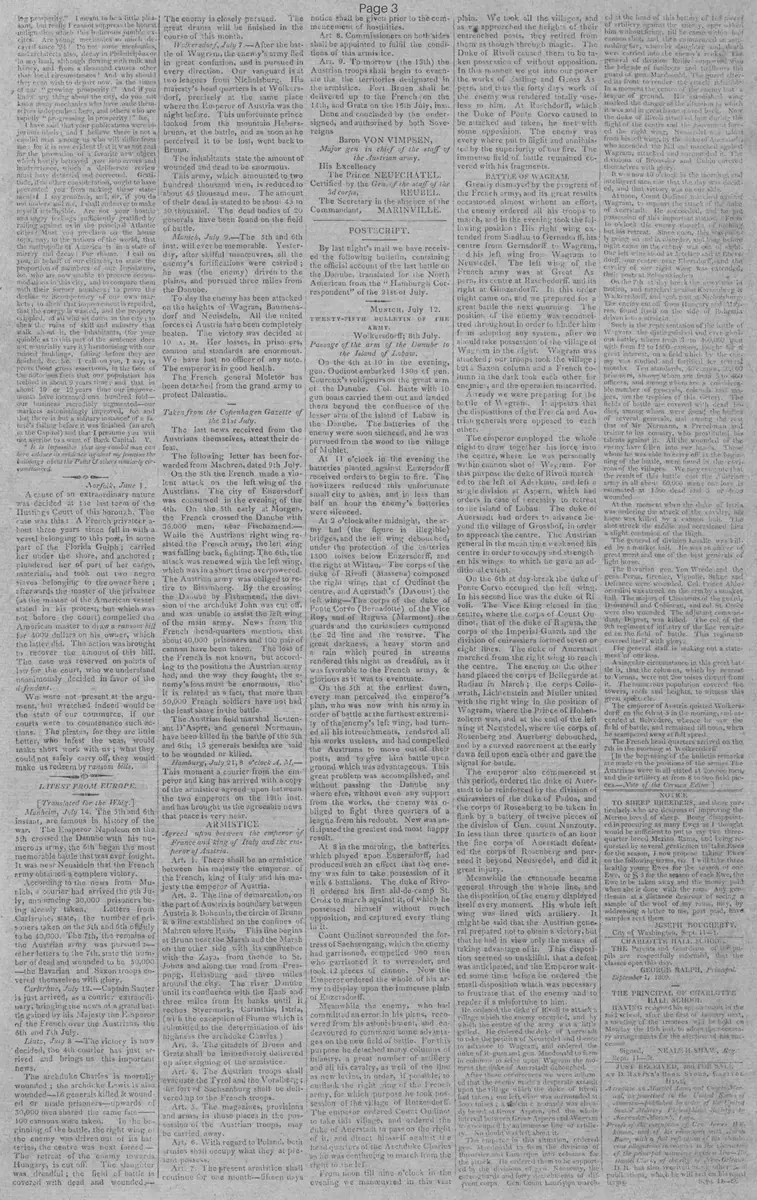
Manheim, July 14. The 5th and 6th instant, are famous in history of the war. The Emperor Napoleon on the 5th crossed the Danube with his numerous army, the 6th began the most memorable battle that was ever fought. It was near Neusiedeln that the French army obtained a complete victory. According to the news from Munich, a courier had arrived the 9th July, announcing 30,000 prisoners being already taken. Letters from Carlsruhe, state, the number of prisoners taken on the 5th and 6th of July to be 40,000. The 7th, the remains of the Austrian army was pursued :-- other letters to the 7th, state the number of dead and wounded to be 50,000 --the Bavarian and Saxon troops covered themselves with glory.
Carlsruhe, July 12.-Captain Sauter is just arrived, as a courier extraordinary, bringing the news of a grand battle gained by his Majesty the Emperor of the French over the Austrians, tho 6th and 7th July.
Lintz, July 8 -The victory is now decided, the 4th courier has just arrived and brings us this important news.
The archduke Charles is mortally wounded ; the archduke Lewis is also wounded- 16 generals killed & wounded or made prisoners--upwards of 50,000 men shared the same fate-- 100 cannons were taken. In the beginning of the battle, the right wing of the enemy was driven out of its batteries, the centre was next forced -- The retreat of the enemy towards Hungary, is cut off. The slaughter was dreadful; the field of battle is covered with dead and wounded--
The enemy is closely pursued. The great drama will be finished in the course of this month.
Wolkersdorf, July 7.-After the battle of Wagram, the enemy's army fled in great confusion, and is pursued in every direction. Our vanguard is at two leagues from Nikolsburg. His majesty's head quarters is at Wolkersdorf, precisely at the same place where the Emperor of Austria was the night before. This unfortunate prince looked from the mountain Hebersbrunn, at the battle, and as soon as he perceived it to be lost, went back to Brunn.
The inhabitants state the amount of wounded and dead to be enormous. This army, which amounted to two hundred thousand men, is reduced to about 45 thousand men. The amount of their dead is stated to be about 45 to 50 thousand. The dead bodies of 20 generals have been found on the field of battle.
Munich, July 9.The 5th and 6th inst. will ever be memorable. Yesterday, after skilful manoeuvres, all the enemy's fortifications were carried; he was (the enemy) driven to the plains, and pursued three miles from the Danube.
To day the enemy has been attacked on the heights of Wagran, Baumensdorf and Neuisdeln. All the united forces of Austria have been completely beaten. The victory was decided at 10 A. M. Her losses, in prisoners, cannon and standards are enormous. We have lost no officer of any note. The emperor is in good health.
The French general Marmont has been detached from the grand army to protect Dalmatia.
Taken from the Copenhagen Gazette of the 21st July.
The last news received from the Austrians themselves, attest their defeat.
The following letter has been forwarded from Mahren, dated 9th July.
On the 5th the French made a violent attack on the left wing of the Austrians. The city of Enzersdorf was consumed in the evening of the 4th. On the 5th early at Morgen, the French crossed the Danube with 36,000 men, near Fischamend.- While the Austrians right wing resisted the French army, the left wing was falling back, fighting. The 6th, the attack was renewed with the left wing, which was in a short time overpowered. The Austrian army was obliged to retire to Bisamberg. By the crossing the Danube by Fischamend, the division of the archduke John was cut off and was unable to assist the left wing of the main army. News from the French head-quarters mention, that about 40,000 prisoners and 100 pair of cannon have been taken. The loss of the French is not known, but according to the positions the Austrian army had, and the way they fought, the enemy's loss must be enormous, tho' it is related as a fact, that more than 50,000 French soldiers have not had the least share in the battle.
The Austrian field marshal lieutenant D'Asprey, and general Normann, have been killed in the battle of the 5th and 6th; 13 generals besides are said to be wounded or killed.
Hamburg, July 21, 8 o'clock A. M.- This moment a courier from the emperor and king has arrived with a copy of the armistice agreed upon between the two emperors on the 12th inst. and has brought us the agreeable news that peace is very near.
ARMISTICE
Agreed upon between the emperor of France and king of Italy and the emperor of Austria.
Art. 1. There shall be an armistice between his majesty the emperor of the French, king of Italy and his majesty the emperor of Austria.
Art. 2. The line of demarcation, on the part of Austria is boundary between Austria & Bohemia, the circle of Brunn & a line established on the confines of Mahren above Raab. This line begins at Brunn near the March and the March on the other side with its confluence with the Zaya, from thence to St. Johns and along the road from Presburg, Reissburg and three miles around the city. The river Danube until its confluence with the Raab and three miles from its banks until it reaches Styermark, Carinthia, Istria, (with the exception of Fiume which is submitted to the determination of his highness the archduke Charles )
Art. 3. The citadels of Bruen and Gratz shall be immediately delivered up after signing of the armistice.
Art. 4. The Austrian troops shall evacuate the Tyrol and the Voralberg ; the fort of Sachsenburg shall be delivered up to the French troops.
Art. 5. The magazines, provisions and arms, in those places in the possession of the Austrian troops, may be carried away.
Art. 6. With regard to Poland, belligerents shall occupy what they at present possess.
Art. 7. The present armistice shall continue for one month--fifteen days notice shall be given prior to the commencement of hostilities.
Art 8. Commissioners on both sides shall be appointed to fulfil the conditions of this armistice.
Art. 9. To morrow (the 13th) the Austrian troops shall begin to evacuate the territories designated in the armistice. Fort Bruen shall be delivered up to the French on the 14th, and Gratz on the 16th July, inst.
Done and concluded by the under-signed, and authorised by both Sovereigns
Baron VON VIMPSEN,
Major gen in chief of the staff of the Austrian army.
His Excellency
The Prince NEUFCHATEL.
Certified by the Gen. of the staff of the 3d corps,
REUBEL.
The Secretary in the absence of the Commandant,
MARINVILLE.
POSTSCRIPT.
By last night's mail we have received the following bulletin, containing the official account of the last battle on the Danube, translated for the North American from the "Hamburgh Correspondent" of the 21st of July.
Munich, July 12.
TWENTY-FIFTH BULLETIN OF THE ARMY.
Wolkersdorff; 5th July.
Passage of the arm of the Danube to the Island of Lobau.
On the 4th at 10 in the evening, gen. Oudinot embarked 1500 of gen. Couroux's voltigeurs on the great arm of the Danube. Col. Baste with 10 gun boats carried them out and landed them beyond the confluence of the lesser arm of the island of Labau in the Danube. The batteries of the enemy were soon silenced, and he was pursued from the wood to the village of Muhlau.
At 11 o'clock in the evening the batteries planted against Enzersdorff received orders to begin to fire. The howitzers reduced this unfortunate small city to ashes, and in less than half an hour the enemy's batteries were silenced.
At 2 o'clock after midnight, the army had (the figure is illegible) bridges, and the left wing debouched, under the protection of the batteries 1500 toises below Enzersdorff, and the right at Wittau. The corps of the duke of Rivoli (Massena) composed the right wing, that of Oudinot the centre, and Auerstadt's (Davoust) the left wing-The corps of the duke of Ponte Corvo (Bernadotte) of the Viceroy, and of Ragusa (Marmont) the guards and the cuirassiers composed the 2d line and the reserve. The great darkness, a heavy storm and a rain which poured in streams rendered this night as dreadful, as it was favorable to the French army, & glorious as it was to eventuate.
On the 5th at the earliest dawn, every man perceived the emperor's plan, who was now with his army in order of battle at the furthest extremity of the enemy's left wing, had turned all his intrenchments, rendered all his works useless, and had compelled the Austrians to move out of their posts, and to give him battle upon ground which was advantageous. This great problem was accomplished, and without passing the Danube any where else, without even any support from the works, the enemy was obliged to fight three quarters of a league from his redoubt. None anticipated the greatest and most happy result.
At 8 in the morning, the batteries which played upon Enzersdorff, had produced such an effect that the enemy was fain to take possession of it with 4 battalions. The duke of Rivoli ordered his first aid-de-camp St. Croix to march against it, of which he possessed himself without much opposition, and captured every thing in it.
Count Oudinot surrounded the fortress of Sachsengang, which the enemy had garrisoned, compelled 700 men who garrisoned it to surrender, and took 12 pieces of cannon. Now the Emperor ordered the whole of his army to display upon the immense plain of Enzersdorff.
Meanwhile the enemy, who had committed an error in his plans, recovered from his astonishment, and endeavoured to command some advantages on the new field of battle. For this purpose he detached many columns of infantry, a great number of artillery and all his cavalry, as well of the line as new levies, in order, if possible, to outflank the right wing of the French army, for which purpose he took possession of the village of Rutzendorf. The emperor ordered Count Oudinot to take this village, and ordered the duke of Auerstadt to pass on the right of it, and direct himself against the head quarters of the Archduke Charles as he was continuing to march from the right to the left
From noon till nine o'clock in the evening we manoeuvred in this vast plain. He took all the villages, and as we approached the heights of their entrenched posts, they retired from them as though through magic. The Duke of Rivoli caused them to be taken possession of without opposition. In this manner we got into our power the works of Essling and Gross Aspern, and thus the forty days work of the enemy was rendered totally useless to him. At Raasdorf, which the Duke of Ponte Corvo caused to be attacked and taken, he met with some opposition. The enemy was every where put to flight and annihilated by the superiority of our fire. The immense field of battle remained covered with his fragments.
BATTLE OF WAGRAM
Greatly dismayed by the progress of the French army, and its great results occasioned almost without an effort. the enemy ordered all his troops to march, and in the evening took the following position: His right wing extended from Stadlau to Gernsdorf, his centre from Gernsdorf to Wagram, and his left wing from Wagram to Neustadel. The left wing of the French army was at Great Aspern, its centre at Raasdorf, and its right at Glinzendorf. In this order night came on, and we prepared for a great battle the next morning. The position of the enemy was reconnoitred throughout in order to hinder him from adopting any system, after we should take possession of the village of Wagram in the night. Wagram was attacked; our troops took the village; but a Saxon column and a French column in the dark took each other for enemies, and the operation miscarried.
Already we were preparing for the battle of Wagram. It appears that the dispositions of the French and Austrian generals were opposed to each other.
The emperor employed the whole night to draw together his force into the centre, where he was personally within cannon shot of Wagram. For this purpose the duke of Rivoli marched to the left of Aderklau, and left a single division at Aspern, which had orders in case of necessity to retreat to the island of Lobau. The duke of Auerstadt had orders to advance beyond the village of Grosshof, in order to approach the centre. The Austrian general in the mean time weakened his centre in order to occupy and strengthen his wings. to which he gave an additional extent.
On the 6th at day-break the duke of Ponte Corvo occupied the left wing. In his second line was the duke of Rivoli. The Vice King closed in the centre, where the Corps of Count Oudinot, that of the duke of Ragusa, the corps of the Imperial Guard, and the division of cuirassiers formed seven or eight lines. The duke of Auerstadt marched from the right wing to reach the centre. The enemy on the other hand placed the corps of Bellegarde at Radlau in March; the corps Collorado, Lichtenstein and Muller united with the right wing in the position of Wagram, where the Prince of Hohen zollern was, and at the end of the left wing at Neustedel, where the corps of Rosenberg and Hiller debouched, and by a curved movement at the early dawn fell upon each other and gave the signal for battle.
The emperor also commenced at this period, ordered the duke of Auerstadt to be reinforced by the division of cuirassiers of the duke of Padua, and the corps of Rosenberg to be taken in flank by a battery of twelve pieces of the division of Gen. count Nansouty. In less than three quarters of an hour the fine corps of Auerstadt defeated the corps of Rosenberg and pursued it beyond Neustadel, and did it great injury.
Meanwhile the cannonade became general through the whole line, and the disposition of the enemy displayed itself every moment. His whole left wing was lined with artillery. It might be said that the Austrian general prepared not to obtain a victory, but that he had in view only the means of taking advantage of it. This disposition seemed so unskilful, that a defeat was anticipated, and the Emperor waited some time before he ordered the small disposition which was necessary to frustrate that of the enemy and to render it a misfortune to him.
He ordered the duke of Rivoli to attack a village which the enemy occupied, and by which the centre of the army was a little galled. He ordered the duke of Auerstadt to take the position of Neustadel and thence to advance to Wagram, and ordered the duke of Ragusa and gen. Macdonald to form in columns to seize upon Wagram the moment the duke of Auerstadt debouched.
After these occurrences we were informed that the enemy made a desperate assault upon the village which the duke of Rivoli had taken; our left wing was surrounded at 300 toises ; a violent cannonade was already heard at Gross Aspern, and the whole interval between Gross Aspern and Wagram was occupied by an immense line of artillery. No doubt was left about it.
The emperor in this situation, ordered gen. Macdonald to form the divisions of Broussier and Lamarque into columns for the attack. He ordered them to be supported by the divisions of gen. Nansouty, the horse-guards and forty detachments of different corps. Gen. Count Lauriston marched at the head of this battery of 105 pieces of artillery against the enemy, approached him without firing, till he came within half cannon shot, and then commenced an astonishing fire, whereby slaughter and death were carried into the enemy's ranks. The general of division Reille supported with the brigade of fusileers and tirailleurs the guard of gen. Macdonald. The guard altered its front to render the attacks infallible. In a moment the centre of the enemy lost a league of ground. Its astonished wing marked the danger of the situation in which it was and in great haste moved back. Now the duke of Rivoli attacked him during the flight of the centre and the movement forced the right wing, Neustadel was taken from his left wing, by the duke of Auerstadt, who ascended the hill and marched against Wagram, attacked and surrounded it. The divisions of Broussier and Collin covered themselves with glory.
It was now 10 o'clock: in the morning, and intelligent men saw that the day was decided, and that victory was on our side.
At noon, Count Oudinot marched against Wagram, to support the attack of the duke of Auerstadt. He succeeded, and he got possession of this important station. From 10 o'clock the enemy thought of nothing but his retreat. Since noon, this was plainly going on and in disorder, and long before night came on the enemy was out of sight.
Our left wing stood at Jetelsee and at Ebersdorff. our centre near Aderdorf,-and the cavalry of our right wing was extended, their posts at Sebarnkirchen
On the 7th at day break the army was in motion, and marched against Kornberg & Wolkersdorff, and took post at Nikolsburg
The enemy cut off from Hungary and Mahren, found itself on the side of Bohemia driven into a strait.
Such is the representation of the battle of Wagram the distinguished and ever glorious battle, where from 300,000 to 400,000 men with from 1200 to 1500 cannon, fought for a great interest, on a field which, by the enemy was studied and fortified for several months Ten standards, 400 cannon, 20,000 prisoners, among whom are from 8 to 10 generals, and among whom are considerable number of generals, colonels and majors, are the trophies of this victory. The fields of battle are covered with dead bodies, among whom were found the bodies of several generals, and among the rest that of Mr Normann, a Frenchman and traitor to his country, who prostituted his talents against it. All the wounded of the enemy have fallen into our hands. Those whom he was able to carry off' at the beginning of the battle. were found in the environs of the villages. We may compute that the result of this battle cost the Austrian army in all about 60,000 men; our loss is estimated at 1500 dead and 3 or 4000 wounded.
At the moment when the duke of Istria was ordering the attack of the cavalry, his horse was killed by a cannon ball. The shot struck the saddle and occasioned him a slight contusion of the thigh.
The general of division Lasalle was killed by a musket ball. He was an officer of great merit and one of the best generals of light horse.
The Bavarian gen. Von Wrede and the gens. Piré, Grenier, Vignolle, Saligné and Defrance were wounded. Col. Prince Aldobrandini was struck on the arm by a musket ball The majors of Chasseurs of the guard, Desmoulins and Coëhorn, and col. St. Croix were also wounded The adjutant commandant, Duprat. was killed. The col. of the 9th regiment of infantry of the line remained on the field of battle. This regiment covered itself with glory.
The general staff is making out a statement of our loss.
A singular circumstance in this great battle is, that the columns, which lay nearest to Vienna, were not 2000 toises distant from it. The numerous population covered the towers, roofs and heights, to witness this great spectacle.
The emperor of Austria quitted Wolkersdorff on the 6th at 5 in the morning, and ascended at Belvedere. whence he saw the field of battle, and remained till noon, when he scampered away at full speed.
The French head quarters arrived on the 7th in the morning at Wolkersdorff
In the beginning of the bulletin remarks are made on the positions of the armies.The Austrians were in all stated at 200,000 men, and their artillery at from 800 to 900 field pieces.-Note of the German Editor
What sub-type of article is it?
What keywords are associated?
What entities or persons were involved?
Where did it happen?
Foreign News Details
Primary Location
Wagram, Austria
Event Date
5th And 6th July 1809; Armistice 12th July 1809
Key Persons
Outcome
austrian losses: 30,000-60,000 dead, wounded, prisoners; 100-400 cannons taken; 10-20 standards; 8-20 generals killed/wounded/prisoners. french losses: 1,500 dead, 3,000-4,000 wounded. austrian army reduced from 200,000 to 45,000. armistice agreed: austrian evacuations of tyrol, vorarlberg; delivery of bruen, gratz, sachsenburg; status quo in poland; one-month duration.
Event Details
Napoleon's French army crossed the Danube on July 5, 1809, near Fischamend, attacking Austrian positions. Battle of Wagram on July 5-6 resulted in French victory after maneuvers capturing villages like Enzersdorf, Essling, Gross Aspern, Raasdorf, and Wagram. Austrian retreat cut off towards Hungary; pursued to Bohemia. Detailed bulletin describes troop movements, assaults, and artillery barrages leading to Austrian defeat. Armistice signed July 12 between Napoleon and Emperor of Austria, establishing demarcation lines, fortress deliveries, and evacuations, signaling impending peace.