Thank you for visiting SNEWPapers!
Sign up free
Story
September 10, 1882
New York Tribune
New York, New York County, New York
What is this article about?
Historical anecdotes from The Cornhill on great men's relatives, focusing on father-son dynamics: sons elevating fathers, proud parental support (e.g., Clive), patronage examples (Grosseteste, Napoleon), and how family mismanagement led to Napoleon's downfall. (248 characters)
Clipping
OCR Quality
75%
Good
Full Text
GREAT MEN'S RELATIVES.
From The Cornhill
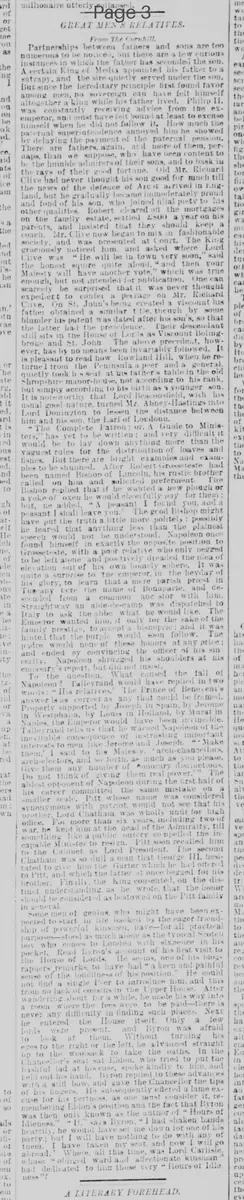
Partnerships between fathers and sons are too numerous to be noticed, but there are a few curious instances in which the father has succeeded the son. A certain King of Media appointed his father to a satrapy, and the sire quietly served under the son. But since the hereditary principle first found favor among men, no sovereign can have felt himself altogether a king while his father lived. Philip II. was constantly receiving advice from the ex-emperor, and must have felt bound at least to excuse himself when he did not follow it. How much the parental superintendence annoyed him he showed by delaying the payment of the paternal pension. There are fathers, again, and more of them, perhaps, than we suppose, who have been content to be the humble admirers of their sons, and to bask in the rays of their good fortune. Old Mr. Richard Clive had never thought his son good for much till the news of the defence of Arcot arrived in England, but he gradually became immoderately proud and fond of his son, who joined filial piety to his other qualities. Robert cleared off the mortgages on the family estate, settled £500 a year on his parents, and insisted that they should keep a coach. Mr. Clive now began to mix in fashionable society, and was presented at Court. The King graciously noticed him, and asked where Lord Clive was. "He will be in town very soon," said the honest squire quite aloud, "and then your Majesty will have another vote," which was true enough, but not intended for publication. One can scarcely be surprised that it was never thought expedient to confer a peerage on Mr. Richard Clive. On St. John's being created a viscount his father obtained a similar title, though by some blunder his patent was dated after his son's, so that the latter had the precedence. Their descendant still sits in the House of Lords as Viscount Bolingbroke and St. John. The above precedent, however, has by no means been invariably followed. It is pleasant to read how Rowland Hill, when he returned from the Peninsula a peer and a general, quietly took his seat at his father's table in the old Shropshire manor-house, not according to his rank, but simply according to his birth as a younger son. It is noteworthy that Lord Beaconsfield, with his usual good nature, turned Mr. Abney-Hastings into Lord Donington to lessen the distance between him and his son, the Earl of Loudoun. "The Complete Patron: or, A Guide to Ministers," has yet to be written: and very difficult it would be to lay down anything more than the vaguest rules for the distribution of loaves and fishes. But there are bright examples and examples to be shunned. After Robert Grosseteste had been named Bishop of Lincoln, his rustic brother called on him and solicited preferment. The Bishop replied that if he wanted a new plough or a yoke of oxen he would cheerfully pay for them: but, he added, "A peasant I found you, and a peasant I shall leave you." The good Bishop might have put the truth a little more politely: possibly he feared that anything less than the plainest speech would not be understood. Napoleon once found himself in exactly the opposite position to Grosseteste, with a poor relative who only begged to be left alone and positively dreaded the idea of elevation out of his own homely sphere. It was quite a surprise to the emperor, in the heyday of his glory, to learn that a mere parish priest in Italy would not ask the abbe what he would like. The Emperor wanted him, if only for the sake of the family prestige, to accept a bishopric; and it was hinted that the purple would soon follow. The priest would none of these honors at any price: certainly, Napoleon shrugged his shoulders at his emissary's report, but did not insist. In the question, What caused the fall of Napoleon? Talleyrand would have replied in two words: "His relatives." The Prince of Benevento's answer was correct as any that could be given. Properly supported by Joseph in Spain, by Jerome in Westphalia, by Louis in Holland, by Murat in Naples, the Emperor would have been invincible. The inevitable consequence of trusting important interests to men like Jerome and Joseph. "Make them any number of honorary distinctions, but stop there." The appointment of Napoleon during the first half of his career committed the same mistake on a synonymous with patent. would not see that his matter se ale. Pitt whose name was considered first understanding as he wrote that the honor should be considered as bestowed on the Pitt family in general.
From The Cornhill
Partnerships between fathers and sons are too numerous to be noticed, but there are a few curious instances in which the father has succeeded the son. A certain King of Media appointed his father to a satrapy, and the sire quietly served under the son. But since the hereditary principle first found favor among men, no sovereign can have felt himself altogether a king while his father lived. Philip II. was constantly receiving advice from the ex-emperor, and must have felt bound at least to excuse himself when he did not follow it. How much the parental superintendence annoyed him he showed by delaying the payment of the paternal pension. There are fathers, again, and more of them, perhaps, than we suppose, who have been content to be the humble admirers of their sons, and to bask in the rays of their good fortune. Old Mr. Richard Clive had never thought his son good for much till the news of the defence of Arcot arrived in England, but he gradually became immoderately proud and fond of his son, who joined filial piety to his other qualities. Robert cleared off the mortgages on the family estate, settled £500 a year on his parents, and insisted that they should keep a coach. Mr. Clive now began to mix in fashionable society, and was presented at Court. The King graciously noticed him, and asked where Lord Clive was. "He will be in town very soon," said the honest squire quite aloud, "and then your Majesty will have another vote," which was true enough, but not intended for publication. One can scarcely be surprised that it was never thought expedient to confer a peerage on Mr. Richard Clive. On St. John's being created a viscount his father obtained a similar title, though by some blunder his patent was dated after his son's, so that the latter had the precedence. Their descendant still sits in the House of Lords as Viscount Bolingbroke and St. John. The above precedent, however, has by no means been invariably followed. It is pleasant to read how Rowland Hill, when he returned from the Peninsula a peer and a general, quietly took his seat at his father's table in the old Shropshire manor-house, not according to his rank, but simply according to his birth as a younger son. It is noteworthy that Lord Beaconsfield, with his usual good nature, turned Mr. Abney-Hastings into Lord Donington to lessen the distance between him and his son, the Earl of Loudoun. "The Complete Patron: or, A Guide to Ministers," has yet to be written: and very difficult it would be to lay down anything more than the vaguest rules for the distribution of loaves and fishes. But there are bright examples and examples to be shunned. After Robert Grosseteste had been named Bishop of Lincoln, his rustic brother called on him and solicited preferment. The Bishop replied that if he wanted a new plough or a yoke of oxen he would cheerfully pay for them: but, he added, "A peasant I found you, and a peasant I shall leave you." The good Bishop might have put the truth a little more politely: possibly he feared that anything less than the plainest speech would not be understood. Napoleon once found himself in exactly the opposite position to Grosseteste, with a poor relative who only begged to be left alone and positively dreaded the idea of elevation out of his own homely sphere. It was quite a surprise to the emperor, in the heyday of his glory, to learn that a mere parish priest in Italy would not ask the abbe what he would like. The Emperor wanted him, if only for the sake of the family prestige, to accept a bishopric; and it was hinted that the purple would soon follow. The priest would none of these honors at any price: certainly, Napoleon shrugged his shoulders at his emissary's report, but did not insist. In the question, What caused the fall of Napoleon? Talleyrand would have replied in two words: "His relatives." The Prince of Benevento's answer was correct as any that could be given. Properly supported by Joseph in Spain, by Jerome in Westphalia, by Louis in Holland, by Murat in Naples, the Emperor would have been invincible. The inevitable consequence of trusting important interests to men like Jerome and Joseph. "Make them any number of honorary distinctions, but stop there." The appointment of Napoleon during the first half of his career committed the same mistake on a synonymous with patent. would not see that his matter se ale. Pitt whose name was considered first understanding as he wrote that the honor should be considered as bestowed on the Pitt family in general.
What sub-type of article is it?
Biography
Curiosity
Historical Event
What themes does it cover?
Family
Fortune Reversal
Moral Virtue
What keywords are associated?
Family Relations
Historical Anecdotes
Patronage
Father Son Dynamics
Peerage
Napoleon Relatives
What entities or persons were involved?
Philip Ii
Richard Clive
Robert Clive
St. John
Rowland Hill
Robert Grosseteste
Napoleon
Talleyrand
Story Details
Key Persons
Philip Ii
Richard Clive
Robert Clive
St. John
Rowland Hill
Robert Grosseteste
Napoleon
Talleyrand
Story Details
The article explores curious historical instances of great men's relations with their fathers, including sons appointing fathers to positions, fathers admiring sons' successes like Clive's family, peerage precedents, humble returns like Hill's, patronage lessons from Grosseteste and Napoleon, and how relatives contributed to Napoleon's fall.