Thank you for visiting SNEWPapers!
Sign up free
The Virginia Gazette
Williamsburg, Virginia
What is this article about?
Epitome of pamphlet detailing the scandalous case of Anne Simpson, Countess of Anglesey, married to Richard Annesley (Earl of Anglesey) in 1727. Chronicles his prior secret marriage, mistreatment, bigamy allegations, cruelty, and disinheritance of Anne and daughters amid legal battles over estates and titles in Ireland and England, spanning 1727-1765.
Clipping
OCR Quality
Full Text
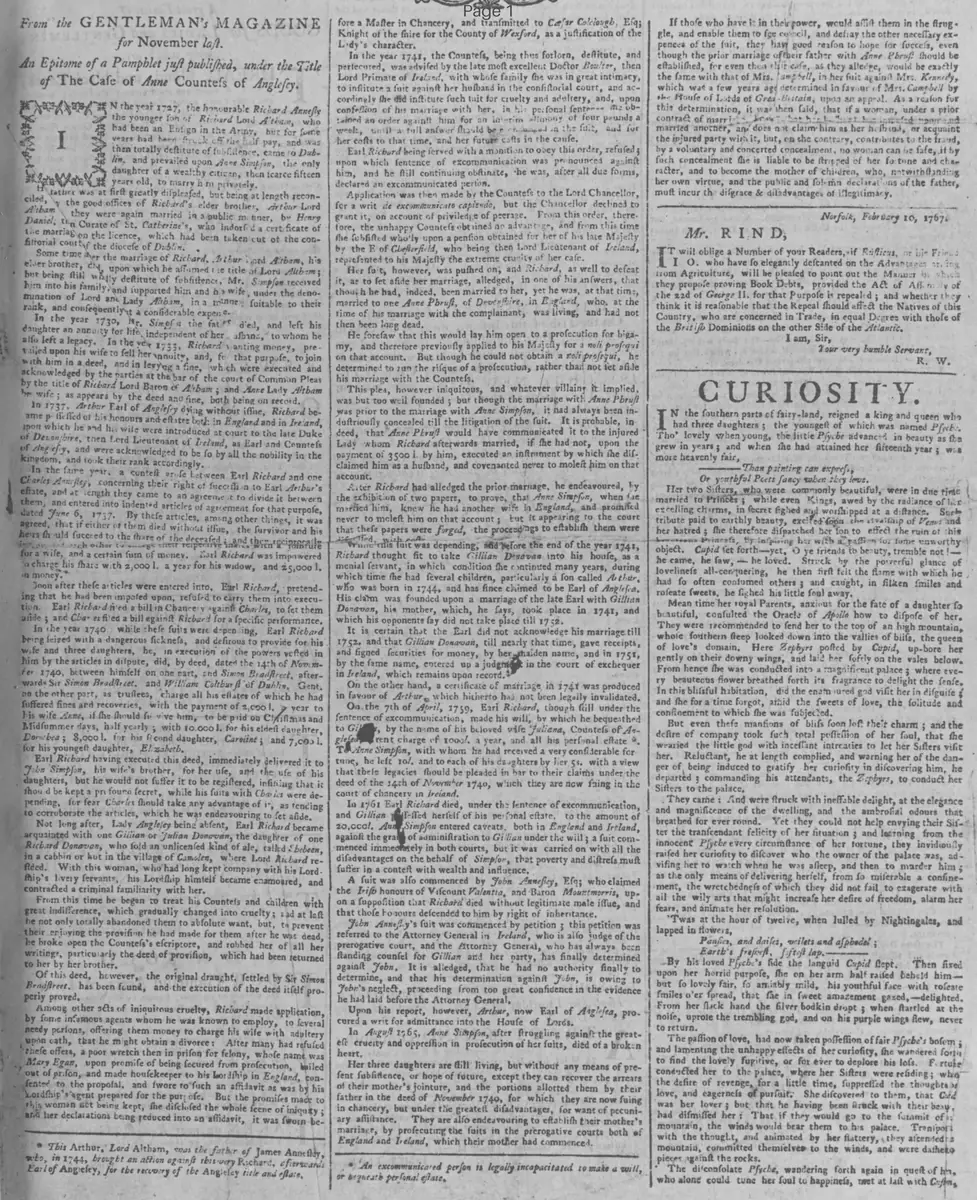
An Epitome of a Pamphlet just published, under the Title of The Case of Anne Countess of Anglesey.
In the year 1727, the honourable Richard Annesley, the younger son of Richard Lord Altham, who had been an Ensign in the Army, but for some years had been struck off the half pay, and was then totally destitute of subsistence, came to Dublin, and prevailed upon Anne Simpson, the only daughter of a wealthy citizen, then scarce fifteen years old, to marry him privately.
Her father was at first greatly displeased, but being at length reconciled, by the good offices of Richard's elder brother, Arthur Lord Altham, they were again married in a public manner, by Henry Daniel, the Curate of St. Catherine's, who endorsed a certificate of the marriage on the licence, which had been taken out of the Consistorial court of the diocese of Dublin.
Some time after the marriage of Richard, Arthur Lord Altham, his elder brother, died, upon which he assumed the title of Lord Altham; but being still wholly destitute of subsistence, Mr. Simpson received him into his family, and supported him and his wife, under the denomination of Lord and Lady Altham, in a manner suitable to their rank, and consequently at a considerable expense.
In the year 1730, Mr. Simpson the father died, and left his daughter an annuity for life independent of her husband, to whom he also left a legacy. In the year 1733, Richard wanting money, prevailed upon his wife to sell her annuity, and, for that purpose, to join with him in a deed, and in levying a fine, which were executed and acknowledged by the parties at the bar of the court of Common Pleas by the title of Richard Lord Baron of Altham; and Anne Lady Altham his wife; as appears by the deed and fine, both being on record.
In 1737, Arthur Earl of Anglesey dying without issue, Richard became possessed of his honours and estates both in England and in Ireland, upon which he and his wife were introduced at court to the late Duke of Devonshire, then Lord Lieutenant of Ireland, as Earl and Countess of Anglesey, and were acknowledged to be so by all the nobility in the kingdom, and took their rank accordingly.
In the same year, a contest arose between Earl Richard and one Charles Annesley, concerning their right of succession to Earl Arthur's estate, and at length they came to an agreement to divide it between them, and entered into indented articles of agreement for that purpose, dated June 6, 1737. By these articles, among other things, it was agreed, that if either of them died without issue, the survivor and his or her heirs should succeed to the share of the deceased; and that their respective shares when jointure for a wife, and a certain sum of money. Earl Richard was empowered to charge his share with 2000 l. a year for his widow, and 25,000 l. in money.
Soon after these articles were entered into, Earl Richard, pretending that he had been imposed upon, refused to carry them into execution. Earl Richard filed a bill in Chancery against Charles, to set them aside; and Charles filed a bill against Richard for a specific performance.
In the year 1740 while these suits were depending, Earl Richard being seized with a dangerous sickness, and desirous to provide for his wife and three daughters, he, in execution of the powers vested in him by the articles in dispute, did, by deed, dated the 14th of November 1740, between himself on one part, and Simon Bradstreet, afterwards Sir Simon Bradstreet, and William Colthurst of Dublin, Gent. on the other part, as trustees, charge all his estates of which he had suffered fines and recoveries, with the payment of 2000 l. a year to his wife Anne, if she should survive him, to be paid on Christmas and Midsummer days, half yearly; with 10,000 l. for his eldest daughter, Dorothee; 8000 l. for his second daughter, Caroline; and 7000 l. for his youngest daughter, Elizabeth.
Earl Richard having executed this deed, immediately delivered it to John Simpson, his wife's brother, for her use, and the use of his daughters, but he would not suffer it to be registered, insisting that it should be kept a profound secret, while his suits with Charles were depending, for fear Charles should take any advantage of it, as tending to corroborate the articles, which he was endeavouring to set aside.
Not long after, Lady Anglesey being absent, Earl Richard became acquainted with one Gillian or Julian Donavan, the daughter of one Richard Donavan, who sold an unlicensed kind of ale, called bebeen, in a cabin or hut in the village of Camolin, where Lord Richard resided. With this woman, who had long kept company with his Lordship's livery servants, his Lordship himself became enamoured, and contracted a criminal familiarity with her.
From this time he began to treat his Countess and children with great indifference, which gradually changed into cruelty; and at last he not only totally abandoned them to absolute want, but, to prevent their enjoying the provision he had made for them after he was dead, he broke open the Countess's escritoire, and robbed her of all her writings, particularly the deed of provision, which had been returned to her by her brother.
Of this deed, however, the original draught, settled by Sir Simon Bradstreet, has been found, and the execution of the deed itself properly proved.
Among other acts of iniquitous cruelty, Richard made application, by some infamous agents whom he was known to employ, to several needy persons, offering them money to charge his wife with adultery upon oath, that he might obtain a divorce: After many had refused these offers, a poor wretch then in prison for felony, whose name was Mary Egan, upon promise of being secured from prosecution, bailed out of prison, and made housekeeper to his Lordship in England, consented to the proposal, and swore to such an affidavit as was by his Lordship's agent prepared for the purpose. But the promises made to this woman not being kept, she disclosed the whole scene of iniquity; and her declarations being reduced into an affidavit, it was sworn before a Master in Chancery, and transmitted to Caesar Colclough, Esq; Knight of the shire for the County of Wexford, as a justification of the Lady's character.
In the year 1741, the Countess, being thus forlorn, destitute, and persecuted, was advised by the late most excellent Doctor Boulter, then Lord Primate of Ireland, with whose family she was in great intimacy, to institute a suit against her husband in the consistorial court, and accordingly she did institute such suit for cruelty and adultery, and, upon confession of his marriage with her, in his personal answer, obtained an order against him for an interim alimony of four pounds a week, until a full answer should be filed upon the suit, and for her costs to that time, and her future costs in the cause.
Earl Richard being served with a monition to obey this order, refused, upon which sentence of excommunication was pronounced against him, and he still continuing obstinate, he was, after all due forms, declared an excommunicated person.
Application was then made by the Countess to the Lord Chancellor, for a writ de excommunicato capiendo, but the Chancellor declined to grant it, on account of privilege of peerage. From this order, therefore, the unhappy Countess obtained no advantage, and from this time she subsisted wholly upon a pension obtained for her of his late Majesty by the E. of Chesterfield, who being then Lord Lieutenant of Ireland, represented to his Majesty the extreme cruelty of her case.
Her suit, however, was pushed on, and Richard, as well to defeat it, as to set aside her marriage, alleged, in one of his answers, that though he had, indeed, been married to her, yet he was, at that time, married to one Anne Phru of Devonshire, in England, who, at the time of his marriage with the complainant, was living, and had not then been long dead.
He foresaw that this would lay him open to a prosecution for bigamy, and therefore previously applied to his Majesty for a noli prosequi on that account. But though he could not obtain a noli prosequi, he determined to run the risque of a prosecution, rather than not set aside his marriage with the Countess.
This plea, however iniquitous, and whatever villainy it implied, was but too well founded; but though the marriage with Anne Phru was prior to the marriage with Anne Simpson, it had always been industriously concealed till the litigation of the suit. It is probable, indeed, that Anne Phru would have communicated it to the injured Lady whom Richard afterwards married, if she had not, upon the payment of 3500 l. by him, executed an instrument by which she disclaimed him as a husband, and covenanted never to molest him on that account.
After Richard had alleged the prior marriage, he endeavoured, by the exhibition of two papers, to prove, that Anne Simpson, when she married him, knew he had another wife in England, and promised never to molest him on that account: but it appearing to the court that these papers were forged, the proceedings to establish them were dismissed, with costs.
While this suit was depending, and before the end of the year 1741, Richard thought fit to take Gillian Donavan into his house, as a menial servant, in which condition she continued many years, during which time he had several children, particularly a son called Arthur, who was born in 1744, and has since claimed to be Earl of Anglesea.
His claim was founded upon a marriage of the late Earl with Gillian Donavan, his mother, which, he says, took place in 1741, and which his opponents say did not take place till 1752.
It is certain that the Earl did not acknowledge his marriage till 1752, and that Gillian Donavan, till nearly that time, gave receipts, and signed securities for money, by her maiden name, and in 1751, by the same name, entered up a judgment in the court of exchequer in Ireland, which remains upon record.
On the other hand, a certificate of marriage in 1741 was produced in favour of Arthur which hitherto had not been legally invalidated.
On the 7th of April, 1759, Earl Richard, though still under the sentence of excommunication, made his will, by which he bequeathed to Gi. by the name of his beloved wife Juliana, Countess of Anglesea, rent charge of 1000 l. a year, and all his personal estate. To Anne Simpson, with whom he had received a very considerable fortune, he left 10 l. and to each of his daughters by her 5 s. with a view that these legacies should be pleaded in bar to their claims under the deed of the 14th of November 1740, which they are now suing in the court of chancery in Ireland.
In 1761 Earl Richard died, under the sentence of excommunication, and Gillian possessed herself of his personal estate, to the amount of 20,000 l. Ann Simpson entered caveats, both in England and Ireland, against the grant of administration to Gilian under the will; a suit commenced immediately in both courts, but it was carried on with all the disadvantages on the behalf of Simpson, that poverty and distress must suffer in a contest with wealth and influence.
A suit was also commenced by John Annesley, Esq; who claimed the Irish honours of Viscount Valentia, and Baron Mountmorris, upon a supposition that Richard died without legitimate male issue, and that those honours descended to him by right of inheritance.
John Annesley's suit was commenced by petition; this petition was referred to the Attorney General in Ireland, who is also judge of the prerogative court, and the Attorney General, who has always been standing counsel for Gillian and her party, has finally determined against John. It is alleged, that he had no authority finally to determine, and that his determination against John, is owing to John's neglect, proceeding from too great confidence in the evidence he had laid before the Attorney General.
Upon his report, however, Arthur, now Earl of Anglesea, procured a writ for admittance into the House of Lords.
In August 1765, Anne Simpson, after struggling against the greatest cruelty and oppression in prosecution of her suits, died of a broken heart.
Her three daughters are still living, but without any means of present subsistence, or hope of future, except they can recover the arrears of their mother's jointure, and the portions allotted them by their father in the deed of November 1740, for which they are now suing in chancery, but under the greatest disadvantages, for want of pecuniary assistance. They are also endeavouring to establish their mother's marriage, by prosecuting the suits in the prerogative courts both of England and Ireland, which their mother had commenced.
This Arthur, Lord Altham, was the father of James Annesley, who, in 1744, brought an action against this very Richard, afterwards Earl of Anglesey, for the recovery of the Anglesey title and estate.
- An excommunicated person is legally incapacitated to make a will, or bequeath personal estate.
If those who have it in their power, would assist them in the struggle, and enable them to fee counsel, and defray the other necessary expenses of the suit, they have good reason to hope for success, even though the prior marriage of their father with Anne Phru should be established, for even then their case, as they allege, would be exactly the same with that of Mrs. Campbell, in her suit against Mrs. Kennedy, which was a few years ago determined in favour of Mrs. Campbell by the House of Lords of Great-Britain, upon an appeal. As a reason for this determination, it was then said, that if a woman, under a prior contract of marriage with a libertine, is clandestinely or openly married to another, and does not claim him as her husband, or acquaint the injured party with it, but, on the contrary, contributes to the fraud, by a voluntary and concerted concealment, no woman can be safe, but by such concealment she is liable to be stripped of her fortune and character, and to become the mother of children, who, notwithstanding her own virtue, and the public and solemn declarations of the father, must incur the disgrace and disadvantages of illegitimacy.
What sub-type of article is it?
What keywords are associated?
What entities or persons were involved?
Where did it happen?
Foreign News Details
Primary Location
Ireland
Event Date
1727 1765
Key Persons
Outcome
anne simpson died in 1765; richard died in 1761 under excommunication; daughters destitute and suing for provisions; arthur admitted to house of lords; ongoing legal battles over titles and estates.
Event Details
Detailed account of Richard Annesley's secret marriage to Anne Simpson in 1727, succession to Anglesey title in 1737, affair with Gillian Donavan, cruelty and abandonment of wife and daughters, bigamy allegations via prior marriage to Anne Phru, legal suits for alimony, divorce, estate division, and validity of second marriage; Richard's will favoring Gillian; daughters' continued struggles post-Anne's death.