Thank you for visiting SNEWPapers!
Sign up free
The News & Observer
Raleigh, Wake County, North Carolina
What is this article about?
In a federal court in Raleigh, the litigation over the Atlantic & North Carolina Railroad's lease to the Howland Improvement Company concludes with the dismissal of receiverships. Speculators' attempts to seize control degenerate into demands for attorney fees of $27,000, opposed by railroad interests and the state. The lease is upheld, ending major disputes.
Merged-components note: Merged continuation of the A. & N. C. Lease story from page 1 to page 6 based on explicit 'Continued on Page Six' indicator in text content and sequential reading order.
Clippings
1 of 2
OCR Quality
Full Text
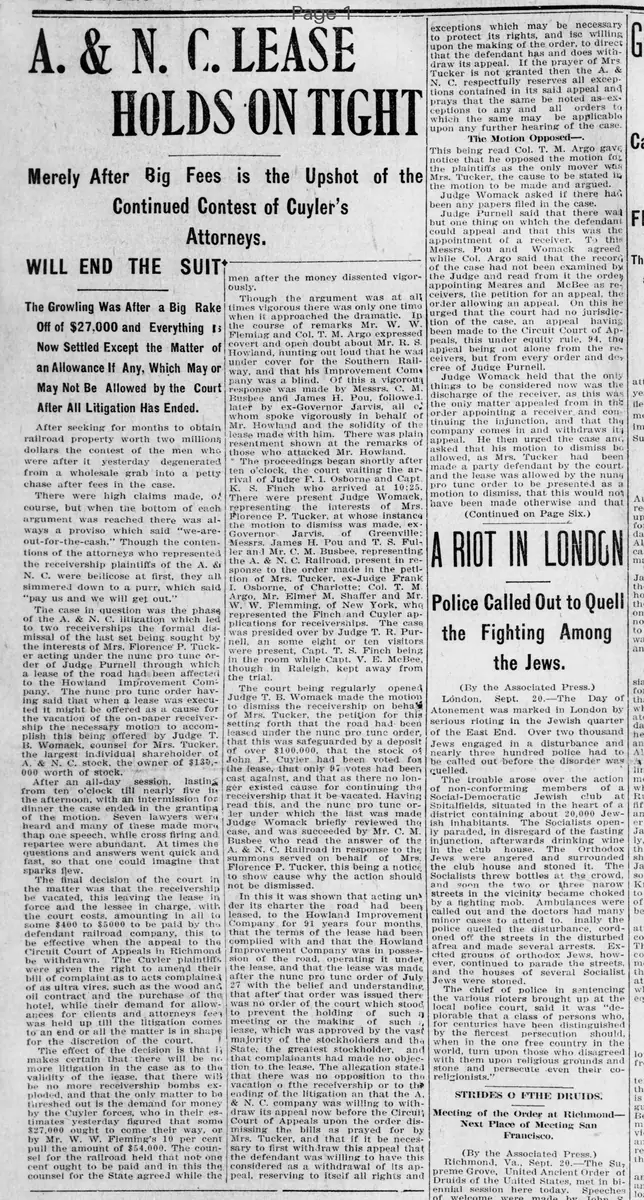
Holds on Tight
Merely After Big Fees is the Upshot of the Continued Contest of Cuyler's
Will End the Suit
The Growling Was After a Big Rake Off of $27,000 and Everything Is Now Settled Except the Matter of an Allowance If Any, Which May or May Not Be Allowed by the Court After All Litigation Has Ended.
After seeking for months to obtain railroad property worth two millions dollars the contest of the men who were after it yesterday degenerated from a wholesale grab into a petty chase after fees in the case. There were high claims made of course, but when the bottom of each argument was reached there was always a proviso which said "we-are-out-for-the-cash." Though the contentions of the attorneys who represented the receivership plaintiffs of the A. & N. C. were bellicose at first, they all simmered down to a purr, which said "pay us and we will get out."
The case in question was the phase of the A. & N. C. litigation which led to two receiverships the formal dismissal of the last set being sought by the interests of Mrs. Florence P. Tucker acting under the nunc pro tunc order of Judge Purnell through which a lease of the road had been affected to the Howland Improvement Company. The nunc pro tunc order having said that when a lease was executed it might be offered as a cause for the vacation of the on-paper receivership the necessary motion to accomplish this being offered by Judge T. B. Womack, counsel for Mrs. Tucker, the largest individual shareholder of A. & N. C. stock, the owner of $130,000 worth of stock.
After an all-day session, lasting from ten o'clock till nearly five in the afternoon, with an intermission for dinner the case ended in the granting of the motion. Seven lawyers were heard and many of these made more than one speech, while cross firing and repartee were abundant. At times the questions and answers went quick and fast, so that one could imagine that sparks flew.
The final decision of the court in the matter was that the receivership be vacated, this leaving the lease in force and the lessee in charge, with the court costs amounting in all to some $400 to $5000 to be paid by the defendant railroad company, this to be effective when the appeal to the Circuit Court of Appeals in Richmond be withdrawn. The Cuyler plaintiffs were given the right to amend their bill of complaint as to acts complained of as ultra vires, such as the wood and oil contract and the purchase of the hotel, while their demand for allowances for clients and attorneys fees was held up till the litigation comes to an end or all the matter is in shape for the discretion of the court.
The effect of the decision is that it makes certain that there will be no more litigation in the case as to the validity of the lease, that there will be no more receivership bombs exploded, and that the only matter to be threshed out is the demand for money by the Cuyler forces, who in their estimates yesterday figured that some $27,000 ought to come their way, or by Mr. W. W. Fleming's 10 per cent pull the amount of $54,000. The counsel for the railroad held that not one cent ought to be paid and in this the counsel for the State agreed while the men after the money dissented vigorously.
Though the argument was at all times vigorous there was only one time when it approached the dramatic. In the course of remarks Mr. W. W. Fleming and Col. T. M. Argo expressed covert and open doubt about Mr. R. S. Howland, hinting out loud that he was under cover for the Southern Railway, and that his Improvement Company was a blind. Of this a vigorous response was made by Messrs. C. M. Busbee and James H. Pou, followed later by ex-Governor Jarvis, all of whom spoke vigorously in behalf of Mr. Howland and the solidity of the lease made with him. There was plain resentment shown at the remarks of those who attacked Mr. Howland.
The proceedings began shortly after ten o'clock, the court waiting the arrival of Judge F. I. Osborne and Capt. K. S. Finch who arrived at 10:25. There were present Judge Womack, representing the interests of Mrs. Florence P. Tucker, at whose instance the motion to dismiss was made, ex-Governor Jarvis of Greenville; Messrs. James H. Pou and T. S. Fuller and Mr. C. M. Busbee, representing the A. & N. C. Railroad, present in response to the order made in the petition of Mrs. Tucker, ex-Judge Frank I. Osborne of Charlotte; Col. T. M. Argo, Mr. Elmer M. Shaffer and Mr. W. W. Fleming of New York, who represented the Finch and Cuyler applications for receiverships. The case was presided over by Judge T. R. Purnell, and some eight or ten visitors were present, Capt. T. S. Finch being in the room while Capt. V. E. McBee, though in Raleigh, kept away from the trial.
The court being regularly opened Judge T. B. Womack made the motion to dismiss the receivership on behalf of Mrs. Tucker, the petition for this setting forth that the road had been leased under the nunc pro tunc order, that this was safeguarded by a deposit of over $100,000, that the stock of John P. Cuyler had been voted for the lease, that only 97 votes had been cast against, and that as there no longer existed cause for continuing the receivership that it be vacated. Having read this, and the nunc pro tunc order under which the last was made Judge Womack briefly reviewed the case, and was succeeded by Mr. C. M. Busbee who read the answer of the A. & N. C. Railroad in response to the summons served on behalf of Mrs. Florence P. Tucker, this being a notice to show cause why the action should not be dismissed.
In this it was shown that acting under its charter the road had been leased to the Howland Improvement Company for 91 years four months, that the terms of the lease had been complied with and that the Howland Improvement Company was in possession of the road, operating it under the lease, and that the lease was made after the nunc pro tunc order of July 27 with the belief and understanding that after that order was issued there was no order of the court which stood to prevent the holding of such a meeting or the making of such lease, which was approved by the vast majority of the stockholders and the State, the greatest stockholder, and that complainants had made no objection to the lease. The allegation stated that there was no opposition to the vacation of the receivership or to the ending of the litigation and that the A. & N. C. company was willing to withdraw its appeal now before the Circuit Court of Appeals upon the order dismissing the bills as prayed for by Mrs. Tucker, and that if it be necessary to first withdraw this appeal that the defendant was willing to have this considered as a withdrawal of its appeal, reserving to itself all rights and exceptions which may be necessary upon the making of the order, to direct to protect its rights, and is willing that the defendant has and does withdraw its appeal. If the prayer of Mrs. Tucker is not granted then the A. & N. C. respectfully reserves all exceptions contained in its said appeal and prays that the same be noted as exceptions to any and all orders to which the same may be applicable upon any further hearing of the case.
The Motion Opposed.
This being read Col. T. M. Argo gave notice that he opposed the motion for the plaintiffs as the only mover was Mrs. Tucker, the cause to be stated in the motion to be made and argued. Judge Womack asked if there had been any papers filed in the case. Judge Purnell said that there was but one thing on which the defendant could appeal and that this was the appointment of a receiver. To this Messrs. Pou and Womack agreed while Col. Argo said that the record of the case had not been examined by the Judge and read from it the order appointing Meares and McBee as receivers, the petition for an appeal, the order allowing an appeal. On this he urged that the court had no jurisdiction of the case, an appeal having been made to the Circuit Court of Appeals, this under equity rule 94, the appeal being not alone from the receivers, but from every order and decree of Judge Purnell.
Judge Womack held that the only things to be considered now was the discharge of the receiver, as this was the only matter appealed from in the order appointing a receiver and continuing the injunction, and that the company comes in and withdraws its appeal. He then urged the case and asked that his motion to dismiss be allowed, as Mrs. Tucker had been made a party defendant by the court, and the lease was allowed by the nunc pro tunc order to be presented as a motion to dismiss, that this would not have been made otherwise and that (Continued on Page Six.)
THE LAST ACT IN THE A. & N. C.
RAILROAD TRAGEDY.
When General Grant was inaugu-
rated President, an unlettered com-
rade in arms went to Washington and
made application for a position in
the Cabinet.
He could not fill the
bill. Grant did not appoint him, but
treated him
kindly.
The applicant
next
asked
successively for almost
every position
within
Grant's gift
without success.
Finally, having be-
come seedy and dispirited, he called
on the President and made application
for a second hand
suit of clothes.
That application
was granted, he
donned the suit and one of Grant's
old hats and left Washington a sad-
der, if not a wiser man. But he had
the hat and the old clothes!
A few months ago, a couple of free
lances pounced
down upon North
Carolina, and determined, without the
investment of a dollar, to grab the At-
lantic and North Carolina railroad
before breakfast. They had their
tooters and their organs to grind out
their tunes and for a time created
quite a sensation in the old State.
The bazoo noise and the spectacular
play dazzled some people for a little
while. Then when there was objec-
tion to turning over the property
worth nearly two million dollars to
people who had not a cent invested in
it, the speculators and grabbers put
up a few hundred dollars by paying
for their previously hypothecated
stock. But still they didn't land. And
then a Federal Judge put one of the
number, under indictment for a
felony, in as receiver of the property
"whether or no," but that high hand-
ed proceeding didn't stick, and again
they didn't land. The subsequent
proceedings showed that, instead of
taking the whole
railroad before
breakfast, the speculators and grab-
bers couldn't even
get a hand-car,
thanks to the
righteous wrath of
the people and
the courage of
an honest Governor!
And so, yes-
terday, after
dropping down by
gradation
from
$1,800,000
prop-
erty, their
attorneys
went into the
Federal Court
and
merely
beg-
ged for
"liberal allowances."
To
be sure they
fixed
the amount of
"liberal allowances"
at a pretty good
sum, something like $27,000, but it is
an open secret that they would love
to turn loose if they could get $2,500
or 3,000.
The story of the procedure, printed
elsewhere, discloses how the whole
thing has degenerated into a demand
for an old suit of clothes. At one
time an argument was made that
Judge Purnell had no jurisdiction. A
little later it was virtually agreed
that if he would fix liberal allowances
for the lawyers the claim that he has
no jurisdiction would not be pressed.
At another stage an attorney for the
speculators stated that a better bid
was in hand and would be presented
to the Circuit Court, and a little later
came almost the virtual proposition
to let this bid go by if the Judge
would make liberal allowances. The
State was criticized for accepting the
bid of Mr. Howland and yet the law-
yers were willing to let that better
lease go by if the Judge would fix
"liberal allowances." The lawyers
claimed $27,000 because of the in-
crease in the value of stock caused,
as they say by the lease, and yet
when asked if they would approve the
lease, refused to do so and protested
against it, and wished the Judge not
to approve it.
The whole procedure has degen-
erated into a demand for allowances.
From a $1,800,000 railroad, they have
dropped to "allowances" of $27,000.
From that they will drop to one-
tenth of that sum. But they will
not get that, and about Christmas
they will get about one thousand dol-
lars--the old suit of clothes--and
imitate the old soldier who dropped
from a cabinet position to a covering
for his nakedness.
What sub-type of article is it?
What themes does it cover?
What keywords are associated?
What entities or persons were involved?
Where did it happen?
Story Details
Key Persons
Location
Raleigh, North Carolina
Event Date
Yesterday; July 27
Story Details
Speculators led by Cuyler and Finch attempt to seize control of the A. & N. C. Railroad through receiverships but fail. Mrs. Tucker, major shareholder, moves to dismiss receivership after leasing the road to Howland Improvement Company under court order. After heated arguments in federal court, Judge Purnell vacates receivership, upholds lease, and defers fee demands of $27,000 by plaintiffs' attorneys, opposed by railroad and state interests.