Thank you for visiting SNEWPapers!
Sign up free
Story
August 16, 1817
Daily National Intelligencer
Washington, District Of Columbia
What is this article about?
Historical account of the discovery of sunspots by Father Scheiner in 1611, their role in proving the sun's rotation, observations by astronomers like Galileo, Hevelius, and Cassini, variations over time, and theories on their nature as opaque masses in the sun's fluid.
Clipping
OCR Quality
98%
Excellent
Full Text
TO THE EDITORS.
Translated for the National Intelligencer.
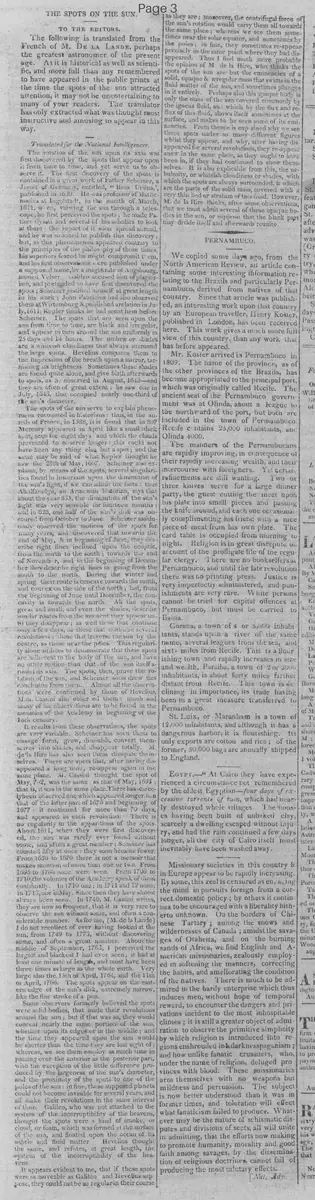
The rotation of the sun upon its axis was first discovered by the spots that appear upon it from time to time, and yet serve us to observe it. The first discovery of the spots is contained in a great work of Father Scheiner, a Jesuit of Germany, entitled, "Rosa Ursina," published in 1630. He was professor of Mathematics at Ingolstadt, in the month of March, 1611, when, viewing the sun through a telescope, he first perceived the spots; he made Father Cysat and several of his scholars to look at them: the report of it soon spread abroad, and he was solicited to publish this discovery; but, as this phenomenon appeared contrary to the principles of the philosophy of those times, his superiors feared he might compromise them, and his first observations were published under a supposed name, by a magistrate of Augsbourg, named Velser. Galileo accused him of plagiarism, and pretended to have first discovered the spots; Scheiner justified himself at great length in his work; John Fabricius had also observed them at Wirtemberg and published a relation in July, 1611; Kepler thinks he had seen them before Scheiner. The spots that are seen upon the sun from time to time, are black and irregular, and appear to turn around the sun uniformly in 25 days and 14 hours. The umbrae or shades are a whitish cloudiness that always surround the large spots. Hevelius compares them to the impression of the breath upon a mirror, tarnishing its brightness. Sometimes these shades are found quite alone, and give birth afterwards to spots, as he observed in August, 1643—and they are often of great extent: he saw one in July, 1643, that occupied nearly one-third of the sun's diameter.
The spots of the sun serve to explain phenomena recounted in historians: thus, in the annals of France, in 1588, it is found that in 807 Mercury appeared in April like a small black spot, seen for eight days and which the clouds prevented to observe longer: this could not have been any thing else but a spot; and the same may be said of what Kepler thought he saw the 28th of May, 1607. Scheiner also explains, by means of the spots, several singularities found in historians upon the diminution of the sun's light, if we can admit the facts: thus Abulfaradge, an Armenian historian, says that about the year 535, the diminution of the sun's light was very sensible for fourteen months; and in 628, one half of the sun's disk was obscured from October to June. Scheiner assiduously observed the motions of the spots for many years, and discovered that towards the end of May, & in beginning of June, they describe right lines inclined upon the ecliptic, from the north to the south; towards the end of November, and in the beginning of December they describe right lines in going from the south to the north. During the winter and spring their route is concave towards the south, and convex on the side of the north; but, from the beginning of June until December, the cavity is towards the north. All the spots, great and small, and even the shades, describe similar routes from the moment they appear until they disappear; as well those that continue only a few days, as those that continue several revolutions: those that traverse the sun by the centre, as those near the poles. This regularity alone suffices to demonstrate that these spots are adherent to the body of the sun, and have no other motion than that of the sun itself around its axis. The spots, then, prove the rotation of the sun, and Scheiner soon drew this conclusion from them. Almost all the observations were confirmed by those of Hevelius. M. Cassini also observed them much and many of his observations are to be found in the memoirs of the Academy in beginning of the 18th century.
It results from these observations, the spots are very variable. Scheiner has seen them to change form, grow, diminish, convert themselves into shades, and disappear totally. M. de la Hire has also seen them dissipate themselves. There are spots that, after having disappeared a long time, re-appear again in the same place, M. Cassini thought the spot of May, 1672, was the same as that of May, 1695; that is, it was in the same place. There has scarcely been observed one which appeared longer than that of the latter part of 1676 and beginning of 1677: it continued for more than 70 days, and appeared in each revolution: There is no regularity in the apparitions of the spots. About 1611, when they were first discovered, the sun was rarely ever found without some, and often a great number; Scheiner has counted fifty at once: they soon became fewer. From 1650 to 1670 there is not a memoir that makes mention of more than one or two. From 1695 to 1700 none were seen. From 1700 to 1710, the volumes of the Academy speak of them continually. In 1710 one; in 1711 and 12 none; in 1713, one in May. Since then they have almost always been seen. In 1740, M. Cassini writes, they are now so frequent, that it is very rare to observe the sun without some, and often a considerable number. As for me, (M. de la Lande) I do not recollect of ever having looked at the sun, from 1749 to 1773, without discovering some, and often a great number. About the middle of September, 1763, I perceived the largest and blackest I had ever seen; it had at least one minute of length, and must have been three times as large as the whole earth. Very large also the 15th of April, 1764, and the 11th of April, 1766. The spots appear on the eastern edge of the sun's disk, extremely narrow, like the fine stroke of a pen.
Some observers formerly believed the spots were solid bodies, that made their revolutions around the sun; but if that was so, they would conceal nearly the same portion of the sun, whether upon its edges or in the middle; and the time they appeared upon the sun would be shorter than the time they are lost sight of; whereas, we see them employ as much time in passing over the anterior as the posterior part, with the exception of the little difference produced by the largeness of the sun's diameter, and the proximity of the spots to one of the poles of the sun: in fine, these supposed planets could not become invisible for several years, and all make their revolutions in the same interval of time. Galileo, who was not attached to the system of the incorruptibility of the heavens, thought the spots were a kind of smoke, or cloud, or foam, which was formed at the surface of the sun, and floated upon the ocean of its subtle and fluid matter. Hevelius thought the same, and refutes, at great length, the system of the incorruptibility of the heavens.
It appears evident to me, that if these spots were as moveable as Galileo and Hevelius suppose, they could not be so regular in their course as they are; moreover, the centrifugal force of the sun's rotation would carry them all towards the same place; whereas we see them sometimes near the solar equator, and sometimes by the poles; in fine, they sometimes re-appear precisely in the same point where they had disappeared. Thus I find much more probable the opinion of M. de la Hire, who thinks the spots of the sun are but the eminences of a solid, opaque & irregular mass that swims in the fluid matter of the sun, and sometimes plunges in it entirely. Perhaps also this opaque body is only the mass of the sun covered commonly by the igneous fluid, and which by the flux and reflux of this fluid, shows itself sometimes at the surface, and makes to be seen some of its eminences. From thence is explained why we see these spots under so many different figures whilst they appear, and why, after having disappeared for several revolutions, they re-appear anew in the same place, as they ought to have been in, if they had continued to show themselves. It is also explicable from this, the nebulosity, or whitish cloudiness or shades, with which the spots are always surrounded, & which are the parts of the solid mass, covered with a very thin bed or stratum of this fluid. However. M. de la Hire thinks, after some observations, that we must admit several of these opaque bodies in the sun, or suppose that the black part may divide itself and afterwards reunite.
Translated for the National Intelligencer.
The rotation of the sun upon its axis was first discovered by the spots that appear upon it from time to time, and yet serve us to observe it. The first discovery of the spots is contained in a great work of Father Scheiner, a Jesuit of Germany, entitled, "Rosa Ursina," published in 1630. He was professor of Mathematics at Ingolstadt, in the month of March, 1611, when, viewing the sun through a telescope, he first perceived the spots; he made Father Cysat and several of his scholars to look at them: the report of it soon spread abroad, and he was solicited to publish this discovery; but, as this phenomenon appeared contrary to the principles of the philosophy of those times, his superiors feared he might compromise them, and his first observations were published under a supposed name, by a magistrate of Augsbourg, named Velser. Galileo accused him of plagiarism, and pretended to have first discovered the spots; Scheiner justified himself at great length in his work; John Fabricius had also observed them at Wirtemberg and published a relation in July, 1611; Kepler thinks he had seen them before Scheiner. The spots that are seen upon the sun from time to time, are black and irregular, and appear to turn around the sun uniformly in 25 days and 14 hours. The umbrae or shades are a whitish cloudiness that always surround the large spots. Hevelius compares them to the impression of the breath upon a mirror, tarnishing its brightness. Sometimes these shades are found quite alone, and give birth afterwards to spots, as he observed in August, 1643—and they are often of great extent: he saw one in July, 1643, that occupied nearly one-third of the sun's diameter.
The spots of the sun serve to explain phenomena recounted in historians: thus, in the annals of France, in 1588, it is found that in 807 Mercury appeared in April like a small black spot, seen for eight days and which the clouds prevented to observe longer: this could not have been any thing else but a spot; and the same may be said of what Kepler thought he saw the 28th of May, 1607. Scheiner also explains, by means of the spots, several singularities found in historians upon the diminution of the sun's light, if we can admit the facts: thus Abulfaradge, an Armenian historian, says that about the year 535, the diminution of the sun's light was very sensible for fourteen months; and in 628, one half of the sun's disk was obscured from October to June. Scheiner assiduously observed the motions of the spots for many years, and discovered that towards the end of May, & in beginning of June, they describe right lines inclined upon the ecliptic, from the north to the south; towards the end of November, and in the beginning of December they describe right lines in going from the south to the north. During the winter and spring their route is concave towards the south, and convex on the side of the north; but, from the beginning of June until December, the cavity is towards the north. All the spots, great and small, and even the shades, describe similar routes from the moment they appear until they disappear; as well those that continue only a few days, as those that continue several revolutions: those that traverse the sun by the centre, as those near the poles. This regularity alone suffices to demonstrate that these spots are adherent to the body of the sun, and have no other motion than that of the sun itself around its axis. The spots, then, prove the rotation of the sun, and Scheiner soon drew this conclusion from them. Almost all the observations were confirmed by those of Hevelius. M. Cassini also observed them much and many of his observations are to be found in the memoirs of the Academy in beginning of the 18th century.
It results from these observations, the spots are very variable. Scheiner has seen them to change form, grow, diminish, convert themselves into shades, and disappear totally. M. de la Hire has also seen them dissipate themselves. There are spots that, after having disappeared a long time, re-appear again in the same place, M. Cassini thought the spot of May, 1672, was the same as that of May, 1695; that is, it was in the same place. There has scarcely been observed one which appeared longer than that of the latter part of 1676 and beginning of 1677: it continued for more than 70 days, and appeared in each revolution: There is no regularity in the apparitions of the spots. About 1611, when they were first discovered, the sun was rarely ever found without some, and often a great number; Scheiner has counted fifty at once: they soon became fewer. From 1650 to 1670 there is not a memoir that makes mention of more than one or two. From 1695 to 1700 none were seen. From 1700 to 1710, the volumes of the Academy speak of them continually. In 1710 one; in 1711 and 12 none; in 1713, one in May. Since then they have almost always been seen. In 1740, M. Cassini writes, they are now so frequent, that it is very rare to observe the sun without some, and often a considerable number. As for me, (M. de la Lande) I do not recollect of ever having looked at the sun, from 1749 to 1773, without discovering some, and often a great number. About the middle of September, 1763, I perceived the largest and blackest I had ever seen; it had at least one minute of length, and must have been three times as large as the whole earth. Very large also the 15th of April, 1764, and the 11th of April, 1766. The spots appear on the eastern edge of the sun's disk, extremely narrow, like the fine stroke of a pen.
Some observers formerly believed the spots were solid bodies, that made their revolutions around the sun; but if that was so, they would conceal nearly the same portion of the sun, whether upon its edges or in the middle; and the time they appeared upon the sun would be shorter than the time they are lost sight of; whereas, we see them employ as much time in passing over the anterior as the posterior part, with the exception of the little difference produced by the largeness of the sun's diameter, and the proximity of the spots to one of the poles of the sun: in fine, these supposed planets could not become invisible for several years, and all make their revolutions in the same interval of time. Galileo, who was not attached to the system of the incorruptibility of the heavens, thought the spots were a kind of smoke, or cloud, or foam, which was formed at the surface of the sun, and floated upon the ocean of its subtle and fluid matter. Hevelius thought the same, and refutes, at great length, the system of the incorruptibility of the heavens.
It appears evident to me, that if these spots were as moveable as Galileo and Hevelius suppose, they could not be so regular in their course as they are; moreover, the centrifugal force of the sun's rotation would carry them all towards the same place; whereas we see them sometimes near the solar equator, and sometimes by the poles; in fine, they sometimes re-appear precisely in the same point where they had disappeared. Thus I find much more probable the opinion of M. de la Hire, who thinks the spots of the sun are but the eminences of a solid, opaque & irregular mass that swims in the fluid matter of the sun, and sometimes plunges in it entirely. Perhaps also this opaque body is only the mass of the sun covered commonly by the igneous fluid, and which by the flux and reflux of this fluid, shows itself sometimes at the surface, and makes to be seen some of its eminences. From thence is explained why we see these spots under so many different figures whilst they appear, and why, after having disappeared for several revolutions, they re-appear anew in the same place, as they ought to have been in, if they had continued to show themselves. It is also explicable from this, the nebulosity, or whitish cloudiness or shades, with which the spots are always surrounded, & which are the parts of the solid mass, covered with a very thin bed or stratum of this fluid. However. M. de la Hire thinks, after some observations, that we must admit several of these opaque bodies in the sun, or suppose that the black part may divide itself and afterwards reunite.
What sub-type of article is it?
Curiosity
Historical Event
What themes does it cover?
Exploration
Triumph
What keywords are associated?
Sunspots
Discovery
Rotation
Astronomy
Observations
Scheiner
Galileo
Hevelius
What entities or persons were involved?
Father Scheiner
Galileo
John Fabricius
Kepler
Hevelius
M. Cassini
M. De La Hire
M. De La Lande
Father Cysat
Velsers
Abulfaradge
Where did it happen?
Ingolstadt
Story Details
Key Persons
Father Scheiner
Galileo
John Fabricius
Kepler
Hevelius
M. Cassini
M. De La Hire
M. De La Lande
Father Cysat
Velsers
Abulfaradge
Location
Ingolstadt
Event Date
March 1611
Story Details
Father Scheiner discovers sunspots in 1611 using a telescope, leading to proof of the sun's rotation; historical disputes with Galileo and others; detailed observations of spots' motions, variations, and theories from cloud-like to opaque masses in the sun's fluid.