Thank you for visiting SNEWPapers!
Sign up free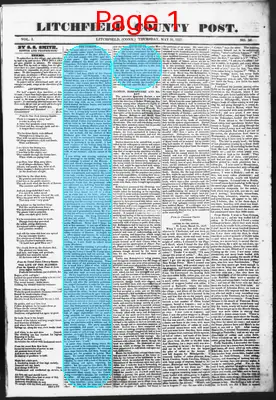
Story
May 31, 1827
The Litchfield County Post
Litchfield, Litchfield County, Connecticut
What is this article about?
Young curate Rev. Alfred Corsar secretly loves parishioner Louisa Mordaunt. Devastated upon learning of her impending marriage, he collapses in anguish while officiating the wedding ceremony in church and soon dies of a broken heart in 1794.
Merged-components note: Continuation of the story 'THE CURATE' across components.
Clipping
OCR Quality
98%
Excellent
Full Text
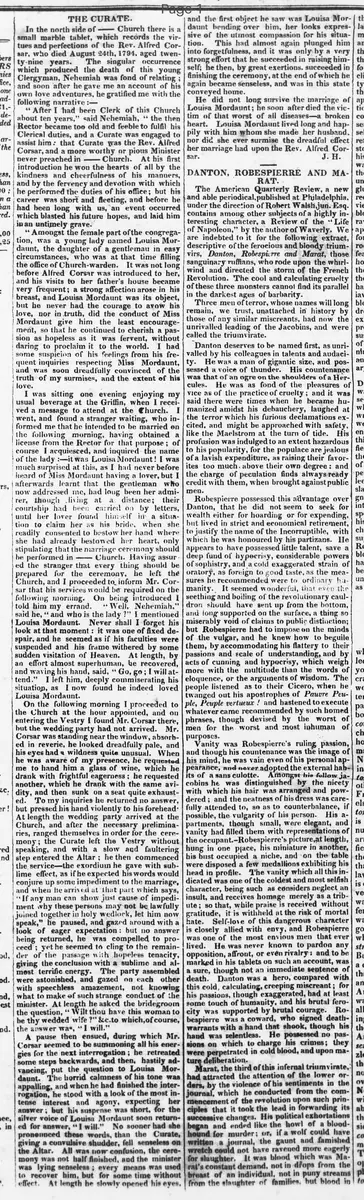
THE CURATE.
In the north side of —Church there is a small marble tablet, which records the virtues and perfections of the Rev. Alfred Corsar, who died August 24th, 1794, aged twenty-nine years.
The singular occurrence which produced the death of this young Clergyman, Nehemiah was fond of relating; and soon after he gave me an account of his own love adventures, he gratified me with the following narrative:-
"After I had been Clerk of this Church about ten years," said Nehemiah, "the then Rector became too old and feeble to fulfil his Clerical duties, and a Curate was engaged to assist him: that Curate was the Rev. Alfred Corsar, and a more worthy or pious Minister never preached in — Church. At his first introduction he won the hearts of all by the kindness and cheerfulness of his manners, and by the fervency and devotion with which he performed the duties of his office; but his career was short and fleeting, and before he had been long with us, an event occurred which blasted his future hopes, and laid him in an untimely grave.
"Amongst the female part of the congregation, was a young lady named Louisa Mordaunt, the daughter of a gentleman in easy circumstances, who was at that time filling the office of Church-warden. It was not long before Alfred Corsar was introduced to her, and his visits to her father's house became very frequent; a strong affection arose in his breast, and Louisa Mordaunt was its object, but he never had the courage to avow his love, nor in truth, did the conduct of Miss Mordaunt give him the least encouragement, so that he continued to cherish a passion as hopeless as it was fervent, without daring to proclaim it to the world. I had some suspicion of his feelings from his frequent inquiries respecting Miss Mordaunt, and was soon dreadfully convinced of the truth of my surmises, and the extent of his love.
I was sitting one evening enjoying my usual beverage at the Griffin, when I received a message to attend at the Church. I went, and found a stranger waiting, who informed me that he intended to be married on the following morning, having obtained a license from the Rector for that purpose; of course I acquiesced, and inquired the name of the lady: - it was Louisa Mordaunt! I was much surprised at this, as I had never before heard of Miss Mordaunt having a lover, but I afterwards learnt that the gentleman who now addressed me, had long been her admirer, though living at a distance; their courtship had been carried on by letters, until her lover found himself in a situation to claim her as his bride, when she readily consented to bestow her hand where she had already bestowed her heart, only stipulating that the marriage ceremony should be performed in — Church. Having assured the stranger that every thing should be prepared for the ceremony, he left the Church, and I proceeded to inform Mr. Corsar that his services would be required on the following morning. On being introduced I told him my errand. "Well, Nehemiah," said he, "and who is the lady?" I mentioned Louisa Mordaunt. Never shall I forget his look at that moment: it was one of fixed despair, and he seemed as if his faculties were suspended and his frame withered by some sudden visitation of Heaven. At length, by an effort almost superhuman, he recovered, and waving his hand, said, "Go, go; I will attend." I left him, deeply commiserating his situation, as I now found he indeed loved Louisa Mordaunt.
On the following morning I proceeded to the Church at the hour appointed, and on entering the Vestry I found Mr. Corsar there, but the wedding party had not arrived. Mr. Corsar was standing near the window, absorbed in reverie, he looked dreadfully pale, and his eyes had a wildness quite unusual. When he was aware of my presence, he requested me to hand him a glass of wine, which he drank with frightful eagerness; he requested another, which he drank with the same avidity, and then sunk on a seat quite exhausted. To my inquiries he returned no answer, but pressed his hand violently to his forehead. At length the wedding party arrived at the Church, and after the necessary preliminaries, ranged themselves in order for the ceremony; the Curate left the Vestry without speaking, and with a slow and faltering step entered the Altar; he then commenced the service - the exordium he gave with sublime effect, as if he expected his words would conjure up some impediment to the marriage, and when he arrived at that part which says, "If any man can show just cause of impediment why these persons may not be lawfully joined together in holy wedlock, let him now speak," he paused, and gazed around with a look of eager expectation: but no answer being returned, he was compelled to proceed; yet he seemed to cling to the remainder of the passage with hopeless tenacity, giving the conclusion with a sublime and almost terrific energy. The party assembled were astonished, and gazed on each other with speechless amazement, not knowing what to make of such strange conduct of the minister. At length he asked the bridegroom the question, "Wilt thou have this woman to be thy wedded wife?" &c. to which, of course, the answer was, "I will."
A pause then ensued, during which Mr. Corsar seemed to be summoning all his energies for the next interrogation; he retreated some steps backwards, and then, hastily advancing, put the question to Louisa Mordaunt. The horrid calmness of his tone was appalling, and when he had finished the interrogation, he stood with a look of the most intense interest and agony, expecting her answer; but his suspense was short, for the silver voice of Louisa Mordaunt soon returned for answer, "I will." No sooner had she pronounced these words, than the Curate, giving a convulsive shudder, fell senseless on the Altar. All was now confusion, the ceremony was not half finished, and the minister was lying senseless; every means was used to recover him, but for some time without effect. At length he slowly opened his eyes
and the first object he saw was Louisa Mordaunt bending over him, her looks expressive of the utmost compassion for his situation. This had almost again plunged him into forgetfulness, and it was only by a very strong effort that he succeeded in raising himself; he then, by great exertions, succeeded in finishing the ceremony, at the end of which he again became senseless, and was in this state conveyed home.
He did not long survive the marriage of Louisa Mordaunt: he soon after died the victim of that worst of all diseases - a broken heart. Louisa Mordaunt lived long and happily with him whom she made her husband, nor did she ever surmise the dreadful effect her marriage had upon the Rev. Alfred Corsar.
J. H.
In the north side of —Church there is a small marble tablet, which records the virtues and perfections of the Rev. Alfred Corsar, who died August 24th, 1794, aged twenty-nine years.
The singular occurrence which produced the death of this young Clergyman, Nehemiah was fond of relating; and soon after he gave me an account of his own love adventures, he gratified me with the following narrative:-
"After I had been Clerk of this Church about ten years," said Nehemiah, "the then Rector became too old and feeble to fulfil his Clerical duties, and a Curate was engaged to assist him: that Curate was the Rev. Alfred Corsar, and a more worthy or pious Minister never preached in — Church. At his first introduction he won the hearts of all by the kindness and cheerfulness of his manners, and by the fervency and devotion with which he performed the duties of his office; but his career was short and fleeting, and before he had been long with us, an event occurred which blasted his future hopes, and laid him in an untimely grave.
"Amongst the female part of the congregation, was a young lady named Louisa Mordaunt, the daughter of a gentleman in easy circumstances, who was at that time filling the office of Church-warden. It was not long before Alfred Corsar was introduced to her, and his visits to her father's house became very frequent; a strong affection arose in his breast, and Louisa Mordaunt was its object, but he never had the courage to avow his love, nor in truth, did the conduct of Miss Mordaunt give him the least encouragement, so that he continued to cherish a passion as hopeless as it was fervent, without daring to proclaim it to the world. I had some suspicion of his feelings from his frequent inquiries respecting Miss Mordaunt, and was soon dreadfully convinced of the truth of my surmises, and the extent of his love.
I was sitting one evening enjoying my usual beverage at the Griffin, when I received a message to attend at the Church. I went, and found a stranger waiting, who informed me that he intended to be married on the following morning, having obtained a license from the Rector for that purpose; of course I acquiesced, and inquired the name of the lady: - it was Louisa Mordaunt! I was much surprised at this, as I had never before heard of Miss Mordaunt having a lover, but I afterwards learnt that the gentleman who now addressed me, had long been her admirer, though living at a distance; their courtship had been carried on by letters, until her lover found himself in a situation to claim her as his bride, when she readily consented to bestow her hand where she had already bestowed her heart, only stipulating that the marriage ceremony should be performed in — Church. Having assured the stranger that every thing should be prepared for the ceremony, he left the Church, and I proceeded to inform Mr. Corsar that his services would be required on the following morning. On being introduced I told him my errand. "Well, Nehemiah," said he, "and who is the lady?" I mentioned Louisa Mordaunt. Never shall I forget his look at that moment: it was one of fixed despair, and he seemed as if his faculties were suspended and his frame withered by some sudden visitation of Heaven. At length, by an effort almost superhuman, he recovered, and waving his hand, said, "Go, go; I will attend." I left him, deeply commiserating his situation, as I now found he indeed loved Louisa Mordaunt.
On the following morning I proceeded to the Church at the hour appointed, and on entering the Vestry I found Mr. Corsar there, but the wedding party had not arrived. Mr. Corsar was standing near the window, absorbed in reverie, he looked dreadfully pale, and his eyes had a wildness quite unusual. When he was aware of my presence, he requested me to hand him a glass of wine, which he drank with frightful eagerness; he requested another, which he drank with the same avidity, and then sunk on a seat quite exhausted. To my inquiries he returned no answer, but pressed his hand violently to his forehead. At length the wedding party arrived at the Church, and after the necessary preliminaries, ranged themselves in order for the ceremony; the Curate left the Vestry without speaking, and with a slow and faltering step entered the Altar; he then commenced the service - the exordium he gave with sublime effect, as if he expected his words would conjure up some impediment to the marriage, and when he arrived at that part which says, "If any man can show just cause of impediment why these persons may not be lawfully joined together in holy wedlock, let him now speak," he paused, and gazed around with a look of eager expectation: but no answer being returned, he was compelled to proceed; yet he seemed to cling to the remainder of the passage with hopeless tenacity, giving the conclusion with a sublime and almost terrific energy. The party assembled were astonished, and gazed on each other with speechless amazement, not knowing what to make of such strange conduct of the minister. At length he asked the bridegroom the question, "Wilt thou have this woman to be thy wedded wife?" &c. to which, of course, the answer was, "I will."
A pause then ensued, during which Mr. Corsar seemed to be summoning all his energies for the next interrogation; he retreated some steps backwards, and then, hastily advancing, put the question to Louisa Mordaunt. The horrid calmness of his tone was appalling, and when he had finished the interrogation, he stood with a look of the most intense interest and agony, expecting her answer; but his suspense was short, for the silver voice of Louisa Mordaunt soon returned for answer, "I will." No sooner had she pronounced these words, than the Curate, giving a convulsive shudder, fell senseless on the Altar. All was now confusion, the ceremony was not half finished, and the minister was lying senseless; every means was used to recover him, but for some time without effect. At length he slowly opened his eyes
and the first object he saw was Louisa Mordaunt bending over him, her looks expressive of the utmost compassion for his situation. This had almost again plunged him into forgetfulness, and it was only by a very strong effort that he succeeded in raising himself; he then, by great exertions, succeeded in finishing the ceremony, at the end of which he again became senseless, and was in this state conveyed home.
He did not long survive the marriage of Louisa Mordaunt: he soon after died the victim of that worst of all diseases - a broken heart. Louisa Mordaunt lived long and happily with him whom she made her husband, nor did she ever surmise the dreadful effect her marriage had upon the Rev. Alfred Corsar.
J. H.
What sub-type of article is it?
Romance
Tragedy
Biography
What themes does it cover?
Love
Tragedy
Misfortune
What keywords are associated?
Unrequited Love
Broken Heart
Wedding Collapse
Curate Tragedy
Romantic Despair
What entities or persons were involved?
Rev. Alfred Corsar
Louisa Mordaunt
Nehemiah
Where did it happen?
—Church
Story Details
Key Persons
Rev. Alfred Corsar
Louisa Mordaunt
Nehemiah
Location
—Church
Event Date
1794
Story Details
Curate Rev. Alfred Corsar develops unrequited love for parishioner Louisa Mordaunt. Upon officiating her wedding to another man, he collapses from despair during the ceremony, completes it with great effort, and dies soon after of a broken heart.