Thank you for visiting SNEWPapers!
Sign up free
Editorial
January 29, 1828
The New Hampshire Gazette
Portsmouth, Rockingham County, New Hampshire
What is this article about?
A letter from Gen. R.K. Call debunks a fabricated story from federal papers claiming Gen. Jackson intended to attack a senator in the Senate antechamber, involving Com. Decatur. Call, Jackson's aide, states Jackson was not present during the alleged 1819 incident and affirms their cordial relations.
Clipping
OCR Quality
95%
Excellent
Full Text
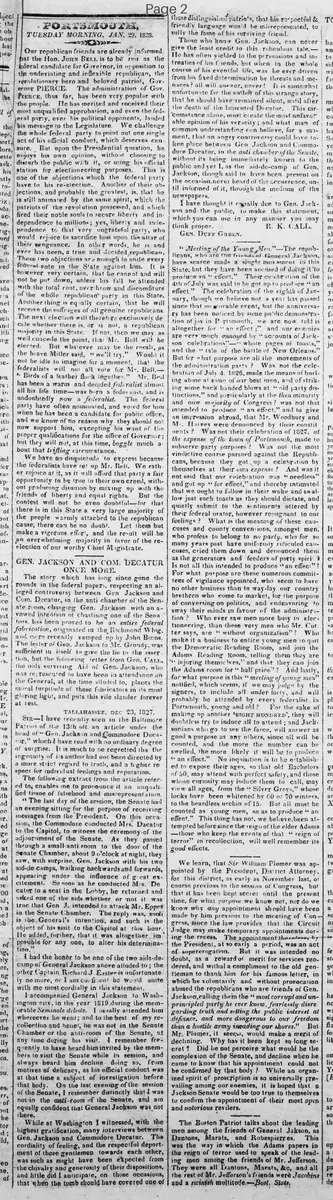
GEN. JACKSON AND COM. DECATUR
ONCE MORE.
The story which has long since gone the rounds in the federal papers, respecting an alleged controversy between Gen Jackson and Com. Decatur, in the anti chamber of the Senate room, charging Gen. Jackson with an avowed intention of chastising one of the Senators, has been proved to be an entire federal fabrication, originated in the Richmond Whig, and more recently vamped up by John Binns.
The letter of Gen. Jackson to Mr. Grundy, was sufficient in itself to give the lie to the assertion, but the following letter from Gen. CALL, the only surviving Aid of Gen. Jackson, who was represented to have been in attendance on the General, at the time alluded to, places the moral turpitude of these fabricators in its most glaring light, and puts this vile slander forever at rest.
TALLAHASSEE, DEC 23, 1827.
Sir—I have recently seen in the Baltimore Patriot of the 13th ult, an article under the head of "Gen. Jackson and Commodore Decatur," which I have read with no ordinary degree of surprise. It is much to be regretted that the ingenuity of its author had not been directed by a more strict regard to truth, and a higher respect for individual feelings and reputation.
The following extract from the article referred to, enables me to pronounce it an unqualified tissue of falsehood and misrepresentation.
"The last day of the session, the Senate had an evening sitting for the purpose of receiving messages from the President. On this occasion, the Commodore conducted Mrs. Decatur to the Capitol, to witness the ceremony of the adjournment of the Senate. As they passed through a small anti room to the door of the Senate Chamber, about 9 o'clock at night, they saw, with surprise, Gen. Jackson with his two aid-de camps, walking back wards and forwards, appearing under the influence of great excitement. So soon as he conducted Mrs. Decatur to a seat in the Lobby, he returned and asked one of the aids whether or not it was true that Gen J. intended to attack Mr. Eppes in the Senate Chamber. The reply was, such is the General's intention, and such is the object of his visit to the Capitol at this hour. He added, further, that it was altogether, impossible for any one, to alter his determination."
I had the honor to be one of the two aids-de-camp of General Jackson above alluded to; the other Captain Richard J. Easter is unfortunately no more, or I am confident he would unite with me most cordially in this statement.
I accompanied General Jackson to Washington city, in the year 1819, during the memorable Seminole debate. I usually attended him wherever he went; and to the best of my recollection and belief, he was not in the Senate Chamber or the anti-room of the Senate, at any time during his visit. I remember frequently to have heard him invited by the members to visit the Senate while in session, and always heard him decline doing so, from motives of delicacy, as his official conduct was at that time a subject of investigation before that body. On the last evening of the session of the Senate, I remember distinctly that I was not in the anti-room of the Senate, and am equally confident that General Jackson was not there.
While at Washington I witnessed, with the highest gratification, many interviews between Gen. Jackson and Commodore Decatur. The cordiality of feeling, and the respectful deportment of those gentlemen towards each other, was such as might have been expected from the chivalry and generosity of their dispositions, and little did I anticipate, on those occasions, that when the tomb should have covered one of those distinguished patriots, that his respectful & friendly language would be misrepresented, to sully the fame of his surviving friend.
Those who know Gen. Jackson, can never give the least credit to this ridiculous tale.—He has often yielded to the persuasions and entreaties of his friends, but when in the whole course of his eventful life, was he ever driven from his fixed determination by threats and menaces? all will answer, never! It is somewhat unfortunate for the author of this strange story, that he should have remained silent, until after the death of the lamented Decatur. This circumstance alone, must create the most unfavorable opinion of his veracity; and what man of common understanding can believe, for a moment, that an angry controversy could have taken place between Gen Jackson and Commodore Decatur, in the anti chamber of the Senate, without its being immediately known to the public and yet I, as the aid-de-camp of Gen. Jackson, though said to have been present on the occasion, never heard of the occurrence, until informed of it, through the medium of the newspapers.
I have thought it equally due to Gen. Jackson and the public, to make this statement, which you can use in any manner you may think proper.
R. K. CALL.
Gen. Duff Green.
ONCE MORE.
The story which has long since gone the rounds in the federal papers, respecting an alleged controversy between Gen Jackson and Com. Decatur, in the anti chamber of the Senate room, charging Gen. Jackson with an avowed intention of chastising one of the Senators, has been proved to be an entire federal fabrication, originated in the Richmond Whig, and more recently vamped up by John Binns.
The letter of Gen. Jackson to Mr. Grundy, was sufficient in itself to give the lie to the assertion, but the following letter from Gen. CALL, the only surviving Aid of Gen. Jackson, who was represented to have been in attendance on the General, at the time alluded to, places the moral turpitude of these fabricators in its most glaring light, and puts this vile slander forever at rest.
TALLAHASSEE, DEC 23, 1827.
Sir—I have recently seen in the Baltimore Patriot of the 13th ult, an article under the head of "Gen. Jackson and Commodore Decatur," which I have read with no ordinary degree of surprise. It is much to be regretted that the ingenuity of its author had not been directed by a more strict regard to truth, and a higher respect for individual feelings and reputation.
The following extract from the article referred to, enables me to pronounce it an unqualified tissue of falsehood and misrepresentation.
"The last day of the session, the Senate had an evening sitting for the purpose of receiving messages from the President. On this occasion, the Commodore conducted Mrs. Decatur to the Capitol, to witness the ceremony of the adjournment of the Senate. As they passed through a small anti room to the door of the Senate Chamber, about 9 o'clock at night, they saw, with surprise, Gen. Jackson with his two aid-de camps, walking back wards and forwards, appearing under the influence of great excitement. So soon as he conducted Mrs. Decatur to a seat in the Lobby, he returned and asked one of the aids whether or not it was true that Gen J. intended to attack Mr. Eppes in the Senate Chamber. The reply was, such is the General's intention, and such is the object of his visit to the Capitol at this hour. He added, further, that it was altogether, impossible for any one, to alter his determination."
I had the honor to be one of the two aids-de-camp of General Jackson above alluded to; the other Captain Richard J. Easter is unfortunately no more, or I am confident he would unite with me most cordially in this statement.
I accompanied General Jackson to Washington city, in the year 1819, during the memorable Seminole debate. I usually attended him wherever he went; and to the best of my recollection and belief, he was not in the Senate Chamber or the anti-room of the Senate, at any time during his visit. I remember frequently to have heard him invited by the members to visit the Senate while in session, and always heard him decline doing so, from motives of delicacy, as his official conduct was at that time a subject of investigation before that body. On the last evening of the session of the Senate, I remember distinctly that I was not in the anti-room of the Senate, and am equally confident that General Jackson was not there.
While at Washington I witnessed, with the highest gratification, many interviews between Gen. Jackson and Commodore Decatur. The cordiality of feeling, and the respectful deportment of those gentlemen towards each other, was such as might have been expected from the chivalry and generosity of their dispositions, and little did I anticipate, on those occasions, that when the tomb should have covered one of those distinguished patriots, that his respectful & friendly language would be misrepresented, to sully the fame of his surviving friend.
Those who know Gen. Jackson, can never give the least credit to this ridiculous tale.—He has often yielded to the persuasions and entreaties of his friends, but when in the whole course of his eventful life, was he ever driven from his fixed determination by threats and menaces? all will answer, never! It is somewhat unfortunate for the author of this strange story, that he should have remained silent, until after the death of the lamented Decatur. This circumstance alone, must create the most unfavorable opinion of his veracity; and what man of common understanding can believe, for a moment, that an angry controversy could have taken place between Gen Jackson and Commodore Decatur, in the anti chamber of the Senate, without its being immediately known to the public and yet I, as the aid-de-camp of Gen. Jackson, though said to have been present on the occasion, never heard of the occurrence, until informed of it, through the medium of the newspapers.
I have thought it equally due to Gen. Jackson and the public, to make this statement, which you can use in any manner you may think proper.
R. K. CALL.
Gen. Duff Green.
What sub-type of article is it?
Partisan Politics
What keywords are associated?
Jackson Decatur Controversy
Federal Fabrication
Political Slander
Seminole Debate
Senate Antechamber
Richmond Whig
What entities or persons were involved?
Gen. Jackson
Com. Decatur
Gen. R.K. Call
John Binns
Richmond Whig
Federal Papers
Editorial Details
Primary Topic
Debunking Fabricated Controversy Between Gen. Jackson And Com. Decatur
Stance / Tone
Strong Defense Against Federal Slander
Key Figures
Gen. Jackson
Com. Decatur
Gen. R.K. Call
John Binns
Richmond Whig
Federal Papers
Key Arguments
The Story Is A Complete Federal Fabrication Originated In The Richmond Whig And Revived By John Binns.
Gen. Jackson's Letter To Mr. Grundy Already Refuted The Claim.
As Jackson's Aide, Call Was Not In The Senate Antechamber On The Last Evening Of The 1819 Session, Nor Was Jackson.
Jackson Declined Senate Visits Due To Ongoing Investigation Of His Conduct.
Jackson And Decatur Shared Cordial And Respectful Interactions.
The Story's Timing After Decatur's Death Questions Its Veracity.
No Public Knowledge Of The Alleged Incident Despite Its Supposed Occurrence.