Thank you for visiting SNEWPapers!
Sign up free
Rhode Island Temperance Herald
Providence, Providence County, Rhode Island
What is this article about?
Report from a Providence newspaper on the Boston convention of January 30-31, featuring speeches by John Russel, Rev. Taylor, Amasa Walker, and Mr. Ryder advocating for temperance laws and against the liquor trade, emphasizing public good over personal liberty in alcohol consumption.
Clipping
OCR Quality
Full Text
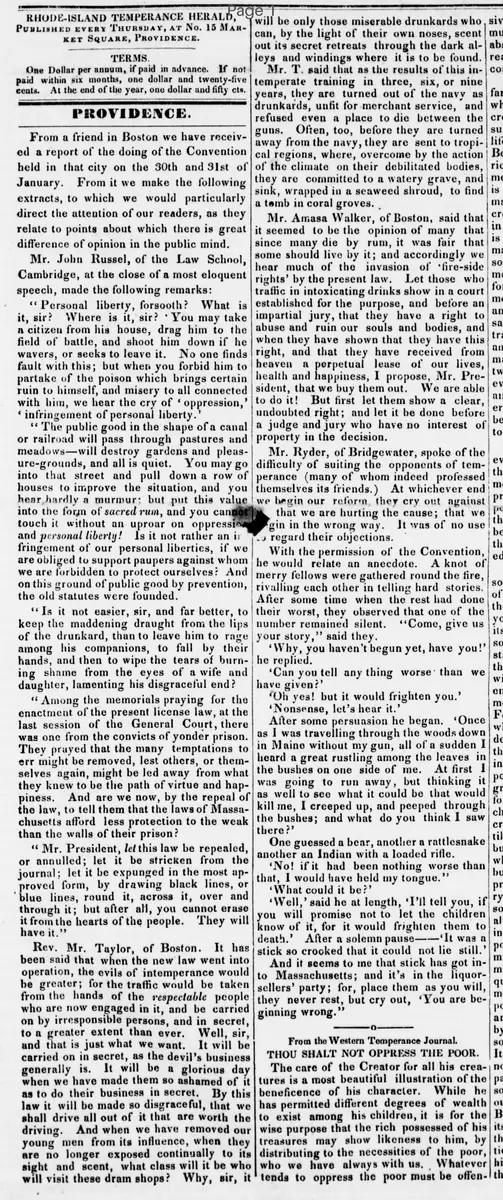
From a friend in Boston we have received a report of the doings of the Convention held in that city on the 30th and 31st of January. From it we make the following extracts, to which we would particularly direct the attention of our readers, as they relate to points about which there is great difference of opinion in the public mind.
Mr. John Russel, of the Law School, Cambridge, at the close of a most eloquent speech, made the following remarks:
"Personal liberty, forsooth? What is it, sir? Where is it, sir? You may take a citizen from his house, drag him to the field of battle, and shoot him down if he wavers, or seeks to leave it. No one finds fault with this: but when you forbid him to partake of the poison which brings certain ruin to himself, and misery to all connected with him, we hear the cry of 'oppression,' 'infringement of personal liberty.'
The public good in the shape of a canal or railroad will pass through pastures and meadows—will destroy gardens and pleasure-grounds, and all is quiet. You may go into that street and pull down a row of houses to improve the situation, and you hear hardly a murmur: but put this value into the form of sacred rum, and you cannot touch it without an uproar on oppression and personal liberty! Is it not rather an infringement of our personal liberties, if we are obliged to support paupers against whom we are forbidden to protect ourselves? And on this ground of public good by prevention, the old statutes were founded.
"Is it not easier, sir, and far better, to keep the maddening draught from the lips of the drunkard, than to leave him to rage among his companions, to fall by their hands, and then to wipe the tears of burning shame from the eyes of a wife and daughter, lamenting his disgraceful end?
"Among the memorials praying for the enactment of the present license law, at the last session of the General Court, there was one from the convicts of yonder prison. They prayed that the many temptations to err might be removed, lest others, or themselves again, might be led away from what they knew to be the path of virtue and happiness. And are we now, by the repeal of the law, to tell them that the laws of Massachusetts afford less protection to the weak than the walls of their prison?
"Mr. President, let this law be repealed, or annulled; let it be stricken from the journal: let it be expunged in the most approved form, by drawing black lines, or blue lines, round it, across it, over and through it: but after all, you cannot erase it from the hearts of the people. They will have it."
Rev. Mr. Taylor, of Boston. It has been said that when the new law went into operation, the evils of intemperance would be greater; for the traffic would be taken from the hands of the respectable people who are now engaged in it, and be carried on by irresponsible persons, and in secret, to a greater extent than ever. Well, sir, and that is just what we want. It will be carried on in secret, as the devil's business generally is. It will be a glorious day when we have made them so ashamed of it as to do their business in secret. By this law it will be made so disgraceful, that we shall drive all out of it that are worth the driving.
And when we have removed our young men from its influence, when they are no longer exposed continually to its sight and scent, what class will it be who will visit these dram shops? Why, sir, it will be only those miserable drunkards who can, by the light of their own noses, scent out its secret retreats through the dark alleys and windings where it is to be found.
Mr. T. said that as the results of this intemperate training in three, six, or nine years, they are turned out of the navy as drunkards, unfit for merchant service, and refused even a place to die between the guns. Often, too, before they are turned away from the navy, they are sent to tropical regions, where, overcome by the action of the climate on their debilitated bodies, they are committed to a watery grave, and sink, wrapped in a seaweed shroud, to find a tomb in coral groves.
Mr. Amasa Walker, of Boston, said that it seemed to be the opinion of many that since many die by rum, it was fair that some should live by it; and accordingly we hear much of the invasion of 'fire-side rights' by the present law. Let those who traffic in intoxicating drinks show in a court established for the purpose, and before an impartial jury, that they have a right to abuse and ruin our souls and bodies, and when they have shown that they have this right, and that they have received from heaven a perpetual lease of our lives, health and happiness, I propose, Mr. President, that we buy them out. We are able to do it! But first let them show a clear, undoubted right; and let it be done before a judge and jury who have no interest of property in the decision.
Mr. Ryder, of Bridgewater, spoke of the difficulty of suiting the opponents of temperance (many of whom indeed professed themselves its friends.) At whichever end we begin our reform, they cry out against that we are hurting the cause; that we begin in the wrong way. It was of no use to regard their objections.
With the permission of the Convention, he would relate an anecdote. A knot of merry fellows were gathered round the fire, rivalling each other in telling hard stories. After some time when the rest had done their worst, they observed that one of the number remained silent.
"Come, give us your story," said they.
"Why, you haven't begun yet, have you!" he replied.
"Can you tell any thing worse than we have given?"
"Oh yes! but it would frighten you."
"Nonsense. let's hear it."
After some persuasion he began. "Once as I was travelling through the woods down in Maine without my gun, all of a sudden I heard a great rustling among the leaves in the bushes on one side of me. At first I was going to run away, but thinking it as well to see what it could be that would kill me, I creeped up, and peeped through the bushes; and what do you think I saw there?"
One guessed a bear, another a rattlesnake, another an Indian with a loaded rifle.
"No! if it had been nothing worse than that, I would have held my tongue."
"What could it be?"
"Well," said he at length, "I'll tell you, if you will promise not to let the children know of it, for it would frighten them to death." After a solemn pause—"It was a stick so crooked that it could not lie still."
And it seems to me that stick has got into Massachusetts; and it's in the liquor-sellers' party; for, place them as you will, they never rest, but cry out, 'You are beginning wrong.'
What sub-type of article is it?
What keywords are associated?
What entities or persons were involved?
Where did it happen?
Domestic News Details
Primary Location
Boston
Event Date
30th And 31st Of January
Key Persons
Outcome
advocacy for maintaining temperance laws; no specific casualties mentioned, but references to societal harms from intemperance including pauperism, deaths in navy, and family misery.
Event Details
Convention in Boston discussing and advocating for the enforcement of liquor license laws to combat intemperance. Speakers including John Russel argued against repeal, emphasizing public good over personal liberty in alcohol consumption. Rev. Taylor supported secret operation of illegal trade to shame participants. Amasa Walker challenged liquor sellers' rights. Mr. Ryder shared an anecdote criticizing opponents of reform.