Thank you for visiting SNEWPapers!
Sign up free
Editorial
January 20, 1866
Springfield Weekly Republican
Springfield, Hampden County, Massachusetts
What is this article about?
Editorial supports Senator Trumbull's bill expanding the Freedmen's Bureau to protect and assign government lands as homesteads to freedmen in Southern states, aligning with the anti-slavery amendment. Urges northern aid commission to provide startup tools on credit for successful farming.
Clipping
OCR Quality
98%
Excellent
Full Text
Homestead Independence for Freedmen.
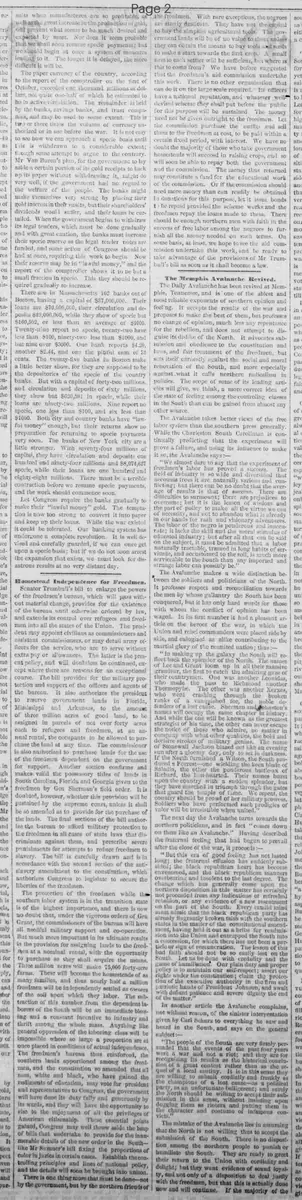
Senator Trumbull's bill to enlarge the powers of the freedmen's bureau, which will pass without material change, provides for the existence of the bureau until otherwise ordered by law, and extends its control over refugees and freedmen into all the states of the Union. The president may appoint civilians as commissioners and assistant commissioners, or may detail army officers for the service, who are to serve without extra pay or allowances. The latter is the present policy, and will doubtless be continued, except where there are reasons for an exceptional course. The bill provides for the military protection and support of the officers and agents of the bureau. It also authorizes the president to reserve government lands in Florida, Mississippi and Arkansas, to the amount of three million acres of good land, to be assigned in parcels of not over forty acres each to refugees and freedmen, at an annual rental, the occupants to be allowed to purchase the land at any time. The commissioner is also authorized to purchase lands for the use of the freedmen dependent on the government for support. Another section confirms and makes valid the possessory titles of lands in South Carolina, Florida and Georgia given to the freedmen by Gen. Sherman's field order. It is doubted, however, whether this provision will be sustained by the supreme court, unless it shall be so amended as to provide for the purchase of the lands. The final sections of the bill authorize the bureau to afford military protection to the freedmen in all cases of state laws that discriminate against them, and prescribe severe punishments for attempts to reduce freedmen to slavery. The bill is carefully drawn and is in accordance with the second section of the anti-slavery amendment to the constitution, which authorizes Congress to legislate to secure the liberties of the freedmen.
The protection of the freedmen while the southern labor system is in the transition state is of the highest importance, and there is now no doubt that, under the vigorous orders of Gen. Grant, the commissioners of the bureau will have all needful military support and co-operation. But much more important in its ultimate results is the provision for assigning lands to the freedmen at a nominal rental, with the opportunity to purchase as they shall acquire the means. Three million acres will make 75,000 forty-acre farms. These will become the homesteads of as many families, and thus nearly half a million freedmen will be independently settled as owners of the soil upon which they labor. The subtraction of this number from the dependent laborers of the South will be an immediate blessing and a constant incentive to industry and thrift among the whole mass. Anything like general oppression of the laboring class will be impossible where so large a proportion are at once placed in conditions of actual independence.
The freedmen's bureau thus reinforced, the southern lands apportioned among the freedmen, and the constitution so amended that all men, white and black, who have gained the rudiments of education, may vote for president and representatives to Congress, the government will have done its duty fully and generously by its wards, and they will have the opportunity to rise to the enjoyment of all the privileges of American citizenship. These essential points gained, Congress may well throw aside the heap of bills that undertake to provide for the innumerable details of the new order in the South—like Mr. Sumner's bill fixing the proportions of color in juries in certain cases. Establish the controlling principles and lines of national policy, and the details will soon be brought into unison.
There is one thing more that must be done—not by the government, but by the northern friends of the freedmen. With rare exceptions, the negroes are utterly destitute. They have not the capital to buy the simplest agricultural tools. The government lands will be of no value to them unless they can obtain the means to buy tools and seeds to make a start towards the first crop. A small sum to each settler will be sufficient, but where is this to come from? We have before suggested that the freedmen's aid commission undertake this work. There is no other organization that can do it on the large scale required. Its officers have a national reputation, and whatever well-devised scheme they shall put before the public for this purpose will be sustained. The money need not be given outright to the freedmen. Let the commission purchase the outfits and sell them to the freedmen at cost, to be paid within a certain fixed period, with interest. We have no doubt the majority of those who take government homesteads will succeed in raising crops, and so will soon be able to repay both the government and the commission. The money thus returned may constitute a fund for the educational work of the commission. Or if the commission should need more money than can readily be obtained in donations for this purpose, let it issue bonds to be repaid provided the scheme works and the freedmen repay the loans made to them. There should be enough northern men with faith in the success of free labor among the negroes to furnish all the money needed on such terms. On some basis, at least, we hope to see the aid commission undertake this work, and be ready to take advantage of the provisions of Mr. Trumbull's bill as soon as it shall become a law.
Senator Trumbull's bill to enlarge the powers of the freedmen's bureau, which will pass without material change, provides for the existence of the bureau until otherwise ordered by law, and extends its control over refugees and freedmen into all the states of the Union. The president may appoint civilians as commissioners and assistant commissioners, or may detail army officers for the service, who are to serve without extra pay or allowances. The latter is the present policy, and will doubtless be continued, except where there are reasons for an exceptional course. The bill provides for the military protection and support of the officers and agents of the bureau. It also authorizes the president to reserve government lands in Florida, Mississippi and Arkansas, to the amount of three million acres of good land, to be assigned in parcels of not over forty acres each to refugees and freedmen, at an annual rental, the occupants to be allowed to purchase the land at any time. The commissioner is also authorized to purchase lands for the use of the freedmen dependent on the government for support. Another section confirms and makes valid the possessory titles of lands in South Carolina, Florida and Georgia given to the freedmen by Gen. Sherman's field order. It is doubted, however, whether this provision will be sustained by the supreme court, unless it shall be so amended as to provide for the purchase of the lands. The final sections of the bill authorize the bureau to afford military protection to the freedmen in all cases of state laws that discriminate against them, and prescribe severe punishments for attempts to reduce freedmen to slavery. The bill is carefully drawn and is in accordance with the second section of the anti-slavery amendment to the constitution, which authorizes Congress to legislate to secure the liberties of the freedmen.
The protection of the freedmen while the southern labor system is in the transition state is of the highest importance, and there is now no doubt that, under the vigorous orders of Gen. Grant, the commissioners of the bureau will have all needful military support and co-operation. But much more important in its ultimate results is the provision for assigning lands to the freedmen at a nominal rental, with the opportunity to purchase as they shall acquire the means. Three million acres will make 75,000 forty-acre farms. These will become the homesteads of as many families, and thus nearly half a million freedmen will be independently settled as owners of the soil upon which they labor. The subtraction of this number from the dependent laborers of the South will be an immediate blessing and a constant incentive to industry and thrift among the whole mass. Anything like general oppression of the laboring class will be impossible where so large a proportion are at once placed in conditions of actual independence.
The freedmen's bureau thus reinforced, the southern lands apportioned among the freedmen, and the constitution so amended that all men, white and black, who have gained the rudiments of education, may vote for president and representatives to Congress, the government will have done its duty fully and generously by its wards, and they will have the opportunity to rise to the enjoyment of all the privileges of American citizenship. These essential points gained, Congress may well throw aside the heap of bills that undertake to provide for the innumerable details of the new order in the South—like Mr. Sumner's bill fixing the proportions of color in juries in certain cases. Establish the controlling principles and lines of national policy, and the details will soon be brought into unison.
There is one thing more that must be done—not by the government, but by the northern friends of the freedmen. With rare exceptions, the negroes are utterly destitute. They have not the capital to buy the simplest agricultural tools. The government lands will be of no value to them unless they can obtain the means to buy tools and seeds to make a start towards the first crop. A small sum to each settler will be sufficient, but where is this to come from? We have before suggested that the freedmen's aid commission undertake this work. There is no other organization that can do it on the large scale required. Its officers have a national reputation, and whatever well-devised scheme they shall put before the public for this purpose will be sustained. The money need not be given outright to the freedmen. Let the commission purchase the outfits and sell them to the freedmen at cost, to be paid within a certain fixed period, with interest. We have no doubt the majority of those who take government homesteads will succeed in raising crops, and so will soon be able to repay both the government and the commission. The money thus returned may constitute a fund for the educational work of the commission. Or if the commission should need more money than can readily be obtained in donations for this purpose, let it issue bonds to be repaid provided the scheme works and the freedmen repay the loans made to them. There should be enough northern men with faith in the success of free labor among the negroes to furnish all the money needed on such terms. On some basis, at least, we hope to see the aid commission undertake this work, and be ready to take advantage of the provisions of Mr. Trumbull's bill as soon as it shall become a law.
What sub-type of article is it?
Slavery Abolition
Social Reform
What keywords are associated?
Freedmen
Homesteads
Trumbull Bill
Freedmen's Bureau
Land Assignment
Reconstruction
Northern Aid
What entities or persons were involved?
Senator Trumbull
Freedmen's Bureau
Gen. Grant
Gen. Sherman
Mr. Sumner
Freedmen's Aid Commission
Editorial Details
Primary Topic
Support For Trumbull's Freedmen's Bureau Bill Providing Land And Protection For Freedmen
Stance / Tone
Strongly Supportive Of The Bill And Additional Aid Measures
Key Figures
Senator Trumbull
Freedmen's Bureau
Gen. Grant
Gen. Sherman
Mr. Sumner
Freedmen's Aid Commission
Key Arguments
Bill Enlarges Freedmen's Bureau Powers And Extends Control To All States
Authorizes Reservation Of Three Million Acres For Freedmen Homesteads
Confirms Sherman's Field Order Land Titles For Freedmen
Provides Military Protection Against Discriminatory State Laws
Aligns With Anti Slavery Constitutional Amendment
Land Assignment Promotes Independence And Thrift Among Freedmen
Northern Aid Commission Should Provide Tools And Seeds On Credit
Congress Should Focus On Principles Over Detailed Bills