Thank you for visiting SNEWPapers!
Sign up free
Editorial
September 2, 1789
Gazette Of The United States
New York, New York County, New York
What is this article about?
An editorial essay debates whether Congress should address the U.S. President with a title beyond 'President,' presenting a conversation between an anti-title advocate (arguing it fosters monarchy and usurpation) and a pro-title supporter (citing ancient republics and state precedents for dignity).
Clipping
OCR Quality
98%
Excellent
Full Text
[No. XLI.]
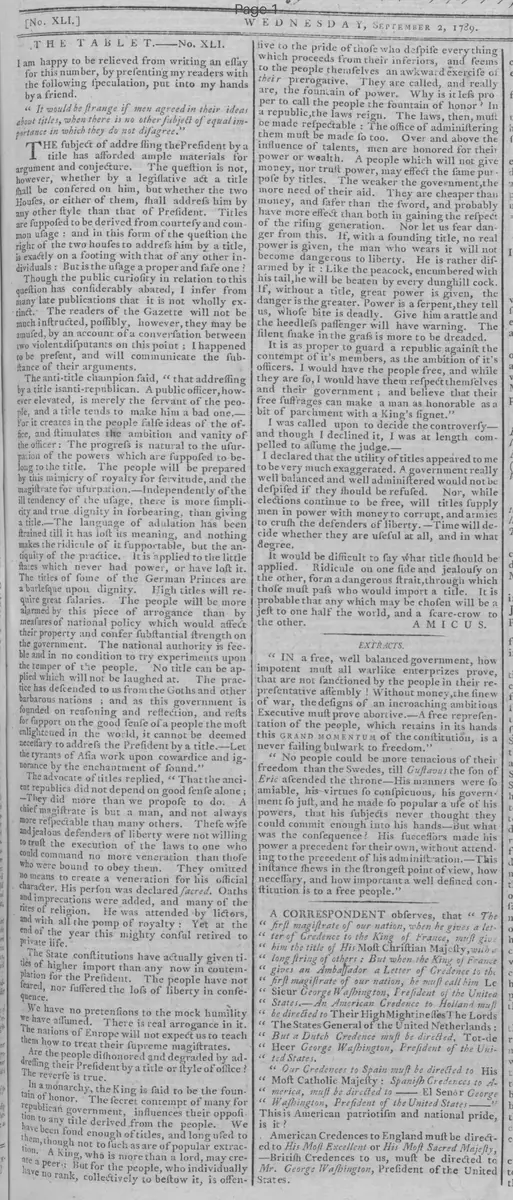
THE TABLET. No. XLI.
I am happy to be relieved from writing an essay for this number, by presenting my readers with the following speculation, put into my hands by a friend.
"It would be strange if men agreed in their ideas about titles, when there is no other subject of equal importance in which they do not disagree."
The subject of addressing the President by a title has afforded ample materials for argument and conjecture. The question is not, however, whether by a legislative act a title shall be conferred on him, but whether the two Houses, or either of them, shall address him by any other style than that of President. Titles are supposed to be derived from courtesy and common usage: and in this form of the question the right of the two houses to address him by a title, is exactly on a footing with that of any other individuals: But is the usage a proper and safe one?
Though the public curiosity in relation to this question has considerably abated, I infer from many late publications that it is not wholly extinct. The readers of the Gazette will not be much instructed, possibly, however, they may be amused, by an account of a conversation between two violent disputants on this point; I happened to be present, and will communicate the substance of their arguments.
The anti-title champion said, "that addressing by a title is anti-republican. A public officer, however elevated, is merely the servant of the people, and a title tends to make him a bad one.— For it creates in the people false ideas of the office, and stimulates the ambition and vanity of the officer: The progress is natural to the usurpation of the powers which are supposed to belong to the title. The people will be prepared by this mimicry of royalty for servitude, and the magistrate for usurpation.—Independently of the ill tendency of the usage, there is more simplicity and true dignity in forbearing, than giving a title.—The language of adulation has been strained till it has lost its meaning, and nothing makes the ridicule of it supportable, but the antiquity of the practice. It is applied to the little states which never had power, or have lost it. The titles of some of the German Princes are a burlesque upon dignity. High titles will require great salaries. The people will be more alarmed by this piece of arrogance than by measures of national policy which would affect their property and confer substantial strength on the government. The national authority is feeble and in no condition to try experiments upon the temper of the people. No title can be applied which will not be laughed at. The practice has descended to us from the Goths and other barbarous nations; and as this government is founded on reasoning and reflection, and rests for support on the good sense of a people the most enlightened in the world, it cannot be deemed necessary to address the President by a title.—Let the tyrants of Asia work upon cowardice and ignorance by the enchantment of sound."
The advocate of titles replied, "That the ancient republics did not depend on good sense alone; —They did more than we propose to do. A chief magistrate is but a man, and not always more respectable than many others. These wise and jealous defenders of liberty were not willing to trust the execution of the laws to one who could command no more veneration than those who were bound to obey them. They omitted no means to create a veneration for his official character. His person was declared Sacred. Oaths and imprecations were added, and many of the rites of religion. He was attended by lictors, and with all the pomp of royalty: Yet at the end of the year this mighty consul retired to private life.
The State constitutions have actually given titles of higher import than any now in contemplation for the President. The people have not feared, nor suffered the loss of liberty in consequence.
We have no pretensions to the mock humility we have assumed. There is real arrogance in it. The nations of Europe will not expect us to teach them how to treat their supreme magistrates. Are the people dishonored and degraded by addressing their President by a title or style of office? The reverse is true.
In a monarchy, the King is said to be the fountain of honor. The secret contempt of many for republican government, influences their opposition to any title derived from the people. We have been fond enough of titles, and long used to them, though not to such as are of popular extraction. A King, who is more than a lord, may create a peer: But for the people, who individually have no rank, collectively to bestow it, is offensive
THE TABLET. No. XLI.
I am happy to be relieved from writing an essay for this number, by presenting my readers with the following speculation, put into my hands by a friend.
"It would be strange if men agreed in their ideas about titles, when there is no other subject of equal importance in which they do not disagree."
The subject of addressing the President by a title has afforded ample materials for argument and conjecture. The question is not, however, whether by a legislative act a title shall be conferred on him, but whether the two Houses, or either of them, shall address him by any other style than that of President. Titles are supposed to be derived from courtesy and common usage: and in this form of the question the right of the two houses to address him by a title, is exactly on a footing with that of any other individuals: But is the usage a proper and safe one?
Though the public curiosity in relation to this question has considerably abated, I infer from many late publications that it is not wholly extinct. The readers of the Gazette will not be much instructed, possibly, however, they may be amused, by an account of a conversation between two violent disputants on this point; I happened to be present, and will communicate the substance of their arguments.
The anti-title champion said, "that addressing by a title is anti-republican. A public officer, however elevated, is merely the servant of the people, and a title tends to make him a bad one.— For it creates in the people false ideas of the office, and stimulates the ambition and vanity of the officer: The progress is natural to the usurpation of the powers which are supposed to belong to the title. The people will be prepared by this mimicry of royalty for servitude, and the magistrate for usurpation.—Independently of the ill tendency of the usage, there is more simplicity and true dignity in forbearing, than giving a title.—The language of adulation has been strained till it has lost its meaning, and nothing makes the ridicule of it supportable, but the antiquity of the practice. It is applied to the little states which never had power, or have lost it. The titles of some of the German Princes are a burlesque upon dignity. High titles will require great salaries. The people will be more alarmed by this piece of arrogance than by measures of national policy which would affect their property and confer substantial strength on the government. The national authority is feeble and in no condition to try experiments upon the temper of the people. No title can be applied which will not be laughed at. The practice has descended to us from the Goths and other barbarous nations; and as this government is founded on reasoning and reflection, and rests for support on the good sense of a people the most enlightened in the world, it cannot be deemed necessary to address the President by a title.—Let the tyrants of Asia work upon cowardice and ignorance by the enchantment of sound."
The advocate of titles replied, "That the ancient republics did not depend on good sense alone; —They did more than we propose to do. A chief magistrate is but a man, and not always more respectable than many others. These wise and jealous defenders of liberty were not willing to trust the execution of the laws to one who could command no more veneration than those who were bound to obey them. They omitted no means to create a veneration for his official character. His person was declared Sacred. Oaths and imprecations were added, and many of the rites of religion. He was attended by lictors, and with all the pomp of royalty: Yet at the end of the year this mighty consul retired to private life.
The State constitutions have actually given titles of higher import than any now in contemplation for the President. The people have not feared, nor suffered the loss of liberty in consequence.
We have no pretensions to the mock humility we have assumed. There is real arrogance in it. The nations of Europe will not expect us to teach them how to treat their supreme magistrates. Are the people dishonored and degraded by addressing their President by a title or style of office? The reverse is true.
In a monarchy, the King is said to be the fountain of honor. The secret contempt of many for republican government, influences their opposition to any title derived from the people. We have been fond enough of titles, and long used to them, though not to such as are of popular extraction. A King, who is more than a lord, may create a peer: But for the people, who individually have no rank, collectively to bestow it, is offensive
What sub-type of article is it?
Constitutional
What keywords are associated?
Presidential Titles
Republican Simplicity
Anti Republican Usage
Ancient Precedents
State Constitutions
Political Dignity
What entities or persons were involved?
President
Two Houses
Ancient Republics
State Constitutions
Editorial Details
Primary Topic
Debate On Addressing The President By Title
Stance / Tone
Balanced Presentation Of Opposing Views
Key Figures
President
Two Houses
Ancient Republics
State Constitutions
Key Arguments
Addressing By Title Is Anti Republican And Leads To Usurpation
Titles Create False Ideas And Stimulate Ambition
Simplicity And Dignity In Avoiding Titles
Ancient Republics Used Pomp And Titles For Veneration Without Losing Liberty
State Constitutions Already Use Higher Titles Without Harm
Opposition To Titles Shows Arrogance And Contempt For Republicanism