Thank you for visiting SNEWPapers!
Sign up free
Literary
May 9, 1844
The Hillsborough Recorder
Hillsboro, Orange County, North Carolina
What is this article about?
A narrative recounts an Irish emigrant family's ordeal on a ship during a gale and food shortage at Mackinaw Island. A lady offers to adopt one of their three children to alleviate poverty, but the parents, after intense emotional struggle, cannot bear to part with any, highlighting Irish parental devotion.
Clipping
OCR Quality
95%
Excellent
Full Text
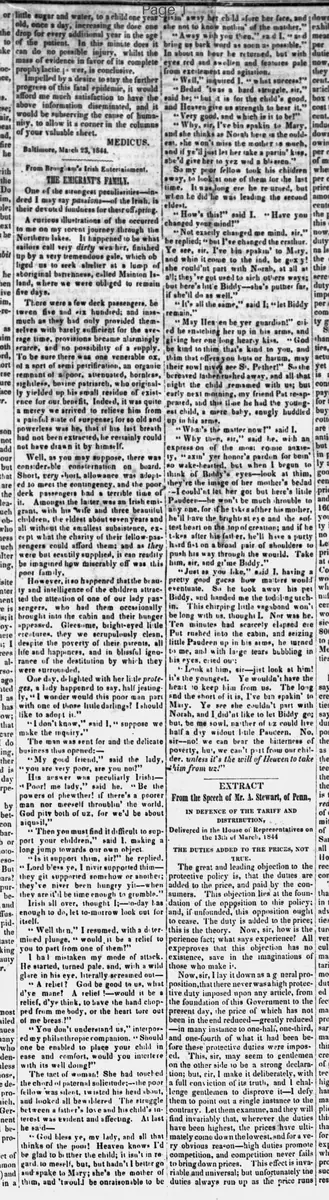
From Brougham's Irish Entertainment.
THE EMIGRANT'S FAMILY.
One of the strongest peculiarities—hundred I may say passions—of the Irish, is their devoted fondness for their offspring. A curious illustration of this occurred to me on my recent journey through the Northern Lakes. It happened to be what sailors call very dirty weather, finished up by a very tremendous gale, which obliged us to seek shelter at a lump of aboriginal barrenness, called Mackinaw Island, where we were obliged to remain five days.
There were a few deck passengers, between five and six hundred; and inasmuch as they had only provided themselves with barely sufficient for the average time, provisions became alarmingly scarce, and no possibility of a supply. To be sure there was one venerable ox, of a sort of semi petrifaction, an organic remnant of a poor, attenuated, hornless, sightless, bovine patriarch, who originally yielded up his small residue of existence for our benefit. Indeed, it was quite a mercy we arrived to relieve him from a painful state of suspense; for so old and powerless was he, that if his last breath had not been extracted, he certainly could not have drawn it by himself.
Well, as you may suppose, there was considerable consternation on board. Short, very short, allowance was adopted to meet the contingency, and the poor deck passengers had a terrible time of it. Amongst the latter was an Irish emigrant, with his wife and three beautiful children, the eldest about seven years and all without the smallest subsistence, except what the charity of their fellow-passengers could afford them; and as they were but scantily supplied, it can readily be imagined how miserably off was this poor family.
However, it so happened that the beauty and intelligence of the children attracted the attention of one of our lady passengers, who had them occasionally brought into the cabin and their hunger appeased. Gleesome, bright-eyed little creatures, they were scrupulously clean, despite the poverty of their parents, all life and happiness, and in blissful ignorance of the destitution by which they were surrounded.
One day, delighted with her little proteges, a lady happened to say, half jestingly, 'I wonder would this poor man part with one of those little darlings? I should like to adopt it.'
'I don't know,' said I, 'suppose we make the inquiry.'
The man was sent for and the delicate business thus opened:—
'My good friend,' said the lady, 'you are very poor, are you not?'
His answer was peculiarly Irish—
'Poor! me lady,' said he. 'Be the powers o' phewater! if there's a poorer man nor meself through the world. God pity both o' uz, for we'll be about a quail,'
'Then you must find it difficult to support your children,' said I, making a long jump towards our own object.
'Is it support thim, sir?' he replied 'Lord b'ess ye, I niver supported thim—they git supported somehow or another; they've niver been hungry yit—when they are it'll be time enough to grumble.'
Irish all over, thought I; to-day has enough to do, let to-morrow look out for itself.
'Well then,' I resumed, with a determined plunge, 'would it be a relief to you to part from one of them?'
I had mistaken my mode of attack. He started, turned pale, and with a wild glare in his eye, literally screamed out—
'A relief? God be good to us, what d'ye mane? A relief! would it be a relief, d'ye think, to have the hand chopped from me body, or the heart tore out of me breast?'
'You don't understand us,' interposed my philanthropic companion. 'Should one be enabled to place your child in ease and comfort, would you interfere with its well doing?'
The tact of woman! She had touched the chord of paternal solicitude:—the poor fellow was silent, twisted his head about and looked all bewildered. The struggle between a father's love and his child's interest was evident and affecting.
At last he said—
'God bless ye, my lady, and all that thinks o' the poor! Heaven knows I'd be glad to be dther the child; it isn't in regard to meself, but, but hadn't I better go and spake to Mary; she's the mother of thim, and 'twould be onraisonable to be gisin away her child afore her face, and she not to know nothin' o' the mather.'
'Away with you then,' said I, 'and bring us back word as soon as possible.'
In about an hour he returned, but with eyes red and swollen and features pale from excitement and agitation.
'Well,' inquired I, 'what success?'
'Bedad 'twas a hard struggle, sir,' said he; 'but it is for the child's good, and Heaven give us strength to bear it.'
'Very good, and which is it to be?'
'Why, sir, I've bin spakin' to Mary, and she thinks as Norah here's the ouldest, the one's miss the mother as much, and if ye'll just let her take a partin' kiss, she'd give her to yez wid a blieren.'
So my poor fellow took his children away, to look at one of them for the last time. It was long ere he returned, but when he did he was leading the second eldest.
'How's this?' said I. 'Have you changed your mind?'
'Not exactly changed me mind, sir,' he replied; 'but I've changed the crathur. Ye see, sir, I've bin spakin' to Mary, and whin it come to the ind, be gox y! she couldn't part with Norah, at all at all; they've got used to airh others ways; but here's little Biddy—she's puttier, sir, if she'll do as well.'
'It's all the same,' said I; 'let Biddy remain.'
'May Heaven be yer guardian!' cried he snatching her up in his arms, and givin' her one long hearty kiss, 'God be kind to thim that's kind to you, and thim that offers you buts or harum, may their sowl niver see St. Pether!' So the bereaved father rushed away, and all that night the child screamed with us; but early next morning, my friend Pat re-appeared, and this time he had the youngest child, a mere baby, snugly huddled up in his arms.
'What's the matter now?' said I.
'Why then, sir,' said he, with an expression of the most comic anxiety, 'axin' yer honor's pardon for bein' so wake-hearted, but when I begun to think of Biddy's eyes—look at thim, they're the image of her mother's bejad—I couldn't let her go: but here's little Paudeen—he won't be much throuble to any one, for if he takes afther his mother, he'll have the brightest eye and the softest heart on the top o' creation; and if he takes afther his father, he'll have a purty hard fist on a broad pair o' shoulders to push his way through the world. Take him, sir, and gi' me Biddy.'
'Just as you like,' said I, having a pretty good guess how matters would eventuate. So he took away his pet Biddy, and handed me the toddlin' urchin. This chirping little vagabond won't be long with us, thought I. Nor was he. Ten minutes had scarcely elapsed ere Pat rushed into the cabin, and seizing little Paudeen up in his arms, he turned to me, and with large tears bubbling in his eyes, cried out:
'Look at him, sir—jist look at him! it's the youngeest. Ye wouldn't have the heart to keep him from us. The long and the short of it is, I've bin spakin' to Mary. Ye see she couldn't part with Norah, and I didn't like to let Biddy go; but, be me sowl, nather o' uz could live half a day widout little Paudeen. No, sir—no! we can bear the bitterniss of poverty, but we can't part from our children, unless it's the will o' Heaven to take him from uz!'
THE EMIGRANT'S FAMILY.
One of the strongest peculiarities—hundred I may say passions—of the Irish, is their devoted fondness for their offspring. A curious illustration of this occurred to me on my recent journey through the Northern Lakes. It happened to be what sailors call very dirty weather, finished up by a very tremendous gale, which obliged us to seek shelter at a lump of aboriginal barrenness, called Mackinaw Island, where we were obliged to remain five days.
There were a few deck passengers, between five and six hundred; and inasmuch as they had only provided themselves with barely sufficient for the average time, provisions became alarmingly scarce, and no possibility of a supply. To be sure there was one venerable ox, of a sort of semi petrifaction, an organic remnant of a poor, attenuated, hornless, sightless, bovine patriarch, who originally yielded up his small residue of existence for our benefit. Indeed, it was quite a mercy we arrived to relieve him from a painful state of suspense; for so old and powerless was he, that if his last breath had not been extracted, he certainly could not have drawn it by himself.
Well, as you may suppose, there was considerable consternation on board. Short, very short, allowance was adopted to meet the contingency, and the poor deck passengers had a terrible time of it. Amongst the latter was an Irish emigrant, with his wife and three beautiful children, the eldest about seven years and all without the smallest subsistence, except what the charity of their fellow-passengers could afford them; and as they were but scantily supplied, it can readily be imagined how miserably off was this poor family.
However, it so happened that the beauty and intelligence of the children attracted the attention of one of our lady passengers, who had them occasionally brought into the cabin and their hunger appeased. Gleesome, bright-eyed little creatures, they were scrupulously clean, despite the poverty of their parents, all life and happiness, and in blissful ignorance of the destitution by which they were surrounded.
One day, delighted with her little proteges, a lady happened to say, half jestingly, 'I wonder would this poor man part with one of those little darlings? I should like to adopt it.'
'I don't know,' said I, 'suppose we make the inquiry.'
The man was sent for and the delicate business thus opened:—
'My good friend,' said the lady, 'you are very poor, are you not?'
His answer was peculiarly Irish—
'Poor! me lady,' said he. 'Be the powers o' phewater! if there's a poorer man nor meself through the world. God pity both o' uz, for we'll be about a quail,'
'Then you must find it difficult to support your children,' said I, making a long jump towards our own object.
'Is it support thim, sir?' he replied 'Lord b'ess ye, I niver supported thim—they git supported somehow or another; they've niver been hungry yit—when they are it'll be time enough to grumble.'
Irish all over, thought I; to-day has enough to do, let to-morrow look out for itself.
'Well then,' I resumed, with a determined plunge, 'would it be a relief to you to part from one of them?'
I had mistaken my mode of attack. He started, turned pale, and with a wild glare in his eye, literally screamed out—
'A relief? God be good to us, what d'ye mane? A relief! would it be a relief, d'ye think, to have the hand chopped from me body, or the heart tore out of me breast?'
'You don't understand us,' interposed my philanthropic companion. 'Should one be enabled to place your child in ease and comfort, would you interfere with its well doing?'
The tact of woman! She had touched the chord of paternal solicitude:—the poor fellow was silent, twisted his head about and looked all bewildered. The struggle between a father's love and his child's interest was evident and affecting.
At last he said—
'God bless ye, my lady, and all that thinks o' the poor! Heaven knows I'd be glad to be dther the child; it isn't in regard to meself, but, but hadn't I better go and spake to Mary; she's the mother of thim, and 'twould be onraisonable to be gisin away her child afore her face, and she not to know nothin' o' the mather.'
'Away with you then,' said I, 'and bring us back word as soon as possible.'
In about an hour he returned, but with eyes red and swollen and features pale from excitement and agitation.
'Well,' inquired I, 'what success?'
'Bedad 'twas a hard struggle, sir,' said he; 'but it is for the child's good, and Heaven give us strength to bear it.'
'Very good, and which is it to be?'
'Why, sir, I've bin spakin' to Mary, and she thinks as Norah here's the ouldest, the one's miss the mother as much, and if ye'll just let her take a partin' kiss, she'd give her to yez wid a blieren.'
So my poor fellow took his children away, to look at one of them for the last time. It was long ere he returned, but when he did he was leading the second eldest.
'How's this?' said I. 'Have you changed your mind?'
'Not exactly changed me mind, sir,' he replied; 'but I've changed the crathur. Ye see, sir, I've bin spakin' to Mary, and whin it come to the ind, be gox y! she couldn't part with Norah, at all at all; they've got used to airh others ways; but here's little Biddy—she's puttier, sir, if she'll do as well.'
'It's all the same,' said I; 'let Biddy remain.'
'May Heaven be yer guardian!' cried he snatching her up in his arms, and givin' her one long hearty kiss, 'God be kind to thim that's kind to you, and thim that offers you buts or harum, may their sowl niver see St. Pether!' So the bereaved father rushed away, and all that night the child screamed with us; but early next morning, my friend Pat re-appeared, and this time he had the youngest child, a mere baby, snugly huddled up in his arms.
'What's the matter now?' said I.
'Why then, sir,' said he, with an expression of the most comic anxiety, 'axin' yer honor's pardon for bein' so wake-hearted, but when I begun to think of Biddy's eyes—look at thim, they're the image of her mother's bejad—I couldn't let her go: but here's little Paudeen—he won't be much throuble to any one, for if he takes afther his mother, he'll have the brightest eye and the softest heart on the top o' creation; and if he takes afther his father, he'll have a purty hard fist on a broad pair o' shoulders to push his way through the world. Take him, sir, and gi' me Biddy.'
'Just as you like,' said I, having a pretty good guess how matters would eventuate. So he took away his pet Biddy, and handed me the toddlin' urchin. This chirping little vagabond won't be long with us, thought I. Nor was he. Ten minutes had scarcely elapsed ere Pat rushed into the cabin, and seizing little Paudeen up in his arms, he turned to me, and with large tears bubbling in his eyes, cried out:
'Look at him, sir—jist look at him! it's the youngeest. Ye wouldn't have the heart to keep him from us. The long and the short of it is, I've bin spakin' to Mary. Ye see she couldn't part with Norah, and I didn't like to let Biddy go; but, be me sowl, nather o' uz could live half a day widout little Paudeen. No, sir—no! we can bear the bitterniss of poverty, but we can't part from our children, unless it's the will o' Heaven to take him from uz!'
What sub-type of article is it?
Prose Fiction
What themes does it cover?
Moral Virtue
What keywords are associated?
Irish Emigrant
Family Devotion
Parental Love
Poverty
Adoption Attempt
Ship Voyage
What entities or persons were involved?
From Brougham's Irish Entertainment
Literary Details
Title
The Emigrant's Family
Author
From Brougham's Irish Entertainment
Subject
Illustration Of Irish Fondness For Offspring During A Journey Through The Northern Lakes
Form / Style
Anecdotal Narrative In Prose
Key Lines
'A Relief? God Be Good To Us, What D'ye Mane? A Relief! Would It Be A Relief, D'ye Think, To Have The Hand Chopped From Me Body, Or The Heart Tore Out Of Me Breast?'
'We Can Bear The Bitterniss Of Poverty, But We Can't Part From Our Children, Unless It's The Will O' Heaven To Take Him From Uz!'