Thank you for visiting SNEWPapers!
Sign up free
Story
June 22, 1842
The Camden Journal
Camden, Kershaw County, South Carolina
What is this article about?
The article illustrates the fickleness of fortune through three cases of individuals and families who lost their entire fortunes by investing in United States Bank stock during its prosperous period, resulting in poverty and drastic lifestyle changes.
Clipping
OCR Quality
95%
Excellent
Full Text
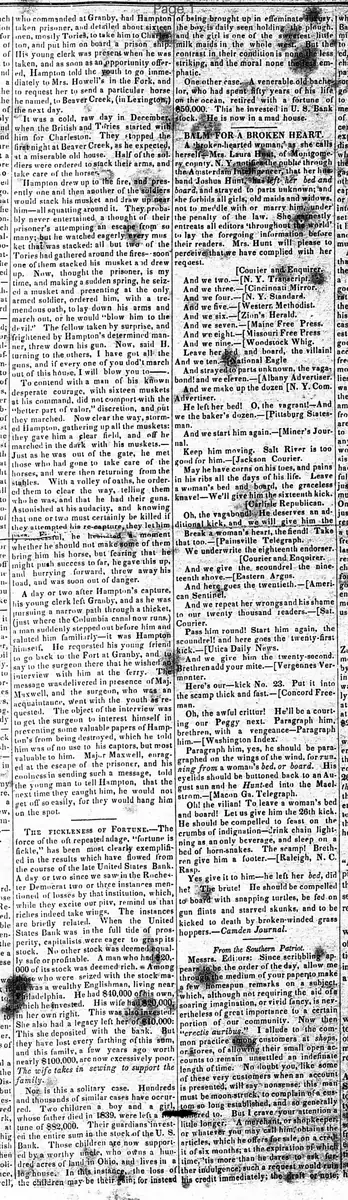
THE FICKLENESS OF FORTUNE
The force of the oft repeated adage, "fortune is fickle," has been most clearly exemplified in the results which have flowed from the course of the late United States Bank. A day or two since we saw in the Rochester Democrat two or three instances mentioned of losses by that institution, which, while they excite our pity, remind us that riches indeed take wings. The instances are briefly related.
When the United States Bank was in the full tide of prosperity, capitalists were eager to grasp its stock. No other stock was deemed equally safe or profitable. A man who had $20,000 of its stock was deemed rich. Among those who were seized with the stock mania—was a wealthy Englishman, living near Philadelphia. He had $40,000 of his own, which he invested. His wife had $20,000. in her own right. This was also invested. She also had a legacy left her of $10,000: This she deposited with the bank. But they have lost every farthing of this sum, and this family, a few years ago worth nearly $100,000, are now excessively poor. The wife takes in sewing to support the family.
Nor is this a solitary case. Hundreds and thousands of similar cases have occurred. Two children a boy and a girl, whose father died in 1839, were left a fortune of $32,000. Their guardians invested the entire sum in the stock of the U. S. Bank. Those children are now supported by a worthy uncle, who owns a hundred acres of land in Ohio, and lives in a log house. In this instance, the loss of the children may be their gain; for instead of being brought up in effeminate luxury, the boy is daily seen holding the plough, and the girl is one of the sweetest little milk maids in the whole west. But the contrast in their condition is none the less striking, and the moral none the less emphatic.
One other case. A venerable old bachelor, who had spent fifty years of his life on the ocean, retired with a fortune of $50,000. This he invested in U. S. Bank stock. He is now in a mad house.
The force of the oft repeated adage, "fortune is fickle," has been most clearly exemplified in the results which have flowed from the course of the late United States Bank. A day or two since we saw in the Rochester Democrat two or three instances mentioned of losses by that institution, which, while they excite our pity, remind us that riches indeed take wings. The instances are briefly related.
When the United States Bank was in the full tide of prosperity, capitalists were eager to grasp its stock. No other stock was deemed equally safe or profitable. A man who had $20,000 of its stock was deemed rich. Among those who were seized with the stock mania—was a wealthy Englishman, living near Philadelphia. He had $40,000 of his own, which he invested. His wife had $20,000. in her own right. This was also invested. She also had a legacy left her of $10,000: This she deposited with the bank. But they have lost every farthing of this sum, and this family, a few years ago worth nearly $100,000, are now excessively poor. The wife takes in sewing to support the family.
Nor is this a solitary case. Hundreds and thousands of similar cases have occurred. Two children a boy and a girl, whose father died in 1839, were left a fortune of $32,000. Their guardians invested the entire sum in the stock of the U. S. Bank. Those children are now supported by a worthy uncle, who owns a hundred acres of land in Ohio, and lives in a log house. In this instance, the loss of the children may be their gain; for instead of being brought up in effeminate luxury, the boy is daily seen holding the plough, and the girl is one of the sweetest little milk maids in the whole west. But the contrast in their condition is none the less striking, and the moral none the less emphatic.
One other case. A venerable old bachelor, who had spent fifty years of his life on the ocean, retired with a fortune of $50,000. This he invested in U. S. Bank stock. He is now in a mad house.
What sub-type of article is it?
Biography
Historical Event
Tragedy
What themes does it cover?
Fortune Reversal
Misfortune
Moral Virtue
What keywords are associated?
United States Bank
Stock Investment
Financial Ruin
Fortune Loss
Poverty
Family Hardship
Orphan Inheritance
Where did it happen?
Near Philadelphia; Ohio
Story Details
Location
Near Philadelphia; Ohio
Event Date
1839
Story Details
Multiple families and individuals lost fortunes invested in U.S. Bank stock: an English family near Philadelphia reduced to poverty with the wife sewing for support; orphans from 1839 now living simply on an uncle's Ohio farm; a retired sailor ending up in a madhouse.