Thank you for visiting SNEWPapers!
Sign up free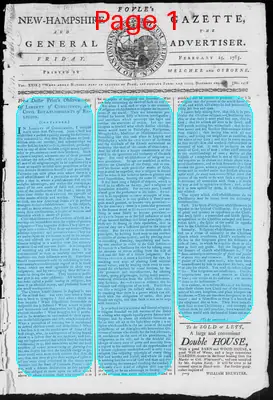
Literary
February 25, 1785
Fowle's New Hampshire Gazette And General Advertiser
Portsmouth, Rockingham County, New Hampshire
What is this article about?
Continuation of Richard Price's essay on civil liberty and conscience, advocating for equality among religions, criticizing civil establishments of religion for promoting hypocrisy, strife, and superstition, praising American constitutions, and emphasizing genuine Christianity free from state interference.
Clipping
OCR Quality
95%
Excellent
Full Text
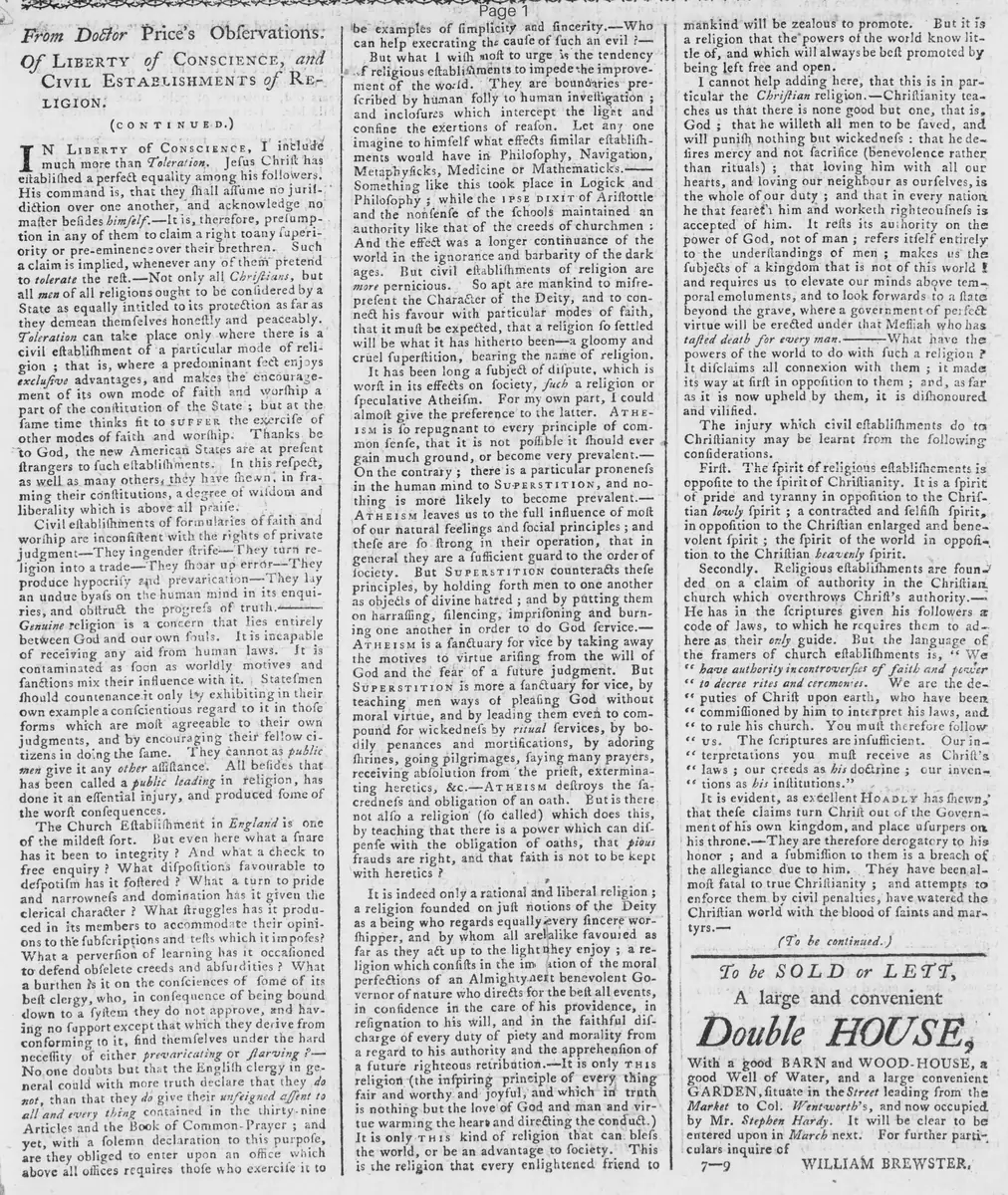
From Doctor Price's "Observations on the Nature of Civil Liberty, of Conscience," and Civil Establishments of Religion.
(Continued.)
On Liberty of Conscience, I include much more than Toleration. Jesus Christ has established a perfect equality among his followers. His command is, that they shall assume no jurisdiction over one another, and acknowledge no master besides himself.--It is, therefore, presumption in any of them to claim a right to any superiority or pre-eminence over their brethren. Such a claim is implied, whenever any of them pretend to tolerate the rest.--Not only all Christians, but all men of all religions ought to be considered by a State as equally entitled to its protection as far as they demean themselves honestly and peaceably. Toleration can take place only where there is a civil establishment of a particular mode of religion ; that is, where a predominant sect enjoys exclusive advantages, and makes the encouragement of its own mode of faith and worship a part of the constitution of the State ; but at the same time thinks fit to SUFFER the exercise of other modes of faith and worship. Thanks be to God, the new American States are at present strangers to such establishments. In this respect, as well as many others, they have shewn, in framing their constitutions, a degree of wisdom and liberality which is above all praise.
Civil establishments of formularies of faith and worship are inconsistent with the rights of private judgment--They engender strife--They turn religion into a trade--They shore up error--They produce hypocrisy and prevarication--They lay an undue bias on the human mind in its enquiries, and obstruct the progress of truth.--
Genuine religion is a concern that lies entirely between God and our own souls. It is incapable of receiving any aid from human laws. It is contaminated as soon as worldly motives and sanctions mix their influence with it. Statesmen should countenance it only by exhibiting in their own examples a conscientious regard to it in those forms which are most agreeable to their own judgments, and by encouraging their fellow citizens in doing the same. They cannot as public men give it any other assistance. All besides that has been called a public leading in religion, has done it an essential injury, and produced some of the worst consequences.
The Church Establishment in England is one of the mildest sort. But even here what a snare has it been to integrity ? And what a check to free enquiry ? What dispositions favourable to despotism has it fostered ? What a turn to pride and narrowness and domination has it given the clerical character ? What struggles has it produced in its members to accommodate their opinions to the subscriptions and tests which it imposes? What a perversion of learning has it occasioned to defend obsolete creeds and absurdities ? What a burden is it on the consciences of some of its best clergy, who, in consequence of being bound down to a system they do not approve, and having no support except that which they derive from conforming to it, find themselves under the hard necessity of either prevaricating or starving ?-- No one doubts but that the English clergy in general could with more truth declare that they do not, than that they do give their unfeigned assent to all and every thing contained in the thirty-nine Articles and the Book of Common-Prayer ; and yet, with a solemn declaration to this purpose, are they obliged to enter upon an office which above all offices requires those who exercise it to be examples of simplicity and sincerity.--Who can help execrating the cause of such an evil ?-- But what I wish not to urge is the tendency of religious establishments to impede the improvement of the world. They are boundaries prescribed by human folly to human investigation ; and enclosures which intercept the light and confine the exertions of reason. Let any one imagine to himself what effects similar establishments would have in Philosophy, Navigation, Metaphysics, Medicine or Mathematicks.-- Something like this took place in Logick and Philosophy ; while the Ipse Dixit of Aristotle and the nonsense of the schools maintained an authority like that of the creeds of churchmen : And the effect was a longer continuance of the world in the ignorance and barbarity of the dark ages. But civil establishments of religion are more pernicious. So apt are mankind to misrepresent the Character of the Deity, and to connect his favour with particular modes of faith, that it must be expected, that a religion so settled will be what it has hitherto been--a gloomy and cruel superstition, bearing the name of religion. It has been long a subject of dispute, which is worst in its effects on society, such a religion or speculative Atheism. For my own part, I could almost give the preference to the latter. ATHEISM is so repugnant to every principle of common sense, that it is not possible it should ever gain much ground, or become very prevalent.-- On the contrary; there is a particular proneness in the human mind to SUPERSTITION, and nothing is more likely to become prevalent.-- Atheism leaves us to the full influence of most of our natural feelings and social principles ; and these are so strong in their operation. that in general they are a sufficient guard to the order of society. But Superstition counteracts these principles, by holding forth men to one another as objects of divine hatred ; and by putting them on harassing, silencing, imprisoning and burning one another in order to do God service.- Atheism is a sanctuary for vice by taking away the motives to virtue arising from the will of God and the fear of a future judgment. But Superstition is more a sanctuary for vice, by teaching men ways of pleasing God without moral virtue, and by leading them even to compound for wickedness by ritual services, by bodily penances and mortifications, by adoring shrines, going pilgrimages, saying many prayers, receiving absolution from the priest, exterminating heretics, &c.--ATHEISM destroys the sacredness and obligation of an oath. But is there not also a religion (so called) which does this. by teaching that there is a power which can dispense with the obligation of oaths, that pious frauds are right, and that faith is not to be kept with heretics ? It is indeed only a rational and liberal religion ; a religion founded on just notions of the Deity as a being who regards equally every sincere worshipper, and by whom all are alike favoured as far as they act up to the light they enjoy ; a religion which consists in the imitation of the moral perfections of an Almighty, most benevolent Governor of nature who directs for the best all events, in confidence in the care of his providence, in resignation to his will, and in the faithful discharge of every duty of piety and morality from a regard to his authority and the apprehension of a future righteous retribution.--It is only THIS religion (the inspiring principle of every thing fair and worthy and joyful, and which in truth is nothing but the love of God and man and virtue warming the heart and directing the conduct.) It is only THIS kind of religion that can bless the world, or be an advantage to society. This is the religion that every enlightened friend to mankind will be zealous to promote. : But it is a religion that the powers of the world know little of, and which will always be best promoted by being left free and open. I cannot help adding here, that this is in particular the Christian religion.-Christianity teaches us that there is none good but one, that is God : that he willeth all men to be saved, and will punish nothing but wickedness : that he desires mercy and not sacrifice (benevolence rather than rituals) ; that loving him with all our hearts, and loving our neighbour as ourselves, is the whole of our duty ; and that in every nation he that feareth him and worketh righteousness is accepted of him. It rests its authority on the power of God, not of man ; refers itself entirely to the understandings of men ; makes us the subjects of a kingdom that is not of this world and requires us to elevate our minds above temporal emoluments, and to look forwards to a state beyond the grave, where a government of perfect virtue will be erected under that Messiah who has tasted death for every man.-i:-What have the powers of the world to do with such a religion ? It disclaims all connexion with them ; it made its way at first in opposition to them ; and, as far as it is now upheld by them, it is dishonoured and vilified. The injury which civil establishments do to Christianity may be learnt from the following considerations. First. The spirit of religious establishments is opposite to the spirit of Christianity. It is a spirit of pride and tyranny in opposition to the Christian lowly spirit ; a contracted and selfish spirit, in opposition to the Christian enlarged and benevolent spirit ; the spirit of the world in opposition to the Christian heavenly spirit. Secondly. Religious establishments are founded on a claim of authority in the Christian church which overthrows Christ's authority.- He has in the scriptures given his followers a code of laws, to which he requires them to adhere as their only guide. But the language of the framers of church establishments is, " We have authority in controversies of faith and power to decree rites and ceremonies. We are the deputies of Christ upon earth, who have been commissioned by him to interpret his laws, and to rule his church. You must therefore follow us. The scriptures are insufficient. Our interpretations you must receive as Christ's laws ; our creeds as his doctrine ; our inventions as his institutions." It is evident, as excellent Hoadly has shewn, that these claims turn Christ out of the Government of his own kingdom, and place usurpers on his throne.- They are therefore derogatory to his honour : and a submission to them is a breach of the allegiance due to him. They have been almost fatal to true Christianity ; and attempts to enforce them by civil penalties, have watered the Christian world with the blood of saints and martyrs.- (To be continued.)
(Continued.)
On Liberty of Conscience, I include much more than Toleration. Jesus Christ has established a perfect equality among his followers. His command is, that they shall assume no jurisdiction over one another, and acknowledge no master besides himself.--It is, therefore, presumption in any of them to claim a right to any superiority or pre-eminence over their brethren. Such a claim is implied, whenever any of them pretend to tolerate the rest.--Not only all Christians, but all men of all religions ought to be considered by a State as equally entitled to its protection as far as they demean themselves honestly and peaceably. Toleration can take place only where there is a civil establishment of a particular mode of religion ; that is, where a predominant sect enjoys exclusive advantages, and makes the encouragement of its own mode of faith and worship a part of the constitution of the State ; but at the same time thinks fit to SUFFER the exercise of other modes of faith and worship. Thanks be to God, the new American States are at present strangers to such establishments. In this respect, as well as many others, they have shewn, in framing their constitutions, a degree of wisdom and liberality which is above all praise.
Civil establishments of formularies of faith and worship are inconsistent with the rights of private judgment--They engender strife--They turn religion into a trade--They shore up error--They produce hypocrisy and prevarication--They lay an undue bias on the human mind in its enquiries, and obstruct the progress of truth.--
Genuine religion is a concern that lies entirely between God and our own souls. It is incapable of receiving any aid from human laws. It is contaminated as soon as worldly motives and sanctions mix their influence with it. Statesmen should countenance it only by exhibiting in their own examples a conscientious regard to it in those forms which are most agreeable to their own judgments, and by encouraging their fellow citizens in doing the same. They cannot as public men give it any other assistance. All besides that has been called a public leading in religion, has done it an essential injury, and produced some of the worst consequences.
The Church Establishment in England is one of the mildest sort. But even here what a snare has it been to integrity ? And what a check to free enquiry ? What dispositions favourable to despotism has it fostered ? What a turn to pride and narrowness and domination has it given the clerical character ? What struggles has it produced in its members to accommodate their opinions to the subscriptions and tests which it imposes? What a perversion of learning has it occasioned to defend obsolete creeds and absurdities ? What a burden is it on the consciences of some of its best clergy, who, in consequence of being bound down to a system they do not approve, and having no support except that which they derive from conforming to it, find themselves under the hard necessity of either prevaricating or starving ?-- No one doubts but that the English clergy in general could with more truth declare that they do not, than that they do give their unfeigned assent to all and every thing contained in the thirty-nine Articles and the Book of Common-Prayer ; and yet, with a solemn declaration to this purpose, are they obliged to enter upon an office which above all offices requires those who exercise it to be examples of simplicity and sincerity.--Who can help execrating the cause of such an evil ?-- But what I wish not to urge is the tendency of religious establishments to impede the improvement of the world. They are boundaries prescribed by human folly to human investigation ; and enclosures which intercept the light and confine the exertions of reason. Let any one imagine to himself what effects similar establishments would have in Philosophy, Navigation, Metaphysics, Medicine or Mathematicks.-- Something like this took place in Logick and Philosophy ; while the Ipse Dixit of Aristotle and the nonsense of the schools maintained an authority like that of the creeds of churchmen : And the effect was a longer continuance of the world in the ignorance and barbarity of the dark ages. But civil establishments of religion are more pernicious. So apt are mankind to misrepresent the Character of the Deity, and to connect his favour with particular modes of faith, that it must be expected, that a religion so settled will be what it has hitherto been--a gloomy and cruel superstition, bearing the name of religion. It has been long a subject of dispute, which is worst in its effects on society, such a religion or speculative Atheism. For my own part, I could almost give the preference to the latter. ATHEISM is so repugnant to every principle of common sense, that it is not possible it should ever gain much ground, or become very prevalent.-- On the contrary; there is a particular proneness in the human mind to SUPERSTITION, and nothing is more likely to become prevalent.-- Atheism leaves us to the full influence of most of our natural feelings and social principles ; and these are so strong in their operation. that in general they are a sufficient guard to the order of society. But Superstition counteracts these principles, by holding forth men to one another as objects of divine hatred ; and by putting them on harassing, silencing, imprisoning and burning one another in order to do God service.- Atheism is a sanctuary for vice by taking away the motives to virtue arising from the will of God and the fear of a future judgment. But Superstition is more a sanctuary for vice, by teaching men ways of pleasing God without moral virtue, and by leading them even to compound for wickedness by ritual services, by bodily penances and mortifications, by adoring shrines, going pilgrimages, saying many prayers, receiving absolution from the priest, exterminating heretics, &c.--ATHEISM destroys the sacredness and obligation of an oath. But is there not also a religion (so called) which does this. by teaching that there is a power which can dispense with the obligation of oaths, that pious frauds are right, and that faith is not to be kept with heretics ? It is indeed only a rational and liberal religion ; a religion founded on just notions of the Deity as a being who regards equally every sincere worshipper, and by whom all are alike favoured as far as they act up to the light they enjoy ; a religion which consists in the imitation of the moral perfections of an Almighty, most benevolent Governor of nature who directs for the best all events, in confidence in the care of his providence, in resignation to his will, and in the faithful discharge of every duty of piety and morality from a regard to his authority and the apprehension of a future righteous retribution.--It is only THIS religion (the inspiring principle of every thing fair and worthy and joyful, and which in truth is nothing but the love of God and man and virtue warming the heart and directing the conduct.) It is only THIS kind of religion that can bless the world, or be an advantage to society. This is the religion that every enlightened friend to mankind will be zealous to promote. : But it is a religion that the powers of the world know little of, and which will always be best promoted by being left free and open. I cannot help adding here, that this is in particular the Christian religion.-Christianity teaches us that there is none good but one, that is God : that he willeth all men to be saved, and will punish nothing but wickedness : that he desires mercy and not sacrifice (benevolence rather than rituals) ; that loving him with all our hearts, and loving our neighbour as ourselves, is the whole of our duty ; and that in every nation he that feareth him and worketh righteousness is accepted of him. It rests its authority on the power of God, not of man ; refers itself entirely to the understandings of men ; makes us the subjects of a kingdom that is not of this world and requires us to elevate our minds above temporal emoluments, and to look forwards to a state beyond the grave, where a government of perfect virtue will be erected under that Messiah who has tasted death for every man.-i:-What have the powers of the world to do with such a religion ? It disclaims all connexion with them ; it made its way at first in opposition to them ; and, as far as it is now upheld by them, it is dishonoured and vilified. The injury which civil establishments do to Christianity may be learnt from the following considerations. First. The spirit of religious establishments is opposite to the spirit of Christianity. It is a spirit of pride and tyranny in opposition to the Christian lowly spirit ; a contracted and selfish spirit, in opposition to the Christian enlarged and benevolent spirit ; the spirit of the world in opposition to the Christian heavenly spirit. Secondly. Religious establishments are founded on a claim of authority in the Christian church which overthrows Christ's authority.- He has in the scriptures given his followers a code of laws, to which he requires them to adhere as their only guide. But the language of the framers of church establishments is, " We have authority in controversies of faith and power to decree rites and ceremonies. We are the deputies of Christ upon earth, who have been commissioned by him to interpret his laws, and to rule his church. You must therefore follow us. The scriptures are insufficient. Our interpretations you must receive as Christ's laws ; our creeds as his doctrine ; our inventions as his institutions." It is evident, as excellent Hoadly has shewn, that these claims turn Christ out of the Government of his own kingdom, and place usurpers on his throne.- They are therefore derogatory to his honour : and a submission to them is a breach of the allegiance due to him. They have been almost fatal to true Christianity ; and attempts to enforce them by civil penalties, have watered the Christian world with the blood of saints and martyrs.- (To be continued.)
What sub-type of article is it?
Essay
What themes does it cover?
Liberty Freedom
Religious
Political
What keywords are associated?
Civil Liberty
Liberty Of Conscience
Religious Establishments
Superstition
Christianity
American Constitutions
Toleration
Hypocrisy
Atheism
What entities or persons were involved?
Doctor Price
Literary Details
Title
Observations On The Nature Of Civil Liberty, Of Conscience, And Civil Establishments Of Religion
Author
Doctor Price
Subject
On Liberty Of Conscience And Civil Establishments Of Religion
Form / Style
Argumentative Prose Essay
Key Lines
On Liberty Of Conscience, I Include Much More Than Toleration.
Thanks Be To God, The New American States Are At Present Strangers To Such Establishments.
Genuine Religion Is A Concern That Lies Entirely Between God And Our Own Souls.
It Is Only This Religion (The Inspiring Principle Of Every Thing Fair And Worthy And Joyful, And Which In Truth Is Nothing But The Love Of God And Man And Virtue Warming The Heart And Directing The Conduct.)
I Cannot Help Adding Here, That This Is In Particular The Christian Religion.