Thank you for visiting SNEWPapers!
Sign up free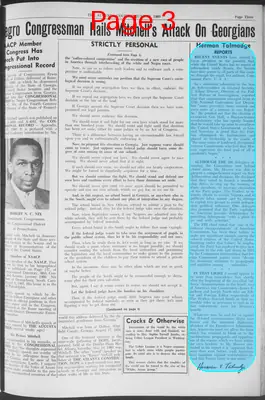
The Augusta Courier
Augusta, Richmond County, Georgia
What is this article about?
Herman Talmadge reports on J. Edgar Hoover's testimony to the Senate Subcommittee on Internal Security about the U.S. Communist Party's 17th National Convention in December, highlighting its strengthened leadership under Gus Hall, plans for membership drives, recruitment of minorities and youth, infiltration of unions, and exploitation of Southern sit-down demonstrations.
Clipping
OCR Quality
Full Text
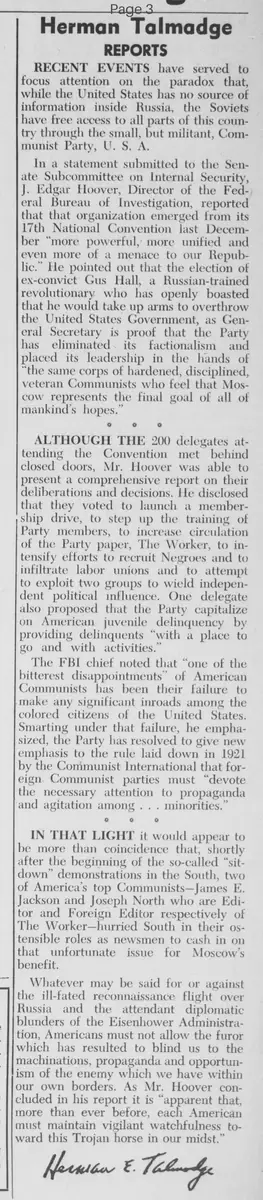
RECENT EVENTS have served to focus attention on the paradox that, while the United States has no source of information inside Russia, the Soviets have free access to all parts of this country through the small, but militant, Communist Party, U. S. A.
In a statement submitted to the Senate Subcommittee on Internal Security, J. Edgar Hoover, Director of the Federal Bureau of Investigation, reported that that organization emerged from its 17th National Convention last December "more powerful,' more unified and even more of a menace to our Republic." He pointed out that the election of ex-convict Gus Hall, a Russian-trained revolutionary who has openly boasted that he would take up arms to overthrow the United States Government, as General Secretary is proof that the Party has eliminated its factionalism and placed its leadership in the hands of "the same corps of hardened, disciplined, veteran Communists who feel that Moscow represents the final goal of all of mankind's hopes.'
ALTHOUGH THE 200 delegates attending the Convention met behind closed doors, Mr. Hoover was able to present a comprehensive report on their deliberations and decisions. He disclosed that they voted to launch a membership drive, to step up the training of Party members, to increase circulation of the Party paper, The Worker, to intensify efforts to recruit Negroes and to infiltrate labor unions and to attempt to exploit two groups to wield independent political influence. One delegate also proposed that the Party capitalize on American juvenile delinquency by providing delinquents "with a place to go and with activities.'
The FBI chief noted that "one of the bitterest disappointments" of American Communists has been their failure to make any significant inroads among the colored citizens of the United States.
Smarting under that failure, he emphasized, the Party has resolved to give new emphasis to the rule laid down in 1921 by the Communist International that foreign Communist parties must "devote the necessary attention to propaganda and agitation among . . . minorities.'
IN THAT LIGHT it would appear to be more than coincidence that, shortly after the beginning of the so-called "sit-down" demonstrations in the South, two of America's top Communists—James E. Jackson and Joseph North who are Editor and Foreign Editor respectively of The Worker—hurried South in their ostensible roles as newsmen to cash in on that unfortunate issue for Moscow's benefit.
Whatever may be said for or against the ill-fated reconnaissance flight over Russia and the attendant diplomatic blunders of the Eisenhower Administration, Americans must not allow the furor which has resulted to blind us to the machinations, propaganda and opportunism of the enemy which we have within our own borders. As Mr. Hoover concluded in his report it is "apparent that, more than ever before, each American must maintain vigilant watchfulness toward this Trojan horse in our midst."
Herman E. Talmadge
What sub-type of article is it?
What keywords are associated?
What entities or persons were involved?
Where did it happen?
Domestic News Details
Primary Location
United States
Event Date
Last December
Key Persons
Outcome
the communist party emerged more powerful and unified, with plans to expand influence through recruitment, infiltration, and exploitation of social issues.
Event Details
J. Edgar Hoover reported to the Senate Subcommittee on Internal Security that the U.S. Communist Party's 17th National Convention resulted in stronger leadership under Gus Hall, elimination of factionalism, and decisions to launch membership drives, train members, increase The Worker circulation, recruit Negroes, infiltrate labor unions, exploit independent political groups, and capitalize on juvenile delinquency. Emphasis on minority propaganda following recruitment failures, with Jackson and North exploiting Southern sit-down demonstrations.