Thank you for visiting SNEWPapers!
Sign up free
Helena Weekly Herald
Helena, Lewis And Clark County, Montana
What is this article about?
A letter from Virginia City, Montana, dated January 6, 1872, defends Judge John L. Murphy against a conspiracy to remove him, arguing that the President lacks power to remove territorial judges except by impeachment, citing the Organic Act sections 2, 3, and 9, and a 1854 Supreme Court opinion by Judge McLean. It highlights support from the legal community and contrasts with removable political officials.
Clipping
OCR Quality
Full Text
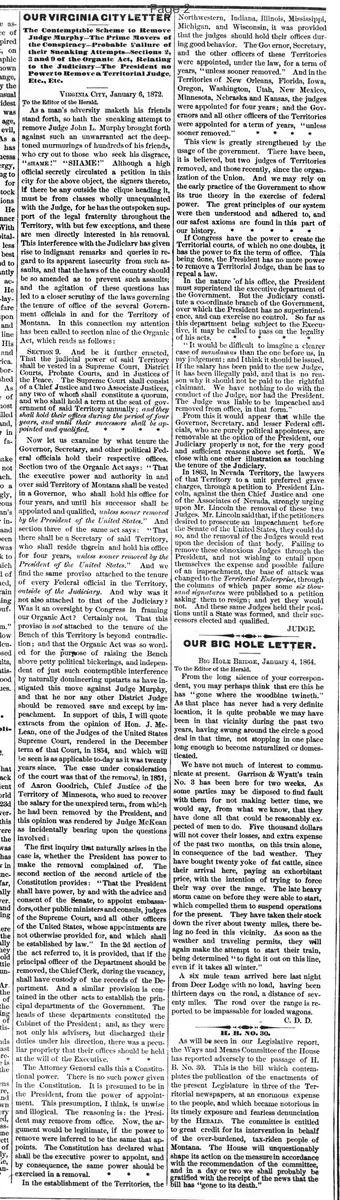
The Contemptible Scheme to Remove Judge Murphy—The Prime Movers of the Conspiracy—Probable Failure of their Sneaking Attempts—Sections 2, 3 and 9 of the Organic Act, Relating to the Judiciary—The President no Power to Remove a Territorial Judge, Etc., Etc.
VIRGINIA CITY, January 6, 1872.
To the Editor of the Herald.
As a man's adversity maketh his friends stand forth, so hath the sneaking attempt to remove Judge John L. Murphy brought forth against such an unwarranted act the deep-toned murmurings of hundreds of his friends, who cry out to those who seek his disgrace, "SHAME!" "SHAME!" Although a high official secretly circulated a petition in this city for the above object, the signers thereto, if there be any outside the clique heading it, must be from classes wholly unacquainted with the Judge, for he has the outspoken support of the legal fraternity throughout the Territory, with but few exceptions, and these are men directly interested in his removal. This interference with the Judiciary has given rise to indignant remarks and queries in regard to its apparent insecurity from such assaults, and that the laws of the country should be so amended as to prevent such assaults; and the agitation of these questions has led to a closer scrutiny of the laws governing the tenure of office of the several Government officials in and for the Territory of Montana. In this connection my attention has been called to section nine of the Organic Act, which reads as follows:
Section 9. And be it further enacted, That the judicial power of said Territory shall be vested in a Supreme Court, District Courts, Probate Courts, and in Justices of the Peace. The Supreme Court shall consist of a Chief Justice and two Associate Justices, any two of whom shall constitute a quorum, and who shall hold a term at the seat of government of said Territory annually; and they shall hold their offices during the period of four years, and until their successors shall be appointed and qualified.
Now let us examine by what tenure the Governor, Secretary, and other political Federal officials hold their respective offices.
Section two of the Organic Act says: "That the executive power and authority in and over said Territory of Montana shall be vested in a Governor, who shall hold his office for four years, and until his successor shall be appointed and qualified, unless sooner removed by the President of the United States." And section three of the same act says: "That there shall be a Secretary of said Territory, who shall reside therein and hold his office for four years, unless sooner removed by the President of the United States." And we find the same proviso attached to the tenure of every Federal official in the Territory, outside of the Judiciary. And why was it not also attached to that of the Judiciary? Was it an oversight by Congress in framing our Organic Act? Certainly not. That this proviso is not attached to the tenure of the Bench of this Territory is beyond contradiction: and that the Organic Act was so worded for the purpose of raising the Bench above petty political bickerings, and independent of just such contemptible interference by naturally domineering upstarts as have instigated this move against Judge Murphy, and that he nor any other District Judge should be removed save and except by impeachment. In support of this, I will quote extracts from the opinion of Hon. J. McLean, one of the Judges of the United States Supreme Court, rendered in the December term of that Court, in 1854, and which will be seen is as applicable to-day as it was twenty years since. The case under consideration of the court was that of the removal, in 1851, of Aaron Goodrich, Chief Justice of the Territory of Minnesota, who sued to recover the salary for the unexpired term, from which he had been removed by the President, and this opinion was rendered by Judge McLean as incidentally bearing upon the questions involved:
The first inquiry that naturally arises in the case is, whether the President has power to make the removal complained of. The second section of the second article of the Constitution provides: "That the President shall have power, by and with the advice and consent of the Senate, to appoint ambassadors, other public ministers and consuls, judges of the Supreme Court, and all other officers of the United States, whose appointments are not otherwise provided for, and which shall be established by law." In the 2d section of the act referred to, it is provided, that if the principal officer of the Department should be removed, the Chief Clerk, during the vacancy, shall have custody of the records of the Department. And a similar provision is contained in the other acts to establish the principal departments of the Government. The heads of these departments constituted the Cabinet of the President; and, as they were not only his advisers, but discharged their duties under his direction, there was a peculiar propriety that their offices should be held at the will of the Executive.
The Attorney General calls this a Constitutional power. There is no such power given in the Constitution. It is presumed to be in the President, from the power of appointment. This presumption, I think, is unwise and illogical. The reasoning is: the President may remove from office. Now, the argument would be legitimate, if the power to remove were inferred to be the same that appoints. The Constitution has declared what shall be the executive power to appoint, and by consequence, the same power should be exercised in a removal.
In the establishment of the Territories, the Northwestern, Indiana, Illinois, Mississippi, Michigan, and Wisconsin, it was provided that the judges should hold their offices during good behavior. The Governor, Secretary, and the other officers of these Territories were appointed, under the law, for a term of years, "unless sooner removed." And in the Territories of New Orleans, Florida, Iowa, Oregon, Washington, Utah, New Mexico, Minnesota, Nebraska and Kansas, the judges were appointed for four years; and the Governors and all other officers of the Territories were appointed for a term of years, "unless sooner removed."
This view is greatly strengthened by the usage of the government. There have been, it is believed, but two judges of Territories removed, and those recently, since the organization of the Union. And we may rely on the early practice of the Government to show its true theory in the exercise of federal power. The great principles of our system were then understood and adhered to, and our safest axioms are found in this part of our history.
If Congress have the power to create the Territorial courts, of which no one doubts, it has the power to fix the term of office. This being done, the President has no more power to remove a Territorial Judge, than he has to repeal a law.
In the nature of his office, the President must superintend the executive department of the Government. But the Judiciary constitute a co-ordinate branch of the Government, over which the President has no superintendence, and can exercise no control. "So far as this department being subject to the Executive, it may be called to pass on the legality of his acts."
"It would be difficult to imagine a clearer case of mandamus than the one before us, in my judgement; and I think it should be issued. If the salary has been paid to the new Judge, it has been illegally paid, and that is no reason why it should not be paid to the rightful claimant. We have nothing to do with the conduct of the Judge, nor had the President. The Judge was liable to be impeached and removed from office, in that form."
From this it would appear that while the Governor, Secretary, and lesser Federal officials, who are purely political appointees, are removable at the option of the President, our Judiciary properly is not, for the very good and sufficient reasons above set forth. We close with one other illustration as touching the tenure of the Judiciary.
In 1863, in Nevada Territory, the lawyers of that Territory to a unit preferred grave charges, through a petition to President Lincoln, against the then Chief Justice and one of the Associates of Nevada, strongly urging upon Mr. Lincoln the removal of these two Judges. Mr. Lincoln said that, if the petitioners desired to prosecute an impeachment before the Senate of the United States, they could do so, and the removal of the Judges would rest upon the decision of that body. Failing to remove these obnoxious Judges through the President, and not wishing to entail upon themselves the expense and possible failure of an impeachment, the base of attack was changed to the Territorial Enterprise, through the columns of which paper some six thousand signatures were published to a petition asking them to resign; and yet they would not. And these same Judges held their positions until a State was formed, and their successors elected and qualified.
JUDGE.
What sub-type of article is it?
What themes does it cover?
What keywords are associated?
What entities or persons were involved?
Letter to Editor Details
Author
Judge.
Recipient
To The Editor Of The Herald.
Main Argument
the president has no constitutional power to remove a territorial judge like john l. murphy except through impeachment; the organic act intentionally omits removal provisions for judges to protect judicial independence from political interference.
Notable Details