Thank you for visiting SNEWPapers!
Sign up free
Literary
July 30, 1752
The Virginia Gazette
Richmond, Williamsburg, Richmond County, Virginia
What is this article about?
A satirical retelling from Ariosto's Orlando Furioso of King Astolpho summoning the beautiful Giocondo from his idyllic rural marriage to his devoted wife, exploring themes of love, constancy, and courtly vanity. Introduced with quotes from Juvenal and Milton questioning what wins women's love.
Clipping
OCR Quality
98%
Excellent
Full Text
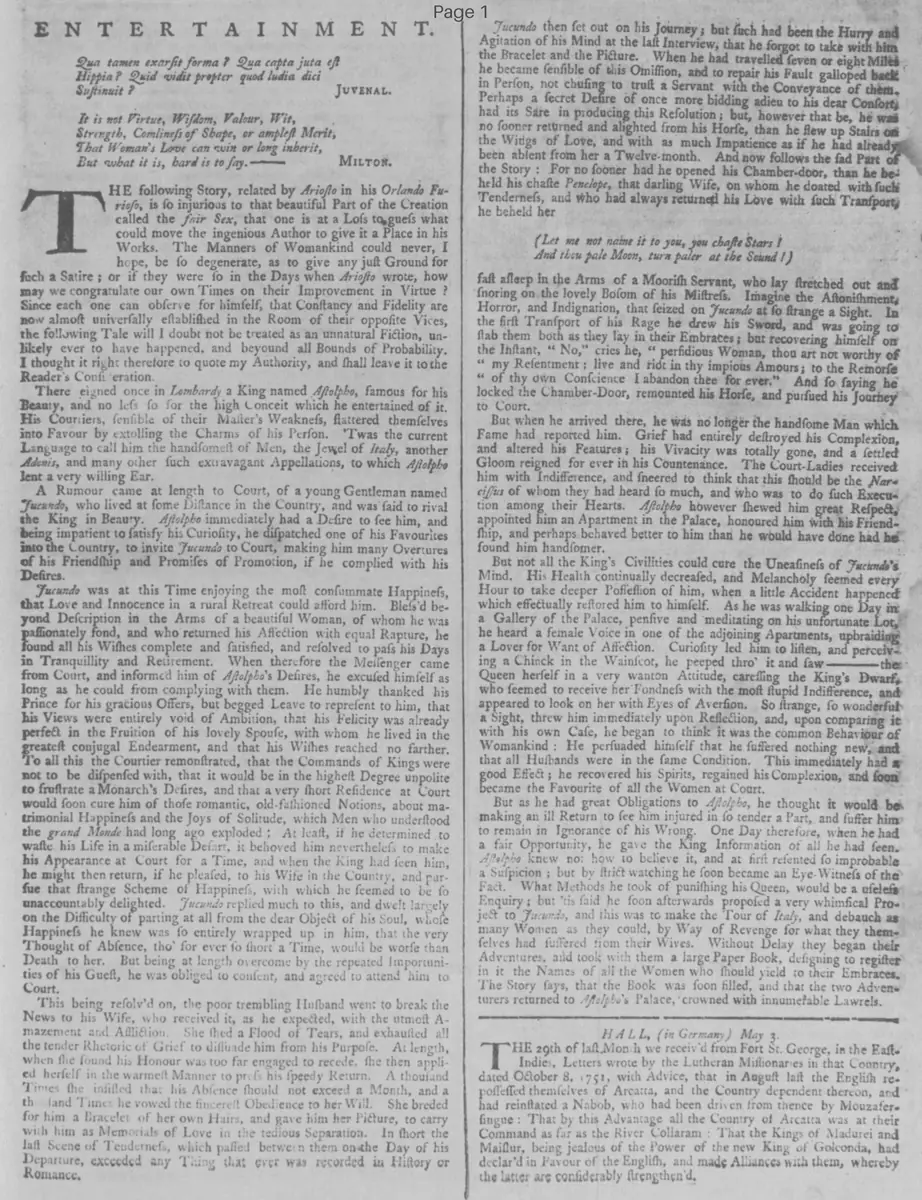
ENTERTAINMENT:
Qua tamen exarsit forma? Qua capta juvat est
Hippia? Quid vidit propter quod lydia dixi
Sustinuit?
JUVENAL.
It is not Virtue, Wisdom, Valour, Wit,
Strength, Comeliness of Shape, or amplest Merit,
That Woman's Love can win or long inherit,
But what it is, hard is to say.—
MILTON.
The following Story, related by Ariosto in his Orlando Furioso, is so injurious to that beautiful Part of the Creation called the fair Sex, that one is at a Loss to guess what could move the ingenious Author to give it a Place in his Works. The Manners of Womankind could never, I hope, be so degenerate, as to give any just Ground for such a Satire; or if they were so in the Days when Ariosto wrote, how may we congratulate our own Times on their Improvement in Virtue? Since each one can observe for himself, that Constancy and Fidelity are now almost universally established in the Room of their opposite Vices, the following Tale will I doubt not be treated as an unnatural Fiction, unlikely ever to have happened, and beyond all Bounds of Probability. I thought it right therefore to quote my Authority, and shall leave it to the Reader's Consideration.
There reigned once in Lombardy a King named Astolpho, famous for his Beauty, and no less so for the high Conceit which he entertained of it. His Courtiers, Sensible of their Master's Weakness, flattered themselves into Favour by extolling the Charms of his Person. Twas the current Language to call him the handsomest of Men, the Jewel of Italy, another Adonis, and many other such extravagant Appellations, to which Astolpho lent a very willing Ear.
A Rumour came at length to Court, of a young Gentleman named Giocondo, who lived at some Distance in the Country, and was said to rival the King in Beauty. Astolpho immediately had a Desire to see him, and being impatient to satisfy his Curiosity, he dispatched one of his Favourites into the Country, to invite Giocondo to Court, making him many Overtures of his Friendship and Promises of Promotion, if he complied with his Desires.
Giocondo was at this Time enjoying the most consummate Happiness, that Love and Innocence in a rural Retreat could afford him. Blessed beyond Description in the Arms of a beautiful Woman, of whom he was passionately fond, and who returned his Affection with equal Rapture, he found all his Wishes complete and satisfied, and resolved to pass his Days in Tranquillity and Retirement. When therefore the Messenger came from Court, and informed him of Astolpho's Desires, he excused himself as long as he could from complying with them. He humbly thanked his Prince for his gracious Offers, but begged Leave to represent to him, that his Views were entirely void of Ambition, that his Felicity was already perfect in the Fruition of his lovely Spouse, with whom he lived in the greatest conjugal Endearment, and that his Wishes reached no farther.
To all this the Courtier remonstrated, that the Commands of Kings were not to be dispensed with, that it would be in the highest Degree unpolite to frustrate a Monarch's Desires, and that a very short Residence at Court would soon cure him of those romantic, old-fashioned Notions, about matrimonial Happiness and the Joys of Solitude, which Men who understood the grand Monde had long ago exploded: At least, if he determined to waste his Life in a miserable Desert, it behoved him nevertheless to make his Appearance at Court for a Time, and when the King had seen him, he might then return, if he pleased, to his Wife in the Country, and pursue that strange Scheme of Happiness, with which he seemed to be so unaccountably delighted. Giocondo replied much to this, and dwelt largely on the Difficulty of parting at all from the dear Object of his Soul, whose Happiness he knew was so entirely wrapped up in him, that the very Thought of Absence, tho' for ever so short a Time, would be worse than Death to her. But being at length overcome by the repeated Importunities of his Guest, he was obliged to consent, and agreed to attend him to Court.
This being resolved on, the poor trembling Husband went to break the News to his Wife, who received it, as he expected, with the utmost Amazement and Affliction. She shed a Flood of Tears, and exhausted all the tender Rhetoric of Grief to dissuade him from his Purpose. At length, when she found his Honour was too far engaged to recede, she then applied herself in the warmest Manner to prevail on his speedy Return. A thousand Times she insisted that his Absence should not exceed a Month, and a thousand Times he vowed the sincerest Obedience to her Will. She braided for him a Bracelet of her own Hairs, and gave him her Picture, to carry with him as Memorials of Love in the tedious Separation. In short the last Scene of Tenderness, which passed between them on the Day of his Departure, exceeded any Thing that ever was recorded in History or Romance.
Qua tamen exarsit forma? Qua capta juvat est
Hippia? Quid vidit propter quod lydia dixi
Sustinuit?
JUVENAL.
It is not Virtue, Wisdom, Valour, Wit,
Strength, Comeliness of Shape, or amplest Merit,
That Woman's Love can win or long inherit,
But what it is, hard is to say.—
MILTON.
The following Story, related by Ariosto in his Orlando Furioso, is so injurious to that beautiful Part of the Creation called the fair Sex, that one is at a Loss to guess what could move the ingenious Author to give it a Place in his Works. The Manners of Womankind could never, I hope, be so degenerate, as to give any just Ground for such a Satire; or if they were so in the Days when Ariosto wrote, how may we congratulate our own Times on their Improvement in Virtue? Since each one can observe for himself, that Constancy and Fidelity are now almost universally established in the Room of their opposite Vices, the following Tale will I doubt not be treated as an unnatural Fiction, unlikely ever to have happened, and beyond all Bounds of Probability. I thought it right therefore to quote my Authority, and shall leave it to the Reader's Consideration.
There reigned once in Lombardy a King named Astolpho, famous for his Beauty, and no less so for the high Conceit which he entertained of it. His Courtiers, Sensible of their Master's Weakness, flattered themselves into Favour by extolling the Charms of his Person. Twas the current Language to call him the handsomest of Men, the Jewel of Italy, another Adonis, and many other such extravagant Appellations, to which Astolpho lent a very willing Ear.
A Rumour came at length to Court, of a young Gentleman named Giocondo, who lived at some Distance in the Country, and was said to rival the King in Beauty. Astolpho immediately had a Desire to see him, and being impatient to satisfy his Curiosity, he dispatched one of his Favourites into the Country, to invite Giocondo to Court, making him many Overtures of his Friendship and Promises of Promotion, if he complied with his Desires.
Giocondo was at this Time enjoying the most consummate Happiness, that Love and Innocence in a rural Retreat could afford him. Blessed beyond Description in the Arms of a beautiful Woman, of whom he was passionately fond, and who returned his Affection with equal Rapture, he found all his Wishes complete and satisfied, and resolved to pass his Days in Tranquillity and Retirement. When therefore the Messenger came from Court, and informed him of Astolpho's Desires, he excused himself as long as he could from complying with them. He humbly thanked his Prince for his gracious Offers, but begged Leave to represent to him, that his Views were entirely void of Ambition, that his Felicity was already perfect in the Fruition of his lovely Spouse, with whom he lived in the greatest conjugal Endearment, and that his Wishes reached no farther.
To all this the Courtier remonstrated, that the Commands of Kings were not to be dispensed with, that it would be in the highest Degree unpolite to frustrate a Monarch's Desires, and that a very short Residence at Court would soon cure him of those romantic, old-fashioned Notions, about matrimonial Happiness and the Joys of Solitude, which Men who understood the grand Monde had long ago exploded: At least, if he determined to waste his Life in a miserable Desert, it behoved him nevertheless to make his Appearance at Court for a Time, and when the King had seen him, he might then return, if he pleased, to his Wife in the Country, and pursue that strange Scheme of Happiness, with which he seemed to be so unaccountably delighted. Giocondo replied much to this, and dwelt largely on the Difficulty of parting at all from the dear Object of his Soul, whose Happiness he knew was so entirely wrapped up in him, that the very Thought of Absence, tho' for ever so short a Time, would be worse than Death to her. But being at length overcome by the repeated Importunities of his Guest, he was obliged to consent, and agreed to attend him to Court.
This being resolved on, the poor trembling Husband went to break the News to his Wife, who received it, as he expected, with the utmost Amazement and Affliction. She shed a Flood of Tears, and exhausted all the tender Rhetoric of Grief to dissuade him from his Purpose. At length, when she found his Honour was too far engaged to recede, she then applied herself in the warmest Manner to prevail on his speedy Return. A thousand Times she insisted that his Absence should not exceed a Month, and a thousand Times he vowed the sincerest Obedience to her Will. She braided for him a Bracelet of her own Hairs, and gave him her Picture, to carry with him as Memorials of Love in the tedious Separation. In short the last Scene of Tenderness, which passed between them on the Day of his Departure, exceeded any Thing that ever was recorded in History or Romance.
What sub-type of article is it?
Prose Fiction
Satire
Essay
What themes does it cover?
Love Romance
Moral Virtue
Social Manners
What keywords are associated?
Orlando Furioso
Astolpho
Giocondo
Constancy
Love
Satire
Rural Happiness
Courtly Vanity
What entities or persons were involved?
Related By Ariosto In His Orlando Furioso
Literary Details
Author
Related By Ariosto In His Orlando Furioso
Subject
Satire On The Constancy Of Women
Form / Style
Prose Retelling Of A Romantic Tale With Introductory Commentary
Key Lines
It Is Not Virtue, Wisdom, Valour, Wit,
Strength, Comeliness Of Shape, Or Amplest Merit,
That Woman's Love Can Win Or Long Inherit,
But What It Is, Hard Is To Say.—
Milton.
The Following Story, Related By Ariosto In His Orlando Furioso, Is So Injurious To That Beautiful Part Of The Creation Called The Fair Sex...
In Short The Last Scene Of Tenderness, Which Passed Between Them On The Day Of His Departure, Exceeded Any Thing That Ever Was Recorded In History Or Romance.