Thank you for visiting SNEWPapers!
Sign up free
Letter to Editor
April 28, 1826
Phenix Gazette
Alexandria, Virginia
What is this article about?
Senator M. Dickerson writes to clarify a Senate debate on a constitutional amendment limiting presidential terms, correcting newspaper reports that he was unfairly prevented from speaking by the Vice President while Mr. Randolph spoke freely. He explains the events, affirms no disrespect occurred, and defends his conduct.
Clipping
OCR Quality
98%
Excellent
Full Text
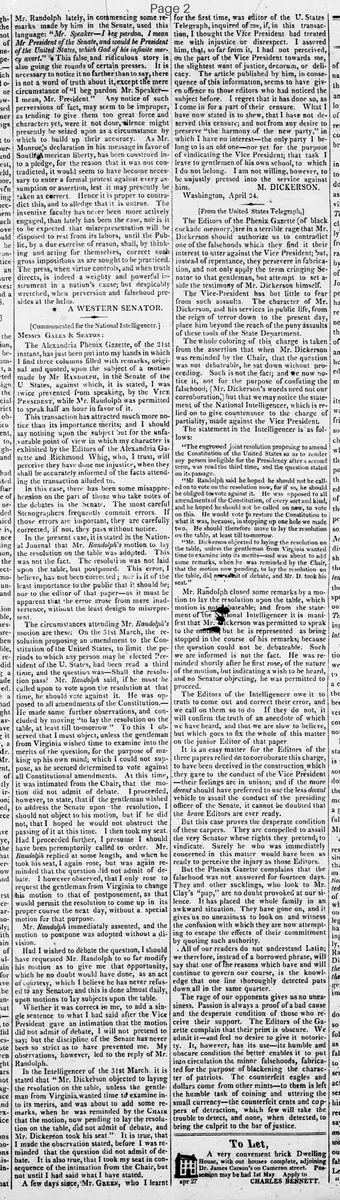
A WESTERN SENATOR.
[Communicated for the National Intelligencer.]
Messrs Gales & Seaton :
The Alexandria Phenix Gazette, of the 21st instant, has just been put into my hands in which I find three columns filled with remarks, original and quoted, upon the subject of a motion made by Mr Randolph, in the Senate of the U States, against which, it is stated, I was twice prevented from speaking, by the Vice President, while Mr. Randolph was permitted to speak half an hour in favor of it.
This transaction has attracted much more notice than its importance merits; and I should say nothing upon the subject but for the unfavorable point of view in which my character is exhibited by the Editors of the Alexandria Gazette and Richmond Whig, who, I trust, will perceive they have done me injustice, when they shall be accurately informed of the facts attending the transaction alluded to.
In this case, there has been some misapprehension on the part of those who take notes of the debates in the Senate. The most careful Stenographers frequently commit errors. If those errors are important, they are carefully corrected, if not, they pass without notice.
In the present case, it is stated in the National Journal that Mr. Randolph's motion to lay the resolution on the table was adopted. This was not the fact. The resolution was not laid upon the table, but postponed. This error, I believe, has not been corrected; nor is it of the least importance to the public that it should be: nor to the editor of that paper-as it must be apparent that the error arose from mere inadvertence, without the least design to misrepresent.
The circumstances attending Mr. Randolph's motion are these: On the 31st March, the resolution proposing an amendment to the Constitution of the United States, to limit the periods to which any person may be elected President of the U. States, had been read a third time, and the question was-Shall the resolution pass? Mr. Randolph said, if he must be called upon to vote upon the resolution at that time, he should vote against it. He was opposed to all amendments of the Constitution.- He made some further observations, and concluded by moving "to lay the resolution on the table, at least till to-morrow" To this I observed that I must object, unless the gentleman from Virginia wished time to examine into the merits of the question, for the purpose of making up his own mind; which I could not suppose, as he seemed determined to vote against all Constitutional amendments. At this time, it was intimated from the Chair, that the motion did not admit of debate. I proceeded, however, to state, that if the gentleman wished to address the Senate upon the resolution, I should not object to his motion, but if he did not, that I hoped he would not obstruct the passing of it at this time. I then took my seat. Had I proceeded further, I presume I should have been peremptorily called to order. Mr. Randolph replied at some length, and when he took his seat, I again rose, but was again reminded that the question did not admit of debate. I however observed, that I only rose to request the gentleman from Virginia to change his motion to that of postponement, as that would permit the resolution to come up in its proper course the next day, without a special motion for that purpose.
Mr. Randolph immediately assented, and the motion to postpone was adopted without a division.
Had I wished to debate the question, I should have requested Mr. Randolph to so far modify his motion as to give me that opportunity, which he no doubt would have done, as an act of courtesy, which I believe he has never refused to any Senator; and this is done almost daily, upon motions to lay subjects upon the table.
Whether it was correct in me, to add a single sentence to what I had said after the Vice President gave an intimation that the motion did not admit of debate, I will not pretend to say; but the discipline of the Senate has never been so strict as to have prevented me. My observations, however, led to the reply of Mr. Randolph.
In the Intelligencer of the 31st March. it is stated that " Mr. Dickerson objected to laying the resolution on the table, unless the gentleman from Virginia wanted time to examine into its merits, and was about to add some remarks, when he was reminded by the CHAIR that the motion, now pending to lay the resolution on the table, did not admit of debate, and Mr. Dickerson took his seat." It is true, that I made the observation stated, before I was reminded that the question did not admit of debate. It is also true, that I took my seat in consequence of the intimation from the Chair, but not until I had said what I have stated.
A few days since, Mr. Green, who I learnt for the first time, was editor of the U. States Telegraph, inquired of me, if, in this transaction, I thought the Vice President had treated me with injustice or disrespect. I assured him, that, so far from it, I had not perceived, on the part of the Vice President towards me, the slightest want of justice, decorum, or delicacy. The article published by him, in consequence of this information, seems to have given offence to those editors who had noticed the subject before. I regret that it has done so, as I come in for a part of their censure. What I have now stated is to shew, that I have not deserved this censure; and not from any desire to preserve "the harmony of the new party," in which I have no interest-the only party I belong to is an old one--nor yet for the purpose of vindicating the Vice President; that task I leave to gentlemen of his own school, to which I do not belong. I am not willing, however, to be unjustly pressed into the service against him.
M. DICKERSON.
Washington, April 24.
[Communicated for the National Intelligencer.]
Messrs Gales & Seaton :
The Alexandria Phenix Gazette, of the 21st instant, has just been put into my hands in which I find three columns filled with remarks, original and quoted, upon the subject of a motion made by Mr Randolph, in the Senate of the U States, against which, it is stated, I was twice prevented from speaking, by the Vice President, while Mr. Randolph was permitted to speak half an hour in favor of it.
This transaction has attracted much more notice than its importance merits; and I should say nothing upon the subject but for the unfavorable point of view in which my character is exhibited by the Editors of the Alexandria Gazette and Richmond Whig, who, I trust, will perceive they have done me injustice, when they shall be accurately informed of the facts attending the transaction alluded to.
In this case, there has been some misapprehension on the part of those who take notes of the debates in the Senate. The most careful Stenographers frequently commit errors. If those errors are important, they are carefully corrected, if not, they pass without notice.
In the present case, it is stated in the National Journal that Mr. Randolph's motion to lay the resolution on the table was adopted. This was not the fact. The resolution was not laid upon the table, but postponed. This error, I believe, has not been corrected; nor is it of the least importance to the public that it should be: nor to the editor of that paper-as it must be apparent that the error arose from mere inadvertence, without the least design to misrepresent.
The circumstances attending Mr. Randolph's motion are these: On the 31st March, the resolution proposing an amendment to the Constitution of the United States, to limit the periods to which any person may be elected President of the U. States, had been read a third time, and the question was-Shall the resolution pass? Mr. Randolph said, if he must be called upon to vote upon the resolution at that time, he should vote against it. He was opposed to all amendments of the Constitution.- He made some further observations, and concluded by moving "to lay the resolution on the table, at least till to-morrow" To this I observed that I must object, unless the gentleman from Virginia wished time to examine into the merits of the question, for the purpose of making up his own mind; which I could not suppose, as he seemed determined to vote against all Constitutional amendments. At this time, it was intimated from the Chair, that the motion did not admit of debate. I proceeded, however, to state, that if the gentleman wished to address the Senate upon the resolution, I should not object to his motion, but if he did not, that I hoped he would not obstruct the passing of it at this time. I then took my seat. Had I proceeded further, I presume I should have been peremptorily called to order. Mr. Randolph replied at some length, and when he took his seat, I again rose, but was again reminded that the question did not admit of debate. I however observed, that I only rose to request the gentleman from Virginia to change his motion to that of postponement, as that would permit the resolution to come up in its proper course the next day, without a special motion for that purpose.
Mr. Randolph immediately assented, and the motion to postpone was adopted without a division.
Had I wished to debate the question, I should have requested Mr. Randolph to so far modify his motion as to give me that opportunity, which he no doubt would have done, as an act of courtesy, which I believe he has never refused to any Senator; and this is done almost daily, upon motions to lay subjects upon the table.
Whether it was correct in me, to add a single sentence to what I had said after the Vice President gave an intimation that the motion did not admit of debate, I will not pretend to say; but the discipline of the Senate has never been so strict as to have prevented me. My observations, however, led to the reply of Mr. Randolph.
In the Intelligencer of the 31st March. it is stated that " Mr. Dickerson objected to laying the resolution on the table, unless the gentleman from Virginia wanted time to examine into its merits, and was about to add some remarks, when he was reminded by the CHAIR that the motion, now pending to lay the resolution on the table, did not admit of debate, and Mr. Dickerson took his seat." It is true, that I made the observation stated, before I was reminded that the question did not admit of debate. It is also true, that I took my seat in consequence of the intimation from the Chair, but not until I had said what I have stated.
A few days since, Mr. Green, who I learnt for the first time, was editor of the U. States Telegraph, inquired of me, if, in this transaction, I thought the Vice President had treated me with injustice or disrespect. I assured him, that, so far from it, I had not perceived, on the part of the Vice President towards me, the slightest want of justice, decorum, or delicacy. The article published by him, in consequence of this information, seems to have given offence to those editors who had noticed the subject before. I regret that it has done so, as I come in for a part of their censure. What I have now stated is to shew, that I have not deserved this censure; and not from any desire to preserve "the harmony of the new party," in which I have no interest-the only party I belong to is an old one--nor yet for the purpose of vindicating the Vice President; that task I leave to gentlemen of his own school, to which I do not belong. I am not willing, however, to be unjustly pressed into the service against him.
M. DICKERSON.
Washington, April 24.
What sub-type of article is it?
Political
Persuasive
Informative
What themes does it cover?
Constitutional Rights
Politics
What keywords are associated?
Senate Debate
Constitutional Amendment
Presidential Terms
Vice President
Randolph Motion
Newspaper Correction
Senate Procedure
What entities or persons were involved?
M. Dickerson
Messrs Gales & Seaton
Letter to Editor Details
Author
M. Dickerson
Recipient
Messrs Gales & Seaton
Main Argument
senator dickerson clarifies the facts of a senate debate on a constitutional amendment, refuting newspaper claims that he was unfairly silenced by the vice president, and asserts that no injustice or disrespect occurred.
Notable Details
Motion By Mr. Randolph To Lay Resolution On Table Changed To Postponement
Intimation From Chair That Motion Did Not Admit Of Debate
Reference To National Intelligencer Report Of March 31
Inquiry By Mr. Green Of U. States Telegraph