Thank you for visiting SNEWPapers!
Sign up free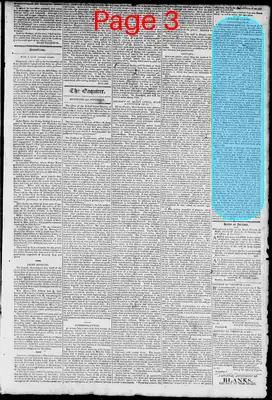
Editorial
November 8, 1805
The Enquirer
Richmond, Henrico County, Virginia
What is this article about?
Editorial opposes U.S. commissioners' recommendation for compromise on Yazoo land claims, arguing it stems from fears of claim revival and legislative corruption. Proposes amending the federal constitution to permanently reject such compromises, mirroring Georgia's approach.
Clipping
OCR Quality
95%
Excellent
Full Text
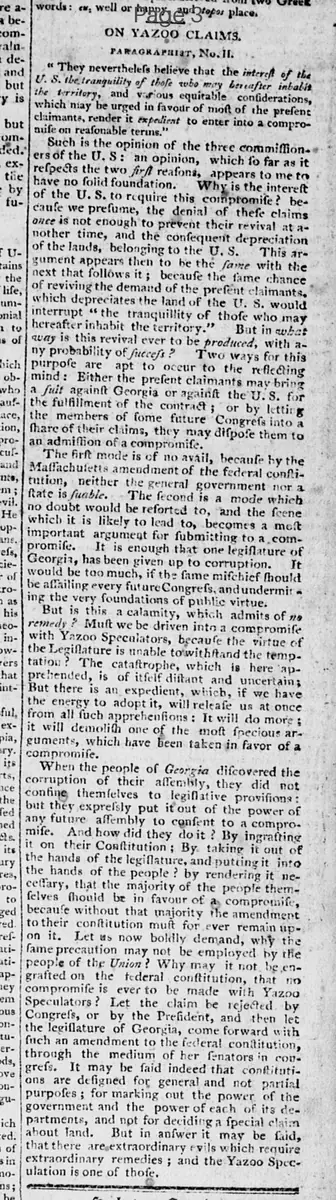
ON YAZOO CLAIMS.
PARAGRAPHIST, No. II.
"They nevertheless believe that the interest of the U. S. the tranquility of those who may hereafter inhabit the territory, and various equitable considerations, which may be urged in favour of most of the present claimants, render it expedient to enter into a compromise on reasonable terms."
Such is the opinion of the three commissioners of the U. S: an opinion, which so far as it respects the two first reasons, appears to me to have no solid foundation. Why is the interest of the U. S. to require this compromise? because we presume, the denial of these claims once is not enough to prevent their revival at another time, and the consequent depreciation of the lands, belonging to the U. S. This argument appears then to be the same with the next that follows it; because the same chance of reviving the demand of the present claimants, which depreciates the land of the U. S. would interrupt "the tranquillity of those who may hereafter inhabit the territory." But in what way is this revival ever to be produced, with any probability of success? Two ways for this purpose are apt to occur to the reflecting mind: Either the present claimants may bring a Suit against Georgia or against the U.S. for the fulfillment of the contract; or by letting the members of some future Congress into a share of their claims, they may dispose them to an admission of a compromise.
The first mode is of no avail, because by the Massachusetts amendment of the federal constitution, neither the general government nor a state is suable. The second is a mode which no doubt would be resorted to, and the scene which it is likely to lead to, becomes a most important argument for submitting to a compromise. It is enough that one legislature of Georgia, has been given up to corruption. It would be too much, if the same mischief should be assailing every future Congress., and undermining the very foundations of public virtue.
But is this a calamity, which admits of no remedy? Must we be driven into a compromise with Yazoo Speculators, because the virtue of the Legislature is unable to withstand the temptation? The catastrophe, which is here apprehended, is of itself distant and uncertain; But there is an expedient, which, if we have the energy to adopt it, will release us at once from all such apprehensions: It will do more; it will demolish one of the most specious arguments, which have been taken in favor of a compromise.
When the people of Georgia discovered the corruption of their assembly, they did not confine themselves to legislative provisions: but they expressly put it out of the power of any future assembly to consent to a compromise. And how did they do it? By ingrafting it on their Constitution; By taking it out of the hands of the legislature, and putting it into the hands of the people? by rendering it necessary, that the majority of the people themselves should be in favour of a compromise, because without that majority the amendment to their constitution must for ever remain upon it. Let us now boldly demand, why the same precaution may not be employed by the people of the Union? Why may it not be engrafted on the federal constitution, that no compromise is ever to be made with Yazoo Speculators? Let the claim be rejected by Congress, or by the President, and then let the legislature of Georgia, come forward with such an amendment to the federal constitution, through the medium of her senators in congress. It may be said indeed that constitutions are designed for general and not partial purposes; for marking out the power of the government and the power of each of its departments, and not for deciding a special claim about land. But in answer it may be said, that there are extraordinary evils which require extraordinary remedies; and the Yazoo Speculation is one of those.
PARAGRAPHIST, No. II.
"They nevertheless believe that the interest of the U. S. the tranquility of those who may hereafter inhabit the territory, and various equitable considerations, which may be urged in favour of most of the present claimants, render it expedient to enter into a compromise on reasonable terms."
Such is the opinion of the three commissioners of the U. S: an opinion, which so far as it respects the two first reasons, appears to me to have no solid foundation. Why is the interest of the U. S. to require this compromise? because we presume, the denial of these claims once is not enough to prevent their revival at another time, and the consequent depreciation of the lands, belonging to the U. S. This argument appears then to be the same with the next that follows it; because the same chance of reviving the demand of the present claimants, which depreciates the land of the U. S. would interrupt "the tranquillity of those who may hereafter inhabit the territory." But in what way is this revival ever to be produced, with any probability of success? Two ways for this purpose are apt to occur to the reflecting mind: Either the present claimants may bring a Suit against Georgia or against the U.S. for the fulfillment of the contract; or by letting the members of some future Congress into a share of their claims, they may dispose them to an admission of a compromise.
The first mode is of no avail, because by the Massachusetts amendment of the federal constitution, neither the general government nor a state is suable. The second is a mode which no doubt would be resorted to, and the scene which it is likely to lead to, becomes a most important argument for submitting to a compromise. It is enough that one legislature of Georgia, has been given up to corruption. It would be too much, if the same mischief should be assailing every future Congress., and undermining the very foundations of public virtue.
But is this a calamity, which admits of no remedy? Must we be driven into a compromise with Yazoo Speculators, because the virtue of the Legislature is unable to withstand the temptation? The catastrophe, which is here apprehended, is of itself distant and uncertain; But there is an expedient, which, if we have the energy to adopt it, will release us at once from all such apprehensions: It will do more; it will demolish one of the most specious arguments, which have been taken in favor of a compromise.
When the people of Georgia discovered the corruption of their assembly, they did not confine themselves to legislative provisions: but they expressly put it out of the power of any future assembly to consent to a compromise. And how did they do it? By ingrafting it on their Constitution; By taking it out of the hands of the legislature, and putting it into the hands of the people? by rendering it necessary, that the majority of the people themselves should be in favour of a compromise, because without that majority the amendment to their constitution must for ever remain upon it. Let us now boldly demand, why the same precaution may not be employed by the people of the Union? Why may it not be engrafted on the federal constitution, that no compromise is ever to be made with Yazoo Speculators? Let the claim be rejected by Congress, or by the President, and then let the legislature of Georgia, come forward with such an amendment to the federal constitution, through the medium of her senators in congress. It may be said indeed that constitutions are designed for general and not partial purposes; for marking out the power of the government and the power of each of its departments, and not for deciding a special claim about land. But in answer it may be said, that there are extraordinary evils which require extraordinary remedies; and the Yazoo Speculation is one of those.
What sub-type of article is it?
Constitutional
Economic Policy
Partisan Politics
What keywords are associated?
Yazoo Claims
Land Speculation
Constitutional Amendment
Political Corruption
Compromise Opposition
Georgia Legislature
What entities or persons were involved?
U.S. Commissioners
Yazoo Speculators
Georgia Legislature
Congress
President
Editorial Details
Primary Topic
Opposition To Compromise On Yazoo Land Claims
Stance / Tone
Strongly Against Compromise, Advocating Constitutional Amendment
Key Figures
U.S. Commissioners
Yazoo Speculators
Georgia Legislature
Congress
President
Key Arguments
Denial Of Claims Insufficient To Prevent Revival And Land Depreciation
Suits Against Government Or States Impossible Due To Constitutional Amendment
Future Congressional Corruption Via Claim Shares Threatens Public Virtue
Georgia's Constitutional Amendment Prevents Future Legislative Compromise
Propose Federal Constitutional Amendment To Permanently Reject Yazoo Claims
Extraordinary Evils Like Yazoo Speculation Require Extraordinary Remedies