Thank you for visiting SNEWPapers!
Sign up free
The National Intelligencer And Washington Advertiser
Washington, District Of Columbia
What is this article about?
The Tenth Report of the Commissioners of Naval Inquiry examines financial irregularities in Lord Viscount Melville's treasurership of the navy from 1785 to 1805, focusing on unauthorized withdrawals of public funds to private bankers by paymaster Alexander Trotter, potential personal gains, and violations of the 1785 act regulating navy finances.
Merged-components note: These components form a continuous article: the Tenth Report on the Commissioners of Naval Inquiry, spanning from page 1 to page 2 with sequential reading order and flowing text content.
Clippings
1 of 2
OCR Quality
Full Text
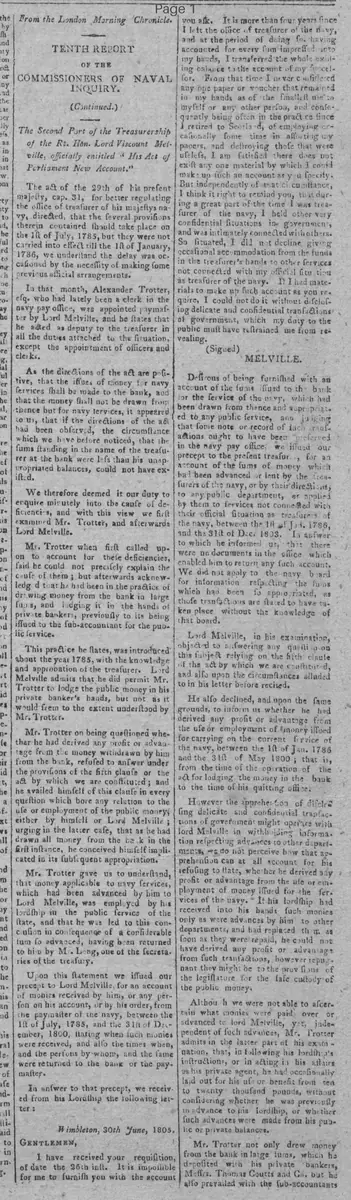
TENTH REPORT
ON THE
COMMISSIONERS OF NAVAL INQUIRY
(Continued.)
The Second Part of the Treasurership of the Rt. Hon. Lord Viscount Melville, officially entitled "His Act of Parliament New Account."
The act of the 29th of his present majesty, cap. 31, for better regulating the office of treasurer of his majesty's navy, directed, that the several provisions therein contained should take place on the 1st of July, 1785, but they were not carried into effect till the 1st of January, 1786, we understand the delay was occasioned by the necessity of making some previous official arrangements.
In that month, Alexander Trotter, esq. who had lately been a clerk in the navy pay office, was appointed paymaster by Lord Melville, and he states that he acted as deputy to the treasurer in all the duties attached to the situation, except the appointment of officers and clerks.
As the directions of the act are positive, that the issues of money for navy services shall be made to the bank, and that the money shall not be drawn from thence but for navy services, it appeared to us, that if the directions of the act had been observed, the circumstance which we have before noticed, that the sums standing in the name of the treasurer at the bank were less than his unappropriated balances, could not have existed.
We therefore deemed it our duty to enquire minutely into the cause of deficiencies, and with this view we first examined Mr. Trotter, and afterwards Lord Melville.
Mr. Trotter when first called upon to account for these deficiencies, said he could not precisely explain the cause of them; but afterwards acknowledged that he had been in the practice of drawing money from the bank in large sums, and lodging it in the hands of private bankers, previously to its being issued to the sub-accountant for the public service.
This practice he states, was introduced about the year 1785, with the knowledge and approbation of the treasurer. Lord Melville admits that he did permit Mr. Trotter to lodge the public money in his private banker's hands, but not as it would seem to the extent understood by Mr. Trotter.
Mr. Trotter on being questioned whether he had derived any profit or advantage from the money withdrawn by him from the bank, refused to answer under the provisions of the fifth clause of the act by which we are constituted; and he availed himself of this clause in every question which bore any relation to the use or employment of the public money either by himself or Lord Melville; urging in the latter case, that as he had drawn all money from the bank in the first instance, he conceived himself implicated in its subsequent appropriation.
Mr. Trotter gave us to understand, that money applicable to navy services, which had been advanced by him to Lord Melville, was employed by his lordship in the public service of the state, and that he was led to this conclusion in consequence of a considerable sum advanced, having been returned to him by Mr. Long, one of the secretaries of the treasury.
Upon this statement we issued our precept to Lord Melville, for an account of monies received by him, or any person on his account, or by his order, from the paymaster of the navy, between the 1st of July, 1785, and the 31st of December, 1805. Stating when such monies were received, and also the times when, and the persons by whom, and the sums were returned to the bank or the paymaster.
In answer to that precept, we received from his Lordship the following letter:
Wimbledon, 30th June, 1805.
GENTLEMEN,
I have received your requisition, of date the 26th inst. It is impossible for me to furnish you with the account you ask. It is more than four years since I left the office of treasurer of the navy, and at the period of doing so. having accounted for every sum imprest into my hands. I transferred the whole existing balance to the account of my successor. From that time I never considered any one paper or voucher that remained in my hands as of the smallest use to myself or any other person, and consequently being often in the practice since I retired to Scotland, of employing occasionally some time in assorting my papers, and destroying those that were useless. I am satisfied there does not exist any one material by which I could make up such an account as you specify.
But independently of that circumstance, I think it right to remind you, that during a great part of the time I was treasurer of the navy, I held other very confidential situations in government, and was intimately connected with others. So situated, I did not decline giving occasional accommodation from the funds in the treasurer's hands to other services not connected with my official situation as treasurer of the navy. If I had materials to make up such account as you require, I could not do it without disclosing delicate and confidential transactions of government, which my duty to the public must have restrained me from revealing.
(Signed) MELVILLE.
Desirous of being furnished with an account of the sums issued to the bank for the service of the navy. which had been drawn from thence and appropriated to any public service, and judging that some note or record of such transactions ought to have been preserved in the navy pay office, we issued our precept to the present treasurer, for an account of the sums of money which had been advanced or lent by the treasurers of the navy, or by their directions, to any public department, or applied by them to services not connected with their official situation as treasurers of the navy, between the 1st of Jan. 1786, and the 31st of Dec. 1805. In answer to which he informed us. that there were no documents in the office which enabled him to return any such account.
We did not apply to the navy board for information respecting the funds which had been so appropriated, as those transactions are stated to have taken place without the knowledge of that board.
Lord Melville, in his examination, objected to answering any question on this subject relying on the fifth clause of the act by which we are constituted. and also upon the circumstances alluded to in his letter before recited.
He also declined, and upon the same grounds, to inform us whether he had derived any profit or advantage from the use or employment of money issued for carrying on the current service of the navy, between the 1st of Jan. 1786 and the 31st of May 1800 ; that is, from the time of the operation of the act for lodging the money in the bank to the time of his quitting office.
However the apprehension of disclosing delicate and confidential transactions of government might operate with lord Melville in withholding information respecting advances to other departments, we do not perceive how that apprehension can at all account for his refusing to state, whether he derived any profit or advantage from the use or employment of money issued for the services of the navy. If his lordship had received into his hands such monies only as were advances by him to other departments, and had replaced them. as soon as they were repaid, he could not have derived any profit or advantage from such transactions, however repugnant they might be to the provisions of the legislature for the safe custody of the public money.
Although we were not able to ascertain what monies were paid over or, advanced to lord Melville, yet, independent of such advances, Mr. Trotter admits in the latter part of his examination, that, in following his lordship's instructions, or in acting in his affairs as his private agent, he had occasionally laid out for his use or benefit from ten to twenty thousand pounds, without considering whether he was previously in advance to his lordship, or whether such advances were made from his public or private balances.
Mr. Trotter not only drew money from the bank in large sums, which he deposited with his private bankers, Messrs. Thomas Coutts and Co. but he also prevailed with the sub-accountants
to concern the greater part of their balances with that house. One of them indeed the cashier of the Victualling, acquainted with resistance, having it. ways before that time kept his balance at the Bank, and wishing still to keep it there: he first wrote to us, that it was by direction of Mr. Trotter he opened an account with Messrs. Thomas Coutts & Co. where he took credit for the sum advanced to him by Mr. Trotter's drafts on that House; but that he drew out those sums as the public service required, and sent the greater part of his balance to the Bank, where he deposited such sums as were advanced to him by drafts of the Bank.
Mr. Trotter says, that between the years 1791 and 1799, the greater part of the monies drawn by him from the Bank, passed through the hands of Messrs. Thomas Coutts & Co. that the monies to drawn were frequently through his credit in his account with them and as checks were carried immediately rather the credit: and he therefore five accounts; and if the treasureraths nd ue ga g
Idied ue hn in a conversation, in which I learned the family at wild
be : oedac tn -he peblie bo ue, aud
the additional term y to the treasurer,
by the drafts t-ug left wih theba. ke9,
i.lyed :heir beang seot to the bank,
asd the moncy b g t rom th rce, at
lns vk, hy the h ergeis c theoice.
Lord Melville denies, that he certainly did not permit Mr. Trotter to lodge any money drawn on the bank for
pu. e purpole in lis private bz ker's
hande, cuivg tle porvd thit i: was not
dinanced for the porpoes for which it
wasdrawn ! but it s do be inesr-d from
hit evideace, that he intended Mr. Trot-
ter to dr:w upon the bank tor the a-
mount oniy of the aLgoments made on
I m ty tLe diserelt boards (an account
of - hirh is furnih.d to bim daiy,) and
Thar the balance oif och um, til de-
than ed, lould alse be lodged by Trot.
ter in th: ha ds of his priva'e bat kers.
The rer'ous given by his lordhip for
this cermiiton t, the os nion that i
vculc and mose lac hty to the condua
of te lunr cf the chice in the ul-
nitu.e di iu all paym: ints to be nada,
t an il tte dicpr y were to be depelited,
2cc.ordine io the contr ution cf the
fhice, in an lion ciell ; and that the
vazu u ysiti s receiving mall payments
woye be leis liabie to be impc led upas
thal. if thiy were each to receive draits
for uch fn..ll fnas upco the bank, at
fu h s diltarce ir. m the cfice aher its
ivicv l to Sonet place.
Althcugh the larger drmands uvon the
tearer are pad by craft, a neceicy
f r makig the all pay ments in mo.
ney ay adwaya x ed, and the monry
.ce ry fur thin jurpoe is of ccusle
dawt from the bnnk. The uns o
drarr, if ccrvenieney only had been
f udied, heuld nave heen placed in the
tha ze ct the ciierent ub eccouotants,
by wnom ch den aiis are paid, and
not kept in t bands of the peymater,
who te not a c buer of public money,
eocept that ifued for tle payment of
the exchequer fees.
W th rerca to he rik ct bringing
the m'ney troin ie bank, and of the
lis or embezzler cht of the drats by
the teengers ot the p yhice, we do
no: find that the a preicuion.s entertain-
ed ey th s ulj a aroe hom the expe-
vicice ot l.nner I - ; for none are
Ibewoto haveha pn d.
The cnijon wlilih ne had formed of
he in.hi r sency cl the me tives : igne?
f. r the c:parwe sroin the ze of Parhi-
ne. t, is corS med by the h quiries in-
fined, ard the meaures taken in con-
ieqoer ce thereuby the ucceeding trea-
jv--..
Lord H'rrewby the immediate uc.
c-i vi-uid Ielv lle, d.pproved of
the jiedier, as being incor itant v ith
thepirit of he-et ; and as he bad
jull quitied the ohca of the pa-rafter
of the arny wheze imilar regulations
hnd reen rftablihed aod carried into
ee without ary compiaint of incon
venicnc, be a as deirous o putting the
circe of trealurer of the navy upon the
ame .otins ; but previcul, to his di-
reCi. g an alteracicr, he decmed it ne-
celary to ircuire minutely into the
v.ludity of the realons urged agains the
chane. Hs lordhip had uca.ly com-
pleted the nece ry er guiri:s, to ati
fy his mird that the dincolties aid in.
conven.ecles wh,ch m ght ariic in the
cotu o th fufiots irotn this change,
wese wt uicidnt tu aler the opiniun
he i d foned, wien ke was plevert-d
by a eveie Mei: wom .Ltenisg fur-
ther to tle buhnct. of the cice.
The right nom Chas. Bathurt, who
fuccrecied lord Ferrowby, put a nal
op to the praclice of drawing the
moncy out of the bank, and lodging it
into the tranos of a private banker, in
the ummer of l802, rom a convialion
thet fuch pr: clice was inconitent with
the spirit of the act for the regulacion
of the oice of the treaurer of the navy,
and that the coovenicnces which were
uggeted to reult from it in fac lizating
the wraulaclion of buines, were not ot
weig he uicient to uiy the continu-
aucc of in.h an irzgularity. 'The iub-
teonntants rere Ik wie dircCed to
lodge ti.eir b. lances in the bark.
Mr. B. hor Sates. that no repreen-
tations vere made to him of inconreni-
entes reultirg trom this change of
yftem ; and Mr. T'rotter hinieit :llows,
th-t ne materit.l ir convenier ce did ariie.
Mr. Trotter, a few days beore he quiz-
ted cice, propofed to the ric ht bon.
G·o. Tierney, the then treaure, that
inflead of drafts being given to the ub-
acceuntants on the bark, payable to
them or bearer, the paymafer thould,
frcm time to time, diieé t uch ums as
might be nece ry to be transferred
rom the tre aurer's accounts at the bank
to tle acc unts of the ub-accourtants.
This prepota', whirh, if adheied to,
would vt an edectval bar to bis ucce-
ors receiving money into their own
hards, by thcir drafts on th- bank, was
adopted bv Mr. Tierney: and we learn
from Mr. Latharn, who aced as his pay-
malter, that no inconivanience was ex-
perienced from this mode of transier,
nor was he awale of sny facility or ad.
rantege fren the interveidion of a pii-
vaehai.ker.
A ic is tie tronge re utation of he
realunine urged for a departore from the
regulaticns eflablilhed by the eat of
parliament, that thee reautations have
been ince carried into execution with-
qut ircnverience, we hali not dw.ll
lorger on tkis ubjeCt; but we feel it
incun.bent un vs io declaie our opition,
that the circumftante uhich adualiy led
to the withdrawing of the money in
large sumns from the bank, previot ly to
its bcing iffued to tbe iub accountants
for the publ:c ervice, was the cpportu-
nity thereby aff rdu or the applieation
of it to purpoes of private ule and ad.
vantage.
As an additiopal ecuriry againt the
public money being draun frow the back
for ary bnt puolic purpofes. it is direCl.
ed bythe aat of purliament, thxt in.
each draft hall be specisied the bead
of ervice for which it is drawn, ard
that without this pec feation the drast
shall not be deemed a voucher to the
bank for the payment; and it has been
stated to us, tl at this form has been
tricaly adhered to, aod that no myney
has been crawn from the bank without
icecifying a particnlar head of crvice.
Such draits micht be in all caes Suf.
fcieot authority to tha bank; but, when
ued by the paym-ter to draw money
into his gwn poeion, ar.d for other
purpoes than the ervices ipecif-d, it
has been a palpable evaion of the act.
As we could not cbtcin information
from M-. T. as to tbe manner in which
the public money had been dilpoed of
between the timeuf its being drawn
from the bank and the time o its being
applied to the publie errice, we called
uon Mr. Thomas Willon, the chief
cicrk in the bill and remittance depart-
ment of the navy pay oice, a brarch
iatrly eablilhed, bu: who ha: been ge
nerally ewployed as an aistant to the
paymater, aid by whom onoof the ac-
counts rendered to us of the dispoition
of the treaure.'s balance w as i ned.
Theevidencegiven of Mr. Wilon is of
extraordinasy nature; he avowed baving
derived an advantage rom the ue or
employment of mnty iued for the
payrent of exchequer fees, the charge
of whch was transterr:d to him by Mr.
T. in the year 18oo ; but he objeded to
anweringeveiy qu tiov put to him as
to the dipoition of the public balances,
or the advantag s d:rived by the pay-
mater thereirom, or even to giving any
ezplanation of the cficial account of
the treaurer's bal nces, although igned
by himfel; and pleaded Lis bring pro-
tedted ly the fiith claue of the aat by
which this commiion is coultituted.
al hough he declared that be had n t
cevived any prosit, advantege, or b-n-fit
w he tever srom or in conequcnce f th-
public money having been applied to
private ufe by any peron or perons.
, Such conduct in a peron in oice ap.
peared to us by no means cr-dible ; and
if it were generally adopted, it might
oe the meaus of rendering ineeaual all
uch commiions of enquiry at that un.
der which we act.
Having no other meens of cbtaining
inormation as to the manner in which
the oubiic money lad been applied to
private ue, ard the extent to which it
bad been carried, but by reorting to
Meis. Tho mas Coutts and Co. we ex.
amined Eln und Antrobus, efq. the prin
cipal aCting partner in that houle. From
him we ltarred that Mr. T. during the
time he was paymafter, bad five accounts
with this houle, et the following de.
criptiont; viz.
An accourt in his name, as payma
ter, which commeoced the lOth of Jan.
1786, and was ci.ied on the 4th of
March 1801.
This account was principally confined
to the money received from the ex.
chequer for the payment of exche-
quer fees, and ome other contin-
gencies.
An account in his own name, vhich
commenced the 1t of April 1786, and
is now open-
To this acceunt the grreater cut of
the mouies drawn from the bank
, wos carried. and blended with his
private monies.
A eparate account, which commenced
the 5:h of Aoril 1788. and was clofed
the 231 of Sept. 1791.
In this account the money drawn
frcm the bank has alfo been blend.
ed with lis private money.
A private account, which commenced
the 9th of Oetober 1789, and was cloled
the 8 h of February 1793.
This acccunt was it decribed by
Mr. Antrobus as containing public
meney ; bat, upon a urther inveti.
gation, be deined to alter that
ftitement.
An account in tru for the etate of
Adam Iellicoe, eq. deceaed, which
commeyced the 19.h. fS:ptemb-r 1789,
and wa. cloed the 17th of May 1800.
To thisacc unt was carried the me-
ney recovered from tne itaie of
M. Adam Iellicos. late aepury
paynalter of the navy, which will
be hzreafter explained.
Mr. Antrobos fhewed great difinclina-
tign to g vivg us aoy information with
rep-Et to Mr. Troiter's pccrunts with.
out his conent; alledging, that the
maney Iectived by Meis. Thomas
Coutts, and co. at the bank, on M.
Trotte's drats, had been carried to ac-
counts in his name as an individual, and
not in hin pullic crpacity of paymaler
of the navv; but af er Mr. Antrohus
h-d taken the opinion of couniei as to
the authority velted in this board, to
require lim to difcloe the trapuctions
of Mr. Trotter with his houle, as lar as
the public money was concerned, he ub-
mitted to anwer the quetions that were
put to him on thoe p ints.
By the evidence of Mr. Antrobus, it
appears, that public money receiv d by
Mr. Thomas Coutts and co. from the
bauk, on Mr. Trotter's drafts, h:d been
inveted in exchequer and navy bills,
lent upon the ecu.ity of slock, aud em-
ployed by Mr. Tratter in dicounting
private bills ; and that coniderable pur-
chaes of bark and Eafl India flock were
made by Mcrs. Thonas Coutts & co.
on account of Mr. Trotter. We there-
upon iued our precept to M rs. T.
Coutts & cb. for the accounts of Mr.
A'exander Trotter, containing any en-
tries cf fums received by his drafts on
the bauk, giving them an option either
to produce their books. or to furnifh us
with eopies of the accounts. They pre-
terred the former mode, and accordingly
laid bef re us the books containing,
Mr. Trotter's account, as paymafter
of the navy, from its commence-
ment to the time of its being
cloed ;
The account in his own name, rom
the 24th of June 1791 to the 17th
of July 1802; and,
His eparate account, from the 27th
of February 1789 to tbe 27th of
May 1790 ;
of which accounts we caued copies to
be t k-n. They withheld the parts of
the two la accounts pripr and ube.
qutnt to the periods mentioned, and his
private account as not containing any
entries of ums received by Mr. Trot.
ter's drasts on the bark. This reaon
for keeping back thus much of the ac.
count was verified by Mr. Chapman,
their clerk, who examined their accounts
for that rurpoe, and produced to us a
lift of the drats given by Mr. Trotter
on the bank, which had been carried to
his credit in the accounts, diflinguihed
as his owh account, and his eparate ac.
count.
The money received by M rs. Thos.
Cutts and c,. by the drafts of Mr.
Trotter on the bank, appears to have
been money iu d for navy ervices, be-
caue Mr. Trotter had no private acc ut
there, and drew upon the bank olely as
the agent or attorney of the treau.er of
the navy.
If oficial convenience only had been
the obje in opening acce unts with
Mers. Thomas Cbu:tsand co. it migat
have been expecled that the public mo-
ney placed there would have been epa-
raied from all private concerns, and kept
under clear and diftinct heads. Intead
of this obvious caution, we do no: find
that even ary open declacation was
made to the houe of the natnre of the
property eotrusted to them; and the
whole of the puolic money received on
account o Mr. Trotier by his duts on
the bank, was placed to his private ac
counts, and o mixed with other monies,
that the one could not be diflingu.ied
from the other; nor could it be dico-
vered, upon the face of the accquats,
from whom veral of the u ns were re-
ceived, or to whor paid; znd Mr.
Trottar him If could not aicer ain whs-
ther certain advances of money made by
him to lord M lville, were from the
public or private balances. The mauner
of keeping Mr. Trottei's accounts is
alo aigned by lord M lvilla as a rea-
on for his not being able to anwer ome
quetions which were put to him, rela-
tive to the employment of the public
money.
It wae net in (ur power. without the!
aMiftance of Mr. Trotter. to ditinguish
whether many of the items in the ac-
counts related to rublic or private mo-
ney ; and Mr. Trotter, when called upon
refued to give us that : istance. We
have therefore entered in the appendix
copies of the accounts, entitled, his own
account, and his eparate account; and
an abtract of his acccunt, entitled, his
paymafter's account. We have oblite-
rated the names to all entries in the two
former accoun's uider one hundred
pounds, to prev nt the unneceary ex-
poure of private concerns. If this has
not been done to the foll extent we could
have wihed, it mult be coridered, that
blendirg in one acce unt oflicial and pri-
vate money tranaClions in the manier
before defcribed. hrs tendered the bring-
ing of th:m together jnto public view
unavoidable. Ihe inpection of thee
accounts wili aord much fuller informa-
tion of the manner in wbich the public
money has been applied tlinn any deorip.
tion which it is in cu' cower to give.
We have diftinguihed in the ace ru7ts
the ums that were received by Mers.
Thomas Cutts aod cp. by Mr. Trot-
ter's dr fes en, the bank.
The part cf tha accouat rendered to
ua, entitled Mr. Trctte.'s eparate ac-
count, Contairs only a ew entries of
money received by his drafts on the
bank; but the money lo received ap-
pears ciftinctly on the face of the ac-
count to have been applied to privace
pu poes.
Although the only dire proof wbich
we have been able to obtain of public
money having been carried to the credit
of Mr. Troiter's accounts with M.s.
Thomas Coutts and co. is, by their
having received money upen his drafts
on the bank; yet on an inpeCtion of
the accounts it will be eeo, that ums
of fuch magnitude not received Mr.
Trotter's drafts on the bank, have bcen
brought to his credit, as to aft rd trong
presumption that they were part of the
public money-depoits of monry, not
received by drafts on the bark, to the
amount of one hundred thouand pounds
aud upwards on the ame day, and io
the coure of a few days, will be met
with frequently. In one intance, nane-
ly on the I Ith of April, 1795, the um
of one million, not received by draits on
the bauk, is placed to his credic.
As a urther proof o cther public
money, beides that rec. ived direAly
rom the bank, being included in the
account called his own account, we
fobj in a comparative tatement of the
ums received direatly from the bank,
and the ums paud from that account to
the Li rent fub-accountants of-the navy
pay cfice, and for ervices which we
conclude to be of a public nature.
Amount offums
Amount of ums
receivad by Meffrt.
paid from the ac.
Thos. Coutts and
count of 'Trotter
C. by the drafts
with Mers. Thos.
of Ms Trotter on
Coutts and e. en-
the bank, and car-
titled bis own ac-
ried to the credit of
count, to the differ.
his
own
acc uot
ent fub-accounts of
8,295,4201. 10. 5.
the navy pay office.
11,756,8041. 6, 6.
Amount of the
ums paid from the
arre account, for
iervices funpofed to
be of a public na-
ture, viz. " to at
of parl:ament ac-
cunt," (bywhich
is meant ths fiit
part of oflord Mel-
ville's fecond crea-
urerhip)aod"10
a cf parliament
new account" be-
ing the second part
of thst treafurer
fhip 3,321,933l 6.
10.
15,078,737 13.4.
We conclude that the difference, ix
million feven hundred and eighty-three
thouand three hundred and event-en
pounds tao hillings and clevenpence,
was money iued for savy ervices,
drawn from the bank, by Mr. Trotter,
and depoited with M- rs. Thomas
C utts & Go. after having ae : thr ugh
hiz own bands, or the har ds of ome
agent employ.d by him to receive it by
his drafts on the bank.
[The remainder of the report contains
detailed matter which it is unneceary
to give.]
What sub-type of article is it?
What keywords are associated?
What entities or persons were involved?
Where did it happen?
Foreign News Details
Primary Location
London
Event Date
1785 1805
Key Persons
Outcome
financial irregularities including unauthorized withdrawals of public navy funds to private bankers; blending of public and private monies; potential personal advantages derived; practice ended in 1802 by successor; inquiry unable to fully ascertain profits due to refusals to answer.
Event Details
The Commissioners of Naval Inquiry report on practices under Lord Melville's treasurership where paymaster Alexander Trotter drew large sums from the Bank for navy services but lodged them with private bankers Thomas Coutts & Co., blending with private funds; advances to Melville for state services or personal use; refusals to disclose under act's clause; accounts examined showing investments and discounts; successors discontinued the practice without inconvenience.