Thank you for visiting SNEWPapers!
Sign up free
Story
May 29, 1822
The Rhode Island Republican
Newport, Newport County, Rhode Island
What is this article about?
Defense of John Calvin's role in the 1553 execution of Michael Servetus in Geneva, refuting claims of personal responsibility through seven propositions supported by historical quotes, emphasizing Calvin's intent for reformation and lack of involvement in condemnation or execution.
Clipping
OCR Quality
98%
Excellent
Full Text
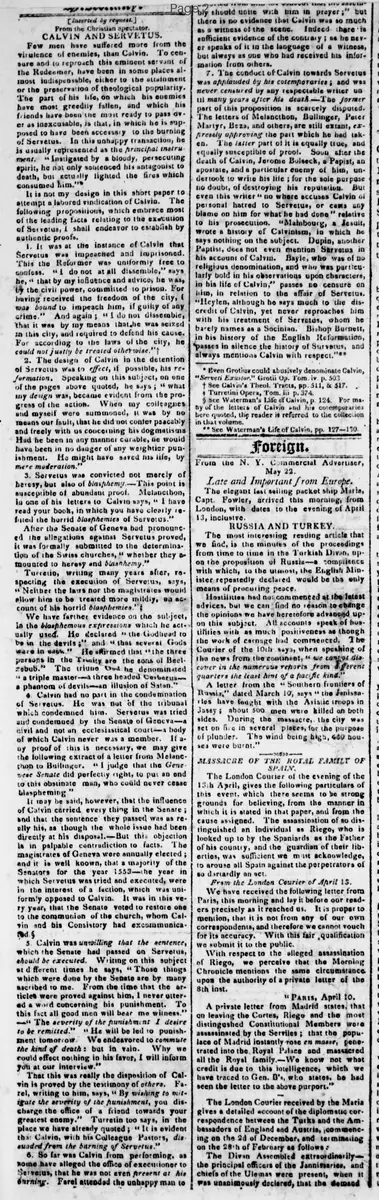
From the Christian Spectator,
CALVIN AND SERVETUS.
Few men have suffered more from the virulence of enemies, than Calvin. To censure and to reproach this eminent servant of the Redeemer, have been in some places almost indispensable, either to the attainment or the preservation of theological popularity. The part of his life, on which his enemies have most greedily fallen, and which his friends have been the most ready to pass over as inexcusable, is that, in which he is supposed to have been accessory to the burning of Servetus. In this unhappy transaction, he is usually represented as the principal instrument. "Instigated by a bloody, persecuting spirit, he not only sentenced his antagonist to death, but actually lighted the fires which consumed him."
It is not my design in this short paper to attempt a labored vindication of Calvin. The following propositions, which embrace most of the leading facts relating to the execution of Servetus, I shall endeavor to establish by authentic proofs.
I. It was at the instance of Calvin that Servetus was impeached and imprisoned. This the Reformer was uniformly free to confess. "I do not at all dissemble," says he, "that by my influence and advice, he was, by the civil power, committed to prison. For having received the freedom of the city, I was bound to impeach him, if guilty of any crime." And again; "I do not dissemble, that it was by my means that he was seized in this city, and required to defend his cause. For according to the laws of the city, he could not justly be treated otherwise."
II. The design of Calvin in the detention of Servetus was to effect, if possible, his reformation. Speaking on this subject, on one of the pages above quoted, he says; "what any design was, became evident from the progress of the action. When my colleagues and myself were summoned, it was by no means our fault, that he did not confer peaceably and freely with us concerning his dogmatisms. Had he been in any manner curable, he would have been in no danger of any weightier punishment. He might have saved his life, by mere moderation."
III. Servetus was convicted not merely of heresy, but also of blasphemy.--This point is susceptible of abundant proof. Melancthon, in one of his letters to Calvin says," I have read your book, in which you have clearly refuted the horrid blasphemies of Servetus.' After the Senate of Geneva had pronounced the allegations against Servetus proved, it was formally submitted to the determination of the Swiss churches, "whether they amounted to heresy and blasphemy." Beza, writing many years after, respecting the execution of Servetus, says, "Neither the laws nor the magistrates would allow him to be treated more mildly, on account of his horrid blasphemies."
We have further evidence on the subject, in the blasphemous expressions which he actually used. He declared "the Godhead to be in the devils :" and "that several Gods were in each." He affirmed that "the three persons in the Trinity are the sons of Beelzebub." The triune God he denominated "a triple monster--a three headed Cerberus--a phantom of devils--an illusion of Satan."
IV. Calvin had no part in the condemnation of Servetus. He was not of the tribunal which condemned him. Servetus was tried and condemned by the Senate of Geneva--a civil and not an ecclesiastical court--a body of which Calvin never was a member. If any proof of this is necessary, we may give the following extract of a letter from Melancthon to Bullinger. " I judge that the Genevese Senate did perfectly right, to put an end to this obstinate man, who could never cease blaspheming."
It may be said, however, that the influence of Calvin carried every thing in the Senate ; and that the sentence they passed was as really his, as though the whole issue had been directly at his disposal.--But this objection is in palpable contradiction to facts. The magistrates of Geneva were annually elected ; and it is well known, that a majority of the Senators for the year 1553--the year in which Servetus was tried and executed, were in the interest of a faction, which was uniformly opposed to Calvin. It was in this very year, that the Senate voted to restore one to the communion of the church, whom Calvin and his Consistory had excommunicated.
V. Calvin was unwilling that the sentence, which the Senate had passed on Servetus, should be executed. Writing on this subject at different times he says, " Those things which were done by the Senate are by many ascribed to me. From the time that the articles were proved against him, I never uttered a word concerning his punishment. To this fact all good men will bear me witness."--" The severity of the punishment I desire to be remitted." " He will be led to punishment tomorrow." We endeavored to commute the kind of death: but in vain. Why we could effect nothing in his favor, I will inform you at our interview.
That this was really the disposition of Calvin is proved by the testimony of others. Farel, writing to him, says, " By wishing to mitigate the severity of the punishment, you discharge the office of a friend towards your greatest enemy."
Turretin too says, in the place we have already quoted;" It is evident that Calvin, with his Colleague Pastors, dissuaded from the burning of Servetus."
VI. So far was Calvin from performing, as some have alleged the office of executioner to Servetus, that he was not even present at his burning. Farel attended the unhappy man to the place of execution, and "earnestly exhorted him to unite with him in prayer;"but there is no evidence that Calvin was so much as a witness of the scene. Indeed- there is sufficient evidence of the contrary; as he never speaks of it in the language of a witness, but always as one who had received his information from others.
VII. The conduct of Calvin towards Servetus was applauded by his contemporaries; and was never censured by any respectable writer until many years after his death. The former part of this proposition is scarcely disputed. The letters of Melancthon, Bullinger, Peter Martyr, Beza, and others, are still extant, expressly approving the part which he had taken. The latter part of it is equally true, and equally susceptible of proof. Soon after the death of Calvin, Jerome Bolsec, a Papist, an apostate, and a particular enemy of him, undertook to write his life ; for the sole purpose no doubt, of destroying his reputation. But even this writer " no where accuses Calvin of personal hatred to Servetus, or casts any blame on him for what he had done"relative to his prosecution. "Mainbourg, a Jesuit, wrote a history of Calvinism, in which he says nothing on the subject. Dupin, another Papist, does not even mention Servetus in his account of Calvin. Bayle, who was of no religious denomination, and who was particularly bold in his observations upon characters, in his life of Calvin,"passes no censure on him, in relation to the affair of Servetus. "Heylin, although he says much to the discredit of Calvin, yet never reproaches him with his treatment of Servetus, whom he barely names as a Socinian."Bishop Burnet, in his history of the English Reformation, passes in silence the history of Servetus, and always mentions Calvin with respect."
•Even Grotius could abusively denominate Calvin, "Serveti Exustor." Grotii Op. Tom. iv.p. 503
See Calvin's Theol. Tracts, Pp. 511, & 517.
Turretini Opera, Tom. iii p. 374.
See Waterman's Life of Calvin, p. 124. For many of the letters of Calvin and his cotemporaries here quoted, the reader is referred to the collection in that volume.
"* See Waterman's Life of Calvin, Pp. 127-130.
CALVIN AND SERVETUS.
Few men have suffered more from the virulence of enemies, than Calvin. To censure and to reproach this eminent servant of the Redeemer, have been in some places almost indispensable, either to the attainment or the preservation of theological popularity. The part of his life, on which his enemies have most greedily fallen, and which his friends have been the most ready to pass over as inexcusable, is that, in which he is supposed to have been accessory to the burning of Servetus. In this unhappy transaction, he is usually represented as the principal instrument. "Instigated by a bloody, persecuting spirit, he not only sentenced his antagonist to death, but actually lighted the fires which consumed him."
It is not my design in this short paper to attempt a labored vindication of Calvin. The following propositions, which embrace most of the leading facts relating to the execution of Servetus, I shall endeavor to establish by authentic proofs.
I. It was at the instance of Calvin that Servetus was impeached and imprisoned. This the Reformer was uniformly free to confess. "I do not at all dissemble," says he, "that by my influence and advice, he was, by the civil power, committed to prison. For having received the freedom of the city, I was bound to impeach him, if guilty of any crime." And again; "I do not dissemble, that it was by my means that he was seized in this city, and required to defend his cause. For according to the laws of the city, he could not justly be treated otherwise."
II. The design of Calvin in the detention of Servetus was to effect, if possible, his reformation. Speaking on this subject, on one of the pages above quoted, he says; "what any design was, became evident from the progress of the action. When my colleagues and myself were summoned, it was by no means our fault, that he did not confer peaceably and freely with us concerning his dogmatisms. Had he been in any manner curable, he would have been in no danger of any weightier punishment. He might have saved his life, by mere moderation."
III. Servetus was convicted not merely of heresy, but also of blasphemy.--This point is susceptible of abundant proof. Melancthon, in one of his letters to Calvin says," I have read your book, in which you have clearly refuted the horrid blasphemies of Servetus.' After the Senate of Geneva had pronounced the allegations against Servetus proved, it was formally submitted to the determination of the Swiss churches, "whether they amounted to heresy and blasphemy." Beza, writing many years after, respecting the execution of Servetus, says, "Neither the laws nor the magistrates would allow him to be treated more mildly, on account of his horrid blasphemies."
We have further evidence on the subject, in the blasphemous expressions which he actually used. He declared "the Godhead to be in the devils :" and "that several Gods were in each." He affirmed that "the three persons in the Trinity are the sons of Beelzebub." The triune God he denominated "a triple monster--a three headed Cerberus--a phantom of devils--an illusion of Satan."
IV. Calvin had no part in the condemnation of Servetus. He was not of the tribunal which condemned him. Servetus was tried and condemned by the Senate of Geneva--a civil and not an ecclesiastical court--a body of which Calvin never was a member. If any proof of this is necessary, we may give the following extract of a letter from Melancthon to Bullinger. " I judge that the Genevese Senate did perfectly right, to put an end to this obstinate man, who could never cease blaspheming."
It may be said, however, that the influence of Calvin carried every thing in the Senate ; and that the sentence they passed was as really his, as though the whole issue had been directly at his disposal.--But this objection is in palpable contradiction to facts. The magistrates of Geneva were annually elected ; and it is well known, that a majority of the Senators for the year 1553--the year in which Servetus was tried and executed, were in the interest of a faction, which was uniformly opposed to Calvin. It was in this very year, that the Senate voted to restore one to the communion of the church, whom Calvin and his Consistory had excommunicated.
V. Calvin was unwilling that the sentence, which the Senate had passed on Servetus, should be executed. Writing on this subject at different times he says, " Those things which were done by the Senate are by many ascribed to me. From the time that the articles were proved against him, I never uttered a word concerning his punishment. To this fact all good men will bear me witness."--" The severity of the punishment I desire to be remitted." " He will be led to punishment tomorrow." We endeavored to commute the kind of death: but in vain. Why we could effect nothing in his favor, I will inform you at our interview.
That this was really the disposition of Calvin is proved by the testimony of others. Farel, writing to him, says, " By wishing to mitigate the severity of the punishment, you discharge the office of a friend towards your greatest enemy."
Turretin too says, in the place we have already quoted;" It is evident that Calvin, with his Colleague Pastors, dissuaded from the burning of Servetus."
VI. So far was Calvin from performing, as some have alleged the office of executioner to Servetus, that he was not even present at his burning. Farel attended the unhappy man to the place of execution, and "earnestly exhorted him to unite with him in prayer;"but there is no evidence that Calvin was so much as a witness of the scene. Indeed- there is sufficient evidence of the contrary; as he never speaks of it in the language of a witness, but always as one who had received his information from others.
VII. The conduct of Calvin towards Servetus was applauded by his contemporaries; and was never censured by any respectable writer until many years after his death. The former part of this proposition is scarcely disputed. The letters of Melancthon, Bullinger, Peter Martyr, Beza, and others, are still extant, expressly approving the part which he had taken. The latter part of it is equally true, and equally susceptible of proof. Soon after the death of Calvin, Jerome Bolsec, a Papist, an apostate, and a particular enemy of him, undertook to write his life ; for the sole purpose no doubt, of destroying his reputation. But even this writer " no where accuses Calvin of personal hatred to Servetus, or casts any blame on him for what he had done"relative to his prosecution. "Mainbourg, a Jesuit, wrote a history of Calvinism, in which he says nothing on the subject. Dupin, another Papist, does not even mention Servetus in his account of Calvin. Bayle, who was of no religious denomination, and who was particularly bold in his observations upon characters, in his life of Calvin,"passes no censure on him, in relation to the affair of Servetus. "Heylin, although he says much to the discredit of Calvin, yet never reproaches him with his treatment of Servetus, whom he barely names as a Socinian."Bishop Burnet, in his history of the English Reformation, passes in silence the history of Servetus, and always mentions Calvin with respect."
•Even Grotius could abusively denominate Calvin, "Serveti Exustor." Grotii Op. Tom. iv.p. 503
See Calvin's Theol. Tracts, Pp. 511, & 517.
Turretini Opera, Tom. iii p. 374.
See Waterman's Life of Calvin, p. 124. For many of the letters of Calvin and his cotemporaries here quoted, the reader is referred to the collection in that volume.
"* See Waterman's Life of Calvin, Pp. 127-130.
What sub-type of article is it?
Biography
Historical Event
What themes does it cover?
Justice
Moral Virtue
What keywords are associated?
Calvin
Servetus
Execution
Geneva
Heresy
Blasphemy
Reformation
Persecution
What entities or persons were involved?
Calvin
Servetus
Melancthon
Beza
Farel
Bullinger
Peter Martyr
Where did it happen?
Geneva
Story Details
Key Persons
Calvin
Servetus
Melancthon
Beza
Farel
Bullinger
Peter Martyr
Location
Geneva
Event Date
1553
Story Details
Article defends Calvin against accusations of instigating the burning of heretic Servetus, arguing Calvin impeached him for reformation, was not part of condemnation by Geneva Senate, sought to mitigate punishment, and was absent from execution; contemporaries approved his actions.