Thank you for visiting SNEWPapers!
Sign up free
The Spokane Press
Spokane, Spokane County, Washington
What is this article about?
In Spokane, Mayor Boyd vetoes the Pratt saloon box ordinance, which aimed to remove private boxes in saloons to reduce crime and protect youth. He defends individual liberty and saloon practices, criticizing the measure despite police testimony linking saloons to crime and immorality.
Clipping
OCR Quality
Full Text
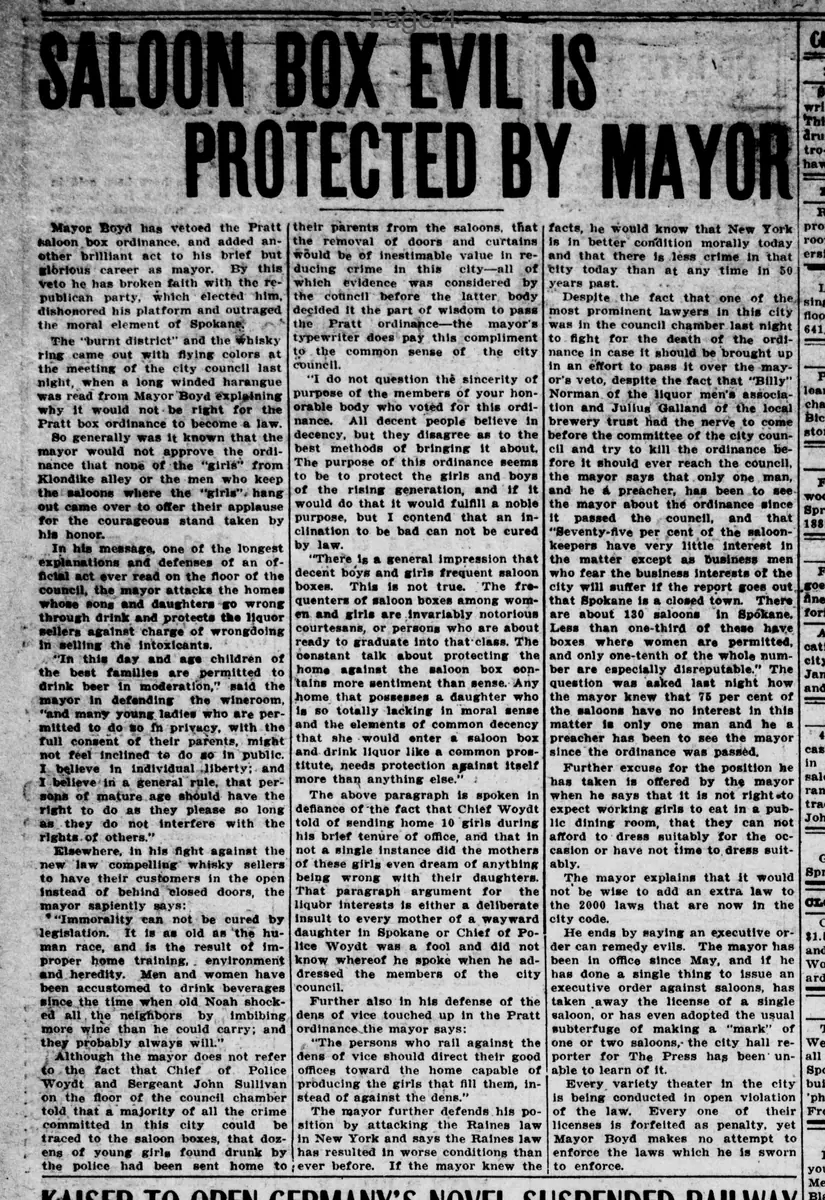
Mayor Boyd has vetoed the Pratt saloon box ordinance, and added another brilliant act to his brief but glorious career as mayor. By this veto he has broken faith with the republican party, which elected him, dishonored his platform and outraged the moral element of Spokane.
The "burnt district" and the whisky ring came out with flying colors at the meeting of the city council last night, when a long winded harangue was read from Mayor Boyd explaining why it would not be right for the Pratt box ordinance to become a law. So generally was it known that the mayor would not approve the ordinance that none of the "girls" from Klondike alley or the men who keep the saloons where the "girls" hang out came over to offer their applause for the courageous stand taken by his honor.
In his message, one of the longest explanations and defenses of an official act ever read on the floor of the council, the mayor attacks the homes whose sons and daughters go wrong through drink and protects the liquor sellers against charge of wrongdoing in selling the intoxicants.
"In this day and age children of the best families are permitted to drink beer in moderation," said the mayor in defending the wineroom, "and many young ladies who are permitted to do so in privacy, with the full consent of their parents, might not feel inclined to do so in public. I believe in individual liberty, and I believe in a general rule that persons of mature age should have the right to do as they please so long as they do not interfere with the rights of others."
Elsewhere, in his fight against the new law compelling whisky sellers to have their customers in the open instead of behind closed doors, the mayor sapiently says:
"Immorality can not be cured by legislation. It is as old as the human race, and is the result of improper home training, environment and heredity. Men and women have been accustomed to drink beverages since the time when old Noah shocked all the neighbors by imbibing more wine than he could carry; and they probably always will."
Although the mayor does not refer to the fact that Chief of Police Woydt and Sergeant John Sullivan on the floor of the council chamber told that a majority of all the crime committed in this city could be traced to the saloon boxes, that dozens of young girls found drunk by the police had been sent home to their parents from the saloons, that the removal of doors and curtains would be of inestimable value in reducing crime in this city-all of which evidence was considered by the council before the latter body decided it the part of wisdom to pass the Pratt ordinance-the mayor's typewriter does pay this compliment to the common sense of the city council.
"I do not question the sincerity of purpose of the members of your honorable body who voted for this ordinance. All decent people believe in decency, but they disagree as to the best methods of bringing it about. The purpose of this ordinance seems to be to protect the girls and boys of the rising generation, and if it would do that it would fulfill a noble purpose, but I contend that an inclination to be bad can not be cured by law.
"There is a general impression that decent boys and girls frequent saloon boxes. This is not true. The frequenters of saloon boxes among women and girls are invariably notorious courtesans, or persons who are about ready to graduate into that class. The constant talk about protecting the home against the saloon box contains more sentiment than sense. Any home that possesses a daughter who is so totally lacking in moral sense and the elements of common decency that she would enter a saloon box and drink liquor like a common prostitute, needs protection against itself more than anything else."
The above paragraph is spoken in defiance of the fact that Chief Woydt told of sending home 10 girls during his brief tenure of office, and that in not a single instance did the mothers of these girls even dream of anything being wrong with their daughters. That paragraph argument for the liquor interests is either a deliberate insult to every mother of a wayward daughter in Spokane or Chief of Police Woydt was a fool and did not know whereof he spoke when he addressed the members of the city council.
Further also in his defense of the dens of vice touched up in the Pratt ordinance the mayor says:
"The persons who rail against the dens of vice should direct their good offices toward the home capable of producing the girls that fill them, instead of against the dens."
The mayor further defends his position by attacking the Raines law in New York and says the Raines law has resulted in worse conditions than ever before. If the mayor knew the facts, he would know that New York is in better condition morally today and that there is less crime in that city today than at any time in 50 years past.
Despite the fact that one of the most prominent lawyers in this city was in the council chamber last night to fight for the death of the ordinance in case it should be brought up in an effort to pass it over the mayor's veto, despite the fact that "Billy" Norman of the liquor men's association and Julius Galland of the local brewery trust had the nerve to come before the committee of the city council and try to kill the ordinance before it should ever reach the council, the mayor says that only one man, and he a preacher, has been to see the mayor about the ordinance since it passed the council, and that "Seventy-five per cent of the saloon-keepers have very little interest in the matter except as business men who fear the business interests of the city will suffer if the report goes out that Spokane is a closed town. There are about 130 saloons in Spokane. Less than one-third of these have boxes where women are permitted, and only one-tenth of the whole number are especially disreputable." The question was asked last night how the mayor knew that 75 per cent of the saloons have no interest in this matter is only one man and he a preacher has been to see the mayor since the ordinance was passed.
Further excuse for the position he has taken is offered by the mayor when he says that it is not right to expect working girls to eat in a public dining room, that they can not afford to dress suitably for the occasion or have not time to dress suitably.
The mayor explains that it would not be wise to add an extra law to the 2000 laws that are now in the city code.
He ends by saying an executive order can remedy evils. The mayor has been in office since May, and if he has done a single thing to issue an executive order against saloons, has taken away the license of a single saloon, or has even adopted the usual subterfuge of making a "mark" of one or two saloons, the city hall reporter for The Press has been unable to learn of it.
Every variety theater in the city is being conducted in open violation of the law. Every one of their licenses is forfeited as penalty, yet Mayor Boyd makes no attempt to enforce the laws which he is sworn to enforce.
What sub-type of article is it?
What keywords are associated?
What entities or persons were involved?
Where did it happen?
Domestic News Details
Primary Location
Spokane
Key Persons
Outcome
mayor vetoes the pratt saloon box ordinance, protecting saloons from reforms aimed at reducing crime and immorality; no enforcement actions against violations noted.
Event Details
Mayor Boyd vetoes the Pratt ordinance requiring saloons to remove private boxes and curtains to prevent hidden drinking and associated crimes. In his message to the city council, he defends individual liberty, argues immorality cannot be legislated, blames homes for wayward youth, and dismisses police evidence linking saloons to crime. Liquor interests lobbied against the ordinance, and the mayor criticizes similar laws elsewhere.