Thank you for visiting SNEWPapers!
Sign up free
Atlanta Daily World
Atlanta, Fulton County, Georgia
What is this article about?
Internationally famous author Philip Wylie warns at Florida State University that small newspapers must uphold fearless free press as big media prioritizes profits over factual reporting. He also critiques U.S. education's emphasis on sports over scholarship, aiding Soviet gains in science.
Clipping
OCR Quality
Full Text
Need For Fearless Free Press
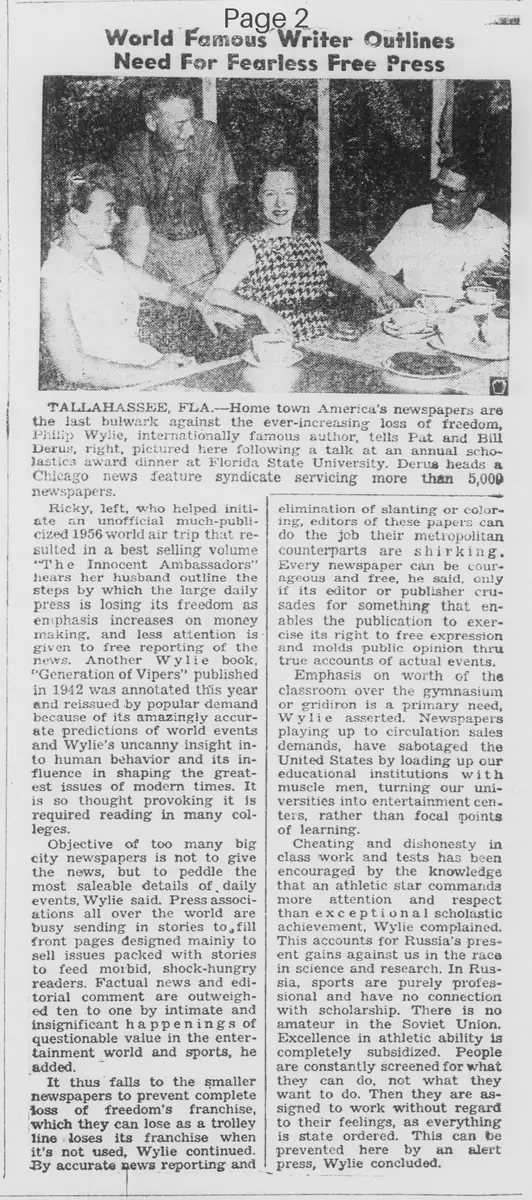
TALLAHASSEE, FLA.-Home town America's newspapers are the last bulwark against the ever-increasing loss of freedom, Philip Wylie, internationally famous author, tells Pat and Bill Derus, right, pictured here following a talk at an annual scholarship award dinner at Florida State University. Derus heads a Chicago news feature syndicate servicing more than 5,000 newspapers.
Ricky, left, who helped initiate an unofficial much-publicized 1956 world air trip that resulted in a best selling volume "The Innocent Ambassadors" hears her husband outline the steps by which the large daily press is losing its freedom as emphasis increases on money making, and less attention is given to free reporting of the news. Another Wylie book, "Generation of Vipers" published in 1942 was annotated this year and reissued by popular demand because of its amazingly accurate predictions of world events and Wylie's uncanny insight into human behavior and its influence in shaping the greatest issues of modern times. It is so thought provoking it is required reading in many colleges.
Objective of too many big city newspapers is not to give the news, but to peddle the most saleable details of, daily events. Wylie said. Press associations all over the world are busy sending in stories to fill front pages designed mainly to sell issues packed with stories to feed morbid, shock-hungry readers. Factual news and editorial comment are outweighed ten to one by intimate and insignificant happenings of questionable value in the entertainment world and sports, he added.
It thus falls to the smaller newspapers to prevent complete loss of freedom's franchise, which they can lose as a trolley line loses its franchise when it's not used, Wylie continued. By accurate news reporting and elimination of slanting or coloring, editors of these papers can do the job their metropolitan counterparts are shirking.
Every newspaper can be courageous and free, he said, only if its editor or publisher crusades for something that enables the publication to exercise its right to free expression and molds public opinion thru true accounts of actual events.
Emphasis on worth of the classroom over the gymnasium or gridiron is a primary need, Wylie asserted. Newspapers playing up to circulation sales demands, have sabotaged the United States by loading up our educational institutions with muscle men, turning our universities into entertainment centers, rather than focal points of learning.
Cheating and dishonesty in class work and tests has been encouraged by the knowledge that an athletic star commands more attention and respect than exceptional scholastic achievement, Wylie complained.
This accounts for Russia's present gains against us in the race in science and research. In Russia, sports are purely professional and have no connection with scholarship. There is no amateur in the Soviet Union. Excellence in athletic ability is completely subsidized. People are constantly screened for what they can do, not what they want to do. Then they are assigned to work without regard to their feelings, as everything is state ordered. This can be prevented here by an alert press, Wylie concluded.
What sub-type of article is it?
What themes does it cover?
What keywords are associated?
What entities or persons were involved?
Where did it happen?
Story Details
Key Persons
Location
Tallahassee, Fla., Florida State University
Story Details
Philip Wylie delivers a talk at Florida State University emphasizing the role of small-town newspapers in preserving press freedom amid commercial pressures on large dailies. He criticizes sensationalism in news, urges accurate reporting, and laments the prioritization of sports over academics in U.S. education, attributing Soviet scientific advances to their focus on merit over athletics.