Thank you for visiting SNEWPapers!
Sign up free
Story
June 23, 1929
Douglas Daily Dispatch
Douglas, Cochise County, Arizona
What is this article about?
Monte Mansfield tells Tucson Kiwanis club about Arizona's highway oil-treatment program for U.S. 80 from Yuma to New Mexico, citing budget limits and maintenance savings. Includes historical road facts and club updates. (187 chars)
Clipping
OCR Quality
95%
Excellent
Full Text
Mansfield Tells Tucson Business Men Arizona Highway Are to Be Given Oil Treatment, Yuma to New Mexico First
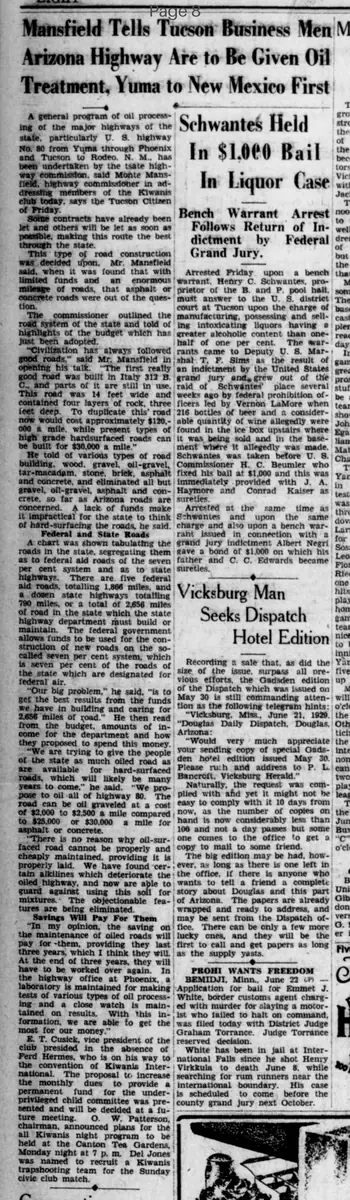
A general program of oil processing of the major highways of the state, particularly U. S. highway No. 80 from Yuma through Phoenix and Tucson to Rodeo, N. M., has been undertaken by the state highway commission, said Monte Mansfield, highway commissioner in addressing members of the Kiwanis club today, says the Tucson Citizen of Friday.
Some contracts have already been let and others will be let as soon as possible, making this route the best through the state.
This type of road construction was decided upon, Mr. Mansfield said, when it was found that with limited funds and an enormous mileage of roads, that asphalt or concrete roads were out of the question.
The commissioner outlined the road system of the state and told of highlights of the budget which has just been adopted.
"Civilization has always followed good roads," said Mr. Mansfield in opening his talk. "The first really good road was built in Italy 312 B. C., and parts of it are still in use. This road was 14 feet wide and contained four layers of rock, three feet deep. To duplicate this road now would cost approximately $120,000 a mile, while present types of high grade hardsurfaced roads can be built for $30,000 a mile."
He told of various types of road building, wood, gravel, oil-gravel, tar-macadam, stone, brick, asphalt and concrete, and eliminated all but gravel, oil-gravel, asphalt and concrete, so far as Arizona roads are concerned. A lack of funds make it impractical for the state to think of hard-surfacing the roads, he said.
Federal and State Roads
A chart was shown tabulating the roads in the state, segregating them as to federal aid roads of the seven per cent system and as to state highways. There are five federal aid roads, totalling 1,866 miles, and a dozen state highways totalling 790 miles, or a total of 2,656 miles of road in the state which the state highway department must build or maintain. The federal government allows funds to be used for the construction of new roads on the so-called seven per cent system, which is seven per cent of the roads of the state which are designated for federal aid.
"Our big problem," he said, "is to get the best results from the funds we have in building and caring for 2,656 miles of road." He then read from the budget, amounts of income for the department and how they proposed to spend this money.
"We are trying to give the people of the state as much oiled road as are available for hard-surfaced roads, which will likely be many years to come," he said. "We propose to oil all of highway 80. The road can be oil graveled at a cost of $2,000 to $2,500 a mile compared to $25,000 or $30,000 a mile for asphalt or concrete.
There is no reason why oil-surfaced road cannot be properly and cheaply maintained, providing it is properly laid. We have found certain alkilines which deteriorate the oiled highway, and now are able to guard against using this soil for mixtures. The objectionable features are being eliminated.
Savings Will Pay For Them
In my opinion, the saving on the maintenance of oiled roads will pay for them, providing they last three years, which I think they will. At the end of three years, they will have to be worked over again. In the highway office at Phoenix, a laboratory is maintained for making tests of various types of oil processing and a close watch is maintained on results. With this information, we are able to get the most for our money."
E. T. Cusick, vice president of the club presided in the absence of Ferd Hermes, who is on his way to the convention of Kiwanis International. The proposal to increase the monthly dues to provide a permanent fund for the under-privileged child committee was presented and will be decided at a future meeting. O. W. Patterson, chairman, announced plans for the all Kiwanis night program to be held at the Canton Tea Gardens, Monday night at 7 p. m. Del Jones was named to recruit a Kiwanis trapshooting team for the Sunday civic club match.
A general program of oil processing of the major highways of the state, particularly U. S. highway No. 80 from Yuma through Phoenix and Tucson to Rodeo, N. M., has been undertaken by the state highway commission, said Monte Mansfield, highway commissioner in addressing members of the Kiwanis club today, says the Tucson Citizen of Friday.
Some contracts have already been let and others will be let as soon as possible, making this route the best through the state.
This type of road construction was decided upon, Mr. Mansfield said, when it was found that with limited funds and an enormous mileage of roads, that asphalt or concrete roads were out of the question.
The commissioner outlined the road system of the state and told of highlights of the budget which has just been adopted.
"Civilization has always followed good roads," said Mr. Mansfield in opening his talk. "The first really good road was built in Italy 312 B. C., and parts of it are still in use. This road was 14 feet wide and contained four layers of rock, three feet deep. To duplicate this road now would cost approximately $120,000 a mile, while present types of high grade hardsurfaced roads can be built for $30,000 a mile."
He told of various types of road building, wood, gravel, oil-gravel, tar-macadam, stone, brick, asphalt and concrete, and eliminated all but gravel, oil-gravel, asphalt and concrete, so far as Arizona roads are concerned. A lack of funds make it impractical for the state to think of hard-surfacing the roads, he said.
Federal and State Roads
A chart was shown tabulating the roads in the state, segregating them as to federal aid roads of the seven per cent system and as to state highways. There are five federal aid roads, totalling 1,866 miles, and a dozen state highways totalling 790 miles, or a total of 2,656 miles of road in the state which the state highway department must build or maintain. The federal government allows funds to be used for the construction of new roads on the so-called seven per cent system, which is seven per cent of the roads of the state which are designated for federal aid.
"Our big problem," he said, "is to get the best results from the funds we have in building and caring for 2,656 miles of road." He then read from the budget, amounts of income for the department and how they proposed to spend this money.
"We are trying to give the people of the state as much oiled road as are available for hard-surfaced roads, which will likely be many years to come," he said. "We propose to oil all of highway 80. The road can be oil graveled at a cost of $2,000 to $2,500 a mile compared to $25,000 or $30,000 a mile for asphalt or concrete.
There is no reason why oil-surfaced road cannot be properly and cheaply maintained, providing it is properly laid. We have found certain alkilines which deteriorate the oiled highway, and now are able to guard against using this soil for mixtures. The objectionable features are being eliminated.
Savings Will Pay For Them
In my opinion, the saving on the maintenance of oiled roads will pay for them, providing they last three years, which I think they will. At the end of three years, they will have to be worked over again. In the highway office at Phoenix, a laboratory is maintained for making tests of various types of oil processing and a close watch is maintained on results. With this information, we are able to get the most for our money."
E. T. Cusick, vice president of the club presided in the absence of Ferd Hermes, who is on his way to the convention of Kiwanis International. The proposal to increase the monthly dues to provide a permanent fund for the under-privileged child committee was presented and will be decided at a future meeting. O. W. Patterson, chairman, announced plans for the all Kiwanis night program to be held at the Canton Tea Gardens, Monday night at 7 p. m. Del Jones was named to recruit a Kiwanis trapshooting team for the Sunday civic club match.
What sub-type of article is it?
Historical Event
What themes does it cover?
Triumph
What keywords are associated?
Highway Oil Treatment
Arizona Roads
Kiwanis Club
Monte Mansfield
Road Construction
What entities or persons were involved?
Monte Mansfield
E. T. Cusick
Ferd Hermes
O. W. Patterson
Del Jones
Where did it happen?
Tucson, Arizona
Story Details
Key Persons
Monte Mansfield
E. T. Cusick
Ferd Hermes
O. W. Patterson
Del Jones
Location
Tucson, Arizona
Event Date
Friday
Story Details
Monte Mansfield addresses Kiwanis club on Arizona highway commission's plan to oil-process major highways, especially U.S. 80 from Yuma to New Mexico, due to limited funds making asphalt or concrete impractical. He outlines road system, budget, and benefits of oil-gravel roads. Club notes include dues increase proposal and upcoming events.