Thank you for visiting SNEWPapers!
Sign up free
Norfolk Gazette And Publick Ledger
Norfolk, Virginia
What is this article about?
Post-acquittal of Judge Chase, Congress debates resolutions to alter the Constitution for removing judges and recalling senators. A bill to compensate trial witnesses passes House but fails after Senate amends for all witnesses; Randolph's Sunday attempt to pay select witnesses from contingent fund lacks quorum and fails.
Clipping
OCR Quality
Full Text
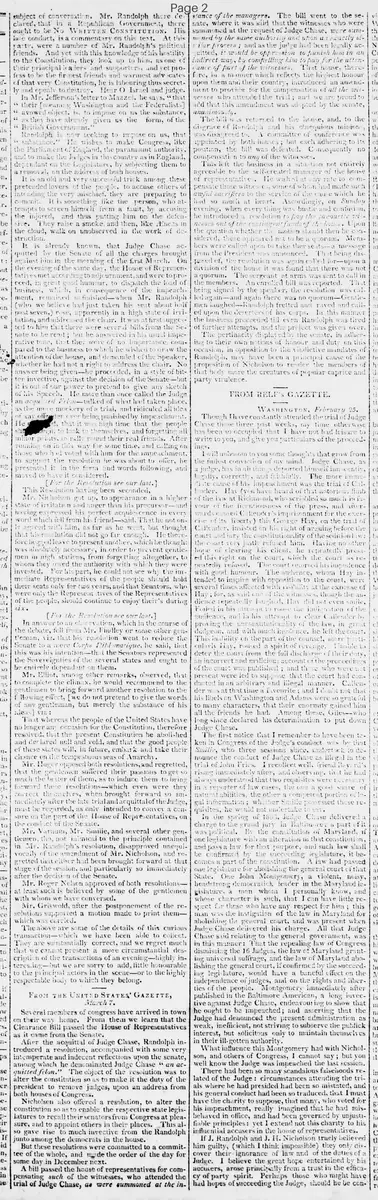
Several members of congress have arrived in town on their way home. From them we learn that the Clearance Bill passed the House of Representatives as it came from the Senate.
After the acquittal of Judge Chase, Randolph introduced a resolution, accompanied with some very intemperate and indecent reflections upon the senate, among which he denominated Judge Chase "an acquitted felon." The object of the resolution was to alter the constitution so as to make it the duty of the president to remove judges, upon an address from both houses of Congress.
Nicholson also offered a resolution, to alter the constitution so as to enable the respective state legislatures to recall their senators from Congress at pleasure, and to appoint others in their places. This also gave rise to much invective from the Randolph junto among the democrats in the house.
But these resolutions were committed to a committee of the whole, and made the order of the day for some day in December next.
A bill passed the house of representatives for compensating such of the witnesses, who attended the trial of Judge Chase, as were summoned at the instance of the managers. The bill went to the senate, where it was said that the witnesses who were summoned at the request of Judge Chase, were summoned by the same authority and upon a exactly similar process; and as the judge had been legally acquitted, it would be oppression to punish him in an indirect way, by compelling him to pay for the attendance of part of the witnesses. That house, therefore, in a manner which reflects the highest honour upon them and their country, introduced an amendment to provide for the compensation of all the witnesses who attended the trial: and we are proud to add that this amendment was adopted by the senate, unanimously.
The bill was returned to the house, and, to the disgrace of Randolph and his obsequious minion, was disagreed to. A committee of conference was appointed by both houses; but each adhering to its position, the bill was defeated. Consequently no compensation to any of the witnesses.
This left the business in a situation not entirely agreeable to the self-created manager or the house of representatives. He wished at any rate to compensate those witnesses, some of whom had made such painful sacrifices to the service of the cause which he had so much at heart. Accordingly, on Sunday evening, when every thing was bustle and confusion, he introduced a resolution to pay the jacquerie witnesses out of the contingent fund of the house. Upon the question whether the motion should then be considered, there appeared not to be a quorum. Members were called upon to take their seats—a message from the President was announced. That being disposed of, the resolution was again called for—upon a division of the house it was found that there was not a quorum. The sergeant at arms was sent to call in the members. An enrolled bill was reported. That being signed by the speaker, the resolution was called again—and again there was no quorum—Gentlemen laughed—Randolph fretted and fumed and called upon the deserters of his corps. In this manner the business proceeded till even Randolph was tired of further attempts, and the project was given over.
The pertinacity displayed by the senate, in adhering to their own notions of honour and duty on this occasion, in opposition to the vindictive mandates of Randolph, may have been a principal cause of the proposition of Nicholson to render the members of that body more the creatures of popular caprice and party virulence.
What sub-type of article is it?
What themes does it cover?
What keywords are associated?
What entities or persons were involved?
Where did it happen?
Story Details
Key Persons
Location
United States Congress
Event Date
March 1805
Story Details
Following Judge Chase's acquittal, Randolph proposes constitutional change to allow presidential removal of judges; Nicholson suggests state recall of senators. Witness compensation bill fails due to partisan divide, with Senate advocating for all witnesses and House opposing; Randolph's last-ditch effort lacks quorum.