Thank you for visiting SNEWPapers!
Sign up free
The Mississippi Enterprise
Jackson, Hinds County, Mississippi
What is this article about?
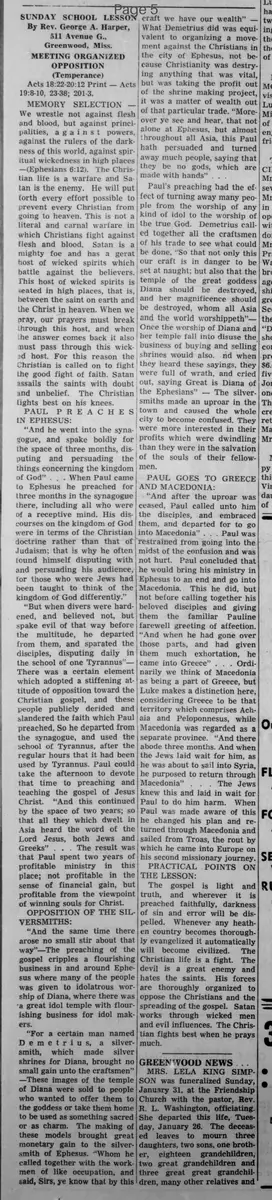
Rev. George A. Harper's Bible lesson on Acts 18:22-20:12 details Apostle Paul's ministry in Ephesus, where he preaches the kingdom of God, faces hardening opposition, relocates to Tyrannus's school, and converts many. Silversmiths riot over lost idol trade profits. Paul then travels to Macedonia and Greece, evading Jewish ambushes. Emphasizes spiritual warfare against Satan.
Clipping
OCR Quality
Full Text
511 Avenue G.,
Greenwood, Miss.
MEETING ORGANIZED
OPPOSITION
(Temperance)
Acts 18:22-20:12 Print - Acts 19:8-10, 23-38; 20:1-3.
MEMORY SELECTION -
We wrestle not against flesh and blood, but against principalities, against powers, against the rulers of the darkness of this world, against spiritual wickedness in high places (Ephesians 6:12). The Christian life is a warfare and Satan is the enemy. He will put forth every effort possible to prevent every Christian from going to heaven. This is not a literal and carnal warfare in which Christians fight against flesh and blood. Satan is a mighty foe and has a great host of wicked spirits which battle against the believers. This host of wicked spirits is seated in high places, that is, between the saint on earth and the Christ in heaven. When we pray, our prayers must break through this host, and when the answer comes back it also must pass through this wicked host. For this reason the Christian is called on to fight the good fight of faith. Satan assails the saints with doubt and unbelief. The Christian fights best on his knees.
PAUL PREACHES IN EPHESUS:
"And he went into the synagogue, and spake boldly for the space of three months, disputing and persuading the things concerning the kingdom of God" . . . When Paul came to Ephesus he preached for three months in the synagogue there, including all who were of a receptive mind. His discourses on the kingdom of God were in terms of the Christian doctrine rather than that of Judaism; that is why he often found himself disputing with and persuading his audience, for those who were Jews had been taught to think of the kingdom of God differently. "But when divers were hardened, and believed not, but spake evil of that way before the multitude, he departed from them, and separated the disciples, disputing daily in the school of one Tyrannus"—There was a certain element which adopted a stiffening attitude of opposition toward the Christian gospel, and these people publicly derided and slandered the faith which Paul preached. So he departed from the synagogue, and used the school of Tyrannus, after the regular hours that it had been used by Tyrannus. Paul could take the afternoon to devote that time to preaching and teaching the gospel of Jesus Christ. "And this continued by the space of two years; so that all they which dwelt in Asia heard the word of the Lord Jesus, both Jews and Greeks" . . . The result was that Paul spent two years of profitable ministry in this place; not profitable in the sense of financial gain, but profitable from the viewpoint of winning souls for Christ.
OPPOSITION OF THE SILVERSMITHS:
"And the same time there arose no small stir about that way" The preaching of the gospel cripples a flourishing business in and around Ephesus where many of the people was given to idolatrous worship of Diana, where there was a great idol temple with flourishing business for idol makers.
"For a certain man named Demetrius, a silversmith, which made silver shrines for Diana, brought no small gain unto the craftsmen"—These images of the temple of Diana were sold to people who wanted to offer them to the goddess or take them home to be used as something sacred or as charm. The making of these models brought great monetary gain to the silversmith of Ephesus. "Whom he called together with the workmen of like occupation, and said, Sirs, ye know that by this craft we have our wealth" What Demetrius did was equivalent to organizing a movement against the Christians in the city of Ephesus, not because Christianity was destroying anything that was vital, but was taking the profit out of the shrine making project, it was a matter of wealth out of that particular trade. "Moreover ye see and hear, that not alone at Ephesus, but almost throughout all Asia, this Paul hath persuaded and turned away much people, saying that they be no gods, which are made with hands" ..
Paul's preaching had the effect of turning away many people from the worship of any kind of idol to the worship of the true God. Demetrius called together all the craftsmen of his trade to see what could be done, "So that not only this our craft is in danger to be set at naught; but also that the temple of the great goddess Diana should be destroyed, and her magnificence should be destroyed, whom all Asia and the world worshippeth"—Once the worship of Diana and her temple fall into disuse the business of buying and selling shrines would also. And when they heard these sayings, they were full of wrath, and cried out, saying Great is Diana of the Ephesians" - The silversmiths made an uproar in the town and caused the whole city to become confused. They were more interested in their profits which were dwindling than they were in the salvation of the souls of their fellow-men.
PAUL GOES TO GREECE AND MACEDONIA:
"And after the uproar was ceased, Paul called unto him the disciples, and embraced them, and departed for to go into Macedonia" . . . Paul was restrained from going into the midst of the confusion and was not hurt. Paul concluded that he would bring his ministry in Ephesus to an end and go into Macedonia. This he did, but not before calling together his beloved disciples and giving them the familiar Pauline farewell greeting of affection. "And when he had gone over those parts, and had given them much exhortation, he came into Greece" . . . Ordinarily we think of Macedonia as being a part of Greece, but Luke makes a distinction here, considering Greece to be that territory which comprises Achaia and Peloponnesus, while Macedonia was regarded as a separate province. "And there abode three months. And when the Jews laid wait for him, as he was about to sail into Syria, he purposed to return through Macedonia"
The Jews knew this and laid in wait for Paul to do him harm. When Paul was made aware of this he changed his plan and returned through Macedonia and sailed from Troas, the rout by which he came into Europe on his second missionary journey.
PRACTICAL POINTS ON THE LESSON:
The gospel is light and truth, and wherever it is preached faithfully, darkness of sin and error will be dispelled. Whenever any heathen country becomes thoroughly evangelized it automatically will become civilized. The Christian life is a fight. The devil is a great enemy and hates the saints. His forces are thoroughly organized to oppose the Christians and the spreading of the gospel. Satan works through wicked men and evil influences. The Christian fights best when he prays much.
What sub-type of article is it?
What themes does it cover?
What keywords are associated?
What entities or persons were involved?
Where did it happen?
Story Details
Key Persons
Location
Ephesus
Story Details
Paul preaches boldly in the Ephesus synagogue for three months, then moves to the school of Tyrannus for two years, spreading the gospel to Asia. Silversmith Demetrius organizes opposition due to declining sales of Diana shrines from Paul's teachings against idols, causing a city uproar. After the stir, Paul departs to Macedonia and Greece, avoiding Jewish plots.