Thank you for visiting SNEWPapers!
Sign up free
Mississippi Democrat
Carrollton, Carroll County, Mississippi
What is this article about?
Mr. Calhoun's report to the Senate on the Memphis Convention's 1845 memorial urges federal improvements to Mississippi River navigation for commerce safety and growth, citing population boom, snag dangers, past losses, and constitutional authority via interstate commerce power. (248 characters)
Merged-components note: Continuation of the Calhoun report on Mississippi navigation across pages.
Clippings
1 of 2
OCR Quality
Full Text
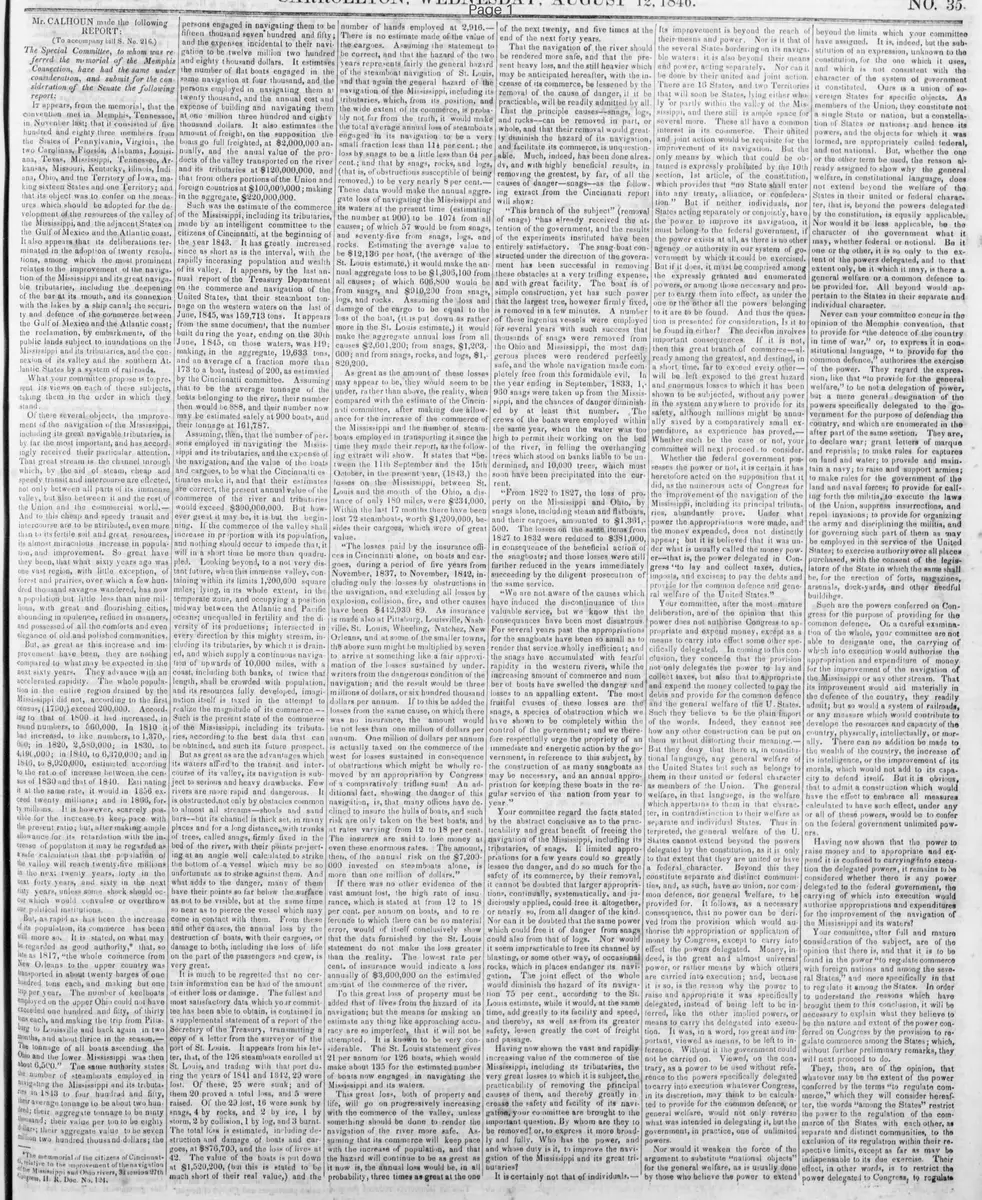
REPORT:
(To accompany bill S. No. 216.)
The Special Committee, to whom was referred the memorial of the Memphis Convention, have had the same under consideration, and submit for the consideration of the Senate the following report:
It appears, from the memorial, that the convention met in Memphis, Tennessee, in November last; that it consisted of five hundred and eighty-three members from the States of Pennsylvania, Virginia, the two Carolinas, Florida, Alabama, Louisiana, Texas, Mississippi, Tennessee, Arkansas, Missouri, Kentucky, Illinois, Indiana, Ohio, and the Territory of Iowa, making sixteen States and one Territory; and that its object was to confer on the measures which should be adopted for the development of the resources of the valley of the Mississippi, and the adjacent States on the Gulf of Mexico and the Atlantic coast.
It also appears that its deliberations terminated in the adoption of twenty resolutions, among which the most prominent relates to the improvement of the navigation of the Mississippi and its great navigable tributaries, including the deepening of the bar at its mouth, and its connexion with the lakes by a ship canal; the security and defence of the commerce between the Gulf of Mexico and the Atlantic coast: the reclamation, by embankments, of the public lands subject to inundations on the Mississippi and its tributaries, and the connexion of its valley and the southern Atlantic States by a system of railroads.
What your committee propose is to present its views on each of these subjects, taking them in the order in which they stand.
Of these several objects, the improvement of the navigation of the Mississippi, including its great navigable tributaries, is by far the most important, and has accordingly received their particular attention.
That great stream is the channel through which, by the aid of steam, cheap and speedy transit and intercourse are effected, not only between all parts of its immense valley, but also between it and the rest of the Union and the commercial world.
And to this cheap and speedy transit and intercourse are to be attributed, even more than to its fertile soil and great resources, its almost miraculous increase in population, and improvement. So great have they been, that what sixty years ago was one vast region, with little exception, of forest and prairies, over which a few hundred thousand savages wandered, has now a population but little less than nine millions, with great and flourishing cities, abounding in opulence, refined in manners, and possessed of all the comforts and even elegance of old and polished communities.
But, as great as this increase and improvement have been, they are nothing compared to what may be expected in the next sixty years. They advance with an accelerated rapidity. The whole population in the entire region drained by the Mississippi did not, according to the first census, (1790,) exceed 200,000. According to that of 1800 it had increased, in round numbers, to 560,000. In 1810 it had increased, to like numbers, to 1,370,000; in 1820, 2,580,000; in 1830, to 4,190,000; in 1840, to 6,370,000; and in 1846, to 8,920,000, estimated according to the ratio of increase between the census of 1830 and that of 1840. Estimating it at the same rate, it would in 1856 exceed twenty millions; and in 1866, forty millions. It is, however, scarcely possible for the increase to keep pace with the present ratio; but, after making ample allowance for its retardation with the increase of population it may be regarded as a safe calculation that the population of the valley will reach twenty-five millions in the next twenty years, forty in the next forty years, and sixty in the next sixty years, unless some shock should occur which would convulse or overthrow our political institutions.
But, as rapid as has been the increase of its population, its commerce has been still more so. It is stated, on what may be regarded as good authority, that, so late as 1817, "the whole commerce from New Orleans to the upper country was transported in about twenty barges of one hundred tons each, and making but one trip per year. The number of keelboats employed on the upper Ohio could not have exceeded one hundred and fifty, of thirty tons each, and making the trip from Pittsburg to Louisville and back again in two months, and about thrice in the season. The tonnage of all boats ascending the Ohio and the lower Mississippi was then about 6,500."
The same authority states the number of steamboats employed in navigating the Mississippi and its tributaries in 1813 to four hundred and fifty, their average tonnage to be about two hundred; their aggregate tonnage to be ninety thousand; their value per ton to be eighty dollars; their aggregate value to be seven million two hundred thousand dollars; the number of persons engaged in navigating them to be fifteen thousand seven hundred and fifty; and the expenses incidental to their navigation to be twelve million two hundred and eighty thousand dollars. It estimates the number of flat boats engaged in the same navigation at four thousand, and the persons employed in navigating them at twenty thousand, and the annual cost and expense of building and navigating them at one million three hundred and eighty thousand dollars. It also estimates the amount of freight, on the supposition the boats go full freighted, at $2,000,000 annually, and the annual value of the products of the valley transported on the river and its tributaries at $120,000,000, and that from other portions of the Union and foreign countries at $100,000,000; making in the aggregate, $220,000,000.
Such was the estimate of the commerce of the Mississippi, including its tributaries, made by an intelligent committee to the citizens of Cincinnati, at the beginning of the year 1843. It has greatly increased since as short as is the interval, with the rapidly increasing population and wealth of its valley. It appears, by the last annual report of the Treasury Department on the commerce and navigation of the United States, that their steamboat tonnage on the western waters on the last of June, 1845, was 159,713 tons. It appears from the same document, that the number built during the year, ending on the 30th June, 1845, on those waters, was 119: making, in the aggregate, 19,633 tons, and an average of a fraction more than 173 to a boat, instead of 200, as estimated by the Cincinnati committee. Assuming that to be the average tonnage of the boats belonging to the river, their number then would be 888, and their number now may be estimated safely at 900 boats, and their tonnage at 161,787.
Assuming, then, that the number of persons employed in navigating the Mississippi and its tributaries, and the expense of the navigation, and the value of the boats and cargoes, to be what the Cincinnati estimates make it, and that their estimates are correct, the present annual value of the commerce of the river and tributaries would exceed $300,000,000. But however great it may be, it is but the beginning. If the commerce of the valley shall increase in proportion with its population, and nothing should occur to impede that, it will in a short time be more than quadrupled. Looking beyond, to a not very distant future, when this immense valley, containing within its limits 1,200,000 square miles; lying, in its whole extent, in the temperate zone, and occupying a position midway between the Atlantic and Pacific oceans; unequalled in fertility and the diversity of its productions; intersected in every direction by this mighty stream, including its tributaries, by which it is drained, and which supply a continuous navigation of upwards of 10,000 miles, with a coast, including both banks, of twice that length, shall be crowded with population, and its resources fully developed, imagination itself is taxed in the attempt to realize the magnitude of its commerce.
Such is the present state of the commerce of the Mississippi, including its tributaries, according to the best data that can be obtained, and such its future prospect. But as great as are the advantages which its waters afford to the transit and intercourse of its valley, its navigation is subject to serious and heavy drawbacks. Few rivers are more rapid and dangerous. It is obstructed, not only by obstacles common to almost all streams—shoals and sand bars—but its channel is thick set, in many places and for a long distance, with trunks of trees, called snags, firmly fixed in the bed of the river, with their points projecting at an angle well calculated to strike the bottom of a vessel which may be so unfortunate as to strike against them. And what adds to the danger, many of them have their points so far below the surface as not to be visible, but at the same time so near as to pierce the vessel which may come in contact with them. From these and other causes, the annual loss by the destruction of boats, with their cargoes, or damage to both, including the loss of life on the part of the passengers and crew, is very great.
It is much to be regretted that no certain information can be had of the amount of either loss or damage. The fullest and most satisfactory data which your committee has been able to obtain, is contained in a supplemental statement of a report of the Secretary of the Treasury, transmitting a copy of a letter from the surveyor of the port of St. Louis. It appears from his letter, that, of the 126 steamboats enrolled at St. Louis, and trading with that port during the years of 1841 and 1842, 29 were lost. Of these, 25 were sunk: and of them 20 proved a total loss, and 5 were raised. Of the 29 lost, 16 were sunk by snags, 4 by rocks, and 2 by ice, 1 by storm, 2 by collision, 1 by log, and 3 burnt. The total loss is estimated, including destruction and damage of boats and cargoes, at $876,700, and the loss of lives at 42. The value of the boats is put down at $1,520,200, (but this is stated to be much short of their real value,) and the number of hands employed at 2,916.
There is no estimate made of the value of the cargoes. Assuming the statement to be correct, and that the hazard of the two years represents fairly the general hazard of the steamboat navigation of St. Louis, and that again the general hazard of the navigation of the Mississippi, including its tributaries, which, from its position, and the wide extent of its commerce, is probably not far from the truth, it would make the total average annual loss of steamboats engaged in its navigation to be a very small fraction less than 11 per cent.; the loss by snags to be a little less than 6 per cent.; and that by snags, rocks, and logs, (that is, of obstructions susceptible of being removed,) to be very nearly 8 per cent.
These data would make the annual aggregate loss of navigating the Mississippi and its waters at the present time (estimating the number at 900) to be 107 from all causes; of which 57 would be from snags, and seventy-five from snags, logs, and rocks. Estimating the average value to be $12,136 per boat, (the average of the St. Louis estimate,) it would make the annual aggregate loss to be $1,306,100 from all causes; of which $606,800 would be from snags, and $910,200 from snags, logs, and rocks. Assuming the loss and damage of the cargo to be equal to the loss of the boat, (it is put down as rather more in the St. Louis estimate,) it would make the aggregate annual loss from all causes $2,601,200; from snags, $1,203,600; and from snags, rocks, and logs, $1,820,200.
As great as the amount of these losses may appear to be, they would seem to be under, rather than above, the reality, when compared with the estimate of the Cincinnati committee, after making due allowance for the increase of the commerce of the Mississippi and the number of steamboats employed in transporting it since the time they made their report, as the following extract will show. It states that "between the 11th September and the 15th October, in the present year, (1843,) the losses on the Mississippi, between St. Louis and the mouth of the Ohio, a distance of only 180 miles, were $234,000. Within the last 17 months there have been lost 72 steamboats, worth $1,200,000, besides their cargoes, which were of great value."
"The losses paid by the insurance offices in Cincinnati alone, on boats and cargoes, during a period of five years from November, 1837, to November, 1842, including only the losses by obstructions in the navigation, and excluding all losses by explosion, collision, fire, and other causes have been $412,930 89. As insurance is made also at Pittsburg, Louisville, Nashville, St. Louis, Wheeling, Natchez, New Orleans, and at some of the smaller towns, the above sum might be multiplied by seven to arrive at something like a fair approximation of the losses sustained by underwriters from the dangerous condition of the navigation; and the result would be three millions of dollars, or six hundred thousand dollars per annum. If to this be added the losses from the same cause, on which there was no insurance, the amount would be not less than one million of dollars per annum. One million of dollars per annum is actually taxed on the commerce of the west for losses sustained in consequence of obstructions which might be wholly removed by an appropriation by Congress of a comparatively trifling sum! An additional fact, showing the danger of this navigation, is, that many offices have declined to insure the hulls of boats, and such risks are only taken on the best boats, and at rates varying from 12 to 18 per cent. The insurers are said to lose money at even these enormous rates. The amount, then, of the annual risk on the $7,200,000 invested on steamboats alone, is more than one million of dollars."
If there was no other evidence of the vast amount lost, the high rate of insurance, which is stated at from 12 to 18 per cent. per annum on boats, and to reference to which there can be no material error, would of itself conclusively show that the data furnished by the St. Louis statement do not make the loss greater than the reality. The lowest rate per cent. of insurance would indicate a loss annually of $3,600,000 on the estimated amount of the commerce of the river.
To this great loss of property must be added that of lives from the hazard of its navigation; but the means for making an estimate any thing like approaching accuracy are so imperfect, that it will not be attempted. It is known to be very considerable. The St. Louis statement gives 21 per annum for 126 boats, which would make about 135 for the estimated number of boats now engaged in navigating the Mississippi and its waters.
This great loss, both of property and life, will go on progressively increasing with the commerce of the valley, unless something should be done to render the navigation of the river more safe. Assuming that its commerce will keep pace with the increase of population, and that the hazard will continue to be as great as it now is, the annual loss would be, in all probability, three times as great at the end of the next twenty, and five times at the end of the next forty years.
That the navigation of the river should be rendered more safe, and that the present heavy loss, and the still heavier which may be anticipated hereafter, with the increase of its commerce, be lessened by the removal of the cause of danger, if it be practicable, will be readily admitted by all. That the principal causes—snags, logs, and rocks—can be removed in part, or whole, and that their removal would greatly diminish the hazard of its navigation, and facilitate its commerce, is unquestionable. Much, indeed, has been done already, and with highly beneficial results, in removing the greatest, by far, of all the causes of danger—snags—as the following extract from the Cincinnati report will show:
"This branch of the subject (removal of snags) has already received the attention of the government, and the results of the experiments instituted have been entirely satisfactory. The snag-boat constructed under the direction of the government has been successful in removing these obstacles at a very trifling expense, and with great facility. The boat is of simple construction, yet has such power that the largest tree, however firmly fixed, is removed in a few minutes. A number of these ingenious vessels were employed for several years with such success that thousands of snags were removed from the Ohio and Mississippi, the most dangerous places were rendered perfectly safe, and the whole navigation made completely free from this formidable evil. In the year ending in September, 1833, 1,960 snags were taken up from the Mississippi, and the chances of danger diminished by at least that number. The crews of the boats were employed within the same year, when the water was too high to permit their working on the bed of the river, in felling the overhanging trees which stood on banks liable to be undermined, and 10,000 trees, which must soon have been precipitated into the current.
"From 1822 to 1827, the loss of property on the Mississippi and Ohio, by snags alone, including steam and flatboats, and their cargoes, amounted to $1,361,500. The losses on the same items from 1827 to 1832 were reduced to $381,000, in consequence of the beneficial action of the snagboats: and those losses were still further reduced in the years immediately succeeding by the diligent prosecution of the same service."
"We are not aware of the causes which have induced the discontinuance of this valuable service, but we know that the consequences have been most disastrous. For several years past the appropriations for the snagboats have been so small as to render that service wholly inefficient; and the snags have accumulated with fearful rapidity in the western rivers, while the increasing amount of commerce and number of boats have swelled the danger and losses to an appalling extent. The most fruitful causes of these losses are the snags, a species of obstruction which we have shown to be completely within the control of the government; and we therefore respectfully urge the propriety of an immediate and energetic action by the government, in reference to this subject, by the construction of as many snagboats as may be necessary, and an annual appropriation for keeping these boats in the regular service of the nation from year to year."
Your committee regard the facts stated by the abstract conclusive as to the practicability and great benefit of freeing the navigation of the Mississippi, including its tributaries, of snags. If limited appropriations for a few years could so greatly lessen the danger, and do so much for the safety of its commerce, by their removal, it cannot be doubted that larger appropriations, continually, systematically, and judiciously applied, could free it altogether, or nearly so, from all danger of the kind. Nor can it be doubted that the same power which could free it of danger from snags could also from that of logs. Nor would it seem impracticable to free its channel by blasting, or some other way, of occasional rocks, which in places endanger its navigation. The joint effect of the whole would diminish the hazard of its navigation 75 per cent., according to the St. Louis estimate, while it would, at the same time, add greatly to its facility and speed, and thereby, as well as from its greater safety, lessen greatly the cost of freight and passage.
Having now shown the vast and rapidly increasing value of the commerce of the Mississippi, including its tributaries, the very great losses to which it is subject, the practicability of removing the principal causes of them, and thereby greatly increase the safety and facility of its navigation, your committee are brought to the important question, By whom are they to be removed? or, to express it more broadly and fully, Who has the power, and whose duty is it, to improve the navigation of the Mississippi and its great tributaries?
It is certainly not that of individuals. Its improvement is beyond the reach of their means and power. Nor is it that of the several States bordering on its navigable waters: it is also beyond their means and power, acting separately. Nor can it be done by their united and joint action. There are 16 States, and two Territories that will soon be States, lying either wholly or partly within the valley of the Mississippi, and there still is ample space for several more. These all have a common interest in its commerce. Their united and joint action would be requisite for the improvement of its navigation. But the only means by which that could be obtained is expressly prohibited by the 10th section, 1st article, of the constitution, which provides that "no State shall enter into any treaty, alliance, or confederation." But if neither individuals, nor States acting separately or conjointly, have the power to improve its navigation, it must belong to the federal government, if the power exists at all, as there is no other agency or authority in our system of government by which it could be exercised.
But if it does, it must be comprised among the expressly granted and enumerated powers, or among those necessary and proper to carry them into effect, as under the one or the other all the powers belonging to it are to be found. And thus the question is presented for consideration, Is it to be found in either? The decision involves important consequences. If it is not, then this great branch of commerce—already among the greatest, and destined, in a short time, far to exceed every other—will be left exposed to the great hazard and enormous losses to which it has been shown to be subjected, without any power in the system anywhere to provide for its safety, although millions might be annually saved by a comparatively small expenditure, as experience has proved. Whether such be the case or not, your committee will next proceed to consider.
Whether the federal government possesses the power or not, it is certain it has heretofore acted on the supposition that it did, as the numerous acts of Congress for the improvement of the navigation of the Mississippi, including its principal tributaries, abundantly prove. Under what power the appropriations were made, and the money expended, does not distinctly appear; but it is believed that it was under what is usually called the money power—that is, the power delegated in Congress "to lay and collect taxes, duties, imposts, and excises; to pay the debts and provide for the common defence and general welfare of the United States."
Your committee, after the most mature deliberation, are of the opinion that this power does not authorise Congress to appropriate and expend money, except as a means to carry into effect some other specifically delegated. In coming to this conclusion, they concede that the provision not only delegates the power to lay and collect taxes, but also that to appropriate and expend the money collected to pay the debts and provide for the common defence and the general welfare of the United States. Such they believe to be the plain import of the words. Indeed, they cannot see how any other construction can be put on them without distorting their meaning.
But they deny that there is, in constitutional language, any general welfare of the United States but such as belongs to them in their united or federal character as members of the Union. The general welfare, in that language, is the welfare which appertains to them in that character, in contradistinction to their welfare as separate and individual States. Thus interpreted, the general welfare of the United States cannot extend beyond the powers delegated by the constitution, as it is only to that extent that they are united or have a federal character. Beyond this they constitute separate and distinct communities, and, as such, have no union, nor common defence, nor general welfare, to be provided for. It follows, as a necessary consequence, that no power can be derived from the provision which would authorise the appropriation or application of money by Congress, except to carry into effect the powers delegated. Money, indeed, is the great and almost universal power, or rather means by which others are carried into execution; and, because it is so, is the reason why the power to raise and appropriate it was specifically delegated, instead of being left to be inferred, like the other implied powers, or means to carry the delegated into execution. It was, in a word, too great and important, viewed as means, to be left to inference. Without it the government could not be carried on. Viewed, on the contrary, as a power to be used without reference to the powers specifically delegated to carry into execution whatever Congress, in its discretion, may think to be calculated to provide for the common defence, or general welfare, would not only reverse what was intended in delegating it, but the government, in practice, one of unlimited powers.
Nor would it weaken the force of the argument to substitute "national objects" for the general welfare, as is usually done by those who believe the power to extend beyond the limits which your committee have assigned. It is, indeed, but the substitution of an expression, unknown to the constitution, for the one which it uses, and which is not consistent with the character of the system of government it constituted. Ours is a union of sovereign States for specific objects. As members of the Union, they constitute not a single State or nation, but a constellation of States or nations; and hence its powers, and the objects for which it was formed, are appropriately called federal, and not national. But, whether the one or the other term be used, the reason already assigned to show why the general welfare, in constitutional language, does not extend beyond the welfare of the States in their united or federal character, that is, beyond the powers delegated by the constitution, is equally applicable. Nor would it be less applicable, be the character of the government what it may, whether federal or national. Be it one or the other, it is so only to the extent of the powers delegated, and to that extent only, be it which it may, is there a general welfare or a common defence to be provided for. All beyond would appertain to the States in their separate and individual character.
Never can your committee concur in the opinion of the Memphis convention, that to provide for the defence of the country in time of war,"or, to express it in constitutional language, " to provide for the common defence," authorises the exercise of the power. They regard the expression, like that "to provide for the general welfare," to be not a delegation of power, but a mere general designation of the powers specifically delegated to the government for the purpose of defending the country, and which are enumerated in the after part of the same section. They are, to declare war; grant letters of marque and reprisals; to make rules for captures on land and water; to provide and maintain a navy; to raise and support armies; to make rules for the government of the land and naval forces; to provide for calling forth the militia, to execute the laws of the Union, suppress insurrections, and repel invasions; to provide for organizing the army and disciplining the militia, and for governing such part of them as may be employed in the service of the United States; to exercise authority over all places purchased, with the consent of the legislature of the State in which the same shall be, for the erection of forts, magazines, arsenals, dock-yards, and other needful buildings.
Such are the powers conferred on Congress for the purpose of providing for the common defence. On a careful examination of the whole, your committee are not able to designate one, the carrying of which into execution would authorise the appropriation and expenditure of money for the improvement of the navigation of the Mississippi or any other stream. That its improvement would aid materially in the defence of the country, they readily admit; but so would a system of railroads, or any measure which would contribute to develope the resources and capacity of the country, physically, intellectually, or morally. There can no addition be made to the wealth of the country, the increase of its intelligence, or the improvement of its morals, which would not add to its capacity to defend itself. But it is obvious, that to admit a construction which would have the effect to embrace all measures calculated to have such effect, under any or all of these powers, would be to confer on the federal government unlimited powers.
Having now shown that the power to raise money and to appropriate and expend it is confined to carrying into execution the delegated powers, it remains to be considered whether there is any power delegated to the federal government, the carrying of which into execution would authorise appropriations and expenditures for the improvement of the navigation of the Mississippi and its waters?
Your committee, after full and mature consideration of the subject, are of the opinion that there is, and that it is to be found in the power "to regulate commerce with foreign nations and among the several States," and more specifically in that to regulate it among the States. In order to understand the reasons which have brought them to this conclusion, it will be necessary to explain what they believe to be the nature and extent of the power conferred on Congress by the provision to regulate commerce among the States; which, without further preliminary remarks, they will next proceed to do.
They, then, are of the opinion, that whatever may be the extent of the power conferred by the terms "to regulate commerce," which they will consider hereafter, the words "among the States" restrict the power to the regulation of the commerce of the States with each other, as separate and distinct communities, to the exclusion of its regulation within their respective limits, except as far as may be indispensable to its due exercise. Their effect, in other words, is to restrict the power delegated to Congress, to regulate the commerce of the States with each other, as separate and distinct communities.
commerce among the States, to their external commerce with each other as States, and to leave their internal commerce, with the exception above stated, under the exclusive control of the several States respectively. Such, in their opinion, is the plain and literal meaning of the words— That they are intended to restrict the power, is certain; but, if that be admitted, it would seem impossible to give any other construction to them, which would not be either so rigid, on the one side, as to deprive them of all meaning, or, on the other, be so liberal as to subject the commerce of the States, internal as well as external, to the control of Congress— To this it may be added, that the construction which they give accords with the reasons which governed the framers of the constitution in delegating the power to regulate commerce with foreign nations and among the States. as a recurrence to the history of the causes which led to its formation will clearly show. It is well known that the present constitution was adopted to remedy the defects of the old articles of confederation,— Among them, none were found more embarrassing, or having a stronger tendency to weaken the Union in its sovereign relations, or to alienate the attachment of the States to each other, and bring them into collision, than the power they possessed under the confederation of regulating commerce, with the exception that no State should enter into any treaty, confederation, agreement, or alliance, with any foreign power or other State, without the consent of Congress, or should lay imposts or duties which may interfere with treaties entered into between the United States and foreign powers. Even this was qualified by a proviso, which prohibited Congress, from making any treaty, by which the States would be prevented from laying such imposts and duties as they might think proper to impose on their citizens, or from prohibiting the exportation of any species of goods or commodities whatever. The embarrassments, distraction, and hazard of collisions, growing out of the exercise of the power thus reserved to the States respectively to regulate their commerce with foreign nations and with each other, were so great and alarming, as, in the opinion of the reflecting and patriotic, to demand a speedy and effectual remedy. and contributed, more than any other cause to the calling of the convention which formed the constitution, as is well known.— Care was accordingly taken to apply effectual remedies, as might be expected, by delegating to the newly formed government the exclusive power of regulating the commerce of the States with foreign nations and with each other. and prohibiting, without qualification, the States from entering into any treaty, alliance or confederation, as has been stated. But equal care was at the same time taken not to extend the remedy beyond the evil. And hence the restriction which limits the power to regulate commerce to the external relations of the States with foreign nations and each other, to the exclusion of their internal commerce, as the evil to be remedied resulted wholly from the one, not at all from the other.
[To be Continued]
What sub-type of article is it?
What themes does it cover?
What keywords are associated?
What entities or persons were involved?
Where did it happen?
Story Details
Key Persons
Location
Mississippi Valley, Memphis Tennessee, Gulf Of Mexico, Atlantic Coast
Event Date
November Last (Convention); Population Estimates From 1790 To 1846
Story Details
The Special Committee reports on the Memphis Convention's memorial, detailing its composition and resolutions for improving Mississippi River navigation, including snag removal, deepening the mouth, connecting to lakes via canal, defending commerce, reclaiming inundated lands, and building railroads. It highlights the river's commerce growth, population increase, navigation dangers from snags and losses, benefits of past snag removal efforts, and argues for federal constitutional power under commerce regulation to fund improvements.