Thank you for visiting SNEWPapers!
Sign up free
Literary
May 29, 1907
The Evening World
New York, New York County, New York
What is this article about?
A detective-reporter, Ralph Slade, disguises himself as a sailor to join the mysterious schooner Laughing Lass as mate, investigating disappearances linked to scientist Dr. Schermerhorn's expedition. He boards, explores the ship, and encounters a eerie, statue-like crewman in the forecastle.
Clipping
OCR Quality
75%
Good
Full Text
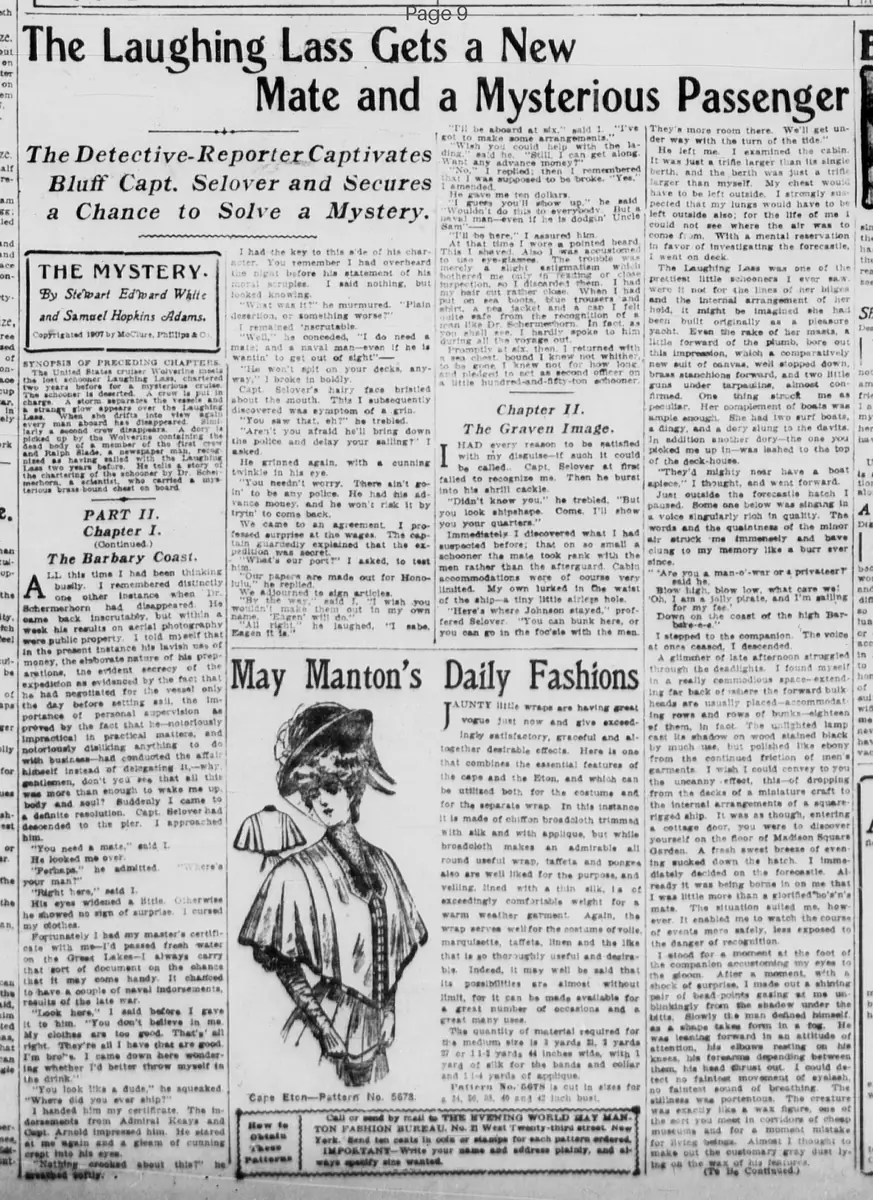
The Laughing Lass Gets a New Mate and a Mysterious Passenger.
The Detective-Reporter Captivates Bluff Capt. Selover and Secures a Chance to Solve a Mystery.
I had the key to this side of his character. You remember I had overheard the night before his statement of his moral scruples. I said nothing, but looked knowing.
"That was it?" he murmured.
"Plain desertion, or something worse?"
I remained inscrutable.
"Well," he conceded, "I do need a mate, and a naval man—even if he is wantin' to get out of sight"—
SYNOPSIS OF PRECEDING CHAPTERS.
The United States cruiser Wolverine meets the lost schooner Laughing Lass, chartered two years before for a mysterious cruise. The schooner is deserted. A crew is put in charge. A storm separates the vessels and when she drifts into view again a strange glow appears over the Laughing Lass. Every man aboard has disappeared. Similar a second crew disappears. A dory is picked up by the Wolverine containing the dead body of a member of the first crew and Ralph Slade, a newspaper man, recognized as having sailed with the Laughing Lass two years before. He tells a story of the chartering of the schooner by Dr. Schermerhorn, a scientist, who carried a mysterious brass-bound chest on board.
PART II.
Chapter I. (Continued)
The Barbary Coast.
All this time I had been thinking busily. One other instance I remembered distinctly when Dr. Schermerhorn had disappeared. He came back inscrutably, but within a week his results on aerial photography were public property. I told myself that in the present instance his lavish use of money, the elaborate nature of his preparations, the evident secrecy of the expedition as evidenced by the fact that he—notoriously impractical in practical matters, and notoriously disliking anything to do with business—had conducted the affair himself instead of delegating it,—why, gentlemen, don't you see that all this was more than enough to wake me up, body and soul? Suddenly I came to a definite resolution. Capt. Selover had descended to the pier. I approached him.
"You need a mate," said I.
He looked me over.
"Perhaps."
"Your man? Right here," said I.
His eyes widened a little. Otherwise he showed no sign of surprise. I cursed my clothes. Fortunately I had my master's certificate with me—I'd passed fresh water on the Great Lakes—I always carry that sort of document on the chance that it may come handy. It had a couple of naval indorsements, results of the late war.
"Look here," said I before I gave it to him. "You don't believe in me. My clothes are too good. That's all right. They're all I have that are good. I'm broke. I came down here wondering whether I'd better throw myself in the drink."
"You look like a dude," he squeaked.
"Where did you ever ship?"
I handed him my certificate. The indorsements from Admiral Kearn and Capt. Arnold impressed him. He stared at me again and a gleam of cunning crept into his eyes.
"Nothing crooked about this?" he breathed voraciously.
"I'll be aboard at six," said I. "I've got to make some arrangements. Wish you could help with the loading," added he.
"Still I can get along. Want any advance money?"
"No," I replied; then I remembered that I was supposed to be broke. "Yes," I amended.
He gave me ten dollars.
"I guess you'll show up," he said.
"Wouldn't do this to everybody. But a naval man—even if he is dodgin' Uncle Sam."
"I'll be here."
I assured him.
At that time I wore a pointed beard. This I shaved. Also I was accustomed to use eye-glasses. The trouble was merely a slight astigmatism which bothered me only in reading or close inspection, so I discarded them. I had my hair cut rather close. When I had put on sea boots, blue trousers and shirt, a pea jacket and a cap I felt quite safe from the recognition of a man like Dr. Schermerhorn. In fact, as you shall see, I hardly spoke to him during all the voyage out.
Promptly at six, then, I returned with a sea chest, bound I knew not whither, to be gone I knew not for how long, and engaged to act as second officer on a little hundred-and-fifty-ton schooner.
Chapter II.
The Graven Image.
I had every reason to be satisfied with my disguise—if Capt. Selover could at first failed to recognize me. Then he burst into his shrill cackle.
"Didn't know you," he trebled. "But you look shipshape. Come, I'll show you your quarters."
Immediately I discovered what I had suspected before; that on so small a schooner the mate took rank with the men rather than the afterguard. Cabin accommodations were of course very limited. My own lurked in the waist of the ship—a tiny little airless hole.
"Here's where Johnson stayed," proffered Selover. "You can bunk here, or you can go in the foc'sle with the men. There's more room there. We'll get under way with the turn of the tide."
He left me. I examined the cabin. It was just a trifle larger than its single berth, and the berth was just a trifle larger than myself. My chest would have to be left outside. I strongly suspected that my lungs would have to be left outside also; for the life of me I could not see where the air was to come from. With a mental reservation in favor of investigating the forecastle, I went on deck.
The Laughing Lass was one of the prettiest little schooners I ever saw. Were it not for the lines of her bilges and the internal arrangement of her hold, it might be imagined she had been built originally as a pleasure yacht. Even the rake of her masts, a little forward of the plumb, bore out this impression, which a comparatively new suit of canvas, well stopped down, brass stanchions forward, and two little guns under tarpaulins, almost confirmed.
One thing struck me as peculiar. Her complement of boats was ample enough. She had two surf boats, a dinghy, and a dory slung to the davits. In addition another dory—the one you picked me up in—was lashed to the top of the deck-house.
"They'd mighty near have a boat apiece," I thought, and went forward.
Just outside the forecastle hatch I paused. Some one below was singing in a voice singularly rich in quality. The words and the quaintness of the minor air struck me immensely and have clung to my memory like a burr ever since.
" 'Are you a man-o'-war or a privateer?' said he.
Blow high, blow low, what care we!
'Oh, I am a jolly pirate, and I'm sailing for my fee
Down on the coast of the high Barbary-e-.'"
I stepped to the companion. The voice at once ceased. I descended.
A glimmer of late afternoon struggled through the deadlights. I found myself in a really commodious space—extending far back of where the forward bulkheads are usually placed—accommodating rows and rows of bunks—eighteen of them, in fact.
The well-lighted lamp cast its shadow on wood stained black by much use, but polished like ebony from the continued friction of men's garments.
I wish I could convey to you the uncanny effect, this—of dropping from the decks of a miniature craft to the internal arrangements of square-rigged ship. It was as though, entering a cottage door, you were to discover yourself on the floor of Madison Square Garden. A fresh sweet breeze of evening sucked down the hatch. I immediately decided on the forecastle. Already it was being borne in on me that I was little more than glorified "bo's'n's mate." The situation suited me, however. It enabled me to watch the course of events more safely, less exposed to the danger of recognition.
I stood for a moment at the foot of the companion accustoming my eyes to the gloom. After a moment, with a shock of surprise, I made out a shining pair of bead-like points gazing at me unblinkingly from the shadow under the bitts. Slowly the man defined himself as a shape takes form in the fog. He was leaning forward in an attitude of attention, his elbows resting on his knees, forearms depending between them. His head thrust out. I could detect no faintest movement of eyelashes, no faintest sound of breathing. The stillness was portentous. The creature was exactly like a wax figure, one of those you meet in conditions of cheap museums and for a moment mistake for living beings. Almost I thought to make out the customary gray dust lying on the wax of his features.
The Detective-Reporter Captivates Bluff Capt. Selover and Secures a Chance to Solve a Mystery.
I had the key to this side of his character. You remember I had overheard the night before his statement of his moral scruples. I said nothing, but looked knowing.
"That was it?" he murmured.
"Plain desertion, or something worse?"
I remained inscrutable.
"Well," he conceded, "I do need a mate, and a naval man—even if he is wantin' to get out of sight"—
SYNOPSIS OF PRECEDING CHAPTERS.
The United States cruiser Wolverine meets the lost schooner Laughing Lass, chartered two years before for a mysterious cruise. The schooner is deserted. A crew is put in charge. A storm separates the vessels and when she drifts into view again a strange glow appears over the Laughing Lass. Every man aboard has disappeared. Similar a second crew disappears. A dory is picked up by the Wolverine containing the dead body of a member of the first crew and Ralph Slade, a newspaper man, recognized as having sailed with the Laughing Lass two years before. He tells a story of the chartering of the schooner by Dr. Schermerhorn, a scientist, who carried a mysterious brass-bound chest on board.
PART II.
Chapter I. (Continued)
The Barbary Coast.
All this time I had been thinking busily. One other instance I remembered distinctly when Dr. Schermerhorn had disappeared. He came back inscrutably, but within a week his results on aerial photography were public property. I told myself that in the present instance his lavish use of money, the elaborate nature of his preparations, the evident secrecy of the expedition as evidenced by the fact that he—notoriously impractical in practical matters, and notoriously disliking anything to do with business—had conducted the affair himself instead of delegating it,—why, gentlemen, don't you see that all this was more than enough to wake me up, body and soul? Suddenly I came to a definite resolution. Capt. Selover had descended to the pier. I approached him.
"You need a mate," said I.
He looked me over.
"Perhaps."
"Your man? Right here," said I.
His eyes widened a little. Otherwise he showed no sign of surprise. I cursed my clothes. Fortunately I had my master's certificate with me—I'd passed fresh water on the Great Lakes—I always carry that sort of document on the chance that it may come handy. It had a couple of naval indorsements, results of the late war.
"Look here," said I before I gave it to him. "You don't believe in me. My clothes are too good. That's all right. They're all I have that are good. I'm broke. I came down here wondering whether I'd better throw myself in the drink."
"You look like a dude," he squeaked.
"Where did you ever ship?"
I handed him my certificate. The indorsements from Admiral Kearn and Capt. Arnold impressed him. He stared at me again and a gleam of cunning crept into his eyes.
"Nothing crooked about this?" he breathed voraciously.
"I'll be aboard at six," said I. "I've got to make some arrangements. Wish you could help with the loading," added he.
"Still I can get along. Want any advance money?"
"No," I replied; then I remembered that I was supposed to be broke. "Yes," I amended.
He gave me ten dollars.
"I guess you'll show up," he said.
"Wouldn't do this to everybody. But a naval man—even if he is dodgin' Uncle Sam."
"I'll be here."
I assured him.
At that time I wore a pointed beard. This I shaved. Also I was accustomed to use eye-glasses. The trouble was merely a slight astigmatism which bothered me only in reading or close inspection, so I discarded them. I had my hair cut rather close. When I had put on sea boots, blue trousers and shirt, a pea jacket and a cap I felt quite safe from the recognition of a man like Dr. Schermerhorn. In fact, as you shall see, I hardly spoke to him during all the voyage out.
Promptly at six, then, I returned with a sea chest, bound I knew not whither, to be gone I knew not for how long, and engaged to act as second officer on a little hundred-and-fifty-ton schooner.
Chapter II.
The Graven Image.
I had every reason to be satisfied with my disguise—if Capt. Selover could at first failed to recognize me. Then he burst into his shrill cackle.
"Didn't know you," he trebled. "But you look shipshape. Come, I'll show you your quarters."
Immediately I discovered what I had suspected before; that on so small a schooner the mate took rank with the men rather than the afterguard. Cabin accommodations were of course very limited. My own lurked in the waist of the ship—a tiny little airless hole.
"Here's where Johnson stayed," proffered Selover. "You can bunk here, or you can go in the foc'sle with the men. There's more room there. We'll get under way with the turn of the tide."
He left me. I examined the cabin. It was just a trifle larger than its single berth, and the berth was just a trifle larger than myself. My chest would have to be left outside. I strongly suspected that my lungs would have to be left outside also; for the life of me I could not see where the air was to come from. With a mental reservation in favor of investigating the forecastle, I went on deck.
The Laughing Lass was one of the prettiest little schooners I ever saw. Were it not for the lines of her bilges and the internal arrangement of her hold, it might be imagined she had been built originally as a pleasure yacht. Even the rake of her masts, a little forward of the plumb, bore out this impression, which a comparatively new suit of canvas, well stopped down, brass stanchions forward, and two little guns under tarpaulins, almost confirmed.
One thing struck me as peculiar. Her complement of boats was ample enough. She had two surf boats, a dinghy, and a dory slung to the davits. In addition another dory—the one you picked me up in—was lashed to the top of the deck-house.
"They'd mighty near have a boat apiece," I thought, and went forward.
Just outside the forecastle hatch I paused. Some one below was singing in a voice singularly rich in quality. The words and the quaintness of the minor air struck me immensely and have clung to my memory like a burr ever since.
" 'Are you a man-o'-war or a privateer?' said he.
Blow high, blow low, what care we!
'Oh, I am a jolly pirate, and I'm sailing for my fee
Down on the coast of the high Barbary-e-.'"
I stepped to the companion. The voice at once ceased. I descended.
A glimmer of late afternoon struggled through the deadlights. I found myself in a really commodious space—extending far back of where the forward bulkheads are usually placed—accommodating rows and rows of bunks—eighteen of them, in fact.
The well-lighted lamp cast its shadow on wood stained black by much use, but polished like ebony from the continued friction of men's garments.
I wish I could convey to you the uncanny effect, this—of dropping from the decks of a miniature craft to the internal arrangements of square-rigged ship. It was as though, entering a cottage door, you were to discover yourself on the floor of Madison Square Garden. A fresh sweet breeze of evening sucked down the hatch. I immediately decided on the forecastle. Already it was being borne in on me that I was little more than glorified "bo's'n's mate." The situation suited me, however. It enabled me to watch the course of events more safely, less exposed to the danger of recognition.
I stood for a moment at the foot of the companion accustoming my eyes to the gloom. After a moment, with a shock of surprise, I made out a shining pair of bead-like points gazing at me unblinkingly from the shadow under the bitts. Slowly the man defined himself as a shape takes form in the fog. He was leaning forward in an attitude of attention, his elbows resting on his knees, forearms depending between them. His head thrust out. I could detect no faintest movement of eyelashes, no faintest sound of breathing. The stillness was portentous. The creature was exactly like a wax figure, one of those you meet in conditions of cheap museums and for a moment mistake for living beings. Almost I thought to make out the customary gray dust lying on the wax of his features.
What sub-type of article is it?
Prose Fiction
What keywords are associated?
Laughing Lass
Schooner
Mystery
Detective Reporter
Disguise
Sea Voyage
Barbary Coast
Graven Image
Dr Schermerhorn
Capt Selover
Literary Details
Title
The Laughing Lass Gets A New Mate And A Mysterious Passenger.
Form / Style
Adventure Narrative In Prose
Key Lines
" 'Are You A Man O' War Or A Privateer?' Said He.
Blow High, Blow Low, What Care We!
'Oh, I Am A Jolly Pirate, And I'm Sailing For My Fee
Down On The Coast Of The High Barbary E .'"
"The Creature Was Exactly Like A Wax Figure, One Of Those You Meet In Conditions Of Cheap Museums And For A Moment Mistake For Living Beings."