Thank you for visiting SNEWPapers!
Sign up free
Editorial
February 7, 1890
The Cambria Freeman
Ebensburg, Cambria County, Pennsylvania
What is this article about?
Editorial criticizes the Speaker of the U.S. House (Caesar Reed) for denying the right of appeal from his decisions, arguing it establishes autocracy, undermines representative government, and corrupts justice in legislation at Washington.
Clipping
OCR Quality
95%
Excellent
Full Text
The Right of Appeal.
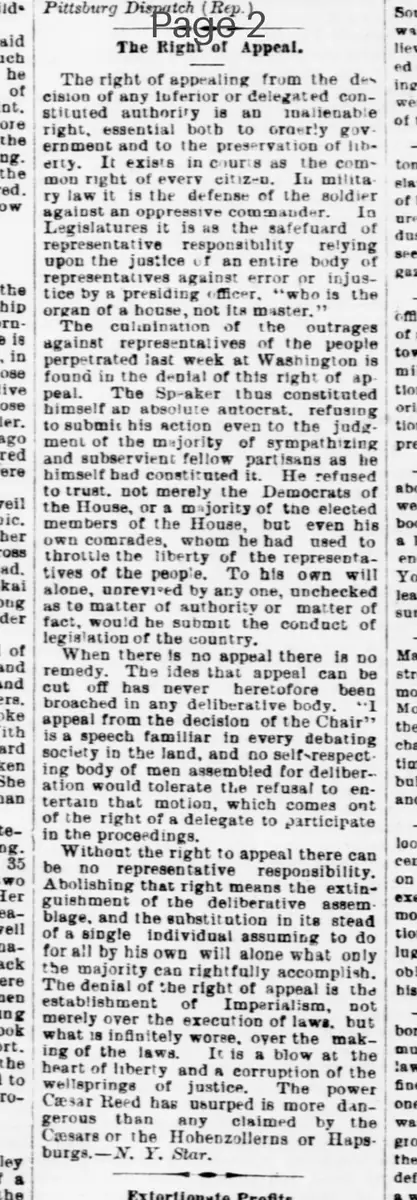
The right of appealing from the decision of any inferior or delegated constituted authority is an inalienable right, essential both to orderly government and to the preservation of liberty. It exists in courts as the common right of every citizen. In military law it is the defense of the soldier against an oppressive commander. In Legislatures it is as the safeguard of representative responsibility relying upon the justice of an entire body of representatives against error or injustice by a presiding officer, "who is the organ of a house, not its master." The culmination of the outrages against representatives of the people perpetrated last week at Washington is found in the denial of this right of appeal. The Speaker thus constituted himself an absolute autocrat, refusing to submit his action even to the judgment of the majority of sympathizing and subservient fellow partisans as he himself had constituted it. He refused to trust, not merely the Democrats of the House, or a majority of the elected members of the House, but even his own comrades, whom he had used to throttle the liberty of the representatives of the people. To his own will alone, unrevised by any one, unchecked as to matter of authority or matter of fact, would he submit the conduct of legislation of the country. When there is no appeal there is no remedy. The idea that appeal can be cut off has never heretofore been broached in any deliberative body. "I appeal from the decision of the Chair" is a speech familiar in every debating society in the land, and no self-respecting body of men assembled for deliberation would tolerate the refusal to entertain that motion, which comes out of the right of a delegate to participate in the proceedings. Without the right to appeal there can be no representative responsibility. Abolishing that right means the extinguishment of the deliberative assemblage, and the substitution in its stead of a single individual assuming to do for all by his own will alone what only the majority can rightfully accomplish. The denial of the right of appeal is the establishment of Imperialism, not merely over the execution of laws, but what is infinitely worse, over the making of the laws. It is a blow at the heart of liberty and a corruption of the wellsprings of justice. The power Caesar Reed has usurped is more dangerous than any claimed by the Caesars or the Hohenzollerns or Hapsburgs.—N. Y. Star.
The right of appealing from the decision of any inferior or delegated constituted authority is an inalienable right, essential both to orderly government and to the preservation of liberty. It exists in courts as the common right of every citizen. In military law it is the defense of the soldier against an oppressive commander. In Legislatures it is as the safeguard of representative responsibility relying upon the justice of an entire body of representatives against error or injustice by a presiding officer, "who is the organ of a house, not its master." The culmination of the outrages against representatives of the people perpetrated last week at Washington is found in the denial of this right of appeal. The Speaker thus constituted himself an absolute autocrat, refusing to submit his action even to the judgment of the majority of sympathizing and subservient fellow partisans as he himself had constituted it. He refused to trust, not merely the Democrats of the House, or a majority of the elected members of the House, but even his own comrades, whom he had used to throttle the liberty of the representatives of the people. To his own will alone, unrevised by any one, unchecked as to matter of authority or matter of fact, would he submit the conduct of legislation of the country. When there is no appeal there is no remedy. The idea that appeal can be cut off has never heretofore been broached in any deliberative body. "I appeal from the decision of the Chair" is a speech familiar in every debating society in the land, and no self-respecting body of men assembled for deliberation would tolerate the refusal to entertain that motion, which comes out of the right of a delegate to participate in the proceedings. Without the right to appeal there can be no representative responsibility. Abolishing that right means the extinguishment of the deliberative assemblage, and the substitution in its stead of a single individual assuming to do for all by his own will alone what only the majority can rightfully accomplish. The denial of the right of appeal is the establishment of Imperialism, not merely over the execution of laws, but what is infinitely worse, over the making of the laws. It is a blow at the heart of liberty and a corruption of the wellsprings of justice. The power Caesar Reed has usurped is more dangerous than any claimed by the Caesars or the Hohenzollerns or Hapsburgs.—N. Y. Star.
What sub-type of article is it?
Constitutional
Partisan Politics
What keywords are associated?
Right Of Appeal
Speaker Autocracy
Congressional Outrages
Representative Liberty
Imperialism In Legislature
What entities or persons were involved?
Speaker Caesar Reed
Democrats Of The House
N. Y. Star
Editorial Details
Primary Topic
Denial Of Right Of Appeal By Speaker In Congress
Stance / Tone
Strongly Critical Of Autocratic Speaker, Defending Representative Liberty
Key Figures
Speaker Caesar Reed
Democrats Of The House
N. Y. Star
Key Arguments
Right Of Appeal Is Inalienable And Essential To Government And Liberty
Denial Of Appeal By Speaker Constitutes Absolute Autocracy
Refusal To Submit To Majority Judgment Undermines Representative Responsibility
Abolishing Appeal Extinguishes Deliberative Bodies And Establishes Imperialism In Law Making
Power Usurped By Reed More Dangerous Than Historical Tyrants