Thank you for visiting SNEWPapers!
Sign up free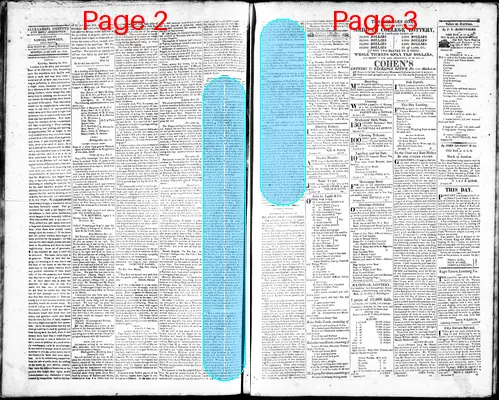
Alexandria Gazette & Daily Advertiser
Alexandria, Virginia
What is this article about?
Excerpt from New-York Evening Post editorial criticizes inaccuracies and outdated information in European publications about the United States, attributing them to political motives to belittle the republic, and urges reliance on American sources for accurate knowledge of the country.
Merged-components note: This is a continuation of the editorial 'MISTAKES RESPECTING AMERICA' across pages 2 and 3, as the text on page 3 picks up directly from where the page 2 text ends.
Clippings

1 of 2
OCR Quality
Full Text
The following judicious remarks are extracted from a communication in the New-York Evening Post, of the 13th instant, exposing the mistakes entertained by foreigners relative to the U. states, and which certain political writers in England have found it convenient both to fabricate and diffuse:
"I institute no comparison between the attainments of Americans and foreigners in the higher departments of science; but I have always imagined that actual residence, research and observation were among the best qualifications, if not indispensable requisites in a writer of original geography; and when I see a respectable work on this country, published in Paris in 1816, deriving its authority and copying its accounts from the compilations (among others) of the veritable Weld and Henry, who ended his travels in 1776; and when I see the prospectus of Mr. Warden, speaking of twenty-one states and five territories ;-- and find in one of the most superb and respectable atlases ever published in the English language, from the first engravers and geographers in London, (by Neele, in 1814) a state of Franklin; elegantly delineated, a New-Jersey district on the Mississippi, and the Indiana territory placed in Virginia, I cannot but suspect a general deficiency in the means of information, or a wilful design to deceive and mislead, in the transatlantic authors and compilers of maps and geographies of the United States.
"Nor can I but view it as somewhat singular, in any writer, however distinguished by his talents and erudition, that he should advance as a principal qualification for writing a history and description of the United States, a residence of ten years at three thousand miles distant from the country! How strangely mal-a-propos is the case of Michaux, quoted as a successful instance of a work upon America by a foreign author! Michaux father and son, personally explored the country, with great labor, care and assiduity, by traversing and examining it on foot, in different directions, from the state of Georgia to Canada, and published the result of their actual observations and personal remarks. Of what European geographer can as much be said? This was materially different from a 'residence in Paris of ten years, and reading ten thousand newspapers' there.
"I complain, generally, of a disposition in my countrymen to patronize exotic talent and enterprize in preference to American genius and undertakings.-- I mention the case of a respectable gentleman purchasing a map of the United States, published in Paris, at a price of twenty dollars, after refusing to pay ten for Bradley's. I censure no foreigner for making books for us, when he knows they will be preferred to those of our own manufacture. On the contrary, I cheerfully yield my gratitude and applause for the incalculable benefits we have derived from them. But for information of the nature, character, features, history, statistics and geology of our country--knowledge to be derived only from the personal experience of authors or compilations of editors, I conceive the United States, as the source, ought to be the seat and repository of intelligence whether the publication be intended for European or American readers. To collect and diffuse correct information is a laudable attempt, and by a people so ignorant as the readers of our French compilation must be, should be gratefully received and liberally supported. On this side the Atlantic the case is somewhat different.
"But a more serious complaint, Mr. Editor, I must prefer against Europeans, who, with means of information and better knowledge within their power, body and disseminate the most ignorant, incorrect and injurious accounts of the United States. I strongly suspect a design in these admirers of legitimate royalty, to belittle and misrepresent, from political motives, every moral and statistical fact in this growing republic. Else why publish accounts of our condition and history, written thirty or forty years preceding, omitting or neglecting a period in which the United States have doubled in almost every thing, and represent the state of the country in 1775 as its actual condition in 1816? Why are the French readers told, for instance, that in 1816 Mr. Jefferson was president: a fact mentioned only to show the period in which the volume was written, notwithstanding a particular statement of the different sections written by the several compilers in every year? Our navy and army...
given at 5,000 troops, 6 frigates, &c. remarks on its weakness. Mr. Morse's make of 70,000, it is stated, would be incorrectly 150,000. A few other blunders, wilful or not, follow:
"In New-England the language is (said to be) so corrupted, that an Englishman can scarcely understand an American!
"In the pretended reformed religion prevails, but in Maryland the Catholics are got now numerous!
The "vog bondage" of the emigrants is described in a peculiar style.
The president is elected for 7 years!
Plymouth, Mass. has 19,000 inhabitants, and Boston 20,000.
In Boston the Marine Society is placed at the head of the learned institutions!
Connecticut produces rice as a staple - and imports it from the West Indies!
"The population of New-York is estimated at 550,000, up to 1795 only! And in this region commences the horrible yellow fever, which figures through the southern states, as annually depopulating the towns and cities! A silver mine in this state! One bank in the city, besides a branch of the United States.
"In Philadelphia 70,000 inhabitants; the grossness of the lower classes surprising strangers. Yellow fever again.
In Ohio, trees 40 feet in circumference. Maize, bacon, milk and butter, the food of the people - seldom anything else found. Inhabitants live in cabins or log houses.
"Bilious and yellow fevers in Virginia; souging described; one-eyed men numerous.
"No church in Richmond - preach in the capitol. &c. &c. ad infinitum.
"Upon the whole, I am not of opinion with a learned and modest editor of a morning print, that the inhabitants of this country are better judges than Europeans of the events of the eastern continent. (the author of said idea alone excepting:)
Nor am I convinced that the citizens of the United States would be more likely to profit by compilations from Weld, Ashe, Fearon, or later European travellers, than from the researches, disquisitions and labors of native or resident geographers, statisticians and writers, on the peculiar state and affairs of North America. On the score of advantage, then, and on the general principle of encouraging merit in the most natural and beneficial manner, as well as from motives of common patriotism or national pride, I wish to see the U. States independent of foreigners on subjects of local interest and knowledge, liberal in fostering native talent and enterprise, and vindicated, in one particular at least, from the charge made, or quoted, by our Parisian shrewd, that 'Les republiques sont toujours ingrates.'
What sub-type of article is it?
What keywords are associated?
What entities or persons were involved?
Editorial Details
Primary Topic
Mistakes In Foreign Publications About The United States
Stance / Tone
Critical Of European Misrepresentations And Patriotic Advocacy For American Sources
Key Figures
Key Arguments