Thank you for visiting SNEWPapers!
Sign up free
The New York Journal, And Daily Patriotic Register
New York, New York County, New York
What is this article about?
In the Massachusetts Convention, Hon. Mr. King argues for two-year terms for congressional representatives, drawing on historical precedents from Europe and early American colonies, emphasizing the need for sufficient time to gain information on national matters while maintaining electoral checks.
Merged-components note: Continuation of 'DEBATES IN MASSACHUSETTS CONVENTION' across two components on the same page, merged for completeness.
Clipping
OCR Quality
Full Text
MASSACHUSETTS CONVENTION,
Continued from Tuesday's paper.
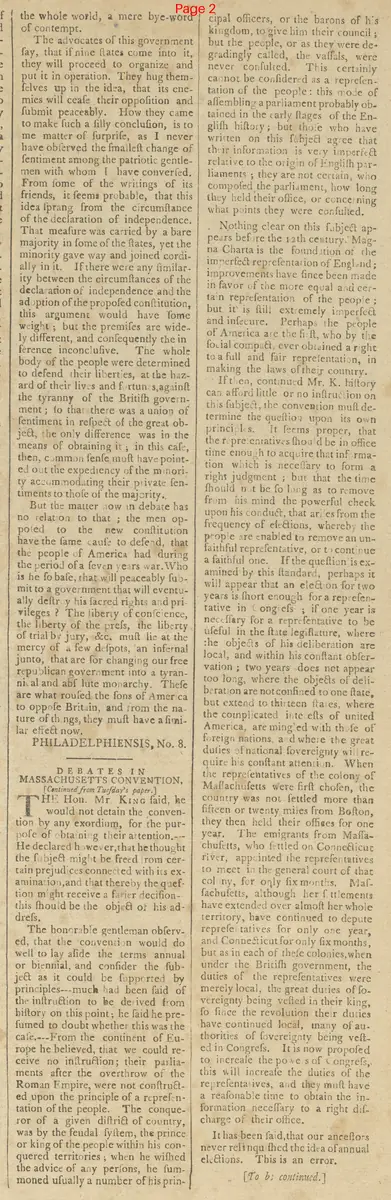
THE Hon. Mr. King said, he would not detain the convention by any exordium, for the purpose of obtaining their attention.— He declared however, that he thought the subject might be freed from certain prejudices connected with its examination, and that thereby the question might receive a fairer decision— this should be the object of his address.
The honorable gentleman observed, that the convention would do well to lay aside the terms annual or biennial, and consider the subject as it could be supported by principles---much had been said of the instruction to be derived from history on this point; he said he presumed to doubt whether this was the case. --From the continent of Europe he believed, that we could receive no instruction; their parliaments after the overthrow of the Roman Empire, were not constructed upon the principle of a representation of the people. The conqueror of a given district of country, was by the feudal system, the prince or king of the people within his conquered territories; when he wished the advice of any persons, he summoned usually a number of his principal officers, or the barons of his kingdom, to give him their council; but the people, or as they were degradingly called, the vassals, were never consulted. This certainly cannot be considered as a representation of the people: this mode of assembling a parliament probably obtained in the early stages of the English history; but those who have written on this subject agree that their information is very imperfect relative to the origin of English parliaments; they are not certain, who composed the parliament, how long they held their office, or concerning what points they were consulted. Nothing clear on this subject appears before the 12th century. Magna Charta is the foundation of the imperfect representation of England improvements have since been made in favor of the more equal and certain representation of the people; but it is still extremely imperfect and insecure. Perhaps the people of America are the first, who by the social compact, ever obtained a right to a full and fair representation, in making the laws of their country.
If then, continued Mr. K. history can afford little or no instruction on this subject, the convention must determine the question upon its own principles. It seems proper, that the representatives should be in office time enough to acquire that information which is necessary to form a right judgment; but that the time should not be so long as to remove from his mind the powerful check upon his conduct, that arises from the frequency of elections, whereby the people are enabled to remove an unfaithful representative, or to continue a faithful one. If the question is examined by this standard, perhaps it will appear that an election for two years is short enough for a representative in Congress; if one year is necessary for a representative to be useful in the state legislature, where the objects of his deliberation are local, and within his constant observation; two years does not appear too long, where the objects of deliberation are not confined to one state, but extend to thirteen states, where the complicated interests of united America, are mingled with those of foreign nations, and where the great duties of national sovereignty will require his constant attention. When the representatives of the colony of Massachusetts were first chosen, the country was not settled more than fifteen or twenty miles from Boston, they then held their offices for one year. The emigrants from Massachusetts, who settled on Connecticut river, appointed the representatives to meet in the general court of that colony, for only six months. Massachusetts. although her settlements have extended over almost her whole territory, have continued to depute representatives for only one year, and Connecticut for only six months, but as in each of these colonies, when under the British government, the duties of the representatives were merely local, the great duties of sovereignty being vested in their king, so since the revolution their duties have continued local, many of the authorities of sovereignty being vested in Congress. It is now proposed to increase the powers of Congress, this will increase the duties of the representatives, and they must have a reasonable time to obtain the information necessary to a right discharge of their office.
It has been said, that our ancestors never relinquished the idea of annual elections. This is an error.
To be continued.
What sub-type of article is it?
What keywords are associated?
What entities or persons were involved?
Where did it happen?
Domestic News Details
Primary Location
Massachusetts
Key Persons
Event Details
Hon. Mr. King addresses the Massachusetts Convention on the merits of two-year terms for congressional representatives, arguing against relying on European history, highlighting the need for time to inform on national duties, and correcting misconceptions about ancestral election practices.