Thank you for visiting SNEWPapers!
Sign up free
Story
November 4, 1843
Arkansas Intelligencer
Van Buren, Crawford County, Arkansas
What is this article about?
Article from the Nashville Agriculturist on the value and management of orchards, emphasizing low-cost fruit production in Tennessee, including selection of varieties, planting, cultivation, and pruning techniques.
Clipping
OCR Quality
95%
Excellent
Full Text
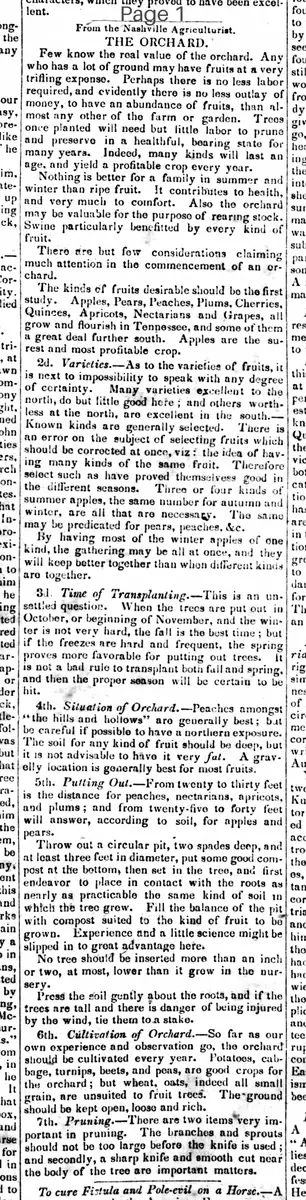
From the Nashville Agriculturist.
THE ORCHARD.
Few know the real value of the orchard. Any
Who has a lot of ground may have fruits at a very
Trifling expense. Perhaps there is no less labor
Required, and evidently there is no less outlay of
Money, to have an abundance of fruits, than al-
Most any other of the farm or garden. Trees
Once planted will need but little labor to prune
And preserve in a healthful, bearing state for
Many years. Indeed, many kinds will last an
Age, and yield a profitable crop every year.
Nothing is better for a family in summer and
Winter than ripe fruit. It contributes to health,
And very much to comfort. Also the orchard
May be valuable for the purpose of rearing stock.
Swine particularly benefitted by every kind of
Fruit.
There are but few considerations claiming
Much attention in the commencement of an or-
Chard.
The kinds of fruits desirable should be the first
Study. Apples, Pears, Peaches, Plums, Cherries,
Quinces, Apricots, Nectarines and Grapes, all
Grow and flourish in Tennessee, and some of them
A great deal further south. Apples are the su-
Rest and most profitable crop.
2d. Varieties.—As to the varieties of fruits, it
Is next to impossibility to speak with any degree
Of certainty.
Many varieties excellent to the
North, do but little good here; and others worth-
Less at the north, are excellent in the south.—
Known kinds are generally selected. There is
An error on the subject of selecting fruits which
Should be corrected at once, viz: the idea of hav-
Ing many kinds of the same fruit. Therefore
Select such as have proved themselves good in
The different seasons. Three or four kinds of
Summer apples, the same number for autumn and
Winter, are all that are necessary. The same
May be predicated for pears, peaches, &c.
By having most of the winter apples of one
Kind, the gathering may be all at once, and they
Will keep better together than when different kinds
Are together.
3d. Time of Transplanting.—This is an un-
Settled question. When the trees are put out in
October, or beginning of November, and the win-
Ter is not very hard, the fall is the best time; but
If the freezes are hard and frequent, the spring
Proves more favorable for putting out trees. It
Is not a bad rule to transplant both fall and spring,
And then the proper season will be certain to be
Hit.
4th. Situation of Orchard.—Peaches amongst
"The hills and hollows" are generally best; but
Be careful if possible to have a northern exposure.
The soil for any kind of fruit should be deep, but
It is not advisable to have it very fat. A grav-
Elly location is generally best for most fruits.
5th. Putting Out.—From twenty to thirty feet
Is the distance for peaches, nectarines, apricots,
And plums; and from twenty-five to forty feet
Will answer, according to soil, for apples and
Pears.
Throw out a circular pit, two spades deep, and
At least three feet in diameter, put some good com-
Post at the bottom, then set in the tree, and first
Endeavor to place in contact with the roots as
Nearly as practicable the same kind of soil in
Which the tree grew. Fill the balance of the pit
With compost suited to the kind of fruit to be
Grown. Experience and a little science might be
Slipped in to great advantage here.
No tree should be inserted more than an inch
Or two, at most, lower than it grow in the nur-
Sery.
Press the soil gently about the roots, and if the
Trees are tall and there is danger of being injured
By the wind, tie them to a stake.
6th. Cultivation of Orchard.—So far as our
Own experience and observation go, the orchard
Should be cultivated every year. Potatoes, cab-
Bage, turnips, beets, and peas, are good crops for
The orchard; but wheat, oats, indeed all small
Grain, are unsuited to fruit trees. The ground
Should be kept open, loose and rich.
7th. Pruning.—There are two items very im-
Portant in pruning. The branches and sprouts
Should not be too large before the knife is used ;
And secondly, a sharp knife and smooth cut near
The body of the tree are important matters.
THE ORCHARD.
Few know the real value of the orchard. Any
Who has a lot of ground may have fruits at a very
Trifling expense. Perhaps there is no less labor
Required, and evidently there is no less outlay of
Money, to have an abundance of fruits, than al-
Most any other of the farm or garden. Trees
Once planted will need but little labor to prune
And preserve in a healthful, bearing state for
Many years. Indeed, many kinds will last an
Age, and yield a profitable crop every year.
Nothing is better for a family in summer and
Winter than ripe fruit. It contributes to health,
And very much to comfort. Also the orchard
May be valuable for the purpose of rearing stock.
Swine particularly benefitted by every kind of
Fruit.
There are but few considerations claiming
Much attention in the commencement of an or-
Chard.
The kinds of fruits desirable should be the first
Study. Apples, Pears, Peaches, Plums, Cherries,
Quinces, Apricots, Nectarines and Grapes, all
Grow and flourish in Tennessee, and some of them
A great deal further south. Apples are the su-
Rest and most profitable crop.
2d. Varieties.—As to the varieties of fruits, it
Is next to impossibility to speak with any degree
Of certainty.
Many varieties excellent to the
North, do but little good here; and others worth-
Less at the north, are excellent in the south.—
Known kinds are generally selected. There is
An error on the subject of selecting fruits which
Should be corrected at once, viz: the idea of hav-
Ing many kinds of the same fruit. Therefore
Select such as have proved themselves good in
The different seasons. Three or four kinds of
Summer apples, the same number for autumn and
Winter, are all that are necessary. The same
May be predicated for pears, peaches, &c.
By having most of the winter apples of one
Kind, the gathering may be all at once, and they
Will keep better together than when different kinds
Are together.
3d. Time of Transplanting.—This is an un-
Settled question. When the trees are put out in
October, or beginning of November, and the win-
Ter is not very hard, the fall is the best time; but
If the freezes are hard and frequent, the spring
Proves more favorable for putting out trees. It
Is not a bad rule to transplant both fall and spring,
And then the proper season will be certain to be
Hit.
4th. Situation of Orchard.—Peaches amongst
"The hills and hollows" are generally best; but
Be careful if possible to have a northern exposure.
The soil for any kind of fruit should be deep, but
It is not advisable to have it very fat. A grav-
Elly location is generally best for most fruits.
5th. Putting Out.—From twenty to thirty feet
Is the distance for peaches, nectarines, apricots,
And plums; and from twenty-five to forty feet
Will answer, according to soil, for apples and
Pears.
Throw out a circular pit, two spades deep, and
At least three feet in diameter, put some good com-
Post at the bottom, then set in the tree, and first
Endeavor to place in contact with the roots as
Nearly as practicable the same kind of soil in
Which the tree grew. Fill the balance of the pit
With compost suited to the kind of fruit to be
Grown. Experience and a little science might be
Slipped in to great advantage here.
No tree should be inserted more than an inch
Or two, at most, lower than it grow in the nur-
Sery.
Press the soil gently about the roots, and if the
Trees are tall and there is danger of being injured
By the wind, tie them to a stake.
6th. Cultivation of Orchard.—So far as our
Own experience and observation go, the orchard
Should be cultivated every year. Potatoes, cab-
Bage, turnips, beets, and peas, are good crops for
The orchard; but wheat, oats, indeed all small
Grain, are unsuited to fruit trees. The ground
Should be kept open, loose and rich.
7th. Pruning.—There are two items very im-
Portant in pruning. The branches and sprouts
Should not be too large before the knife is used ;
And secondly, a sharp knife and smooth cut near
The body of the tree are important matters.
What sub-type of article is it?
Agricultural Guide
Horticultural Advice
What keywords are associated?
Orchard
Fruit Trees
Planting
Tennessee
Agriculture
Pruning
Cultivation
Varieties
Transplanting
Where did it happen?
Tennessee
Story Details
Location
Tennessee
Story Details
Advises on the benefits and low cost of orchards for fruit production and stock rearing; recommends selecting proven fruit varieties like apples, pears, peaches suited to Tennessee; discusses transplanting in fall or spring, ideal locations with northern exposure and gravelly soil, planting distances and methods, annual cultivation with certain crops, and proper pruning techniques.