Thank you for visiting SNEWPapers!
Sign up free
Virginia Argus
Richmond, Virginia
What is this article about?
British Captain Bingham reports on the May 21, 1811, naval encounter off Cape Charles where the US frigate President fired on HMS Little Belt after a chase and hailing exchange, resulting in 32 British casualties and ship damage; Commodore Rodgers later apologized, claiming the British fired first.
Clipping
OCR Quality
Full Text
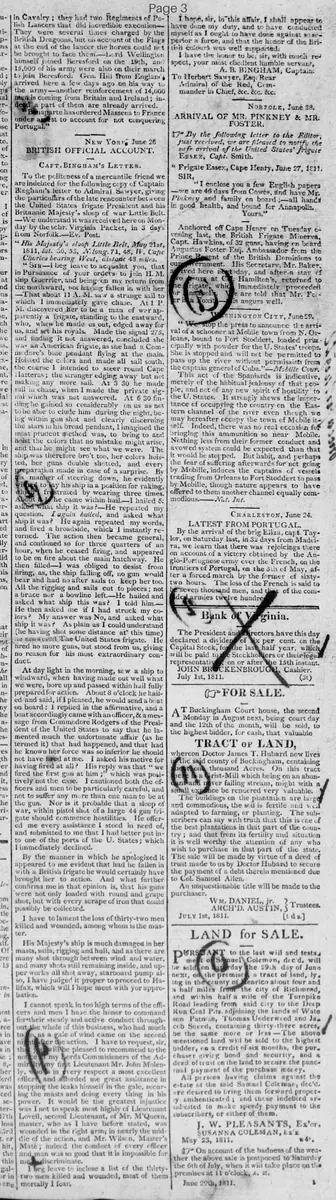
BRITISH OFFICIAL ACCOUNT.
Capt. Bingham's Letter.
To the politeness of a mercantile friend we are indebted for the following copy of Captain Bingham's letter to Admiral Sawyer, giving the particulars of the late rencounter between the United States frigate President and his Britannic Majesty's sloop of war Little Belt. —We understand it was received here on Monday by the schr. Virginia Packet, in 3 days from Norfolk.—Ev. Post.
"His Majesty's sloop Little Belt, May 21st, 1811, lat. 36, 53, N. long. 71, 48, W. Cape Charles bearing West, distant 48 miles.
SIR—I beg leave to acquaint you, that in Pursuance of your orders to join H.M. ship Guerrier, and being on my return from the northward, not having fallen in with her—That about 11 A.M. saw a strange sail to which I immediately gave chase. At 1 P.M. discovered her to be a man of war apparently a frigate, standing to the eastward, who, when he made us out, edged away for us, and set his royals. Made the signal 275, and finding it not answered, concluded she was an American frigate, as she had a Commodore's blue pendant flying at the main. Hoisted the colors and made all sail south, the course I intended to steer round Cape Hatteras; the stranger edging away but not making any more sail. At 3 30 he made sail in chase, when I made the private signal which was not answered. At 6 30 finding he gained so considerably on us as not to be able to elude him during the night, being within gun shot and clearly discerning the stars in his broad pendant, I imagined the most prudent method was, to bring to and hoist the colors that no mistake might arise, and that he might see what we were. The ship was therefore bro't too, her colors hoisted, her guns double shotted, and every preparation made in case of a surprise. By his manner of steering down, he evidently wished to lay his ship in a position for raking, which frustrated by wearing three times. About 8 1 he came within hail.—I hailed & asked what ship it was?—He repeated my question. I again hailed, and asked what ship it was? He again repeated my words, and fired a broadside, which I instantly returned. The action then became general, and continued so for three quarters of an hour, when he ceased firing, and appeared to be on fire about the main hatchway. He then filled—I was obliged to desist from firing, as, the ship falling off, no gun would bear and had no after sails to keep her too. All the rigging and sails cut to pieces; not a brace nor a bowline left.—He hailed and asked what ship this was? I told him.— He then asked if I had struck my colors? My answer was No, and asked what ship it was? As plain as I could understand (he having shot some distance at this time) he answered The United States frigate. He fired no more guns, but stood from us, giving no reason for his most extraordinary conduct.
At day light in the morning, saw a ship to windward, when having made out well what we were, bore up and passed within hail fully prepared for action. About 8 o'clock he hailed and said, if I pleased, he would send a boat on board: I replied in the affirmative, and a boat accordingly came with an officer, & a message from Commodore Rodgers of the President of the United States to say that he lamented much the unfortunate affair (as he termed it) that had happened, and that had he known her force was so inferior he should not have fired at me. I asked his motive for having fired at all? His reply was that "we fired the first gun at him;" which was positively not the case. I cautioned both the officers and men to be particularly careful, and not to suffer any more than one man to be at the gun. Nor is it probable that a sloop of war, within pistol shot of a large 44 gun frigate should commence hostilities. He offered me every assistance I stood in need of, and submitted to me that I had better put into one of the ports of the U. States; which I immediately declined.
By the manner in which he apologized it appeared to me evident that had he fallen in with a British frigate he would certainly have brought her to action. And what further confirms me in that opinion is, that his guns were not only loaded with round and grape shot, but with every scrape of iron that could possibly be collected.
I have to lament the loss of thirty-two men killed and wounded, among whom is the master.
His Majesty's ship is much damaged in her masts, sails, rigging and hull, and as there are many shot through between wind and water, and many shots still remaining inside, and upper works all shot away, starboard pump also, I have judged it proper to proceed to Halifax, which will I hope meet with your approbation.
I cannot speak in too high terms of the officers and men I have the honor to command for their steady and active conduct throughout the whole of this business, who had much to do, as a gale of wind came on the second night after the action. I have to request, sir, that you will be pleased to recommend to the honorable the Lords Commissioners of the admiralty, the officers and men who afforded stopping the leaks himself in the gale, securing the masts and doing every thing in his power. It would be the greatest injustice was I not to speak most highly of Lieutenant Lovell, second Lieutenant, of Mr. M'Queen, master, who as I have before stated, was wounded in the right arm; in nearly the middle of the action, and Mr. Wilson, Master's Mate: indeed the conduct of every officer and man was so good that it is impossible for me to discriminate.
I beg leave to inclose a list of the thirty-two men killed and wounded, most of them mortally I fear.
I hope, sir, in this affair, I shall appear to have done my duty, and to have conducted myself as I ought to have done against so superior a force, and that the honor of the British colors was well supported:
I have the honor to be, sir, with much respect, your most obedient humble servant,
A. B. BINGHAM, Captain:
To Herbert Sawyer, Esq: Rear Admiral of the Red, Commander in Chief, &c. &c. &c:
What sub-type of article is it?
What keywords are associated?
What entities or persons were involved?
Where did it happen?
Foreign News Details
Primary Location
Off Cape Charles
Event Date
May 21st, 1811
Key Persons
Outcome
32 british men killed and wounded; hms little belt severely damaged in masts, sails, rigging, hull; proceeds to halifax; us frigate president appeared on fire but disengaged without further firing.
Event Details
Captain Bingham of HMS Little Belt chased a strange sail, identified as the US frigate President under Commodore Rodgers. After signals went unanswered, Bingham brought to and hoisted colors. President approached, hailing exchanged, then President fired a broadside, which was returned. Action lasted 45 minutes until President ceased fire and appeared on fire. Next morning, Rodgers sent a boat apologizing for the 'unfortunate affair,' claiming Little Belt fired first, and offered assistance, which was declined.