Thank you for visiting SNEWPapers!
Sign up free
Montana Oil And Mining Journal
Great Falls, Billings, Cascade County, Yellowstone County, Montana
What is this article about?
Montana faces reduced oil revenue from major companies' price cuts and premium refusals, impacting schools; Auditor Porter resists $3,400 storage fee, deducted from sales, contributing to his election defeat amid corporate control.
Clipping
OCR Quality
Full Text
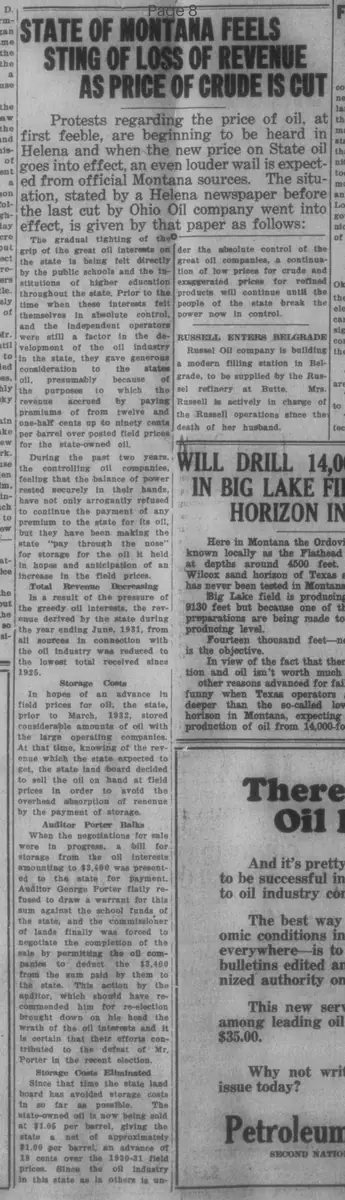
Protests regarding the price of oil, at first feeble, are beginning to be heard in Helena and when the new price on State oil goes into effect, an even louder wail is expected from official Montana sources.
The situation, stated by a Helena newspaper before the last cut by Ohio Oil company went into effect, is given by that paper as follows:
The gradual tightening of grip of the great oil interests on the state is being felt directly by the public schools and the institutions of higher education throughout the state. Prior to the time when these interests felt themselves in absolute control, and the independent operators were still a factor in the development of the oil industry in the state, they gave generous consideration to the state's oil, presumably because of the purposes to which the revenue accrued by paying premiums of from twelve and one-half cents up to ninety cents per barrel over posted field prices for the state-owned oil.
During the past two years, the controlling oil companies, feeling that the balance of power rested securely in their hands, have not only arrogantly refused to continue the payment of any premium to the state for its oil, but they have been making the state "pay through the nose" for storage for the oil it held in hopes and anticipation of an increase in the field prices.
Total Revenue Decreasing As a result of the pressure of the greedy oil interests, the revenue derived by the state during the year ending June, 1931, from all sources in connection with the oil industry was reduced to the lowest total received since 1925.
Storage Costs In hopes of an advance in field prices for oil, the state, prior to March, 1932, stored considerable amounts of oil with the large operating companies. At that time, knowing of the revenue which the state expected to get, the state land board decided to sell the oil on hand at field prices in order to avoid the overhead absorption of revenue by the payment of storage.
Auditor Porter Balks When the negotiations for sale were in progress, a bill for storage from the oil interests amounting to $3,400 was presented to the state for payment. Auditor George Porter flatly refused to draw a warrant for this sum against the school funds of the state, and the commissioner of lands finally was forced to negotiate the completion of the sale by permitting the oil companies to deduct the $3,400 from the sum paid by them to the state. This action by the auditor, which should have recommended him for re-election brought down on his head the wrath of the oil interests and it is certain that their efforts contributed to the defeat of Mr. Porter in the recent election.
Storage Costs Eliminated Since that time the state land board has avoided storage costs in so far as possible. The state-owned oil is now being sold at $1.05 per barrel, giving the state a net of approximately $1.00 per barrel, an advance of 19 cents over the 1930-31 field prices. Since the oil industry in this state as in others is under the absolute control of the great oil companies, a continuation of low prices for crude and exaggerated prices for refined products will continue until the people of the state break the power now in control.
What sub-type of article is it?
What themes does it cover?
What keywords are associated?
What entities or persons were involved?
Where did it happen?
Story Details
Key Persons
Location
Montana, Helena
Event Date
1931 1932
Story Details
Montana's state revenue from oil decreases due to price cuts and refusal of premiums by controlling oil companies, affecting public schools. State stores oil hoping for price rise but incurs storage costs; Auditor George Porter refuses to pay $3,400 storage bill from school funds, leading to deduction from sale proceeds and his electoral defeat. State now sells oil at $1.05 per barrel for net $1.00.