Thank you for visiting SNEWPapers!
Sign up free
Morning Republican
Little Rock, Pulaski County, Arkansas
What is this article about?
The Daily Republican discusses the English Church's decision to revise the Bible translation, highlighting advantages of older manuscripts from the 4th-5th centuries over later copies used in the King James version. Scholar Count Tischendorf notes variations, supporting a supplementary accurate version.
Clipping
OCR Quality
Full Text
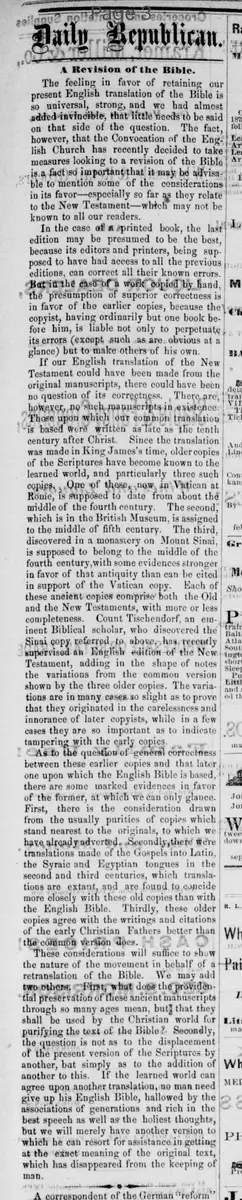
A Revision of the Bible.
The feeling in favor of retaining our present English translation of the Bible is so universal, strong, and we had almost added invincible, that little needs to be said on that side of the question. The fact, however, that the Convocation of the English Church has recently decided to take measures looking to a revision of the Bible is a fact so important that it may be advisable to mention some of the considerations in its favor—especially so far as they relate to the New Testament—which may not be known to all our readers.
In the case of a printed book, the last edition may be presumed to be the best, because its editors and printers, being supposed to have had access to all the previous editions, can correct all their known errors. But in the case of a work copied by hand, the presumption of superior correctness is in favor of the earlier copies, because the copyist, having ordinarily but one book before him, is liable not only to perpetuate its errors (except such as are obvious at a glance) but to make others of his own.
If our English translation of the New Testament could have been made from the original manuscripts, there could have been no question of its correctness. There are, however, no such manuscripts in existence. Those upon which our common translation is based were written as late as the tenth century after Christ. Since the translation was made in King James's time, older copies of the Scriptures have become known to the learned world, and particularly three such copies. One of these, now in Vatican at Rome, is supposed to date from about the middle of the fourth century. The second, which is in the British Museum, is assigned to the middle of fifth century. The third, discovered in a monastery on Mount Sinai, is supposed to belong to the middle of the fourth century, with some evidences stronger in favor of that antiquity than can be cited in support of the Vatican copy. Each of these ancient copies comprise both the Old and the New Testaments, with more or less completeness. Count Tischendorf, an eminent Biblical scholar, who discovered the Sinai copy, referred to above, has recently supervised an English edition of the New Testament, adding in the shape of notes the variations from the common version shown by the three older copies. The variations are in many cases so slight as to prove that they originated in the carelessness and ignorance of later copyists, while in a few cases they are so important as to indicate tampering with the early copies.
As to the question of general correctness between these earlier copies and that later one upon which the English Bible is based, there are some marked evidences in favor of the former, at which we can only glance. First, there is the consideration drawn from the usually purities of copies which stand nearest to the originals, to which we have already adverted. Secondly, there were translations made of the Gospels into Latin, the Syriac and Egyptian tongues in the second and third centuries, which translations are extant, and are found to coincide more closely with these old copies than with the English Bible. Thirdly, these older copies agree with the writings and citations of the early Christian Fathers better than the common version does.
These considerations will suffice to show the nature of the movement in behalf of a retranslation of the Bible. We may add two others. First, must not divine the providential preservation of these ancient manuscripts through so many ages mean, but that they shall be used by the Christian world for purifying the text of the Bible? Secondly, the question is not as to the displacement of the present version of the Scriptures by another, but simply as to the addition of another to this. If the learned world can agree upon another translation, no man need give up his English Bible, hallowed by the associations of generations and rich in the best speech as well as the holiest thoughts; but we will merely have another version to which he can resort for assistance in getting at the exact meaning of the original text, which has disappeared from the keeping of man.
What sub-type of article is it?
What themes does it cover?
What keywords are associated?
What entities or persons were involved?
Where did it happen?
Story Details
Key Persons
Location
Vatican At Rome, British Museum, Mount Sinai
Event Date
Tenth Century After Christ, Middle Of The Fourth Century, Middle Of Fifth Century, King James's Time
Story Details
The English Church Convocation decides on Bible revision; older 4th-5th century manuscripts like Vatican, British Museum, and Sinai copies show variations from the 10th-century basis of the King James translation, supporting a supplementary accurate version via providential preservation.