Thank you for visiting SNEWPapers!
Sign up free
Editorial
August 18, 1809
Virginia Argus
Richmond, Virginia
What is this article about?
This editorial from the Virginia Argus criticizes the British government's disavowal of Minister Erskine's agreements for reparation over the Chesapeake attack, revocation of Orders in Council, and commercial restoration, accusing British leaders like Canning of perfidy and defending Erskine's fidelity to instructions. It includes excerpts of Erskine's letters to Secretary Smith and addresses US partisan responses.
Clipping
OCR Quality
98%
Excellent
Full Text
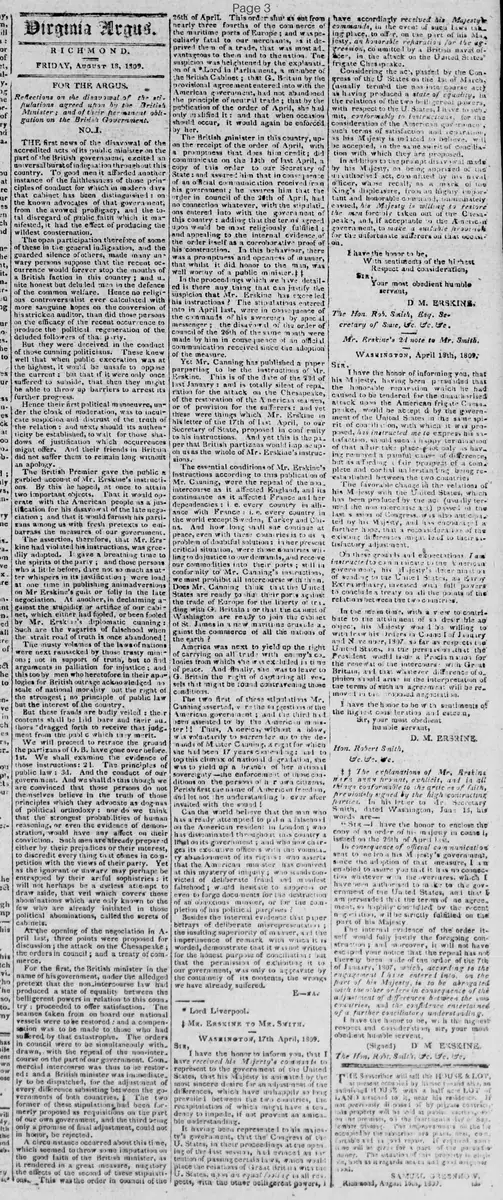
Virginia: Argus.
RICHMOND:
FRIDAY, AUGUST 18, 1809.
FOR THE ARGUS.
Reflections on the disavowal of the stipulations agreed upon by the British Minister: and of their permanent obligation on the British Government.
NO. I.
THE first news of the disavowal of the accredited acts of its public minister on the part of the British government, excited an universal burst of indignation throughout this country. To good men it afforded another instance of the faithlessness of those principles of conduct for which in modern days that cabinet has been distinguished: on the known advocates of that government, from the avowed profligacy and the total disregard of public faith which it manifested, it had the effect of producing the wildest consternation.
The open participation therefore of some of these in the general indignation, and the guarded silence of others, made many unwary persons suppose that the recent occurrence would forever stop the mouths of a British faction in this country; and unite honest but deluded men in the defence of the common welfare. Hence no religious controversialist ever calculated with more sanguine hopes on the conversion of his stricken auditor, than did those persons on the efficacy of the recent occurrence to produce the political regeneration of the deluded followers of that party.
But they were deceived in the conduct of those cunning politicians. These knew well that when public execration was at the highest, it would be unsafe to oppose the current: but that if it were only once suffered to subside, that then they might be able to throw up barriers to arrest its further progress.
Hence their first political manoeuvre, under the cloak of moderation, was to inculcate suspicion and distrust of the truth of the relation: and next, should its authenticity be established, to wait for those shadows of justification which occurrences might offer. And their friends in Britain did not suffer them to remain long without an apology.
The British Premier gave the public a garbled account of Mr. Erskine's instructions. By this he hoped, at once to attain two important objects. That it would operate with the American people as a justification for his disavowal of the late negotiation; and that it would furnish his partisans among us with fresh pretexts to embarrass the measures of our government.
The assertion, therefore, that Mr. Erskine had violated his instructions, was greedily adopted. It gave a breathing time to the spirits of the party; and those persons who a little before, dare not so much as utter whispers in its justification; were loud at one time in publishing animadversions on Mr Erskine's guilt or folly in the late negotiation. At another, in declaiming against the stupidity or artifice of our cabinet, which either had fooled, or been fooled by Mr. Erskine's diplomatic cunning:
Such are the vagaries of falsehood when the strait road of truth is once abandoned!
These musty volumes of the laws of nations were next ransacked by those trusty minions; not in support of truth, but to find arguments in palliation for injustice: and this too by men who heretofore in their apologies for British outrage acknowledged no scale of national morality but the right of the strongest; no principle of public law but the interest of the country.
But these frauds are badly veiled: their contents shall be laid bare and their authors dragged forth to receive that judgment from the public which they merit.
We will proceed to retrace the ground the partisans of C. B. have gone over before.
1st. We shall examine the evidence of those instructions: 2d. The principles of public law: 3d. And the conduct of our government. And we shall do this though we are convinced that those persons do not themselves believe in the truth of those principles which they advocate as dogmas of political orthodoxy: nor do we think that the strongest probabilities of human reasoning, or even the evidence of demonstration, would have any effect on their conviction. Such men are already prepared either by their prejudices or their interest, to discredit every thing that comes in competition with the views of their party. Yet as the ignorant or unwary may perhaps be entrapped by their artful sophistries: it will not perhaps be a useless attempt to draw aside, that veil which covers those abominations which are only known to the few who are already initiated in those political abominations, called the secrets of Cabinets.
At the opening of the negotiation in April last, three points were proposed for discussion; the attack on the Chesapeake; the orders in council; and a treaty of commerce.
For the first, the British minister in the name of his government, under the alleged pretext that the non intercourse law had produced a state of equality between the belligerent powers in relation to this country; proceeded to offer satisfaction. The seamen taken from on board our national vessels were to be restored: and a compensation was to be made to those who had suffered by that catastrophe. The orders in council were to be simultaneously withdrawn, with the repeal of the non-intercourse on the part of our government. Commercial intercourse was thus to be restored: and a British minister was immediately to be dispatched, for the adjustment of every difference subsisting between the governments of both countries. The two former of these stipulations had been formerly proposed as requisitions on the part of our own government, and the third being only a promise of final adjustment, could not in honor, be rejected.
A circumstance occurred about this time, which seemed to throw some imputation on the good faith of the British minister, as it rendered in a great measure, nugatory the effects of the second of these stipulations. This was the order in Council of the 26th of April. This order shut us out from nearly three fourths of the commerce of the maritime ports of Europe: and was peculiarly fatal to our merchants, as it deprived them of a trade, that was most advantageous to them and to the nation. The suspicion was heightened by the explanation of a Lord in Parliament, a member of the British Cabinet: that G. Britain by the provisional agreement entered into with the American government, had not abandoned the principle of neutral trade; that by the justification of the order of April, she had only modified it: and that when occasion should occur, it would again be enforced by her.
The British minister in this country, upon the receipt of the order of April, with a promptness that does him credit; did communicate on the 18th of last April, a copy of this order to our Secretary of State: and assured him that in consequence of an official communication received from his government; he assures him that the order in council of the 26th of April, had no connection whatever, with the stipulations entered into with the government of this country: adding that the terms agreed upon would be most religiously fulfilled: and appealing to the internal evidence of the order itself as a corroborative proof of his construction. In this behaviour, there was a promptness and openness of manner, that whilst it did honor to the man, was well worthy of a public minister.
In the proceedings which we have detailed is there anything that can justify the suspicion that Mr. Erskine has exceeded his instructions? The stipulations entered into in April last, were in consequence of the commands of his sovereign by special messenger; the disavowal of the order of council of the 26th of the same month were made by him in consequence of an official communication received since the adoption of the measure.
Yet Mr. Canning has published a paper purporting to be the instructions of Mr. Erskine. This is of the date of the 23d of last January: and is totally silent of reparation for the attack on the Chesapeake, of the restoration of the American seamen, or of provision for the sufferers: and yet these were things which Mr. Erskine in his letter of the 17th of last April, to our Secretary of State, proposed in conformity to his instructions. And yet this is the paper that British partisans would impose upon us as the whole of Mr. Erskine's instructions.
The essential conditions of Mr. Erskine's instructions according to the publication of Mr. Canning, were the repeal of the non-intercourse as it affected England, and its continuance as it affected France and her dependencies: i.e. every country in alliance with France: i.e. every Country in the world except Sweden, Turkey and China. And how long shall we continue at peace, even with these Countries is to us a problem of doubtful solution: in her present critical situation, were those countries willing to do justice to our demands, and receive our commodities into their ports; still in conformity to Mr. Canning's instructions, we must prohibit all intercourse with them.
Does Mr. Canning think that the United States are ready to shut their ports against the trade of Europe for the liberty of trading with G. Britain: or that the Cabinet of Washington are ready to join the cabinet of St. James in a new maritime crusade against the commerce of all the nations of the earth?
America was next to yield up the right of carrying on all trade with enemy's colonies from which she was excluded in time of peace. And finally, she was to leave to G. Britain the right of capturing all vessels that might be found contravening those conditions.
The two first of these stipulations Mr. Canning asserted, were the suggestions of the American government: and the third had been assented to by the American minister!! Thus, America, without a blow, was voluntarily to surrender up to the demands of Minister Canning, a right for which she had been 17 years contending: and to top this climax of national degradation, she was to yield up a branch of her national sovereignty -the enforcement of those conditions on the persons of her own citizens.
Perish first the name of American freedom, and let not the understanding be ever after insulted with the sound!
Can the world believe that the man who has already attempted to put in a false light the American resident in London; who has disseminated throughout this Country a libel on its government; and who now charges its executive officers with the voluntary abandonment of its rights: who asserts that the American minister has connived at this mystery of iniquity; who stands convicted of deliberate fraud and manifest falsehood: would hesitate to suppress or even to forge documents for the destruction of an obnoxious minister, or for the completion of his political purposes?
Besides the internal evidence that paper betrays of deliberate misrepresentation; the insulting superiority of manner, and the imper tinence of remark with which it is worded, demonstrate that it was not written for the honest purpose of conciliation: but that the permission of exhibiting it to our government, was only to aggravate by the contumely of its Contents, the wrongs we have already suffered.
EXA
* Lord Liverpool.
MR. Erskine to Mr. Smith.
Washington, 17th April, 1809.
SIR,
I have the honor to inform you, that I have received his Majesty's commands to represent to the government of the United States, that his Majesty is animated by the most sincere desire for an adjustment of the differences, which have unhappily so long prevailed between the two countries, the recapitulation of which might have a tendency to impede, if not prevent an amicable understanding.
It having been represented to his majesty's government, that the Congress of the U. States, in their proceedings at the opening of the last session, had evinced an intention of passing certain laws, which would place the relations of Great Britain with the U. States, on an equal footing in all respects, with the other belligerent powers, I have accordingly received his Majesty's commands, in the event of such laws taking place, to offer, on the part of his Majesty, an honorable reparation for the aggression, committed by a British naval officer, in the attack on the United States frigate Chesapeake.
Considering the act, passed by the Congress of the U States on the 1st of March, (usually termed the non intercourse act) as having produced a state of equality, in the relations of the two belligerent powers, with respect to the U. States, I have to submit, conformably to instructions, for the consideration of the American government, such terms of satisfaction and reparation, as his Majesty is inclined to believe, will be accepted, in the same spirit of conciliation with which they are proposed.
In addition to the prompt disavowal made by his Majesty, on being apprised of the unauthorised act, committed by his naval officer, whose recall; as a mark of the King's displeasure, from an highly important and honorable command, immediately ensued, his Majesty is willing to restore the men forcibly taken out of the Chesapeake, and, if acceptable to the American government, to make a suitable provision for the unfortunate sufferers on that occasion.
I have the honor to be,
With sentiments of the highest
Respect and consideration,
SIR
Your most obedient humble
servant,
D M. ERSKINE,
The Hon. Rob. Smith, Esq. Secretary of State, &c. &c.
Mr. Erskine's 2d note to Mr. Smith.
Washington, April 18th, 1809:
SIR.
I have the honor of informing you, that his Majesty, having been persuaded that the honorable reparation which he had caused to be tendered for the unauthorised attack upon the American frigate Chesapeake, would be accepted by the government of the United States in the same spirit of conciliation, with which it was proposed, has instructed me to express his satisfaction, should such a happy termination of that affair take place—not only as having removed a painful cause of difference, but as a prelude to fair prospect of a complete and cordial understanding being re-established between the two countries
The favorable change in the relations of his Majesty with the United States, which has been produced by the act (usually termed the non intercourse act) passed in the last session of Congress, is also anticipated by his Majesty, and has encouraged a further hope, that a reconsideration of the existing differences might lead to their satisfactory adjustment.
On these grounds and expectations I am instructed to communicate to the American government, his Majesty's determination of sending to the United States, an Envoy Extraordinary, invested with full powers to conclude a treaty on all the points of the relations between the two countries.
In the mean time, with a view to contribute to the attainment of so desirable an object, his Majesty would be willing to withdraw his Orders in Council of January and November, 1807, so far as respects the United States, in the persuasion that the President would issue a Proclamation for the renewal of the intercourse with Great Britain, and that whatever difference of opinion should arise in the interpretation of the terms of such an agreement will be removed in the proposed negotiation.
I have the honor to be with sentiments the highest Consideration and esteem,
Sir, your most obedient
humble servant,
D. M. ERSKINE.
Hon. Robert Smith,
&c. &c.
The explanations of Mr. Erskine were prompt, explicit, and in all things conformable to the articles of faith, previously signed by the high contracting parties. In his letter to Mr. Secretary Smith, dated Washington, June 15, his words are--.
"Sir—I have the honor to enclose the copy of an order of his Majesty in council, issued on the 26th of April last.
In consequence of official communication sent to me from his Majesty's government, since the adoption of that measure, I am enabled to assure you that it has no connection whatever with the overtures, which I have been authorised to make to the government of the United States, and that I am persuaded that the terms of the agreement, so happily concluded by the recent negotiation, will be strictly fulfilled on the part of his Majesty
The internal evidence of the order itself would fully justify the foregoing construction; and moreover, it will not have escaped your notice that the repeal has not thereby been made of the order of the 7th of January, 1807, which, according to the engagement I have entered into, on the part of his Majesty, is to be abrogated with the other orders in consequence of the adjustment of differences between the two countries, and the confidence entertained of a further conciliatory understanding.
I have the honor to be, with the highest respect and consideration sir, your most
obedient humble servant,
(Signed) D M ERSKINE.
The Hon, Rbt. Smith, &c. &c.
RICHMOND:
FRIDAY, AUGUST 18, 1809.
FOR THE ARGUS.
Reflections on the disavowal of the stipulations agreed upon by the British Minister: and of their permanent obligation on the British Government.
NO. I.
THE first news of the disavowal of the accredited acts of its public minister on the part of the British government, excited an universal burst of indignation throughout this country. To good men it afforded another instance of the faithlessness of those principles of conduct for which in modern days that cabinet has been distinguished: on the known advocates of that government, from the avowed profligacy and the total disregard of public faith which it manifested, it had the effect of producing the wildest consternation.
The open participation therefore of some of these in the general indignation, and the guarded silence of others, made many unwary persons suppose that the recent occurrence would forever stop the mouths of a British faction in this country; and unite honest but deluded men in the defence of the common welfare. Hence no religious controversialist ever calculated with more sanguine hopes on the conversion of his stricken auditor, than did those persons on the efficacy of the recent occurrence to produce the political regeneration of the deluded followers of that party.
But they were deceived in the conduct of those cunning politicians. These knew well that when public execration was at the highest, it would be unsafe to oppose the current: but that if it were only once suffered to subside, that then they might be able to throw up barriers to arrest its further progress.
Hence their first political manoeuvre, under the cloak of moderation, was to inculcate suspicion and distrust of the truth of the relation: and next, should its authenticity be established, to wait for those shadows of justification which occurrences might offer. And their friends in Britain did not suffer them to remain long without an apology.
The British Premier gave the public a garbled account of Mr. Erskine's instructions. By this he hoped, at once to attain two important objects. That it would operate with the American people as a justification for his disavowal of the late negotiation; and that it would furnish his partisans among us with fresh pretexts to embarrass the measures of our government.
The assertion, therefore, that Mr. Erskine had violated his instructions, was greedily adopted. It gave a breathing time to the spirits of the party; and those persons who a little before, dare not so much as utter whispers in its justification; were loud at one time in publishing animadversions on Mr Erskine's guilt or folly in the late negotiation. At another, in declaiming against the stupidity or artifice of our cabinet, which either had fooled, or been fooled by Mr. Erskine's diplomatic cunning:
Such are the vagaries of falsehood when the strait road of truth is once abandoned!
These musty volumes of the laws of nations were next ransacked by those trusty minions; not in support of truth, but to find arguments in palliation for injustice: and this too by men who heretofore in their apologies for British outrage acknowledged no scale of national morality but the right of the strongest; no principle of public law but the interest of the country.
But these frauds are badly veiled: their contents shall be laid bare and their authors dragged forth to receive that judgment from the public which they merit.
We will proceed to retrace the ground the partisans of C. B. have gone over before.
1st. We shall examine the evidence of those instructions: 2d. The principles of public law: 3d. And the conduct of our government. And we shall do this though we are convinced that those persons do not themselves believe in the truth of those principles which they advocate as dogmas of political orthodoxy: nor do we think that the strongest probabilities of human reasoning, or even the evidence of demonstration, would have any effect on their conviction. Such men are already prepared either by their prejudices or their interest, to discredit every thing that comes in competition with the views of their party. Yet as the ignorant or unwary may perhaps be entrapped by their artful sophistries: it will not perhaps be a useless attempt to draw aside, that veil which covers those abominations which are only known to the few who are already initiated in those political abominations, called the secrets of Cabinets.
At the opening of the negotiation in April last, three points were proposed for discussion; the attack on the Chesapeake; the orders in council; and a treaty of commerce.
For the first, the British minister in the name of his government, under the alleged pretext that the non intercourse law had produced a state of equality between the belligerent powers in relation to this country; proceeded to offer satisfaction. The seamen taken from on board our national vessels were to be restored: and a compensation was to be made to those who had suffered by that catastrophe. The orders in council were to be simultaneously withdrawn, with the repeal of the non-intercourse on the part of our government. Commercial intercourse was thus to be restored: and a British minister was immediately to be dispatched, for the adjustment of every difference subsisting between the governments of both countries. The two former of these stipulations had been formerly proposed as requisitions on the part of our own government, and the third being only a promise of final adjustment, could not in honor, be rejected.
A circumstance occurred about this time, which seemed to throw some imputation on the good faith of the British minister, as it rendered in a great measure, nugatory the effects of the second of these stipulations. This was the order in Council of the 26th of April. This order shut us out from nearly three fourths of the commerce of the maritime ports of Europe: and was peculiarly fatal to our merchants, as it deprived them of a trade, that was most advantageous to them and to the nation. The suspicion was heightened by the explanation of a Lord in Parliament, a member of the British Cabinet: that G. Britain by the provisional agreement entered into with the American government, had not abandoned the principle of neutral trade; that by the justification of the order of April, she had only modified it: and that when occasion should occur, it would again be enforced by her.
The British minister in this country, upon the receipt of the order of April, with a promptness that does him credit; did communicate on the 18th of last April, a copy of this order to our Secretary of State: and assured him that in consequence of an official communication received from his government; he assures him that the order in council of the 26th of April, had no connection whatever, with the stipulations entered into with the government of this country: adding that the terms agreed upon would be most religiously fulfilled: and appealing to the internal evidence of the order itself as a corroborative proof of his construction. In this behaviour, there was a promptness and openness of manner, that whilst it did honor to the man, was well worthy of a public minister.
In the proceedings which we have detailed is there anything that can justify the suspicion that Mr. Erskine has exceeded his instructions? The stipulations entered into in April last, were in consequence of the commands of his sovereign by special messenger; the disavowal of the order of council of the 26th of the same month were made by him in consequence of an official communication received since the adoption of the measure.
Yet Mr. Canning has published a paper purporting to be the instructions of Mr. Erskine. This is of the date of the 23d of last January: and is totally silent of reparation for the attack on the Chesapeake, of the restoration of the American seamen, or of provision for the sufferers: and yet these were things which Mr. Erskine in his letter of the 17th of last April, to our Secretary of State, proposed in conformity to his instructions. And yet this is the paper that British partisans would impose upon us as the whole of Mr. Erskine's instructions.
The essential conditions of Mr. Erskine's instructions according to the publication of Mr. Canning, were the repeal of the non-intercourse as it affected England, and its continuance as it affected France and her dependencies: i.e. every country in alliance with France: i.e. every Country in the world except Sweden, Turkey and China. And how long shall we continue at peace, even with these Countries is to us a problem of doubtful solution: in her present critical situation, were those countries willing to do justice to our demands, and receive our commodities into their ports; still in conformity to Mr. Canning's instructions, we must prohibit all intercourse with them.
Does Mr. Canning think that the United States are ready to shut their ports against the trade of Europe for the liberty of trading with G. Britain: or that the Cabinet of Washington are ready to join the cabinet of St. James in a new maritime crusade against the commerce of all the nations of the earth?
America was next to yield up the right of carrying on all trade with enemy's colonies from which she was excluded in time of peace. And finally, she was to leave to G. Britain the right of capturing all vessels that might be found contravening those conditions.
The two first of these stipulations Mr. Canning asserted, were the suggestions of the American government: and the third had been assented to by the American minister!! Thus, America, without a blow, was voluntarily to surrender up to the demands of Minister Canning, a right for which she had been 17 years contending: and to top this climax of national degradation, she was to yield up a branch of her national sovereignty -the enforcement of those conditions on the persons of her own citizens.
Perish first the name of American freedom, and let not the understanding be ever after insulted with the sound!
Can the world believe that the man who has already attempted to put in a false light the American resident in London; who has disseminated throughout this Country a libel on its government; and who now charges its executive officers with the voluntary abandonment of its rights: who asserts that the American minister has connived at this mystery of iniquity; who stands convicted of deliberate fraud and manifest falsehood: would hesitate to suppress or even to forge documents for the destruction of an obnoxious minister, or for the completion of his political purposes?
Besides the internal evidence that paper betrays of deliberate misrepresentation; the insulting superiority of manner, and the imper tinence of remark with which it is worded, demonstrate that it was not written for the honest purpose of conciliation: but that the permission of exhibiting it to our government, was only to aggravate by the contumely of its Contents, the wrongs we have already suffered.
EXA
* Lord Liverpool.
MR. Erskine to Mr. Smith.
Washington, 17th April, 1809.
SIR,
I have the honor to inform you, that I have received his Majesty's commands to represent to the government of the United States, that his Majesty is animated by the most sincere desire for an adjustment of the differences, which have unhappily so long prevailed between the two countries, the recapitulation of which might have a tendency to impede, if not prevent an amicable understanding.
It having been represented to his majesty's government, that the Congress of the U. States, in their proceedings at the opening of the last session, had evinced an intention of passing certain laws, which would place the relations of Great Britain with the U. States, on an equal footing in all respects, with the other belligerent powers, I have accordingly received his Majesty's commands, in the event of such laws taking place, to offer, on the part of his Majesty, an honorable reparation for the aggression, committed by a British naval officer, in the attack on the United States frigate Chesapeake.
Considering the act, passed by the Congress of the U States on the 1st of March, (usually termed the non intercourse act) as having produced a state of equality, in the relations of the two belligerent powers, with respect to the U. States, I have to submit, conformably to instructions, for the consideration of the American government, such terms of satisfaction and reparation, as his Majesty is inclined to believe, will be accepted, in the same spirit of conciliation with which they are proposed.
In addition to the prompt disavowal made by his Majesty, on being apprised of the unauthorised act, committed by his naval officer, whose recall; as a mark of the King's displeasure, from an highly important and honorable command, immediately ensued, his Majesty is willing to restore the men forcibly taken out of the Chesapeake, and, if acceptable to the American government, to make a suitable provision for the unfortunate sufferers on that occasion.
I have the honor to be,
With sentiments of the highest
Respect and consideration,
SIR
Your most obedient humble
servant,
D M. ERSKINE,
The Hon. Rob. Smith, Esq. Secretary of State, &c. &c.
Mr. Erskine's 2d note to Mr. Smith.
Washington, April 18th, 1809:
SIR.
I have the honor of informing you, that his Majesty, having been persuaded that the honorable reparation which he had caused to be tendered for the unauthorised attack upon the American frigate Chesapeake, would be accepted by the government of the United States in the same spirit of conciliation, with which it was proposed, has instructed me to express his satisfaction, should such a happy termination of that affair take place—not only as having removed a painful cause of difference, but as a prelude to fair prospect of a complete and cordial understanding being re-established between the two countries
The favorable change in the relations of his Majesty with the United States, which has been produced by the act (usually termed the non intercourse act) passed in the last session of Congress, is also anticipated by his Majesty, and has encouraged a further hope, that a reconsideration of the existing differences might lead to their satisfactory adjustment.
On these grounds and expectations I am instructed to communicate to the American government, his Majesty's determination of sending to the United States, an Envoy Extraordinary, invested with full powers to conclude a treaty on all the points of the relations between the two countries.
In the mean time, with a view to contribute to the attainment of so desirable an object, his Majesty would be willing to withdraw his Orders in Council of January and November, 1807, so far as respects the United States, in the persuasion that the President would issue a Proclamation for the renewal of the intercourse with Great Britain, and that whatever difference of opinion should arise in the interpretation of the terms of such an agreement will be removed in the proposed negotiation.
I have the honor to be with sentiments the highest Consideration and esteem,
Sir, your most obedient
humble servant,
D. M. ERSKINE.
Hon. Robert Smith,
&c. &c.
The explanations of Mr. Erskine were prompt, explicit, and in all things conformable to the articles of faith, previously signed by the high contracting parties. In his letter to Mr. Secretary Smith, dated Washington, June 15, his words are--.
"Sir—I have the honor to enclose the copy of an order of his Majesty in council, issued on the 26th of April last.
In consequence of official communication sent to me from his Majesty's government, since the adoption of that measure, I am enabled to assure you that it has no connection whatever with the overtures, which I have been authorised to make to the government of the United States, and that I am persuaded that the terms of the agreement, so happily concluded by the recent negotiation, will be strictly fulfilled on the part of his Majesty
The internal evidence of the order itself would fully justify the foregoing construction; and moreover, it will not have escaped your notice that the repeal has not thereby been made of the order of the 7th of January, 1807, which, according to the engagement I have entered into, on the part of his Majesty, is to be abrogated with the other orders in consequence of the adjustment of differences between the two countries, and the confidence entertained of a further conciliatory understanding.
I have the honor to be, with the highest respect and consideration sir, your most
obedient humble servant,
(Signed) D M ERSKINE.
The Hon, Rbt. Smith, &c. &c.
What sub-type of article is it?
Foreign Affairs
Partisan Politics
War Or Peace
What keywords are associated?
Erskine Disavowal
British Perfidy
Chesapeake Affair
Orders In Council
Non Intercourse Act
Us British Relations
Diplomatic Fraud
What entities or persons were involved?
British Government
David M. Erskine
George Canning
Robert Smith
Chesapeake Frigate
Orders In Council
Editorial Details
Primary Topic
British Disavowal Of Erskine Agreements On Chesapeake And Orders In Council
Stance / Tone
Indignant Anti British Perfidy, Defensive Of Us Diplomacy
Key Figures
British Government
David M. Erskine
George Canning
Robert Smith
Chesapeake Frigate
Orders In Council
Key Arguments
British Disavowal Excites Universal Indignation In Us
Erskine Acted Within Instructions From His Sovereign
Canning's Published Instructions Are Garbled And Incomplete
British Faction In Us Uses Disavowal To Embarrass American Government
Agreements Included Chesapeake Reparation And Orders Revocation
April 26 Order In Council Unrelated To Us Negotiations Per Erskine
Us Should Not Yield Neutral Trade Rights Or Sovereignty
Canning's Document Betrays Deliberate Misrepresentation