Thank you for visiting SNEWPapers!
Sign up free
Berkeley And Jefferson Intelligencer
Martinsburg, Berkeley County, Virginia
What is this article about?
Congress passed an embargo law on Dec. 23 amid heated debate, aimed at pressuring Britain and France over neutral trade rights, based on reports from U.S. minister Armstrong in Paris. Opponents feared it would lead to war with Britain; the measure is indefinite, likely lasting months or a year.
Clipping
OCR Quality
Full Text
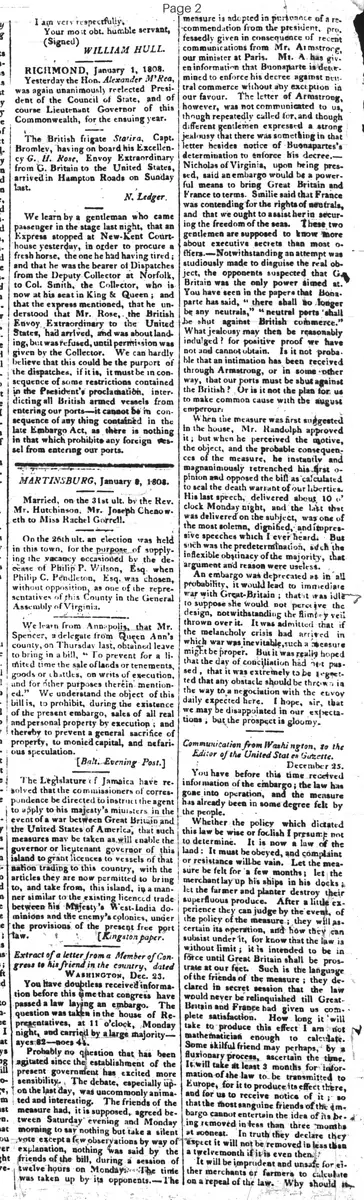
You have doubtless received information before this time that congress have passed a law laying an embargo. The question was taken in the house of Representatives, at 11 o'clock, Monday night, and carried by a large majority—ayes 82—noses 44.
Probably no question that has been agitated since the establishment of the present government has excited more sensibility. The debate, especially upon the last day, was uncommonly animated and interesting. The friends of the measure had, it is supposed, agreed between Saturday evening and Monday morning to say nothing but take a silent vote, except a few observations by way of explanation, nothing was said by the friends of the bill, during a session of twelve hours—on Monday the time was taken up by its opponents.
The measure is adopted in pursuance of a recommendation from the president, professedly given in consequence of recent communications from Mr. Armstrong, our minister at Paris. Mr. A. has given information that Buonaparte is determined to enforce his decree against neutral commerce without any exception in our favour. The letter of Armstrong, however, was not communicated to us, though repeatedly called for, and though different gentlemen expressed a strong jealousy that there was something in that letter besides notice of Buonaparte's determination to enforce his decree. Nicholas of Virginia, upon being pressed, said an embargo would be a powerful means to bring Great Britain and France to terms. Smilie said that France was contending for the rights of neutrals, and that we ought to assist her in securing the freedom of the seas. These two gentlemen are supposed to know more about executive secrets than most others. Notwithstanding an attempt was studiously made to disguise the real object, the opponents suspected that G. Britain was the only power aimed at.
You have seen in the papers that Bonaparte has said, "there shall no longer be any neutrals," "neutral ports shall be shut against British commerce."
What jealousy may then be reasonably indulged? for positive proof we have not and cannot obtain. Is it not probable that an intimation has been received through Armstrong, or in some other way, that our ports must be shut against the British? Or is it not the plan for us to make common cause with the august emperour?
When the measure was first suggested in the house, Mr. Randolph approved it: but when he perceived the motive, the object, and the probable consequences of the measure, he instantly and magnanimously retrenched his first opinion and opposed the bill as calculated to seal the death warrant of our liberties. His last speech, delivered about 10 o'clock Monday night, and the last that was delivered on the subject, was one of the most solemn, dignified, and impressive speeches which I ever heard. But such was the predetermination, such the inflexible obstinacy of the majority, that argument and reason were useless.
An embargo was deprecated as in all probability, it would lead to immediate war with Great-Britain: that it was idle to suppose she would not perceive the design, notwithstanding the flimsy veil thrown over it. It was admitted that if the melancholy crisis had arrived in which war was inevitable, such a measure might be proper. But it was really hoped that the day of conciliation had not passed, that it was extremely to be regretted that any obstacle should be thrown in the way to a negotiation with the envoy daily expected here. I hope, sir, that we may be disappointed in our expectations; but the prospect is gloomy.
Communication from Washington, to the Editor of the United States Gazette.
December 25.
You have before this time received information of the embargo; the law has gone into operation, and the measure has already been in some degree felt by the people.
Whether the policy which dictated this law be wise or foolish I presume not to determine. It is now a law of the land: It must be obeyed, and complaint or resistance will be vain. Let the measure be felt for a few months; let the merchant lay up his ships in his docks: let the farmer and planter destroy their superfluous produce. After a little experience they can judge by the event of the policy of the measure.; they will ascertain its operation, and how they can subsist under it, for know that the law is without limit; it is intended to be in force until Great Britain shall be prostrate at our feet. Such is the language of the friends of the measure; they declared in secret session, that the law would never be relinquished till Great Britain and France had given us complete satisfaction. How long it will take to produce this effect I am not mathematician enough to calculate. Some skilful friend may perhaps, by a fluxionary process, ascertain the time.
It will take at least 3 months for information of the law to be transmitted to Europe, for it to produce its effect there, and for us to receive notice of it; so that the most sanguine friends of the embargo cannot entertain the idea of its being removed in less than three months at soonest. In truth they declare they expect it will not be removed in less than a twelvemonth if it is even then.
It will be imprudent and unsafe for either merchants or farmers to calculate on a repeal of the law. Why should they? The law is passed, and it will be executed.
What sub-type of article is it?
What keywords are associated?
What entities or persons were involved?
Where did it happen?
Domestic News Details
Primary Location
Washington
Event Date
Dec. 23
Key Persons
Outcome
the embargo law passed in the house of representatives by a vote of ayes 82, noes 44. the law is intended to remain in force until great britain and france provide complete satisfaction, potentially for at least a year.
Event Details
Congress passed a law laying an embargo following a recommendation from the President based on communications from Mr. Armstrong in Paris regarding Napoleon's enforcement of decrees against neutral commerce. The debate was animated, with opponents suspecting the measure targeted Great Britain. Mr. Randolph opposed it, warning of potential war. The law went into operation on December 25 and is expected to last at least three months, possibly a year.