Thank you for visiting SNEWPapers!
Sign up free
The Daily Madisonian
Washington, District Of Columbia
What is this article about?
Editorial denounces J.Q. Adams' 1843 opposition to Texas annexation as treasonous and inconsistent, citing his involvement in ceding Texas via Florida Treaty and prior efforts to reclaim it, affirming annexation's constitutionality per historical precedents like Louisiana.
Merged-components note: Continuation of the article discussing Mr. Adams and the annexation of Texas.
Clipping
OCR Quality
Full Text
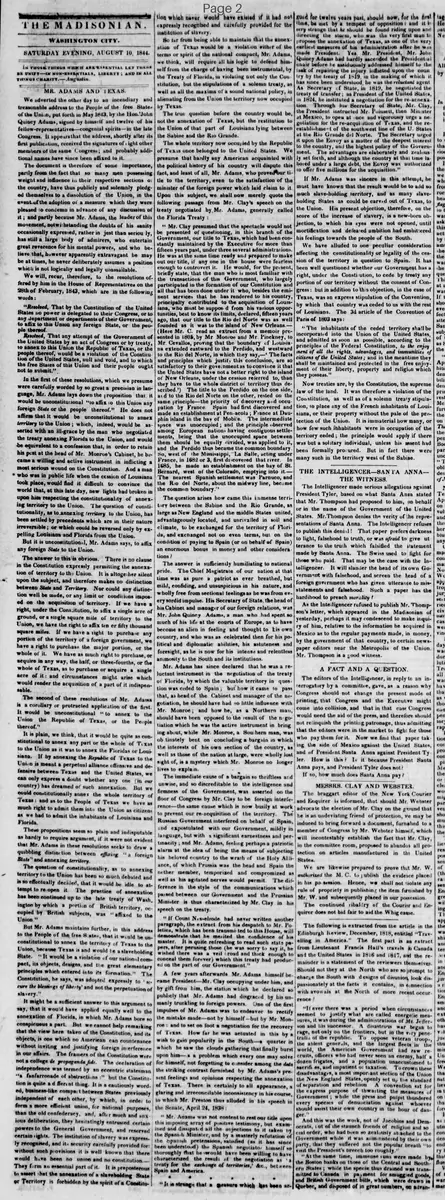
We adverted the other day to an incendiary and treasonable address to the People of the free States of the Union, put forth in May 1843, by the Hon. John Quincy Adams, signed by himself and twelve of his fellow-representatives—congenial spirits—in the late Congress. It appears that the address, shortly after its first publication, received the signatures of eight other members of the same Congress; and probably additional names have since been affixed to it.
The document is therefore of some importance, partly from the fact that so many men possessing weight and influence in their respective sections of the country, have thus publicly and solemnly pledged themselves to a dissolution of the Union, in the event of the adoption of a measure which they were pleased to condemn in advance of any discussion of it; and partly because Mr. Adams, the leader of this movement, notwithstanding the doubts of his sanity occasionally expressed, rather in jest than seriously, has still a large body of admirers, who entertain great reverence for his mental powers, and who believe that, however apparently extravagant he may be at times, he never deliberately assumes a position which is not logically and legally unassailable.
We will, therefore, recur to the resolutions offered by him in the House of Representatives on the 28th of February, 1843, which are in the following words:
"Resolved, That by the Constitution of the United States no power is delegated to their Congress, or to any department or departments of their Government, to affix to this Union any foreign State, or the people thereof.
Resolved, That any attempt of the Government of the United States by an act of Congress or by treaty, to annex to this Union the Republic of Texas, or the people thereof, would be a violation of the Constitution of the United States, null and void, and to which the free States of this Union and their people ought not to submit."
In the first of these resolutions, which we presume were carefully worded by so great a precisian in language, Mr. Adams lays down the proposition that, it would be unconstitutional "to affix to this Union any foreign State or the people thereof." He does not affirm that it would be unconstitutional to annex territory to the Union; which, indeed, would be asserted with an ill-grace by the man who negotiated the treaty annexing Florida to the Union, and would be equivalent to a confession that, in order to retain his post at the head of Mr. Monroe's Cabinet, he became a willing and active instrument in inflicting a most serious wound on the Constitution. And a man who was in public life when the cession of Louisiana took place, would find it difficult to convince the world that, at this late day, new lights had broken in upon him respecting the constitutionality of annexing territory to the Union. The question of constitutionality, as to annexing territory to the Union, has been settled by precedents which are in their nature irreversible; or which could be reversed only by expelling Louisiana and Florida from the Union.
But it is unconstitutional, Mr. Adams says, to affix any foreign State to the Union.
The answer to this is obvious. There is no clause in the Constitution expressly permitting the annexation of territory to the Union. It is altogether silent upon the subject, and therefore makes no distinction between State and Territory. Nor could any distinction well be made, or any limit or conditions imposed on the acquisition of territory. If we have a right, under the Constitution, to affix a single acre of ground, or a single square mile of territory to the Union, we have the right to affix ten or fifty thousand square miles. If we have a right to purchase any portion of the territory of a foreign government, we have a right to purchase the major portion, or the whole of it. We have as much right to purchase, or acquire in any way, the half, or three-fourths, or the whole of Texas, as to purchase or acquire a single acre of it: and circumstances might arise which would render the acquisition of a part of it indispensable.
The second of these resolutions of Mr. Adams is a corollary or protracted application of the first. It would be unconstitutional "to annex to the Union the Republic of Texas, or the People thereof."
It is plain, we think, that it would be quite as constitutional to annex any part or the whole of Texas to the Union as it was to annex the Floridas or Louisiana. If by annexing the Republic of Texas to the Union is meant a perpetual alliance offensive and defensive between Texas and the United States, we can only express a doubt whether any one (in our country) has dreamed of such annexation. But we could constitutionally annex the whole territory of Texas: and as to the People of Texas we have as much right to admit them into the Union as citizens as we had to admit the inhabitants of Louisiana and Florida.
These propositions seem so plain and indisputable as hardly to require argument, if it were not evident that Mr. Adams in these resolutions seeks to draw a quibbling distinction between affixing "a foreign State" and annexing territory.
The question of constitutionality, as to annexing territory to the Union has been so much debated and is so effectually decided, that it would be idle to attempt to re-open it. The practice of annexation has been continued up to the late treaty of Washington by which a portion of British territory, occupied by British subjects, was "affixed to the Union."
But Mr. Adams maintains further, in this address to the People of the free States, that it would be unconstitutional to annex the territory of Texas to the Union, because Texas is and would be a slaveholding State. "It would be a violation of our national compact, its objects, designs, and the great elementary principles which entered into its formation." The Constitution, he says, was adopted expressly to "secure the blessings of liberty" and not the perpetuation of slavery.
It might be a sufficient answer to this argument to say, that it would have applied equally well to the annexation of Florida, in which Mr. Adams bore so conspicuous a part. But we cannot help remarking that the view here taken of the Constitution, and its objects, is one which no American can countenance without inviting and justifying foreign interference in our affairs. The framers of the Constitution were not a college de propaganda fide. The declaration of independence was termed by an eccentric statesman "a farrago of abstractions:" but the Constitution is quite a different thing. It is a cautiously worded, business-like compact between States previously independent of each other, by which, in order to form a more efficient union, for national purposes, than the old confederacy, and, after much and anxious deliberation, they hesitatingly entrusted certain powers to the General Government, and reserved certain rights. The institution of slavery was expressly recognised, and its security carefully provided for: without such provisions it is well known that there would have been no union and no constitution.—They form an essential part of it. It is preposterous to assert that the annexation of a slaveholding State or Territory is forbidden by the spirit of a Constitution which never would have existed if it had not expressly recognised and carefully provided for the institution of slavery.
So far from being able to maintain that the annexation of Texas would be a violation either of the terms or spirit of the national compact, Mr. Adams, we think, will require all his logic to defend himself from the charge of having been instrumental, by the Treaty of Florida, in violating not only the Constitution, but the stipulations of a solemn treaty, as well as all the maxims of a sound national policy, in alienating from the Union the territory now occupied by Texas.
The true question before the country would be, not the annexation of Texas, but the restitution to the Union of that part of Louisiana lying between the Sabine and the Rio Grande.
The whole territory now occupied by the Republic of Texas once belonged to the United States. We presume that hardly any American acquainted with the political history of his country will dispute this fact, and least of all, Mr. Adams, who proved our title to the territory, even to the satisfaction of the minister of the foreign power which laid claim to it.
Upon this subject, we shall now merely quote the following passage from Mr. Clay's speech on the treaty negotiated by Mr. Adams, generally called the Florida Treaty:
"Mr. Clay presumed that the spectacle would not be presented of questioning, in this branch of the Government, our title to Texas, which had been constantly maintained by the Executive for more than fifteen years past, under three several administrations. He was at the same time ready and prepared to make out our title, if any one in the house were fearless enough to controvert it. He would, for the present, briefly state, that the man who is most familiar with the transactions of this Government, who largely participated in the formation of our Constitution and all that has been done under it who, besides the eminent services that he has rendered to his country, principally contributed to the acquisition of Louisiana, who must be supposed from his various opportunities, best to know its limits, declared, fifteen years ago, that our title to the Rio del Norte was as well founded as it was to the island of New Orleans.—(Here Mr. C. read an extract from a memoir presented in 1805, by Mr Monroe and Mr. Pinckney, to Mr. Cevallos, proving that the boundary of Louisiana extended eastward to the Perdido, and westward to the Rio del Norte, in which they say, 'The facts and principles which justify this conclusion, are so satisfactory to their government as to convince it that the United States have not a better right to the island of New Orleans, under the cession referred to, than they have to the whole district of territory thus described.') The title to the Perdido on the one side, and to the Rio del Norte on the other, rested on the same principle—the priority of discovery and occupation by France Spain had first discovered and made an establishment at Pensacola; France at Dauphin island in the bay of Mobile. The intermediate space was unoccupied; and the principle observed among European nations having contiguous settlements, being that the unoccupied space between them should be equally divided, was applied to it, and the Perdido thus became the common boundary So, west of the Mississippi,—La Salle, acting under France, in 1682 or 3, first discovered that river. In 1685, he made an establishment on the bay of St. Bernard, west of the Colorado, emptying into it.—The nearest Spanish settlement was Parruco, and the Rio del Norte, about the midway line, became the common boundary.'
The question arises how came this immense territory between the Sabine and the Rio Grande, as large as New England and the middle States united, advantageously located, and unrivalled in soil and climate, to be exchanged for the territory of Florida, and exchanged not on even terms, but on the condition of paying to Spain (or on behalf of Spain) an enormous bonus in money and other considerations?
The answer is sufficiently humiliating to national pride. The Chief Magistrate of our nation at that time was as pure a patriot as ever breathed, but mild, confiding, and unsuspicious in his nature, and wholly free from sectional feelings as he was from every sordid impulse. His Secretary of State, the head of his Cabinet and manager of our foreign relations, was Mr. John Quincy Adams, a man who had spent so much of his life at the courts of Europe, as to have become an alien in feeling and thought to his own country, and who was as celebrated then for his political and diplomatic abilities, his astuteness and foresight, as he is now for his intense and relentless animosity to the South and its institutions Mr. Adams has since declared that he was a reluctant instrument in the negotiation of the treaty of Florida, by which the valuable territory in question was ceded to Spain; but how it came to pass that, as head of the Cabinet and manager of the negotiation, he should have had so little influence with Mr. Monroe; and how he, as a Northern man, should have been opposed to the result of the negotiation which he was the active instrument in bringing about, while Mr. Monroe, a Southern man, was obstinately bent on concluding a bargain in which the interests of his own section of the country, as well as those of the nation at large, were wholly lost sight of, is a mystery which Mr. Monroe no longer lives to explain.
The immediate cause of a bargain so thriftless and unwise, and so discreditable to the intelligence and firmness of the Government, was asserted on the floor of Congress by Mr. Clay to be foreign interference—the same cause which is now busily at work to prevent our re-acquisition of the territory. The Russian Government interfered on behalf of Spain, and expostulated with our Government, mildly in language, but with a significant earnestness and pertinacity; and Mr. Adams, feeling perhaps a patriotic alarm at the idea of being the means of subjecting his beloved country to the wrath of the Holy Alliance, of which Prussia was the head and Spain the nether member, temporized and compromised as well as his agitated nerves would permit. The difference in the style of the communications which passed between our Government and the Prussian Minister is thus characterized by Mr. Clay in his speech on the treaty.
"If Count Nesselrode had never written another paragraph, the extract from his despatch to Mr. Poletica, which has been transmitted to this House, will demonstrate that he merited the confidence of his master. It is quite refreshing to read such state papers, after perusing those (he was sorry to say it, he wished there was a veil broad and thick enough to conceal them forever) which this treaty had produced on the part of our Government."
A few years afterwards Mr. Adams himself became President—Mr. Clay occupying under him, and by gift from him, the station which he declared so publicly that Mr. Adams had disgraced by his unmanly truckling to foreign powers. One of the first impulses of Mr. Adams was to endeavor to rectify the mistake made—not by himself—but by Mr. Monroe: and to set on foot a negotiation for the recovery of Texas. How far he was actuated in this by a wish to gain popularity in the South—a quarter in which he saw the clouds gathering that finally burst upon him—is a problem which every one may solve for himself, not forgetting to consider among the data the striking contrast furnished by Mr. Adams's present feelings and opinions respecting the annexation of Texas. There is certainly to all appearance, a glaring and irreconcilable inconsistency in his course, to which Mr. Preston thus alluded in his speech in the Senate, April 24, 1838:
"Mr. Adams was not content to rest our title upon this imposing array of positive testimony, but examined and dissipated all the objections to it taken by the Spanish Minister, and by a masterly refutation of the Spanish pretensions, satisfied (as it has since been understood) the Spanish negotiator himself so thoroughly that he would have been willing to have characterized the result of the negotiation as 'a treaty for the exchange of territories,' &c., between Spain and America.
"It is strange that
aceouco which
gu ed for twelve years past. should now, for the first time, be met by a tempest of opposition : and it is every strange that he should be found riding upon and directing the storm, who was the very first man to propose the annexation of Texas, as one of the very earliest measures of his administration after he was made President. Yes. Mr. President, Mr. John Quincy Adams had hardly ascended the Presidential chair before he assiduously addressed himself to the task of repairing the injury inflicted upon the country by the treaty of 1819, in the making of which it has since been understood, he was the reluctant agent As Secretary of State, in 1819, he negotiated the treaty of transfer; as President of the United States, in 1824, he instituted a negotiation for the re-annexation. Through his Secretary of State, Mr. Clay, the President instructed Mr. Poinsett, then Minister at Mexico, to open at once and vigorously urge a negotiation for the re-acquisition of Texas, and the re-establishment of the southwest line of the U. States at the Rio Grande del Norte. The Secretary urged it upon the Envoy as a matter of the deepest interest to the country, and the highest policy of the Government. The advantages are elaborately and zealously set forth, and although the country at that time labored under a large debt, the Envoy was authorized to offer five millions for the acquisition." If Mr. Adams was sincere in this attempt, he must have known that the result would be to add so much slave-holding territory, and as many slave-holding States as could be carved out of Texas, to the Union. His present objection, therefore, on the score of the increase of slavery, is a new-born objection, to which his eyes were not opened, until mortification and defeated ambition had embittered his feelings towards the people of the South. We have alluded to one peculiar consideration affecting the constitutionality or legality of the cession of the territory in question to Spain. It has been well questioned whether our Government has a right, under the Constitution, to cede by treaty any portion of our territory without the consent of Congress: but in addition to this objection, in the case of Texas, was an express stipulation of the Convention, by which that country was ceded to us with the rest of Louisiana. The 3d article of the Convention of Paris of 1803 says: "The inhabitants of the ceded territory shall be incorporated into the Union of the United States, and admitted as soon as possible, according to the principles of the Federal Constitution, to the enjoyment of all the rights, advantages, and immunities of citizens of the United States; and in the meantime they shall be maintained and protected in the free enjoyment of their liberty, property and religion which they possess." Now treaties are, by the Constitution, the supreme law of the land. It was therefore a violation of the Constitution, as well as of a solemn treaty stipulation, to place any of the French inhabitants of Louisiana, or their property without the pale of the protection of the Union. It is immaterial how many, or how few such inhabitants were in occupation of the territory ceded; the principle would apply if there was but a solitary individual, unless his assent had been formally procured. But in fact there were many such in the territory west of the Sabine.
What sub-type of article is it?
What themes does it cover?
What keywords are associated?
What entities or persons were involved?
Where did it happen?
Story Details
Key Persons
Location
United States, Texas, Florida, Louisiana
Event Date
1843
Story Details
An editorial critiques John Quincy Adams' 1843 resolutions and address opposing the annexation of Texas as unconstitutional, highlighting his inconsistency given his role in the Florida Treaty ceding Texas territory and his later attempt as President to reacquire it, arguing that annexation aligns with precedents like Louisiana and Florida, and that the Constitution recognizes slavery.