Thank you for visiting SNEWPapers!
Sign up free
The Watchman And Southron
Sumter, Sumter County, South Carolina
What is this article about?
Champ Clark's enthusiastic letter from Washington details the triumphant 1900 Democratic National Convention in Kansas City, reuniting the party behind Bryan and Stevenson on an anti-imperialist platform, celebrates Webster Davis's defection and oration, notes other Republican revolts including by George S. Boutwell, and lambasts GOP corruption under Hanna and McKinley.
Clipping
OCR Quality
Full Text
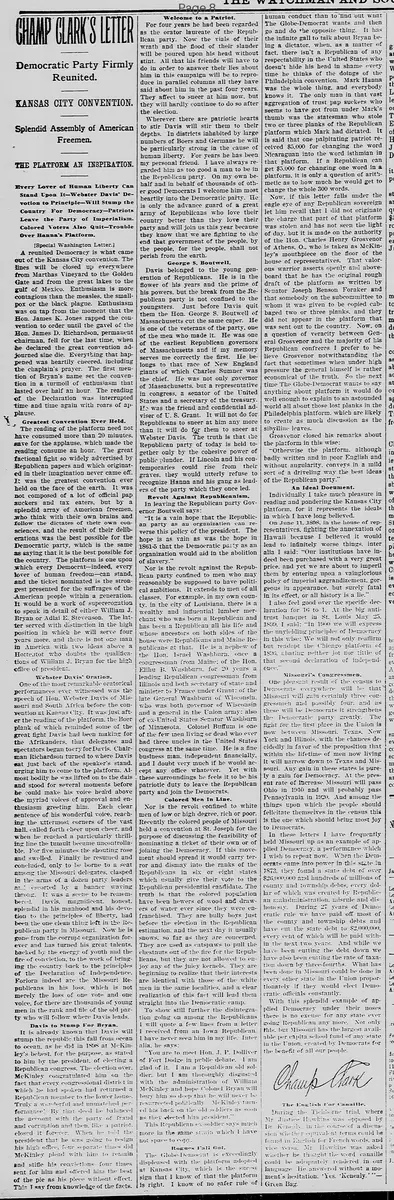
Democratic Party Firmly Reunited.
KANSAS CITY CONVENTION
Splendid Assembly of American Freemen.
THE PLATFORM AN INSPIRATION.
Every Lover of Human Liberty Can Stand Upon It—Webster Davis' Devotion to Principle—Will Stump the Country For Democracy—Patriotism Leave the Party of Imperialism.
Colored Voters Also Quit—Trouble Over Hanna's Platform.
[Special Washington Letter.]
A reunited Democracy is what came out of the Kansas City convention. The lines will be closed up everywhere from Martha's Vineyard to the Golden Gate and from the great lakes to the gulf of Mexico. Enthusiasm is more contagious than the measles, the small pox or the black plague. Enthusiasm was on tap from the moment that the Hon. James K. Jones rapped the convention to order until the gavel of the Hon. James D. Richardson, permanent chairman, fell for the last time, when he declared the great convention adjourned sine die. Everything that happened was heartily cheered, including the chaplain's prayer. The first mention of Bryan's name set the convention in a turmoil of enthusiasm that lasted over half an hour. The reading of the Declaration was interrupted time and time again with roars of applause.
Greatest Convention Ever Held.
The reading of the platform need not have consumed more than 20 minutes, save for the applause, which made the reading consume an hour. The great factional fight so widely advertised by Republican papers and which originated in their imagination never came off. It was the greatest convention ever held on the face of the earth. It was not composed of a lot of official pap suckers and tax eaters, but by a splendid array of American freemen, who think with their own brains and follow the dictates of their own consciences, and the result of their deliberations was the best possible for the Democratic party, which is the same as saying that it is the best possible for the country. The platform is one upon which every Democrat—indeed, every lover of human freedom—can stand, and the ticket nominated is the strongest presented for the suffrages of the American people within a generation.
It would be a work of supererogation to speak in detail of either William J. Bryan or Adlai E. Stevenson. The latter served with distinction in the high position in which he will serve four years more, and there is not one man in America with two ideas above a Hottentot who doubts the qualifications of William J. Bryan for the high office of president.
Webster Davis' Oration.
One of the most remarkable oratorical performances ever witnessed was the speech of Hon. Webster Davis of Missouri and South Africa before the convention at Kansas City. It was just after the reading of the platform, the Boer plank of which reminded some of the great fight Davis had been making for the Afrikanders, that delegates and spectators began to cry for Davis. Chairman Richardson turned to where Davis sat just back of the speaker's stand, urging him to come to the platform. Almost bodily he was lifted on to the dais and stood for several moments before he could make his voice heard above the myriad voices of approval and enthusiasm greeting him. Each clear sentence of his wonderful voice, reaching the uttermost corners of the vast hall, called forth cheer upon cheer, and when he reached a particularly thrilling line the tumult became uncontrollable. For five minutes the shouting rose and swelled. Finally he resumed and concluded, only to be borne to a seat among the Missouri delegates, clasped in the arms of a dozen party leaders all escorted by a banner waving throng. It was a scene to be remembered. Davis, magnificent, honest, splendid in his manhood and his devotion to the principles of liberty, had been the one clean thing left in the Republican party in Missouri. Now he is gone from the corrupt organization forever and has turned his great talents, backed by the energy of youth and the fire of conviction, to the work of bringing the country back to the principles of the Declaration of Independence.
Forlorn indeed are the Missouri Republicans in his loss, which is not merely the loss of one vote and one voice, for there are thousands of young men in the rank and file of the old party who will follow where Davis leads.
Davis to Stump For Bryan.
It is already known that Davis will stump the republic this fall from ocean to ocean, as he did in 1896 at McKinley's behest, for the purpose, as stated to him by the president, of electing a Republican congress. The election over, McKinley congratulated him on the fact that every congressional district in which he had spoken had returned a Republican member to the lower house. Truly a wonderful and unmatched performance! By that deed he balanced the account with the party of fraud and corruption and then, like a patriot, closed it forever. When he told the president that he was going to resign his high office, four separate times did McKinley plead with him to remain and stifle his convictions—four times sent for him and offered him the best of the pie as his piece without effect. This I say from knowledge of the facts.
Welcome to a Patriot.
For four years he had been regarded as the orator laureate of the Republican party. Now the vials of their wrath and the flood of their slander will be poured upon his head without stint. All that his friends will have to do in order to answer their lies about him in this campaign will be to reproduce in parallel columns all they have said about him in the past four years. They affect to sneer at him now, but they will hardly continue to do so after the election.
Wherever there are patriotic hearts to stir Davis will stir them to their depths. In districts inhabited by large numbers of Boers and Germans he will be particularly strong in the cause of human liberty. For years he has been my personal friend. I have always regarded him as too good a man to be in the Republican party. On my own behalf and in behalf of thousands of other good Democrats I welcome him most heartily into the Democratic party. He is only the advance guard of a great army of Republicans who love their country better than they love their party and will join us this year because they know that we are fighting to the end that government of the people, by the people, for the people, shall not perish from the earth.
George S. Boutwell.
Davis belonged to the young generation of Republicans. He is in the flower of his years and the prime of his powers, but the break from the Republican party is not confined to the youngsters. Just before Davis quit them the Hon. George S. Boutwell of Massachusetts cut the same caper. He is one of the veterans of the party, one of the men who made it. He was one of the earliest Republican governors of Massachusetts and if my memory serves me correctly the first. He belongs to that race of New England giants of which Charles Sumner was the chief. He was not only governor of Massachusetts, but a representative in congress, a senator of the United States and a secretary of the treasury. He was the friend and confidential adviser of U. S. Grant. It will not do for Republicans to sneer at him any more than it will do for them to sneer at Webster Davis. The truth is that the Republican party of today is held together only by the cohesive power of public plunder. If Lincoln and his contemporaries could rise from their graves, they would utterly refuse to recognize Hanna and his gang as leaders of the party which they once led.
Revolt Against Republicanism.
In leaving the Republican party Governor Boutwell says:
It is a vain hope that the Republican party as an organization can reverse this policy of the president. The hope is as vain as was the hope in 1861 that the Democratic party as an organization would aid in the abolition of slavery.
Nor is the revolt against the Republican party confined to men who may reasonably be supposed to have political ambitions. It extends to men of all classes. For example, in my own county, in the city of Louisiana, there is a wealthy and influential lumber merchant who was born a Republican and has been a Republican all his life and whose ancestors on both sides of the house were Republicans and Maine Republicans at that. He is a nephew of the Hon. Israel Washburn, once a congressman from Maine; of the Hon. Elihu B. Washburn, for 20 years a leading Republican congressman from Illinois and both secretary of state and minister to France under Grant; of the late General Washburn of Wisconsin, who was both governor of Wisconsin and a general in the Union army; also of ex-United States Senator Washburn of Minnesota. Colonel Buffum is one of the few men living or dead who ever had three uncles in the United States congress at the same time. He is a fine business man, independent financially, and I doubt very much if he would accept any office whatever. Yet with these surroundings he feels it to be his patriotic duty to leave the Republican party and join the Democrats.
Colored Men In Line.
Nor is the revolt confined to white men of low or high degree, rich or poor. Recently the colored people of Missouri held a convention at St. Joseph for the purpose of discussing the feasibility of nominating a ticket of their own or of joining the Democracy. If this movement should spread it would carry terror and dismay into the ranks of the Republicans in six or eight states which usually give their vote to the Republican presidential candidate. The truth is that the colored population have been hewers of wood and drawers of water ever since they were enfranchised. They are bully boys just before the election in the Republican estimation, and the next day it usually snows, so far as they are concerned. They are used as catspaws to pull the chestnuts out of the fire for the Republicans, but they are not allowed to enjoy any of the juicy kernels. They are beginning to realize that their interests are identical with those of the white men in the same localities, and a clear realization of this fact will lead them straight into the Democratic camp.
To show still further the disintegration going on among the Republicans I will quote a few lines from a letter I received from an Iowa Republican. I have never seen him in my life. Inter alia, he says:
"You are to meet Hon. J. P. Dolliver of Fort Dodge in public debate. I am glad of it. I am a Republican old soldier, but I am thoroughly disgusted with the administration of William McKinley and hope Colonel Bryan will bury him so deep that he will never be resurrected politically. McKinley turned his back on the old soldiers as soon as they elected him president."
This Republican ex-soldier says much more in the same strain which I have not space to copy.
Rogues Fall Out.
The Globe-Democrat is exceedingly displeased with the platform adopted at Kansas City, which is the surest sign that I know of that the platform is right. I know of no safer rule of human conduct than to find out what The Globe-Democrat wants and then go and do the opposite thing. It has the infinite gall to talk about Bryan being a dictator, when, as a matter of fact, there isn't a Republican of any respectability in the United States who doesn't hide his head in shame every time he thinks of the doings of the Philadelphia convention. Mark Hanna was the whole thing, and everybody knows it. The only man in that vast aggregation of trust pap suckers who seems to have got from under Mark's thumb was the statesman who stole two or three planks of the Republican platform which Mark had dictated. It is said that one palpitating patriot received $5,000 for changing the word Nicaraguan into the word isthmian in that platform. If a Republican can get $5,000 for changing one word in a platform, it is only a question of arithmetic as to how much he would get to change the whole 300 words.
Now, if this letter falls under the eagle eye of any Republican sovereign let him recall that I did not originate the charge that part of that platform was stolen and has not seen the light of day, but it is made on the authority of the Hon. Charles Henry Grosvenor of Athens, O., who is taken as McKinley's mouthpiece on the floor of the house of representatives. That valorous warrior asserts openly and aboveboard that he has the original rough draft of the platform as written by Senator Joseph Benson Foraker and that somebody on the subcommittee to whom it was given to be copied cab baged two or three planks, and they did not appear in the platform that was sent out to the country. Now, on a question of veracity between General Grosvenor and the majority of his Republican confreres I prefer to believe Grosvenor notwithstanding the fact that sometimes when under high pressure the general himself is rather economical of the truth. So the next time The Globe-Democrat wants to say anything about platform it would do well enough to explain to an astounded world all about those lost planks in the Philadelphia platform, which are likely to create as much discussion as the sibylline leaves.
Grosvenor closed his remarks about the platform in this wise:
Otherwise the platform, although badly written and in poor English and without angularity, covers in a mild sort of a driveling way the best ideas of the Republican party.
An Ideal Document.
Individually I take much pleasure in reading and pondering the Kansas City platform, for it represents the ideals in which I have long believed.
On June 11, 1898, in the house of representatives, fighting the annexation of Hawaii because I believed it would lead to infinitely worse things, inter alia I said: "Our institutions have indeed been purchased with a very great price, and yet we are about to imperil them by entering upon a vainglorious policy of imperial aggrandizement, gorgeous in appearance, but surely fatal in its effect, or all history is a lie."
I also feel good over the specific declaration for 16 to 1. At the big anti-trust banquet in St. Louis May 25, 1899, I said: "In 1900 we will express the unyielding principles of Democracy in this wise: We will not only reaffirm but readopt the Chicago platform of 1896, abating neither jot nor tittle of that second declaration of independence."
Missouri's Congressmen.
One pleasant result of the census to Democrats everywhere will be that Missouri will gain certainly three congressmen and possibly four, and as these will be Democrats it strengthens the Democratic party greatly. The fight for the first place in the Union is now between Missouri, Texas, New York and Illinois, with the chances decidedly in favor of the proposition that within the lifetime of men now living it will narrow down to Texas and Missouri. Any gain in these states is purely a gain for Democracy. At the present rate of increase Missouri will pass Ohio in 1910 and will probably pass Pennsylvania in 1920. And among the things upon which the people should felicitate themselves in the census this is the one which should bring most joy to Democrats.
In these letters I have frequently held Missouri up as an example of applied Democracy, a performance which I wish to repeat now. When the Democrats came into power in this state in 1873, they found a state debt of over $26,000,000 and hundreds of millions of county and township debts, every dollar of which was created by Republican maladministration, misrule and dishonesty. During 27 years of Democratic rule we have paid off most of the county and township debts and have cut the state debt to $2,000,000 every cent of which will be paid within the next two years. And while we have been cutting the debt down we have also been cutting the rate of taxation down by three-fourths. What has been done in Missouri could be done in every other state in the Union proportionately if they would elect Democratic officials constantly.
With this splendid example of applied Democracy under their noses there is no excuse for any state ever going Republican any more. Not only this, but Missouri has the largest available per capita school fund of any state in the Union, created by Democrats for the benefit of all our people.
What sub-type of article is it?
What themes does it cover?
What keywords are associated?
What entities or persons were involved?
Where did it happen?
Story Details
Key Persons
Location
Kansas City
Event Date
1900
Story Details
Champ Clark's letter celebrates the Democratic National Convention in Kansas City, describing its enthusiastic reunification of the party, the inspiring platform against imperialism, nomination of Bryan and Stevenson, Webster Davis's oration and defection from Republicans, similar moves by Boutwell and others, and critiques of Republican corruption.