Thank you for visiting SNEWPapers!
Sign up free
Literary
June 22, 1900
The Red Cloud Chief
Red Cloud, Webster County, Nebraska
What is this article about?
Arthur Mason, secretly in love with the passive Vera Fray, hesitates to propose due to his reserved nature. At a dinner party, he suggests marriage in the garden, arguing that their lack of romantic love ensures a healthy union. Vera tests him, revealing mutual affection under the moonlight.
Merged-components note: Image overlaps spatially with the literary story 'THEIR COURTSHIP' and appears to be an illustration for it; merged for coherent component.
Clipping
OCR Quality
85%
Good
Full Text
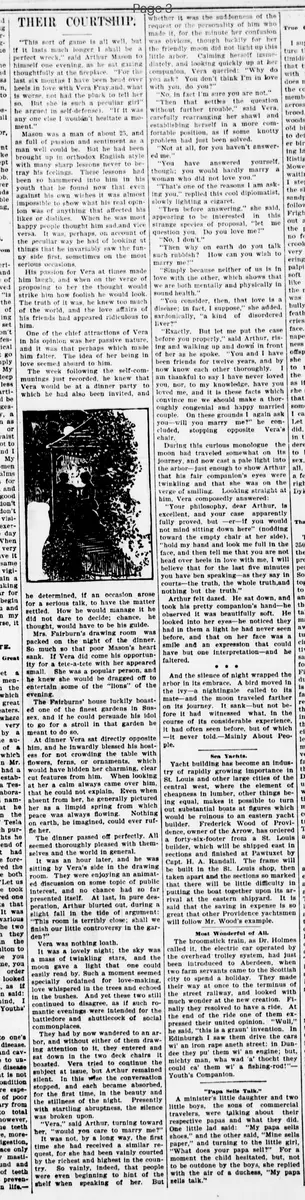
THEIR COURTSHIP
"This sort of game is all well, but if it lasts much longer I shall be a perfect wreck," said Arthur Mason to himself one evening, as he sat gazing thoughtfully at the fireplace. "For the last six months I have been head over heels in love with Vera Fray, and, what is worse, not had the pluck to tell her so.
But she is such a peculiar girl," he argued in self-defense. "If it was any one else I wouldn't hesitate a moment."
Mason was a man of about 25, and as full of passion and sentiment as a man well could be. But he had been brought up in orthodox English style with many sharp lessons never to betray his feelings. These lessons had been so hammered into him in his youth that he found now that even against his own wishes it was almost impossible to show what his real opinion was of anything that affected his likes or dislikes. When he was most happy people thought him sad, and vice versa. It was, perhaps, on account of the peculiar way he had of looking at things that he invariably saw the funny side first, sometimes on the most serious occasions.
His passion for Vera at times made him laugh, and when on the verge of proposing to her the thought would strike him how foolish he would look.
The truth of it was, he knew too much of the world, and the love affairs of his friends had appeared ridiculous to him.
One of the chief attractions of Vera in his opinion was her passive nature, and it was that perhaps which made him falter. The idea of her being in love seemed absurd to him.
The week following the self-communings just recorded, he knew that Vera would be at a dinner party to which he had also been invited, and he determined, if an occasion arose for a serious talk, to have the matter settled. How he would manage it he did not dare to decide; chance, he thought, would have to be his guide.
Mrs. Fairburn's drawing room was packed on the night of the dinner. So much so that poor Mason's heart sank. If Vera did come his opportunity for a tete-a-tete with her appeared small. She was a popular person, and he knew she would be dragged off to entertain some of the "lions" of the evening.
The Fairburns' house luckily boasted one of the finest gardens in Sussex, and if he could persuade his idol to go for a stroll in that garden he meant to do so.
At dinner Vera sat directly opposite him, and he inwardly blessed his hostess for not crowding the table with flowers, ferns, or ornaments, which would have hidden her charming, clear cut features from him. When looking at her a calm always came over him, that he could not explain. Even when absent from her, he generally pictured her as a limpid spring from which peace was always flowing.
Nothing on earth, he imagined, could ever ruffle her.
The dinner passed off perfectly. All seemed thoroughly pleased with themselves and the world in general.
It was an hour later, and he was sitting by Vera's side in the drawing room. They were enjoying an animated discussion on some topic of public interest, and no chance had so far presented itself.
At last, in pure desperation, Arthur blurted out, during a slight fall in the tide of argument:
"This room is terribly close; shall we finish our little controversy in the garden?"
Vera was nothing loath.
It was a lovely night; the sky was a mass of twinkling stars, and the moon gave a light that one could easily read by. Such a moment seemed specially ordained for love-making. Love whispered in the trees and echoed in the bushes. And yet these two still continued to disagree, as if such romantic evenings were intended for the battledore and shuttlecock of social commonplaces.
They had by now wandered to an arbor, and without either of them drawing attention to it, they entered and sat down in the two deck chairs it boasted. Vera tried to continue the subject at issue, but Arthur remained silent. In this wise the conversation stopped, and each became absorbed, for the first time, in the beauty and the stillness of the night.
Presently with startling abruptness, the silence was broken upon.
"Vera," said Arthur, turning toward her, "would you care to marry me?"
It was not, by a long way, the first time she had received a similar request, for she had been vainly courted by the richest and highest in the country.
So vainly, indeed, that people were even beginning to hint of the shelf when speaking of her.
But whether it was the suddenness of the request or the personality of him who made it, for the minute her confusion was obvious, though luckily for her the friendly moon did not light up this little arbor. Calming herself immediately, and looking quickly up at her companion, Vera queried:
"Why do you ask? You don't think I'm in love with you, do you?"
"No, in fact I'm sure you are not."
"Then that settles the question without further trouble," said Vera, carefully rearranging her shawl and establishing herself in a more comfortable position, as if some knotty problem had just been solved.
"Not at all, for you haven't answered me."
"You have answered yourself, though: you would hardly marry a woman who did not love you."
"That's one of the reasons I am asking you," replied this cool diplomatist, slowly lighting a cigaret.
"Then before answering," she said, appearing to be interested in this strange species of proposal, "let me question you. Do you love me?"
"No, I don't."
"Then why on earth do you talk such rubbish? How can you wish to marry me?"
"Simply because neither of us is in love with the other, which shows that we are both mentally and physically in sound health."
"You consider, then, that love is a disease: in fact, I suppose," she added sardonically, "a kind of disordered liver?"
"Exactly. But let me put the case before you properly," said Arthur, rising and walking up and down in front of her as he spoke. "You and I have been friends for twelve years, and by now know each other thoroughly. I am thankful to say I have never loved you, nor, to my knowledge, have you loved me, and it is these facts which convince me we should make a thoroughly congenial and happy married couple. On these grounds I again ask you—will you marry me?" he concluded, stopping opposite Vera's chair.
During this curious monologue the moon had traveled somewhat on its journey, and now cast a pale light into the arbor—just enough to show Arthur that his fair companion's eyes were twinkling and that she was on the verge of smiling. Looking straight at him, Vera composedly answered:
"Your philosophy, dear Arthur, is excellent, and your case apparently fully proved, but—er—if you would not mind sitting down here" (nodding toward the empty chair at her side), "hold my hand and look me full in the face, and then tell me that you are not head over heels in love with me. I will believe that for the last five minutes you have been speaking—as they say in courts—the truth, the whole truth, and nothing but the truth."
Arthur felt dazed. He sat down, and took his pretty companion's hand—he observed it was beautifully soft. He looked into her eyes—he noticed they had in them a light he had never seen before, and that on her face was a smile and an expression that could have but one interpretation—and he faltered.
And the silence of night wrapped the arbor in its embrace. A bird moved in the ivy—a nightingale called to its mate—and the moon traveled farther on its journey. It sank—but not before it had witnessed what, in the course of its considerable experience, it had often seen before, but of which—it never told.
Mainly About People.
"This sort of game is all well, but if it lasts much longer I shall be a perfect wreck," said Arthur Mason to himself one evening, as he sat gazing thoughtfully at the fireplace. "For the last six months I have been head over heels in love with Vera Fray, and, what is worse, not had the pluck to tell her so.
But she is such a peculiar girl," he argued in self-defense. "If it was any one else I wouldn't hesitate a moment."
Mason was a man of about 25, and as full of passion and sentiment as a man well could be. But he had been brought up in orthodox English style with many sharp lessons never to betray his feelings. These lessons had been so hammered into him in his youth that he found now that even against his own wishes it was almost impossible to show what his real opinion was of anything that affected his likes or dislikes. When he was most happy people thought him sad, and vice versa. It was, perhaps, on account of the peculiar way he had of looking at things that he invariably saw the funny side first, sometimes on the most serious occasions.
His passion for Vera at times made him laugh, and when on the verge of proposing to her the thought would strike him how foolish he would look.
The truth of it was, he knew too much of the world, and the love affairs of his friends had appeared ridiculous to him.
One of the chief attractions of Vera in his opinion was her passive nature, and it was that perhaps which made him falter. The idea of her being in love seemed absurd to him.
The week following the self-communings just recorded, he knew that Vera would be at a dinner party to which he had also been invited, and he determined, if an occasion arose for a serious talk, to have the matter settled. How he would manage it he did not dare to decide; chance, he thought, would have to be his guide.
Mrs. Fairburn's drawing room was packed on the night of the dinner. So much so that poor Mason's heart sank. If Vera did come his opportunity for a tete-a-tete with her appeared small. She was a popular person, and he knew she would be dragged off to entertain some of the "lions" of the evening.
The Fairburns' house luckily boasted one of the finest gardens in Sussex, and if he could persuade his idol to go for a stroll in that garden he meant to do so.
At dinner Vera sat directly opposite him, and he inwardly blessed his hostess for not crowding the table with flowers, ferns, or ornaments, which would have hidden her charming, clear cut features from him. When looking at her a calm always came over him, that he could not explain. Even when absent from her, he generally pictured her as a limpid spring from which peace was always flowing.
Nothing on earth, he imagined, could ever ruffle her.
The dinner passed off perfectly. All seemed thoroughly pleased with themselves and the world in general.
It was an hour later, and he was sitting by Vera's side in the drawing room. They were enjoying an animated discussion on some topic of public interest, and no chance had so far presented itself.
At last, in pure desperation, Arthur blurted out, during a slight fall in the tide of argument:
"This room is terribly close; shall we finish our little controversy in the garden?"
Vera was nothing loath.
It was a lovely night; the sky was a mass of twinkling stars, and the moon gave a light that one could easily read by. Such a moment seemed specially ordained for love-making. Love whispered in the trees and echoed in the bushes. And yet these two still continued to disagree, as if such romantic evenings were intended for the battledore and shuttlecock of social commonplaces.
They had by now wandered to an arbor, and without either of them drawing attention to it, they entered and sat down in the two deck chairs it boasted. Vera tried to continue the subject at issue, but Arthur remained silent. In this wise the conversation stopped, and each became absorbed, for the first time, in the beauty and the stillness of the night.
Presently with startling abruptness, the silence was broken upon.
"Vera," said Arthur, turning toward her, "would you care to marry me?"
It was not, by a long way, the first time she had received a similar request, for she had been vainly courted by the richest and highest in the country.
So vainly, indeed, that people were even beginning to hint of the shelf when speaking of her.
But whether it was the suddenness of the request or the personality of him who made it, for the minute her confusion was obvious, though luckily for her the friendly moon did not light up this little arbor. Calming herself immediately, and looking quickly up at her companion, Vera queried:
"Why do you ask? You don't think I'm in love with you, do you?"
"No, in fact I'm sure you are not."
"Then that settles the question without further trouble," said Vera, carefully rearranging her shawl and establishing herself in a more comfortable position, as if some knotty problem had just been solved.
"Not at all, for you haven't answered me."
"You have answered yourself, though: you would hardly marry a woman who did not love you."
"That's one of the reasons I am asking you," replied this cool diplomatist, slowly lighting a cigaret.
"Then before answering," she said, appearing to be interested in this strange species of proposal, "let me question you. Do you love me?"
"No, I don't."
"Then why on earth do you talk such rubbish? How can you wish to marry me?"
"Simply because neither of us is in love with the other, which shows that we are both mentally and physically in sound health."
"You consider, then, that love is a disease: in fact, I suppose," she added sardonically, "a kind of disordered liver?"
"Exactly. But let me put the case before you properly," said Arthur, rising and walking up and down in front of her as he spoke. "You and I have been friends for twelve years, and by now know each other thoroughly. I am thankful to say I have never loved you, nor, to my knowledge, have you loved me, and it is these facts which convince me we should make a thoroughly congenial and happy married couple. On these grounds I again ask you—will you marry me?" he concluded, stopping opposite Vera's chair.
During this curious monologue the moon had traveled somewhat on its journey, and now cast a pale light into the arbor—just enough to show Arthur that his fair companion's eyes were twinkling and that she was on the verge of smiling. Looking straight at him, Vera composedly answered:
"Your philosophy, dear Arthur, is excellent, and your case apparently fully proved, but—er—if you would not mind sitting down here" (nodding toward the empty chair at her side), "hold my hand and look me full in the face, and then tell me that you are not head over heels in love with me. I will believe that for the last five minutes you have been speaking—as they say in courts—the truth, the whole truth, and nothing but the truth."
Arthur felt dazed. He sat down, and took his pretty companion's hand—he observed it was beautifully soft. He looked into her eyes—he noticed they had in them a light he had never seen before, and that on her face was a smile and an expression that could have but one interpretation—and he faltered.
And the silence of night wrapped the arbor in its embrace. A bird moved in the ivy—a nightingale called to its mate—and the moon traveled farther on its journey. It sank—but not before it had witnessed what, in the course of its considerable experience, it had often seen before, but of which—it never told.
Mainly About People.
What sub-type of article is it?
Prose Fiction
What themes does it cover?
Love Romance
Social Manners
What keywords are associated?
Courtship
Marriage Proposal
Romantic Comedy
Unconventional Love
Friendship To Romance
Literary Details
Title
Their Courtship
Key Lines
"Vera," Said Arthur, Turning Toward Her, "Would You Care To Marry Me?"
"Simply Because Neither Of Us Is In Love With The Other, Which Shows That We Are Both Mentally And Physically In Sound Health."
"Your Philosophy, Dear Arthur, Is Excellent, And Your Case Apparently Fully Proved, But—Er—If You Would Not Mind Sitting Down Here" (Nodding Toward The Empty Chair At Her Side), "Hold My Hand And Look Me Full In The Face, And Then Tell Me That You Are Not Head Over Heels In Love With Me."