Thank you for visiting SNEWPapers!
Sign up free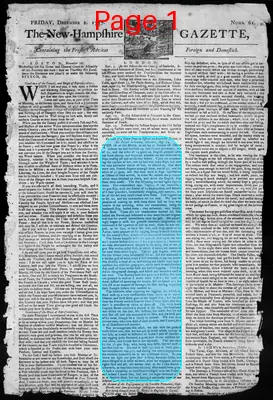
The New Hampshire Gazette
Portsmouth, Rockingham County, New Hampshire
What is this article about?
British ships Seahorse, Raven, and Bonetta engaged two French frigates off Ostend on August 1, blocking privateers. After a three-hour battle, the French retreated, inflicting heavy damage on British vessels and causing casualties including wounded Captain Bover and several deaths.
Clipping
OCR Quality
Full Text
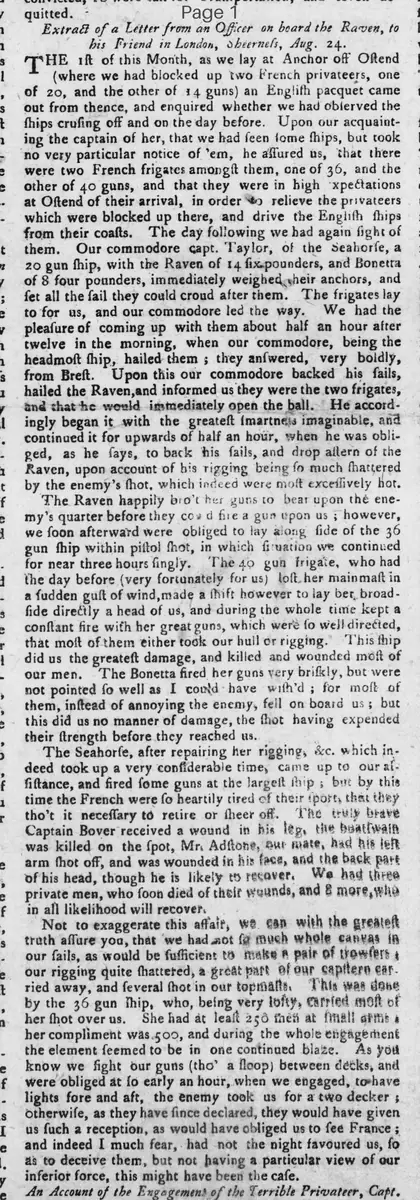
The 1st of this Month, as we lay at Anchor off Ostend (where we had blocked up two French privateers, one of 20, and the other of 14 guns) an English pacquet came out from thence, and enquired whether we had observed the ships cruising off and on the day before. Upon our acquainting the captain of her, that we had seen some ships, but took no very particular notice of 'em, he assured us, that there were two French frigates amongst them, one of 36, and the other of 40 guns, and that they were in high expectations at Ostend of their arrival, in order to relieve the privateers which were blocked up there, and drive the English ships from their coasts. The day following we had again sight of them. Our commodore capt. Taylor, of the Seahorse, a 20 gun ship, with the Raven of 14 pounders, and Bonetta of 8 four pounders, immediately weighed their anchors, and set all the sail they could crowd after them. The frigates lay to for us, and our commodore led the way. We had the pleasure of coming up with them about half an hour after twelve in the morning, when our commodore, being the headmost ship, hailed them; they answered, very boldly, from Brest. Upon this our commodore backed his sails, hailed the Raven, and informed us they were the two frigates, and that he would immediately open the ball. He accordingly began it with the greatest smartness imaginable, and continued it for upwards of half an hour, when he was obliged, as he says, to back his sails, and drop astern of the Raven, upon account of his rigging being so much shattered by the enemy's shot, which indeed were most excessively hot. The Raven happily brought her guns to bear upon the enemy's quarter before they could fire a gun upon us; however, we soon afterward were obliged to lay alongside of the 36 gun ship within pistol shot, in which situation we continued for near three hours singly. The 40 gun frigate, who had the day before (very fortunately for us) lost her mainmast in a sudden gust of wind, made a shift however to lay her broadside directly ahead of us, and during the whole time kept a constant fire with her great guns, which were so well directed, that most of them either took our hull or rigging. This ship did us the greatest damage, and killed and wounded most of our men. The Bonetta fired her guns very briskly, but were not pointed so well as I could have wished; for most of them, instead of annoying the enemy, fell on board us; but this did us no manner of damage, the shot having expended their strength before they reached us. The Seahorse, after repairing her rigging, &c. which indeed took up a very considerable time, came up to our assistance, and fired some guns at the largest ship; but by this time the French were so heartily tired of their sport, that they thought it necessary to retire or sheer off. The truly brave Captain Bover received a wound in his leg. The boatswain was killed on the spot. Mr. Adstone, our mate, had his left arm shot off, and was wounded in his face, and the back part of his head, though he is likely to recover. We had three private men, who soon died of their wounds, and 8 more, who in all likelihood will recover. Not to exaggerate this affair, we can with the greatest truth assure you, that we had not so much whole canvas in our sails, as would be sufficient to make a pair of trousers: our rigging quite shattered, a great part of our carpenter carried away, and several shot in our topmast. This was done by the 36 gun ship, who, being very lofty, carried most of her shot over us. She had at least 220 men at small arms; her complement was 300, and during the whole engagement the element seemed to be in one continued blaze. As you know we fight our guns (though a sloop) between decks, and were obliged at so early an hour, when we engaged, to have lights fore and aft, the enemy took us for a two decker; otherwise, as they have since declared, they would have given us such a reception, as would have obliged us to see France; and indeed I much fear, had not the night favoured us, so as to deceive them, but not having a particular view of our inferior force, this might have been the case.
What sub-type of article is it?
What keywords are associated?
What entities or persons were involved?
Where did it happen?
Foreign News Details
Primary Location
Off Ostend
Event Date
1st Of This Month
Key Persons
Outcome
british casualties: captain bover wounded in leg, boatswain killed, mr. adstone left arm shot off and wounded in face and head (likely to recover), 3 private men died of wounds, 8 more wounded (likely to recover). french frigates retreated after engagement; heavy damage to british ships' rigging, sails, and hulls.
Event Details
On the 1st of the month, British ships Seahorse (20 guns, Capt. Taylor), Raven (14 pounders), and Bonetta (8 four-pounders) engaged two French frigates (36 and 40 guns) off Ostend after sighting them while blockading two French privateers (20 and 14 guns). The Seahorse initiated the battle, followed by the Raven laying alongside the 36-gun frigate for three hours. The 40-gun frigate, having lost its mainmast the previous day, fired from ahead. Bonetta provided support but with inaccurate fire. After repairs, Seahorse rejoined and fired. The French, tiring of the fight, sheered off. The British mistook for a two-decker due to lights, deceiving the enemy about force.