Thank you for visiting SNEWPapers!
Sign up free
Phenix Gazette
Alexandria, Virginia
What is this article about?
The Catholics of Ireland issue an address to the English people at the start of a new Parliament, appealing against disqualifications barring them from full political participation in the British Empire, citing shared Christian faith, loyalty, and historical precedents for emancipation.
Clipping
OCR Quality
Full Text
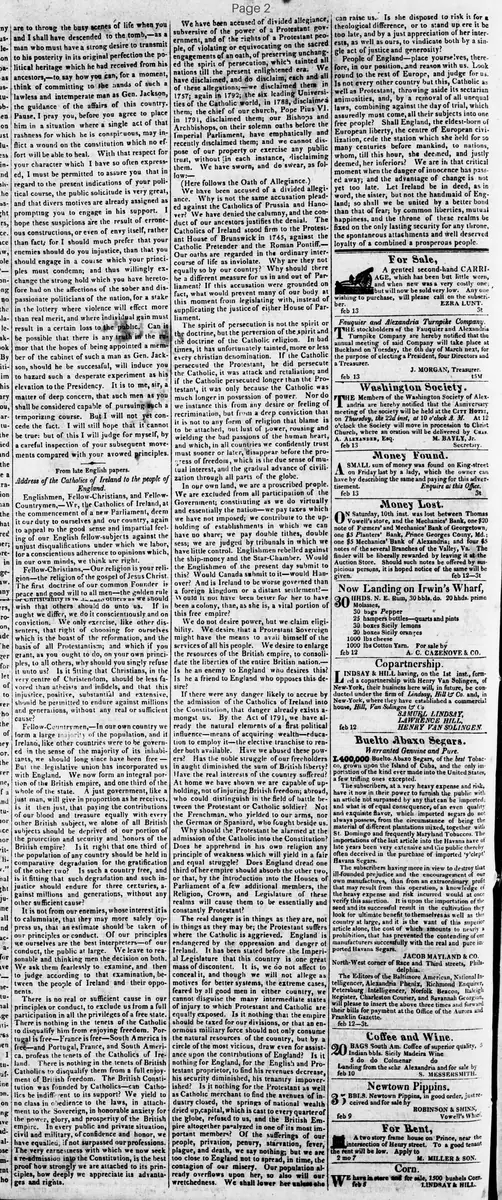
Address of the Catholics of Ireland to the people of England.
Englishmen, Fellow-Christians, and Fellow-Countrymen,—We, the Catholics of Ireland, at the commencement of a new Parliament, deem it our duty to ourselves and our country, again to appeal to the good sense and impartial feeling of our English fellow-subjects against the unjust disqualifications under which we labor, for a conscientious adherence to opinions which, in our own minds, we think are right.
Fellow-Christians,—Our religion is your religion—the religion of the gospel of Jesus Christ. The first doctrine of our common Founder is peace and good will to all men—the golden rule of doing unto others as we should wish that others should do unto us. If in aught we differ, we do it conscientiously and on conviction. We only exercise, like other dissenters, that right of choosing for ourselves which is the boast of the reformation, and the basis of all Protestantism; and which if you grant, as you ought to do, on your own principles, to all others, why should you singly refuse it unto us? Is it fitting that Christians, in the very centre of Christendom, should be less favored than atheists and infidels, and that this injustice, positive, substantial and extensive, should be permitted to endure against millions and generations, without any real or sufficient cause?
Fellow-Countrymen,—In our own country we form a large majority of the population, and if Ireland, like other countries were to be governed in the sense of the majority of its inhabitants, we should long since have been free—But the legislative union has incorporated us with England. We now form an integral portion of the British empire, and one third of the whole of the state. A just government, like a just man, will give in proportion as he receives. Is it then just, that paying the contributions of our blood and treasure equally with every other British subject, we alone of all British subjects should be deprived of our portion of the protection and security and honors of the British empire? Is it right that one third of the population of any country should be held in comparative degradation for the gratification of the other two? Is such a country free, and is it fitting that such degradation and such injustice should endure for three centuries, against millions and generations, without any other sufficient cause?
It is not from our enemies, whose interest it is to calumniate, that they may more safely oppress us, that an estimate should be taken of our principles or conduct. Of our principles we ourselves are the best interpreters—of our conduct, the public at large. We leave to reasonable and thinking men the decision on both. We ask them fearlessly to examine, and then to judge according to that examination, between the people of Ireland and their opponents.
There is no real or sufficient cause in our principles or conduct, to exclude us from a full participation in all the privileges of a free state. There is nothing in the tenets of the Catholic to disqualify him from enjoying freedom. Portugal is free—France is free—South America is free—and Portugal, France, and South America, profess the tenets of the Catholics of Ireland. There is nothing in the tenets of British Catholics to disqualify them from a full enjoyment of British freedom. The British Constitution was founded by Catholics—can Catholics be indifferent to its support? We yield to no class in obedience to the laws, in attachment to the Sovereign, in honorable anxiety for the power, glory, and prosperity of the British empire. In every public and private situation, civil and military, of confidence and honor, we have equalled, if not surpassed our professions. The very earnestness with which we now seek a re-admission into the Constitution, is the best proof how strongly we are attached to its principles, how deeply we appreciate its advantages and rights.
We have been accused of divided allegiance, subversive of the power of a Protestant government, and of the rights of a Protestant people, of violating or equivocating on the sacred engagements of an oath, of preserving unchanged the spirit of persecution, which tainted all nations till the present enlightened era. We have disclaimed, and do disclaim, each and all of these allegations; we disclaimed them in 1757; again in 1792; the six leading Universities of the Catholic world, in 1788, disclaimed them; the chief of our church, Pope Pius VI. in 1791, disclaimed them; our Bishops and Archbishops, on their solemn oaths before the Imperial Parliament, have emphatically and recently disclaimed them; and we cannot dispose of our property or exercise any public trust, without in each instance, disclaiming them. We have sworn, and do swear, as follows:—
(Here follows the Oath of Allegiance.)
We have been accused of a divided allegiance. Why is not the same accusation pleaded against the Catholics of Prussia and Hanover? We have denied the calumny, and the conduct of our ancestors justifies the denial. The Catholics of Ireland stood firm to the Protestant House of Brunswick in 1745, against the Catholic Pretender and the Roman Pontiff.—Our oaths are regarded in the ordinary intercourse of life as inviolate. Why are they not equally so by our country? Why should there be a different measure for us in and out of Parliament? If this accusation were grounded on fact, what would prevent many of our body at this moment from legislating with, instead of supplicating the justice of either House of Parliament.
The spirit of persecution is not the spirit or the doctrine, but the perversion of the spirit and the doctrine of the Catholic religion. In bad times, it has unfortunately tainted, more or less every christian denomination. If the Catholic persecuted the Protestant, he did persecute the Catholic, it was attack and retaliation; and if the Catholic persecuted longer than the Protestant, it was only because the Catholic was much longer in possession of power. Nor do we instance this from any desire or feeling of recrimination, but from a deep conviction that it is not to any form of religion that blame is to be attached, but lust of power, rousing and wielding the bad passions of the human heart, and which, in all countries we confidently trust must sooner or later, disappear before the progress of freedom, which is the due sense of mutual interest, and the gradual advance of civilization through all parts of the globe.
In our own land, we are a proscribed people. We are excluded from all participation of the Government; constituting as we do virtually and essentially the nation—we pay taxes which we have not imposed; we contribute to the upholding of establishments in which we can have no share; we pay double tithes, double cess; we are judged by tribunals in which we have little control. Englishmen rebelled against the ship-money and the Star-Chamber. Would the Englishmen of the present day submit to this? Would Canada submit to it—would Hanover? And is Ireland to be worse governed than a foreign kingdom or a distant settlement?—Would it not have been better for her to have been a colony, than, as she is, a vital portion of this free empire?
We do not desire power, but we claim eligibility. We desire that a Protestant Sovereign might have the means to avail himself of the services of all his people. We desire to enlarge the resources of the British empire, to consolidate the liberties of the entire British nation.—Is he an enemy to England who desires this? Is he a friend to England who opposes this desire?
If there were any danger likely to accrue by the admission of the Catholics of Ireland into the Constitution, that danger already exists amongst us. By the Act of 1793, we have already the natural elements of a first political influence—means of acquiring wealth—education to employ it—the elective franchise to render both available. Have we abused these powers? Has the noble struggle of our freeholders in aught diminished the sum of British liberty? Have the real interests of the country suffered? At home we have shown we are capable of upholding, not of injuring British freedom; abroad, who could distinguish in the field of battle between the Protestant or Catholic soldier? Not the Frenchman, who yielded to our arms, nor the German or Spaniard, who fought beside us. Why should the Protestant be alarmed at the admission of the Catholic into the Constitution? Does he apprehend in his own religion any principle of weakness which will yield in a fair and equal struggle? Does England dread one third of her empire should absorb the other two, or that, by the introduction into the Houses of Parliament of a few additional members, the Religion, Crown, and Legislature of these realms will cause them to be essentially and constantly Protestant?
The real danger is in things as they are, not in things as they may be; the Protestant suffers where the Catholic is aggrieved. England is endangered by the oppression and danger of Ireland. It has been stated before the Imperial Legislature that this country is one great mass of discontent. It is, we do not affect to conceal it, and though we will not allege as motives for better systems, the extreme cases, feared by all good men in either country, we cannot disguise the many intermediate states of injury to which Protestant and Catholic are equally exposed. Is it nothing that the empire should be taxed for our divisions, or that an enormous military force should not only consume the natural resources of the country, but by a circle of the most vicious, draw even for assistance upon the contributions of England? Is it nothing for England, for the English and Protestant proprietor, to find his revenues decrease, his security diminished, his tenantry impoverished? Is it nothing for the Protestant as well as Catholic merchant to find the avenues of industry closed, the springs of national wealth dried up, capital, which is cast to every quarter of the globe, refused to us, and the British Empire altogether paralyzed in one of its most important members? Of the sufferings of our people, privation, penury, starvation, fever, plague, and death, we say nothing; but we are too close to England not to spread, in time, the contagion of our misery. Our population already overflows upon her, so also will our wretchedness. We shall lower her unless she can raise us. Is she disposed to risk it for a theological difference, or to stand up ere it be too late, and by a just appreciation of her interests, as well as ours, to vindicate both by a single act of justice and generosity?
People of England—place yourselves, therefore, in our position, and reason with us. Look round to the rest of Europe, and judge of us. Is not every other country but this, Catholic as well as Protestant, throwing aside its sectarian animosities, and, by a removal of all unequal laws, combining against the day of trial, which assuredly must come, all their subjects into one free people? Shall England, the eldest-born of European liberty, the centre of European civilization, cede the station which she held for so many centuries before mankind, to nations, whom, till this hour, she deemed, and justly deemed, her inferiors? We are in that critical moment when the danger of innocence has passed away; and the advantage of change is not yet too late. Let Ireland be in deed, as in word, the sister, but not the handmaid of England; so shall we be united by a better bond than that of fear; by common liberties, mutual happiness, and the throne of these realms be fixed on the only lasting security for any throne, the spontaneous attachments and well deserved loyalty of a combined and prosperous people.
What sub-type of article is it?
What keywords are associated?
What entities or persons were involved?
Where did it happen?
Foreign News Details
Primary Location
Ireland
Event Date
At The Commencement Of A New Parliament
Key Persons
Event Details
The Catholics of Ireland address the people of England, appealing for the removal of disqualifications preventing their participation in British governance, denying accusations of disloyalty, citing historical disavowals and loyalty, and arguing for justice based on shared contributions and religion.