Thank you for visiting SNEWPapers!
Sign up free
The New Hampshire Gazette And General Advertiser
Portsmouth, Rockingham County, New Hampshire
What is this article about?
U.S. House of Representatives proceedings in August 1789 debating and amending proposed constitutional amendments, including protections for religion, speech, press, assembly, bearing arms, quartering soldiers, due process, and excessive bail/fines. Key debates on omitting self-evident rights and binding instructions for representatives.
Merged-components note: Continuation of Congress proceedings across pages, sequential reading order and text flows directly from one to the next.
Clippings
1 of 2
OCR Quality
Full Text
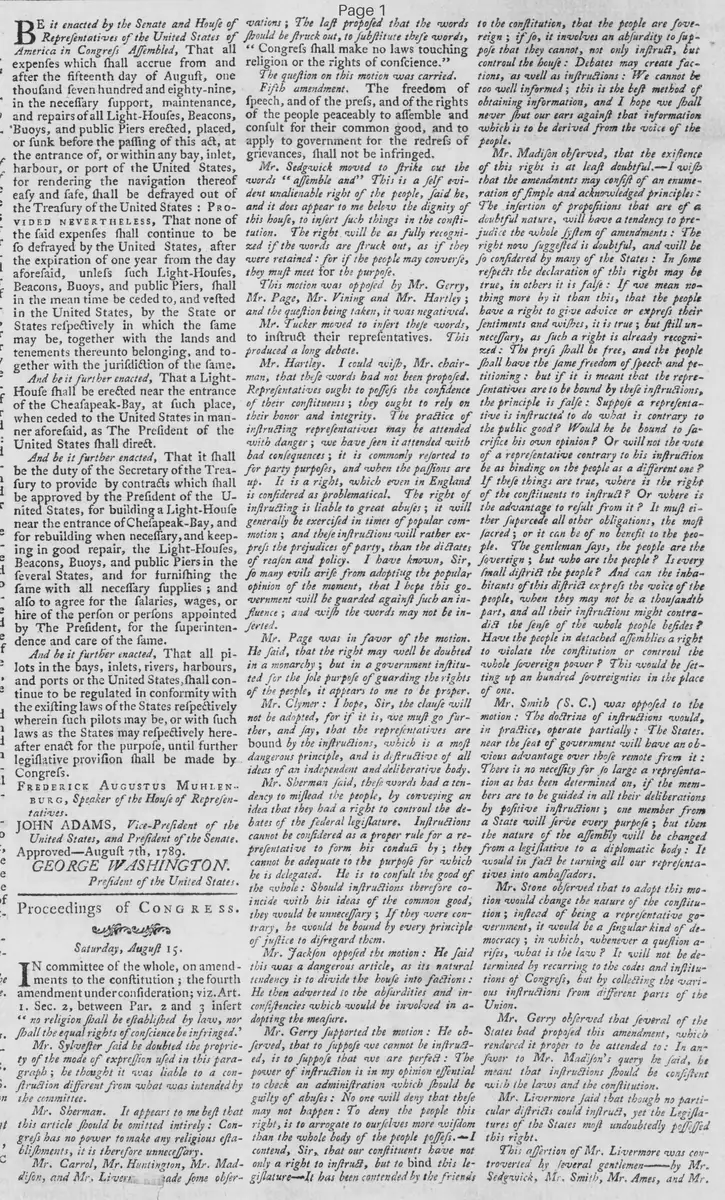
Saturday, August 15.
In committee of the whole, on amendments to the constitution; the fourth amendment under consideration: viz. Art. I. Sec. 2. between Par. 2 and 3 insert 'No religion shall be established by law, nor shall the equal rights of conscience be infringed.'
Mr. Sylvester said he doubted the propriety of the mode of expression used in this paragraph; he thought it was liable to a construction different from what was intended by the committee.
Mr. Sherman. It appears to me best that this article should be omitted entirely: Congress has no power to make any religious establishments, it is therefore unnecessary.
Mr. Carroll, Mr. Huntington, Mr. Madison, and Mr. Livingston made some observations: The last proposed that the words should be struck out, to substitute these words, 'Congress shall make no laws touching religion or the rights of conscience.'
The question on this motion was carried.
Fifth amendment. The freedom of speech, and of the press, and of the rights of the people peaceably to assemble and consult for their common good, and to apply to government for the redress of grievances, shall not be infringed.
Mr. Sedgwick moved to strike out the words 'assemble and' This is a self-evident unalienable right of the people, said he, and it does appear to me below the dignity of this house, to insert such things in the constitution. The right will be as fully recognized if the words are struck out, as if they were retained: for if the people may converse, they must meet for the purpose.
This motion was opposed by Mr. Gerry, Mr. Page, Mr. Vining and Mr. Hartley; and the question being taken, it was negatived.
Mr. Tucker moved to insert these words, to instruct their representatives. This produced a long debate.
Mr. Hartley. I could wish, Mr. Chairman, that these words had not been proposed. Representatives ought to possess the confidence of their constituents; they ought to rely on their honor and integrity. The practice of instructing representatives may be attended with danger; we have seen it attended with bad consequences; it is commonly resorted to for party purposes, and when the passions are up. It is a right, which even in England is considered as problematical. The right of instructing is liable to great abuses; it will generally be exercised in times of popular commotion; and these instructions will rather express the prejudices of party, than the dictates of reason and policy. I have known, Sir, so many evils arise from adopting the popular opinion of the moment, that I hope this government will be guarded against such an influence; and wish the words may not be inserted.
Mr. Page was in favor of the motion. He said, that the right may well be doubted in a monarchy; but in a government instituted for the sole purpose of guarding the rights of the people, it appears to me to be proper.
Mr. Clymer: I hope, Sir, the clause will not be adopted, for if it is, we must go further, and say, that the representatives are bound by the instructions, which is a most dangerous principle, and is destructive of all ideas of an independent and deliberative body.
Mr. Sherman said, these words had a tendency to mislead the people, by conveying an idea that they had a right to control the debates of the federal legislature. Instructions cannot be considered as a proper rule for a representative to form his conduct by; they cannot be adequate to the purpose for which he is delegated. He is to consult the good of the whole: Should instructions therefore coincide with his ideas of the common good, they would be unnecessary; If they were contrary, he would be bound by every principle of justice to disregard them.
Mr. Jackson opposed the motion: He said this was a dangerous article, as its natural tendency is to divide the house into factions: He then adverted to the absurdities and inconsistencies which would be involved in adopting the measure.
Mr. Gerry supported the motion: He observed, that to suppose we cannot be instructed, is to suppose that we are perfect: The power of instruction is in my opinion essential to check an administration which should be guilty of abuses: No one will deny that these may happen: To deny the people this right, is to arrogate to ourselves more wisdom than the whole body of the people possess. I contend, Sir, that our constituents have not only a right to instruct, but to bind this legislature—It has been contended by the friends to the constitution, that the people are sovereign; if so, it involves an absurdity to suppose that they cannot, not only instruct, but control the house: Debates may create factions, as well as instructions: We cannot be too well informed; this is the best method of obtaining information, and I hope we shall never shut our ears against that information which is to be derived from the voice of the people.
Mr. Madison observed, that the existence of this right is at least doubtful.—I wish that the amendments may consist of an enumeration of simple and acknowledged principles. The insertion of propositions that are of a doubtful nature, will have a tendency to prejudice the whole System of amendments: The right now suggested is doubtful, and will be so considered by many of the States: In some respects the declaration of this right may be true, in others it is false: If we mean nothing more by it than this, that the people have a right to give advice or express their sentiments and wishes, it is true; but still unnecessary, as such a right is already recognized: The press shall be free, and the people shall have the same freedom of speech and petitioning: but if it is meant that the representatives are to be bound by these instructions, the principle is false: Suppose a representative is instructed to do what is contrary to the public good? Would he be bound to sacrifice his own opinion? Or will not the vote of a representative contrary to his instruction be as binding on the people as a different one? If these things are true, where is the right of the constituents to instruct? Or where is the advantage to result from it? It must either supersede all other obligations, the most sacred; or it can be of no benefit to the people. The gentleman says, the people are the sovereign; but who are the people? Is every small district the people? And can the inhabitants of this district express the voice of the people, when they may not be a thousandth part, and all their instructions might contradict the sense of the whole people besides? Have the people in detached assemblies a right to violate the constitution or control the whole sovereign power? This would be setting up an hundred sovereignties in the place of one.
Mr. Smith (S. C.) was opposed to the motion: The doctrine of instructions would, in practice, operate partially: The States near the seat of government will have an obvious advantage over those remote from it: There is no necessity for so large a representation as has been determined on, if the members are to be guided in all their deliberations by positive instructions; one member from a State will serve every purpose; but then the nature of the assembly will be changed from a legislative to a diplomatic body: It would in fact be turning all our representatives into ambassadors.
Mr. Stone observed that to adopt this motion would change the nature of the constitution; instead of being a representative government, it would be a singular kind of democracy; in which, whenever a question arises, what is the law? It will not be determined by recurring to the codes and institutions of Congress, but by collecting the various instructions from different parts of the Union.
Mr. Gerry observed that several of the States had proposed this amendment, which rendered it proper to be attended to: In answer to Mr. Madison's query he said, he meant that instructions should be consistent with the laws and the constitution.
Mr. Livermore said that though no particular districts could instruct, yet the Legislatures of the States most undoubtedly possessed this right.
This assertion of Mr. Livermore was controverted by several gentlemen—by Mr. Sedgwick, Mr. Smith, Mr. Ames, and Mr.
Wadsworth: The last, speaking on the subject of instructions in general, said, I never knew merely political instructions to be observed; and I never knew a representative brought to an account for it: But I have known representatives follow instructions, contrary to their private sentiments, and they have ever been despised for it. Others have disregarded their instructions, and have been re-elected, and caressed. Now, if the people considered it as an inherent right in them to instruct their representatives, they would undoubtedly have punished the violation of such instructions; but this I believe has never been the case. I consider the measure as having a mischievous tendency.
The debate was continued much longer, but in a desultory way, as the speakers appeared to take it for granted, that they might touch upon collateral circumstances. The question on the motion being at length taken, it was negatived by a large majority; and then the committee agreed to the amendment in its original form.
The committee rose and the chairman reported progress.
Mr. Ames introduced a motion that all questions on amendments should be determined in committee, by two thirds of the members. Laid on the table.
Adjourned.
Monday, August 17.
In committee of the whole on the subject On amendments to the Constitution.
The 6th and 7th amendments were agreed to without alteration.
In the 8th, on motion of Mr. Laurance, after the words "nor shall" these words were inserted, in any criminal cases. The 9th was adopted without alteration. In the 10th, on motion of Mr. Benson, after the words "and effects" these words were inserted, against unreasonable searches and seizures. 11th, 12th, 13th and 14th, were agreed to in their original form. The committee then rose, and the house adjourned.
Tuesday, August 18.
The committee appointed to bring in a bill to regulate the Post-Office, brought in a resolve, which, with the Preamble, was to the following effect, That as the shortness of the time previous to the adjournment would not admit of making the necessary arrangements, therefore Resolved, that the Post MASTER GENERAL be directed to continue the Post-Office upon the System established by the late Congress, and that he be authorised to make the necessary contracts, &c.
Mr. Gerry introduced a motion upon the subject of amendments, to this purport, That such amendments to the Constitution of the United States as have been proposed by the different States, which are not in the report of the select committee, be referred to a committee of the whole house--and that those, with the amendments proposed by that committee, be included in one report. This motion was introduced by a lengthy speech upon the subject of amendments at large, and was seconded by Mr. Sumter--This brought on a warm debate, which continued till near one o'clock--when the question being called for from various parts of the house, the ayes and noes were required by Mr. Gerry. Upon which Mr. Vining called for the previous question, and the Ayes and Noes were then required upon that also--this occasioned a further debate--at length the Speaker directed the Clerk to call the Ayes and Noes on Shall the main question be put?
Noes. Messrs. Ames, Baldwin, Benson, Boudinot, Brown, Cadwallader, Carrol, Clymer, Fitzsimons, Foster, Gilman, Goodhue, Hartley, Heister, Huntington, Laurance, Lee, Madison, Moore, P. Muhlenberg, Partridge, Schureman, Scott, Sedgwick, Seney, Sylvester, Sinnickson, Smith, (S. C.) Smith, (M.) Thatcher, Trumbull, Vining, Wadsworth, Wynkoop. 34.
Ayes. Messrs. Burke, Coles, Floyd, Gerry, Griffin, Grout, Hathorn, Livermore, Page, Parker, Van Rensselaer, Sherman, Stone, Sturgis, Sumter, Tucker. 16.
Majority 18.
The house then went into a committee of the whole on the report of the select committee. The five remaining amendments were agreed to by the committee, with some little variation. They then rose, and the chairman reported their proceedings, which, it was ordered, should lie on the table for the consideration of the members.
A message was received from the Senate by their Secretary, informing the house that they had concurred with one amendment in the bill to provide for the necessary expenses attending negociations, and treating with the Indian tribes, &c.
The proposed amendment was, to strike out "Forty," and insert twenty, which would make the provision for the expenses twenty thousand instead of forty thousand dollars.
Mr. Tucker presented a number of papers containing seventeen proposed amendments to the constitution; which were read and laid on the table.
The committee on the subject of the disputed election of the members from New-Jersey, brought in a report containing a state of facts respecting said election, which was read, and then the house adjourned.
Monday, August 17.
Further sketch of the Debate on Amendments to the Constitution.
In committee of the whole House.
SIXTH AMENDMENT--A well regulated militia, composed of the body of the people, being the best security of a free State, the right of the people to keep and bear arms shall not be infringed, but no person religiously scrupulous shall be compelled to bear arms.
Mr. Benson moved that the words "but no person religiously scrupulous shall be compelled to bear arms," be struck out. He wished that this humane provision should be left to the benevolence of the government. It was improper to make it a fundamental in the constitution.
The motion was negatived, and the amendment agreed to.
Mr. Burke moved to add a clause to the last paragraph to this effect: That a standing army of regular troops in time of peace is dangerous to public liberty, and should not be supported in time of peace, except by the consent of two thirds of both houses.
This amendment was negatived.
7th Amendment. "No Soldier shall in time of peace be quartered in any house without the consent of the owner, nor in time of war, but in a manner to be prescribed by law."
Mr. Sumter moved to strike out the words "in time of peace" and also the last words of the paragraph from the word "owner."
Mr. Sherman said he thought this was going too far; occasion might arise in which it would be extremely injurious to put it in the power of any man to obstruct the public service: He adverted to the British regulations in this case, of quartering soldiers in public houses. This motion was negatived.
Mr. Gerry said, that he conceived the article might be so altered as to relieve the minds of the citizens of the United States. It is said, government will take care of the rights of the people; but these amendments are designed to prevent the arbitrary exercise of power. He then moved to insert between the words "but" and "in a manner," the words, by a civil magistrate. Negatived.
The amendment was agreed to.
8th Amendment. "No person shall be subject, except in case of impeachment, to more than one trial for the same offence, nor shall be compelled to be a witness against himself, nor be deprived of life, liberty or property, without due process of law, nor shall private property be taken for public use without just compensation."
Mr. Benson observed, that it was certainly a fact, that a person might be tried more than once for the same offence: Instances of this kind frequently occurred. He therefore moved to strike out the words "one trial or." This was negatived.
Mr. Sherman was in favor of the motion.
Mr. Livermore was opposed to it: He said: The clause appears to me essential; if it is struck out, it will hold up the idea that a person may be tried more than once for the same offence: Some instances of this kind have taken place; but they have caused great uneasiness: It is contrary to the usages of law and practice among us; and so it is to those of that country from which we have adopted our laws. I hope the clause will not be struck out.
Mr. Partridge moved to insert after the words "same offence," the words by any law of the United States." Negatived.
Mr. Laurance moved to insert after the words "nor shall" these words in any criminal case. This amendment was agreed to.
9th Amendment. "Excessive bail shall not be required, nor excessive fines imposed,"
What sub-type of article is it?
What themes does it cover?
What keywords are associated?
What entities or persons were involved?
Story Details
Key Persons
Event Date
August 15, 1789; August 17, 1789; August 18, 1789
Story Details
Debates in the U.S. House Committee of the Whole on proposed constitutional amendments, including revisions to clauses on religion and conscience, freedom of speech, press, assembly, and petition; extended discussion opposing inclusion of right to instruct representatives; agreements on amendments regarding militia, arms, quartering soldiers, trials, due process, property, bail, and fines; procedural motions and votes on further amendments and post-office regulation.