Thank you for visiting SNEWPapers!
Sign up free
Literary
October 12, 1824
Constitutional Whig
Richmond, Virginia
What is this article about?
Charles J. Ingersoll's discourse, delivered October 1, 1824, before the American Philosophical Society with Lafayette present, argues for governmental improvements through political philosophy, equality, and independence, celebrating American progress and Lafayette's role in revolutions.
Clipping
OCR Quality
75%
Good
Full Text
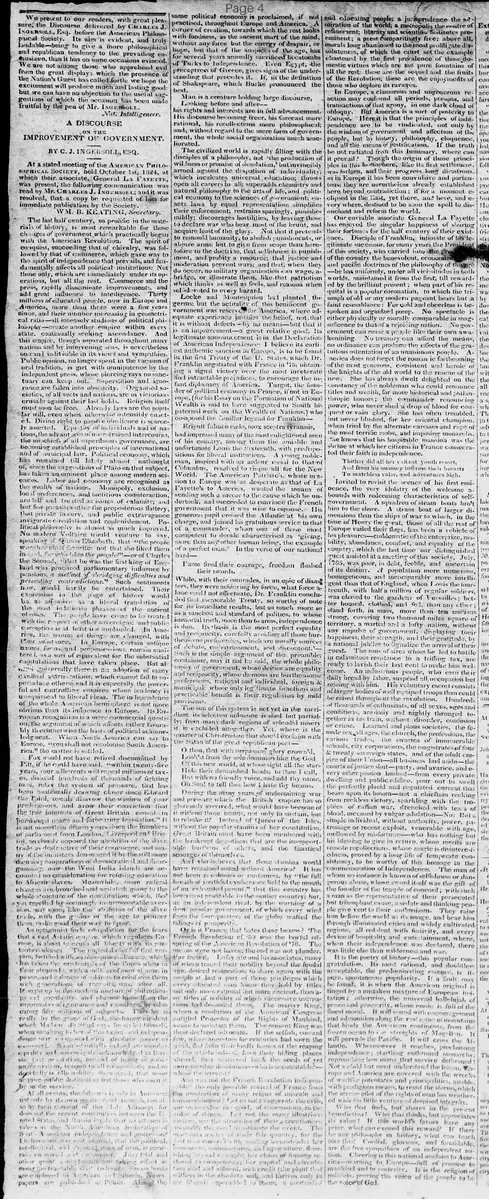
We present to our readers, with great pleasure, this Discourse, delivered by Charles J. Ingersoll, Esq., before the American Philosophical Society. Its aim is evident, and truly laudable—being to give a more philosophical and republican tendency to the prevailing enthusiasm, than it has on some occasions evinced. We are not among those who apprehend evil from the great displays which the presence of the Nation's Guest has called forth: we hope the excitement will produce much and lasting good: but we can have no objection to the seasonable suggestions of which this occasion has been made fruitful by the pen of Mr. Ingersoll.
Nat. Intelligencer.
A DISCOURSE
ON THE
IMPROVEMENT OF GOVERNMENT
BY C.J. INGERSOLL, ESQ.
At a stated meeting of the American Philosophical Society, held October 1st, 1824, at which their associate, General La Fayette, was present, the following communication was read by Mr. Charles J. Ingersoll; and it was resolved, that a copy be requested of him for immediate publication by the Society.
WM. B. KEATING, Secretary.
The last half century, so prolific in the materials of history, is most remarkable for those changes of government which practically began with the American Revolution. The spirit of conquest, succeeding that of chivalry, was followed by that of commerce, which gave way to the spirit of independence that prevails, and fundamentally affects all political institutions: Not those only, which are immediately under its operations, but all the rest. Commerce and the press, rapidly disseminate improvements, and add great influence to intelligence. Thirty millions of educated people, now in Europe and America, more than there were a few years since, and their number increasing in geometrical ratio—all intensely studious of political philosophy—create another empire within every state, continually seeking ascendancy. And this empire, though separated throughout many nations and by intervening seas, is nevertheless one and indivisible in its views and sympathies. Public opinion, no longer spent in the vacuum of oral tradition, is girt with omnipotence by the independent press, whose piercing rays no sanctuary can keep out. Superstition and ignorance are fallen into obscurity. Organised societies, of all sects and nations, are in victorious crusade against their last holds. Religion itself must soon be free. Already laws are the popular will, even when otherwise ostensibly enacted. Divine right to passive obedience is scarcely asserted. Equality of individuals and of nations, the advantages of unrestrained intercourse, the mischiefs of all superfluous governance, are becoming established principles of international and of municipal law. Political economy, which has remained till lately almost unthought of, since the suggestions of Plato on that subject, has taken an eminent place among modern sciences. Labor and economy are recognised as the wealth of nations. Monopoly, exclusion, local preferences, and factitious counteraction, are felt and treated as issues of calamity; and but few parasites utter the preposterous flattery, that private luxury, and public extravagance invigorate circulation and replenishment. Political philosophy is almost as much improved. No modern Voltaire would venture to say, speaking of Queen Elizabeth, that "the people were born chiefly for her favorite: not that she liked them indeed, for she takes the people?"—or of Charles the Second, "that he was the first king of England who procured parliamentary influence by pensions, a method of abridging difficulties and preventing convulsions." Such sentiments now, would hardly be entertained. Their expression in the page of history would be as offensive as a literal translation of the most indelicate phrases of the ancient classics. The people have come to be treated with the respect of other sovereigns: and public corruption is at least not applauded. In America, the names of things are changed, with their substance. In Europe, certain antique names, for us, and prepossessions, remain unaltered, as a sort of equivalent for the substantial capitulations that have taken place. But all governments universally there is an adoption of many cardinal ameliorations, which cannot fail to superinduce others; and it is especially the powerful and controlling empires whose tendency is unequivocal to liberal ideas. The independence of the whole American hemisphere is not more obvious than its influence in Europe. Its European recognition is a mere commercial question, the argument of which affects rather favorably than otherwise the basis of political acknowledgment. When North America can say to Europe, "you shall not recolonise South America," the matter is settled. Fox would not have retired discountenanced by Pitt, if he could have said, "within twenty-five years, your adherents will repeal millions of taxes, disband hundreds of thousands of fighting men, relax the system of pressure, that has been continually drawing closer since Edward the Third, openly disavow the wisdom of your predecessors, and avow their conviction that the true interests of Great Britain consist in permanent peace and forbearing legislation." It is not more than fifteen years since the members of parliament from London, Liverpool and Bristol, anxiously opposed the abolition of the slave trade as destructive of their commerce, and many of the ministers denounced it by the still more damning conjurations of democratical and disorganising; now the West India islands are accounted no consideration for refusing education to African slaves. Meanwhile, more radical changes are broached and agitated; going to the whole structure of the constitution; which, tho yet repelled by seemingly insurmountable aversion, may soon, like the abolition of the slave trade, with the genius of the age to pioneer them, make good their way to favor. An optimist finds consolation for the fears that a vast Asiatic empire, which regulates Europe, is about to crush all liberty with its portentous ukases. The imperial chief of that empire, fortified with an obsequious alliance, which has taken the credentials of the Popes when in their plenitude, with a million of men at arms in peace, and colonies of soldiers to reinforce them with generations of recruits, was, after all, brought up in the modern nurture of philanthropy and popularity: and plumes himself on the suppression of ignorance and vassalage, by educating fifty millions of subjects. This he is really, by the grace of God, the happy incident which Mme. de Staël says he styles himself when speaking to her of this topic of independence by comparison with absolute power so ex officio. Such flattery indeed uncommonly unpopular equally and sovereign acknowledgment in his situation. But Russia, instead of being of obloquy, is open to all competitors: and so decidedly is the nobility, that no empire public distinction but those who gain it by public service. At all events, the Sultan, who in Asia not all by its own position through, has so by tacit consent of the Holy Alliance: for does not the recent convention between the United States and Russia proclaim the cool acknowledgment by the North American delegation of South American independence and protection? I believe we no longer reject, that the political, intellectual, and wealth of nations now, is more rational. Jury trial and other great doctrines are taking effect among the republics of Monroe than has ever been employed in its remark. In Siberian. Newspapers are now read in Pekin. Almost the same political economy is proclaimed, if not practised, throughout Europe and America. A corner of creation, towards which the rest looks with fondness, as the ancient mart of the mind, without any force but the energy of despair, or hope, but that of the auspices of the age, has for several years annually sacrificed hecatombs of Turks to Independence. Even Egypt, the preceptress of Greece, gives signs of the understanding that precedes it. If, in the definition of Shakespeare, which Burke pronounced the best,
Man is a creature holding large discourse,
Looking before and after—
his rights and interests are in full advancement. His discourse becoming freer, his forecast more rational, his recollections more philosophical; and, without regard to the mere form of government, the whole social organization much ameliorated.
The civilized world is rapidly filling with the disciples of a philosophy, not the production of wildness or promise of desolation, but invincibly armed against the despotism of individuality: which inculcates universal education; throws open all careers to all; superadds chemistry and natural philosophy to the arts of life, and political economy to the sciences of government; enacts laws by equal representation; simplifies their enforcement; restrains sparingly, punishes mildly: discourages hostilities, by leaving those to declare war who bear most of the brunt, and acquire least of the glory. Not that it pretends to remould humanity, to abolish punishments, or abjure arms: but to give freer scope than heretofore to the doctrine, that selfishness is punishment, and probity a resource; that justice and moderation prevent wars; and that, when they do occur, no military organization can wage, abridge, or illustrate them, like that patriotism which thinks as well as feels, and reasons when self-devoted to every hazard.
Locke and Montesquieu had planted the germs; but the actuality of this beneficent government was reserved for America, where adequate experience justifies the belief, not that it is without defects—by no means—but that it is an improvement—a great relative good. Its legitimate announcement is in the Declaration of American Independence: I believe its earliest authentic sanction in Europe, is to be found in the first Treaty of the U. States, which Dr. Franklin negotiated with France in '78: obtaining a signal victory over the most inveterate and intractable prejudices, to encourage the infant diplomacy of America. Turgot, the founder of political economy in France, if not in Europe, (for his Essay on the Formation of National Wealth is said to have suggested to Smith his paternal work on the Wealth of Nations,) who composed the familiar legend for Franklin—
Eripuit coelo fulmen, mox sceptra tyrannis,
had impressed many of the most enlightened men of his country, among them the amiable and unfortunate Louis the Sixteenth, with predispositions for liberal institutions. A young nobleman, inspired with an ardor equal to that of Columbus, resolved to visit all for the New World. The American Patriarch, whose mission to Europe was as desperate as that of La Fayette's to America, wanted the means of sending such a succor to the cause which he undertook, and succeeded to convince the French government that it was wise to espouse. His generous pupil crossed the Atlantic at his own charge, and joined his gratuitous service to that of a commander, whom one of those most competent to decide characterised as 'giving, more than any other human being, the example of a perfect man.' In the verse of our national bard—
Fame fired their courage, freedom flushed their swords.
While, with their comrades, in an epic of disasters, they were achieving by force, what force alone could not effectuate, Dr. Franklin concluded that memorable Treaty, so worthy of note for its immediate results, but so much more so as a sanction and standard of politics, to whose immortal truth, more than to arms, independence is due. Its basis is the most perfect equality and reciprocity, carefully avoiding all those burdensome preferences, which are usually sources of debate, embarrassment, and discontent. Such is the simple argument of the preamble; containing, may it not be said, the whole philosophy of government, whose deities are equality and reciprocity, whose daemons are burdensome preferences, national and individual, foreign & municipal; whose only legitimate functions and practicable benefit is their regulation by mild provisions.
The sun of this system is not yet in the meridian: its selected influence is shed but partially: from many dark regions of splendid misery it is excluded altogether. Yet, where is the quarter of Christendom that should exclaim with the Satan of the great republican poet—
O thou, that with surpassing glory crown'd,
Lookest from thy sole dominion like the God
Of this new world, at whose sight all the stars
Hide their diminish'd heads; to thee I call,
But with no friendly voice, and add thy name
Oh Sun! to tell thee how I hate thy beams.
During the many years of undermining war and pressure which the British empire has so gloriously survived, what would have become of it without those beams, not only to sustain, but to revive it? Instead of Queen of the Isles, without the popular stamina of her constitution, Great Britain must have been numbered with the bankrupt despotisms that are the insupportable burdens of others, and the fanatical scourges of themselves. And who believes that those stamina would have remained sound without America? It has not been as colonies or customers, by "the full breath of youthful exuberance held to the mouth of an exhausted parent," that this country has been most profitable to the mother country; but, as an independent rival, by the warning of a firm popular government, of which every wind from the four quarters of the globe wafted the tidings of prosperity. Or is it France that hates these beams? The French Revolution of '89 was the lawful off-spring of the American Revolution of '76. The means were not havoc: the end was not plunder. Far from it. La Fayette and his associates, many of whom traced their nobility beyond the feudal age, desired restoration: to share again with the people at last a part of those privileges which every educated man know they hold by titles not only more natural but more ancient, than any titles of nobility of which successive usurpations had despoiled them. The martyr King, whom a resolution of the American Congress entitled Protector of the Rights of Mankind, swore to maintain them. The present King was then declared an advocate. If the selfish, coward few, whose ancestors for centuries had sown the wind, fled from their lordly homes at the reaping of the whirlwind—from their hiding places shroal, they scattered back the seeds of yet more terrible destruction—who is accountable?—whose re-harvest?
Was not the French Revolution indispensable the only possible revival of France from the prostration of many reigns of spoliation and impoverishment: Let us not exaggerate the evils, nor overlook the consolations in the end of things. Let not the many illustrious victims, nor the atrocities of their executioners. Hand it to the nations to note the event. The murder was not the event. The murder was the atonement for their fair country's long suffering instead; her finances, manufactures, and agriculture. Householding, commerce, simple, her chaos of finance restored by economists: Her capital surrounding solid and affluent, with credit (the plant that withers in the absolute soil, and thrives only in the liberal) to them; a contented and educating people; a jurisprudence the admiration of the world; a metropolis the centre of refinement; literary and scientific institutes pre-eminent; a press comparatively free; above all, morals long abandoned to the most profligate dissoluteness, of which the court set the example chastened by the first prevalence of those domestic virtues which are the pure fountains of all the rest: these are the sequel and the fruits of the Revolution; these are the enjoyments of those who deplore its ravages.
In Europe, a clamorous and ungenerous reaction may confound all periods, persons, and transactions of that agony, in one dark cloud of obloquy. But America is a sort of posterity to Europe. Here it is that the principles of independence are to be vindicated, not only by the wisdom of government and affection of the people, but by history, philosophy, eloquence, and all the means of justification. "If the truth be not radiated from this luminary, where can it prevail? Though the origin of those principles in this hemisphere, like its first settlement, was forlorn, and their progress long disastrous, as in Europe it has been convulsive and portentous; they are nevertheless already established here beyond contradiction; if for a moment eclipsed in the East, yet there, and here, and everywhere, destined to be soon the spell to disenchant and reform the world."
Our enviable associate General La Fayette has enjoyed the singular happiness of sharing their fortunes for the half century of their existence. Disciple of Franklin, intimate of his legitimate successor, for many years the President of this society, who carried into the presidency of the country the benevolent, economical and pacific doctrines of the philosophy of the age—which has uniformly, under all vicissitudes in both worlds, maintained it from the first, till rewarded by the brilliant present: when part of his requital is a popular coronation, to which the triumph of old or any modern pageant bears but a faint resemblance: For cold and cheerless is be- spoken and organized pomp. No spectacle is either physically or morally comparable in magnificence to that of a rejoicing nation. No government can rouse a people like their own awakening. No treasury can afford the means, no ordinance can produce—the effects of the gratuitous ostentation of an unanimous people. America does not forget the romantic forthcoming of the most generous, consistent and heroic of the knights of the old world to the rescue of the new. She has always dwelt delighted on the constancy of the nobleman who could renounce titles and wealth, for more historical and philanthropic honors; the commander renouncing power, who never shed a drop of blood for conquest or vain glory. She has often trembled, but never blushed, for her oriental champion, when tried by the alternate caresses and rage of the most terrific mobs, and imposing monarchs. He knows that his hospitable mansion was the shrine at which her citizens in France consecrated their faith in independence. Thither did all her valiant youth resort,
And from his memory inflame their breasts
To matchless valor, and adventures high.
Invited to revisit the scenes of his first eminence, the very idolatry of the welcome abounds with redeeming characteristics of self-government. A squadron of steam boats bro't him to the shore. A steam boat of larger dimensions than the ships of war to which, in the time of Henry the great, those of all the rest of Europe vailed their flags, has been a vehicle of his pleasures—emblematic of the enterprise, mobility, abundance, comfort, and equality of the country, which the last time our distinguished guest assisted at a meeting of this society, July, 1788, was poor, in debt, feeble, and uncertain of its destiny. A population more numerous, homogeneous, and incomparably more intelligent than that of England, when Louis the fourteenth, with half a million of regular soldiers, was chased to the gardens of Versailles; better housed, clothed, and fed, than any other; stand forth, in mass, more than ten millions strong, covering two thousand miles square of territory, a martial and a lofty nation, without any impulse of government, displaying their happiness, their strength, and their gratitude, by a national jubilee to signalize the arrival of their guest. The sons of sires whom he led to battle in calamitous resistance to a trifling tax, are ready to lavish their last cent to make him welcome. An industrious people, who earn their daily bread by labor, suspend all occupation but rejoicing with him. His voluntary escort consists of larger bodies of well equipped troops than could be raised throughout the revolution. Hundreds of thousands of enthusiasts, of all sexes, ages and conditions, are daily and nightly thronged together in his train, without disorder, confusion or crime. Learned and pious societies, the female sex all ages, the church, the professions, the various trades, the swarms of innumerable schools, city corporations, the magistrates of four & twenty sovereign states, and of the adult empire of their Union—all business laid aside—the courts of justice shut—party, and avarice, and every other passion hushed—from every private dwelling and public edifice, pour out to swell the perfectly placid and regulated current that bears upon its bosom—not a chieftain reeking from reckless victory, sparkling with the trophies of ruffian war, drenched with fears of blood, inccused by vulgar adulation—No: But a simple individual, without authority, power, patronage or recent exploit, venerable with age, mellowed by misfortunes—who has nothing but his blessing to give in return, whose merits are remote recollections, whose magic is disinterestedness, proved by a long life of temperate consistency, to be worthy of this homage in the commemoration of Independence. The man of whom no instance is known of selfishness or dangerous abuse, whose sword itself was the gift of the founder of the temple of concord; with such a man as the representative of their persecuted but triumphant cause, a sedate and thinking people give vent to their enthusiasm. They raise him before the world as its image, and bear him through illuminated cities and widely cultivated regions, all redolent with festivity, and every device of hospitality and entertainment, where, when their independence was declared, there was little else than wilderness and war.
It is the poetry of history—this popular congratulation. Its most rational, and doubtless acceptable, the predominating essence, is its pure, spontaneous popularity. If a fault may be found, it is when the American original is tinged by a mistaken mixture of European imitation; otherwise, the universal hallelujah of peace and prosperity, whose music is full of the finest moral. It will sound with encouragement and admonition along the vast spine of mountains that binds the American continents, from the frozen ocean to the straights of Magellan. It will pervade the Pacific. It will cross the Atlantic. Wheresoever it reaches, proclaiming independence; startling enthroned monarchs: reproaching how many that survive dethroned! Not a child but must understand the lesson. Europe and America are covered with the wrecks of warlike potentates and principalities, unable, with prodigious means, to resist the storm, which the serene pilot of the rights of man has weathered with his little venture of despised integrity. Who that feels, but shares in the present benediction! Who that thinks, but appreciates its value! If this world's favors have any price what can exceed this reward? If there be any philosophy in history, what can teach like this? Cordial, glorious, and formidable, are the free sympathies of an independent nation. Cheering is this national acclaim to America—warning to Europe—full of promise to mankind and to posterity. It is the religion of politics, proving the voice of the people to be the voice of God.
Nat. Intelligencer.
A DISCOURSE
ON THE
IMPROVEMENT OF GOVERNMENT
BY C.J. INGERSOLL, ESQ.
At a stated meeting of the American Philosophical Society, held October 1st, 1824, at which their associate, General La Fayette, was present, the following communication was read by Mr. Charles J. Ingersoll; and it was resolved, that a copy be requested of him for immediate publication by the Society.
WM. B. KEATING, Secretary.
The last half century, so prolific in the materials of history, is most remarkable for those changes of government which practically began with the American Revolution. The spirit of conquest, succeeding that of chivalry, was followed by that of commerce, which gave way to the spirit of independence that prevails, and fundamentally affects all political institutions: Not those only, which are immediately under its operations, but all the rest. Commerce and the press, rapidly disseminate improvements, and add great influence to intelligence. Thirty millions of educated people, now in Europe and America, more than there were a few years since, and their number increasing in geometrical ratio—all intensely studious of political philosophy—create another empire within every state, continually seeking ascendancy. And this empire, though separated throughout many nations and by intervening seas, is nevertheless one and indivisible in its views and sympathies. Public opinion, no longer spent in the vacuum of oral tradition, is girt with omnipotence by the independent press, whose piercing rays no sanctuary can keep out. Superstition and ignorance are fallen into obscurity. Organised societies, of all sects and nations, are in victorious crusade against their last holds. Religion itself must soon be free. Already laws are the popular will, even when otherwise ostensibly enacted. Divine right to passive obedience is scarcely asserted. Equality of individuals and of nations, the advantages of unrestrained intercourse, the mischiefs of all superfluous governance, are becoming established principles of international and of municipal law. Political economy, which has remained till lately almost unthought of, since the suggestions of Plato on that subject, has taken an eminent place among modern sciences. Labor and economy are recognised as the wealth of nations. Monopoly, exclusion, local preferences, and factitious counteraction, are felt and treated as issues of calamity; and but few parasites utter the preposterous flattery, that private luxury, and public extravagance invigorate circulation and replenishment. Political philosophy is almost as much improved. No modern Voltaire would venture to say, speaking of Queen Elizabeth, that "the people were born chiefly for her favorite: not that she liked them indeed, for she takes the people?"—or of Charles the Second, "that he was the first king of England who procured parliamentary influence by pensions, a method of abridging difficulties and preventing convulsions." Such sentiments now, would hardly be entertained. Their expression in the page of history would be as offensive as a literal translation of the most indelicate phrases of the ancient classics. The people have come to be treated with the respect of other sovereigns: and public corruption is at least not applauded. In America, the names of things are changed, with their substance. In Europe, certain antique names, for us, and prepossessions, remain unaltered, as a sort of equivalent for the substantial capitulations that have taken place. But all governments universally there is an adoption of many cardinal ameliorations, which cannot fail to superinduce others; and it is especially the powerful and controlling empires whose tendency is unequivocal to liberal ideas. The independence of the whole American hemisphere is not more obvious than its influence in Europe. Its European recognition is a mere commercial question, the argument of which affects rather favorably than otherwise the basis of political acknowledgment. When North America can say to Europe, "you shall not recolonise South America," the matter is settled. Fox would not have retired discountenanced by Pitt, if he could have said, "within twenty-five years, your adherents will repeal millions of taxes, disband hundreds of thousands of fighting men, relax the system of pressure, that has been continually drawing closer since Edward the Third, openly disavow the wisdom of your predecessors, and avow their conviction that the true interests of Great Britain consist in permanent peace and forbearing legislation." It is not more than fifteen years since the members of parliament from London, Liverpool and Bristol, anxiously opposed the abolition of the slave trade as destructive of their commerce, and many of the ministers denounced it by the still more damning conjurations of democratical and disorganising; now the West India islands are accounted no consideration for refusing education to African slaves. Meanwhile, more radical changes are broached and agitated; going to the whole structure of the constitution; which, tho yet repelled by seemingly insurmountable aversion, may soon, like the abolition of the slave trade, with the genius of the age to pioneer them, make good their way to favor. An optimist finds consolation for the fears that a vast Asiatic empire, which regulates Europe, is about to crush all liberty with its portentous ukases. The imperial chief of that empire, fortified with an obsequious alliance, which has taken the credentials of the Popes when in their plenitude, with a million of men at arms in peace, and colonies of soldiers to reinforce them with generations of recruits, was, after all, brought up in the modern nurture of philanthropy and popularity: and plumes himself on the suppression of ignorance and vassalage, by educating fifty millions of subjects. This he is really, by the grace of God, the happy incident which Mme. de Staël says he styles himself when speaking to her of this topic of independence by comparison with absolute power so ex officio. Such flattery indeed uncommonly unpopular equally and sovereign acknowledgment in his situation. But Russia, instead of being of obloquy, is open to all competitors: and so decidedly is the nobility, that no empire public distinction but those who gain it by public service. At all events, the Sultan, who in Asia not all by its own position through, has so by tacit consent of the Holy Alliance: for does not the recent convention between the United States and Russia proclaim the cool acknowledgment by the North American delegation of South American independence and protection? I believe we no longer reject, that the political, intellectual, and wealth of nations now, is more rational. Jury trial and other great doctrines are taking effect among the republics of Monroe than has ever been employed in its remark. In Siberian. Newspapers are now read in Pekin. Almost the same political economy is proclaimed, if not practised, throughout Europe and America. A corner of creation, towards which the rest looks with fondness, as the ancient mart of the mind, without any force but the energy of despair, or hope, but that of the auspices of the age, has for several years annually sacrificed hecatombs of Turks to Independence. Even Egypt, the preceptress of Greece, gives signs of the understanding that precedes it. If, in the definition of Shakespeare, which Burke pronounced the best,
Man is a creature holding large discourse,
Looking before and after—
his rights and interests are in full advancement. His discourse becoming freer, his forecast more rational, his recollections more philosophical; and, without regard to the mere form of government, the whole social organization much ameliorated.
The civilized world is rapidly filling with the disciples of a philosophy, not the production of wildness or promise of desolation, but invincibly armed against the despotism of individuality: which inculcates universal education; throws open all careers to all; superadds chemistry and natural philosophy to the arts of life, and political economy to the sciences of government; enacts laws by equal representation; simplifies their enforcement; restrains sparingly, punishes mildly: discourages hostilities, by leaving those to declare war who bear most of the brunt, and acquire least of the glory. Not that it pretends to remould humanity, to abolish punishments, or abjure arms: but to give freer scope than heretofore to the doctrine, that selfishness is punishment, and probity a resource; that justice and moderation prevent wars; and that, when they do occur, no military organization can wage, abridge, or illustrate them, like that patriotism which thinks as well as feels, and reasons when self-devoted to every hazard.
Locke and Montesquieu had planted the germs; but the actuality of this beneficent government was reserved for America, where adequate experience justifies the belief, not that it is without defects—by no means—but that it is an improvement—a great relative good. Its legitimate announcement is in the Declaration of American Independence: I believe its earliest authentic sanction in Europe, is to be found in the first Treaty of the U. States, which Dr. Franklin negotiated with France in '78: obtaining a signal victory over the most inveterate and intractable prejudices, to encourage the infant diplomacy of America. Turgot, the founder of political economy in France, if not in Europe, (for his Essay on the Formation of National Wealth is said to have suggested to Smith his paternal work on the Wealth of Nations,) who composed the familiar legend for Franklin—
Eripuit coelo fulmen, mox sceptra tyrannis,
had impressed many of the most enlightened men of his country, among them the amiable and unfortunate Louis the Sixteenth, with predispositions for liberal institutions. A young nobleman, inspired with an ardor equal to that of Columbus, resolved to visit all for the New World. The American Patriarch, whose mission to Europe was as desperate as that of La Fayette's to America, wanted the means of sending such a succor to the cause which he undertook, and succeeded to convince the French government that it was wise to espouse. His generous pupil crossed the Atlantic at his own charge, and joined his gratuitous service to that of a commander, whom one of those most competent to decide characterised as 'giving, more than any other human being, the example of a perfect man.' In the verse of our national bard—
Fame fired their courage, freedom flushed their swords.
While, with their comrades, in an epic of disasters, they were achieving by force, what force alone could not effectuate, Dr. Franklin concluded that memorable Treaty, so worthy of note for its immediate results, but so much more so as a sanction and standard of politics, to whose immortal truth, more than to arms, independence is due. Its basis is the most perfect equality and reciprocity, carefully avoiding all those burdensome preferences, which are usually sources of debate, embarrassment, and discontent. Such is the simple argument of the preamble; containing, may it not be said, the whole philosophy of government, whose deities are equality and reciprocity, whose daemons are burdensome preferences, national and individual, foreign & municipal; whose only legitimate functions and practicable benefit is their regulation by mild provisions.
The sun of this system is not yet in the meridian: its selected influence is shed but partially: from many dark regions of splendid misery it is excluded altogether. Yet, where is the quarter of Christendom that should exclaim with the Satan of the great republican poet—
O thou, that with surpassing glory crown'd,
Lookest from thy sole dominion like the God
Of this new world, at whose sight all the stars
Hide their diminish'd heads; to thee I call,
But with no friendly voice, and add thy name
Oh Sun! to tell thee how I hate thy beams.
During the many years of undermining war and pressure which the British empire has so gloriously survived, what would have become of it without those beams, not only to sustain, but to revive it? Instead of Queen of the Isles, without the popular stamina of her constitution, Great Britain must have been numbered with the bankrupt despotisms that are the insupportable burdens of others, and the fanatical scourges of themselves. And who believes that those stamina would have remained sound without America? It has not been as colonies or customers, by "the full breath of youthful exuberance held to the mouth of an exhausted parent," that this country has been most profitable to the mother country; but, as an independent rival, by the warning of a firm popular government, of which every wind from the four quarters of the globe wafted the tidings of prosperity. Or is it France that hates these beams? The French Revolution of '89 was the lawful off-spring of the American Revolution of '76. The means were not havoc: the end was not plunder. Far from it. La Fayette and his associates, many of whom traced their nobility beyond the feudal age, desired restoration: to share again with the people at last a part of those privileges which every educated man know they hold by titles not only more natural but more ancient, than any titles of nobility of which successive usurpations had despoiled them. The martyr King, whom a resolution of the American Congress entitled Protector of the Rights of Mankind, swore to maintain them. The present King was then declared an advocate. If the selfish, coward few, whose ancestors for centuries had sown the wind, fled from their lordly homes at the reaping of the whirlwind—from their hiding places shroal, they scattered back the seeds of yet more terrible destruction—who is accountable?—whose re-harvest?
Was not the French Revolution indispensable the only possible revival of France from the prostration of many reigns of spoliation and impoverishment: Let us not exaggerate the evils, nor overlook the consolations in the end of things. Let not the many illustrious victims, nor the atrocities of their executioners. Hand it to the nations to note the event. The murder was not the event. The murder was the atonement for their fair country's long suffering instead; her finances, manufactures, and agriculture. Householding, commerce, simple, her chaos of finance restored by economists: Her capital surrounding solid and affluent, with credit (the plant that withers in the absolute soil, and thrives only in the liberal) to them; a contented and educating people; a jurisprudence the admiration of the world; a metropolis the centre of refinement; literary and scientific institutes pre-eminent; a press comparatively free; above all, morals long abandoned to the most profligate dissoluteness, of which the court set the example chastened by the first prevalence of those domestic virtues which are the pure fountains of all the rest: these are the sequel and the fruits of the Revolution; these are the enjoyments of those who deplore its ravages.
In Europe, a clamorous and ungenerous reaction may confound all periods, persons, and transactions of that agony, in one dark cloud of obloquy. But America is a sort of posterity to Europe. Here it is that the principles of independence are to be vindicated, not only by the wisdom of government and affection of the people, but by history, philosophy, eloquence, and all the means of justification. "If the truth be not radiated from this luminary, where can it prevail? Though the origin of those principles in this hemisphere, like its first settlement, was forlorn, and their progress long disastrous, as in Europe it has been convulsive and portentous; they are nevertheless already established here beyond contradiction; if for a moment eclipsed in the East, yet there, and here, and everywhere, destined to be soon the spell to disenchant and reform the world."
Our enviable associate General La Fayette has enjoyed the singular happiness of sharing their fortunes for the half century of their existence. Disciple of Franklin, intimate of his legitimate successor, for many years the President of this society, who carried into the presidency of the country the benevolent, economical and pacific doctrines of the philosophy of the age—which has uniformly, under all vicissitudes in both worlds, maintained it from the first, till rewarded by the brilliant present: when part of his requital is a popular coronation, to which the triumph of old or any modern pageant bears but a faint resemblance: For cold and cheerless is be- spoken and organized pomp. No spectacle is either physically or morally comparable in magnificence to that of a rejoicing nation. No government can rouse a people like their own awakening. No treasury can afford the means, no ordinance can produce—the effects of the gratuitous ostentation of an unanimous people. America does not forget the romantic forthcoming of the most generous, consistent and heroic of the knights of the old world to the rescue of the new. She has always dwelt delighted on the constancy of the nobleman who could renounce titles and wealth, for more historical and philanthropic honors; the commander renouncing power, who never shed a drop of blood for conquest or vain glory. She has often trembled, but never blushed, for her oriental champion, when tried by the alternate caresses and rage of the most terrific mobs, and imposing monarchs. He knows that his hospitable mansion was the shrine at which her citizens in France consecrated their faith in independence. Thither did all her valiant youth resort,
And from his memory inflame their breasts
To matchless valor, and adventures high.
Invited to revisit the scenes of his first eminence, the very idolatry of the welcome abounds with redeeming characteristics of self-government. A squadron of steam boats bro't him to the shore. A steam boat of larger dimensions than the ships of war to which, in the time of Henry the great, those of all the rest of Europe vailed their flags, has been a vehicle of his pleasures—emblematic of the enterprise, mobility, abundance, comfort, and equality of the country, which the last time our distinguished guest assisted at a meeting of this society, July, 1788, was poor, in debt, feeble, and uncertain of its destiny. A population more numerous, homogeneous, and incomparably more intelligent than that of England, when Louis the fourteenth, with half a million of regular soldiers, was chased to the gardens of Versailles; better housed, clothed, and fed, than any other; stand forth, in mass, more than ten millions strong, covering two thousand miles square of territory, a martial and a lofty nation, without any impulse of government, displaying their happiness, their strength, and their gratitude, by a national jubilee to signalize the arrival of their guest. The sons of sires whom he led to battle in calamitous resistance to a trifling tax, are ready to lavish their last cent to make him welcome. An industrious people, who earn their daily bread by labor, suspend all occupation but rejoicing with him. His voluntary escort consists of larger bodies of well equipped troops than could be raised throughout the revolution. Hundreds of thousands of enthusiasts, of all sexes, ages and conditions, are daily and nightly thronged together in his train, without disorder, confusion or crime. Learned and pious societies, the female sex all ages, the church, the professions, the various trades, the swarms of innumerable schools, city corporations, the magistrates of four & twenty sovereign states, and of the adult empire of their Union—all business laid aside—the courts of justice shut—party, and avarice, and every other passion hushed—from every private dwelling and public edifice, pour out to swell the perfectly placid and regulated current that bears upon its bosom—not a chieftain reeking from reckless victory, sparkling with the trophies of ruffian war, drenched with fears of blood, inccused by vulgar adulation—No: But a simple individual, without authority, power, patronage or recent exploit, venerable with age, mellowed by misfortunes—who has nothing but his blessing to give in return, whose merits are remote recollections, whose magic is disinterestedness, proved by a long life of temperate consistency, to be worthy of this homage in the commemoration of Independence. The man of whom no instance is known of selfishness or dangerous abuse, whose sword itself was the gift of the founder of the temple of concord; with such a man as the representative of their persecuted but triumphant cause, a sedate and thinking people give vent to their enthusiasm. They raise him before the world as its image, and bear him through illuminated cities and widely cultivated regions, all redolent with festivity, and every device of hospitality and entertainment, where, when their independence was declared, there was little else than wilderness and war.
It is the poetry of history—this popular congratulation. Its most rational, and doubtless acceptable, the predominating essence, is its pure, spontaneous popularity. If a fault may be found, it is when the American original is tinged by a mistaken mixture of European imitation; otherwise, the universal hallelujah of peace and prosperity, whose music is full of the finest moral. It will sound with encouragement and admonition along the vast spine of mountains that binds the American continents, from the frozen ocean to the straights of Magellan. It will pervade the Pacific. It will cross the Atlantic. Wheresoever it reaches, proclaiming independence; startling enthroned monarchs: reproaching how many that survive dethroned! Not a child but must understand the lesson. Europe and America are covered with the wrecks of warlike potentates and principalities, unable, with prodigious means, to resist the storm, which the serene pilot of the rights of man has weathered with his little venture of despised integrity. Who that feels, but shares in the present benediction! Who that thinks, but appreciates its value! If this world's favors have any price what can exceed this reward? If there be any philosophy in history, what can teach like this? Cordial, glorious, and formidable, are the free sympathies of an independent nation. Cheering is this national acclaim to America—warning to Europe—full of promise to mankind and to posterity. It is the religion of politics, proving the voice of the people to be the voice of God.
What sub-type of article is it?
Essay
What themes does it cover?
Political
Liberty Freedom
Patriotism
What keywords are associated?
Government Improvement
American Revolution
Political Philosophy
Lafayette Visit
Independence Principles
French Revolution
Public Opinion
Equality Reciprocity
What entities or persons were involved?
C.J. Ingersoll, Esq.
Literary Details
Title
A Discourse On The Improvement Of Government
Author
C.J. Ingersoll, Esq.
Subject
Delivered Before The American Philosophical Society On October 1st, 1824, In The Presence Of General La Fayette
Key Lines
The Last Half Century, So Prolific In The Materials Of History, Is Most Remarkable For Those Changes Of Government Which Practically Began With The American Revolution.
Its Legitimate Announcement Is In The Declaration Of American Independence.
The French Revolution Of '89 Was The Lawful Off Spring Of The American Revolution Of '76.
America Does Not Forget The Romantic Forthcoming Of The Most Generous, Consistent And Heroic Of The Knights Of The Old World To The Rescue Of The New.
It Is The Religion Of Politics, Proving The Voice Of The People To Be The Voice Of God.