Thank you for visiting SNEWPapers!
Sign up free
The Kentucky Gazette
Lexington, Fayette County, Kentucky
What is this article about?
An 'Old American' critiques a purported July 4, 1798, address from Bourbon County, Kentucky, published in Freeman's Journal, arguing it promotes unnecessary war with France and ignores greater threats from unconstitutional federal acts like the alien and sedition laws, which endanger liberty more than British taxes in 1775. The writer questions the address's authenticity and calls for constitutional resistance.
Clipping
OCR Quality
Full Text
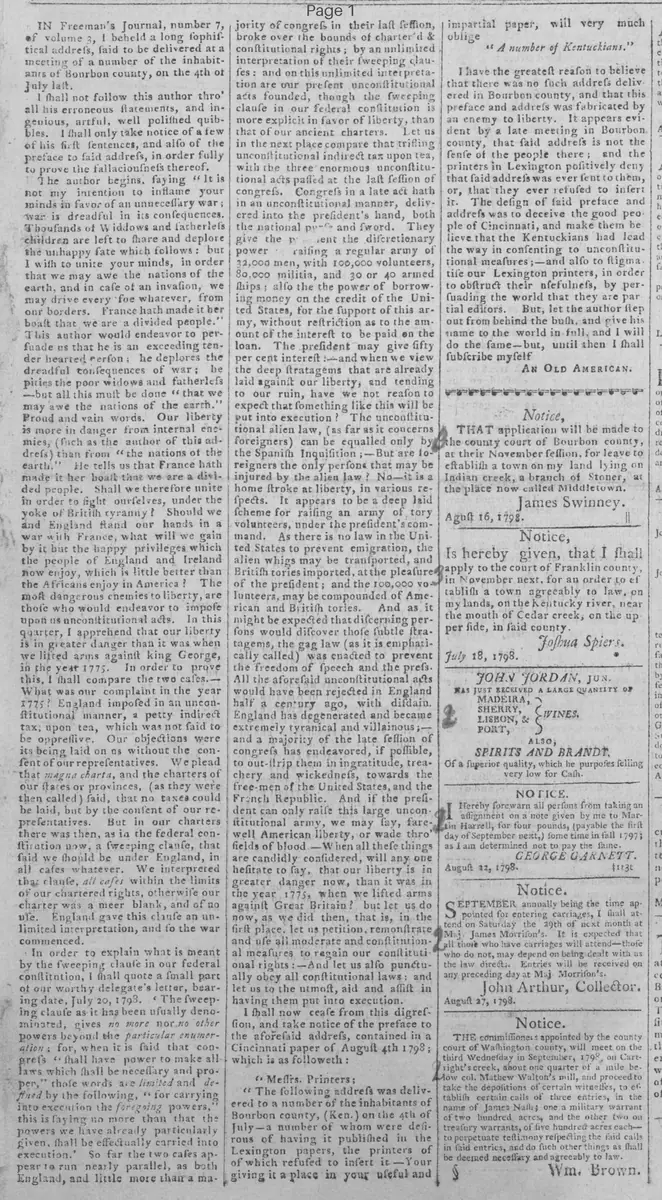
I shall not follow this author thro' all his erroneous statements, and ingenious, artful, well polished quibbles. I shall only take notice of a few of his first sentences. and also of the preface to said address, in order fully to prove the fallaciousness thereof.
The author begins, saying "It is not my intention to inflame your minds in favor of an unnecessary war; war is dreadful in its consequences. Thousands of Widows and fatherless children are left to share and deplore the unhappy fate which follows: but I wish to unite your minds, in order that we may awe the nations of the earth, and in case of an invasion, we may drive every foe whatever, from our borders. France hath made it her boast that we are a divided people."
This author would endeavor to persuade us that he is an exceeding tender hearted person; he deplores the dreadful consequences of war; he pities the poor widows and fatherless -but all this must be done "that we may awe the nations of the earth."' Proud and vain words. Our liberty is more in danger from internal enemies, such as the author of this address than from "the nations of the earth." He tells us that France hath made it her boast that we are a divided people. Shall we therefore unite in order to fight ourselves, under the yoke of British tyranny? Should we and England stand our hands in a war with France, what will we gain by it but the happy privileges which the people of England and Ireland now enjoy, which is little better than the Africans enjoy in America! The most dangerous enemies to liberty, are those who would endeavor to impose upon us unconstitutional acts. In this quarter, I apprehend that our liberty is in greater danger than it was when we lifted arms against king George, in the year 1775. In order to prove this. I shall compare the two cases.-
What was our complaint in the year 1775? England imposed in an unconstitutional manner, a petty indirect tax; upon tea, which was not said to be oppressive. Our objections were its being laid on us without the consent of our representatives. We plead that magna charta, and the charters of our states or provinces, (as they were then called) said. that no taxes could be laid, but by the consent of our representatives. But in our charters there was then, as is the federal constitution now, a sweeping clause, that said we should be under England, in all cases whatever. We interpreted that clause, all cases within the limits of our chartered rights, otherwise our charter was a mere blank, and of no use. England gave this clause an unlimited interpretation, and so the war commenced.
In order to explain what is meant by the sweeping clause in our federal constitution, I shall quote a small part of our worthy delegate's letter, bearing date, July 20, 1793. The sweeping clause as it has been usually denominated, gives no more nor no other powers beyond the particular enumeration : for, when it is said that congress ' shall have power to make all laws which shall be necessary and proper," those words are limited and defined by the following, " for carrying into execution the foregoing powers," this is saying no more than that the powers we have already particularly given, shall be effectually carried into execution.' So far the two cases appear to run nearly parallel, as both England, and little more than a majority of congress in their last session, broke over the bounds of charter'd & constitutional rights; by an unlimited interpretation of their sweeping clauses: and on this unlimited interpretation are our present unconstitutional acts founded, though the sweeping clause in our federal constitution is more explicit in favor of liberty, than that of our ancient charters. Let us in the next place compare that trifling unconstitutional indirect tax upon tea, with the three enormous unconstitutional acts passed at the last session of congress. Congress in a late act hath in an unconstitutional manner, delivered into the president's hand, both the national purse and sword. They give the president the discretionary power ' raising a regular army of 32,000 men, with 100,000 volunteers, 80,000 militia, and 30 or 40 armed ships; also the power of borrowing money on the credit of the United States, for the support of this army, without restriction as to the amount of the interest to be paid on the loan. The president may give fifty per cent interest :and when we view the deep stratagems that are already laid against our liberty, and tending to our ruin. have we not reason to expect that something like this will be put into execution?The unconstitutional alien law, (as far as it concerns foreigners) can be equalled only by the Spanish Inquisition;-But are foreigners the only persons that may be injured by the alien law ? No—it is a home stroke at liberty, in various respects. It appears to be a deep laid scheme for raising an army of tory volunteers. under the president's command. As there is no law in the United States to prevent emigration, the alien whigs may be transported, and British tories imported, at the pleasure of the president: and the 100,000 volunteers, may be compounded of American and British tories. And as it might be expected that discerning persons would discover those subtle stratagems, the gag law (as it is emphatically called) was enacted to prevent the freedom of speech and the pres. All the aforesaid unconstitutional acts would have been rejected in England half a century ago, with disdain. England has degenerated and became extremely tyrannical and villainous;- and a majority of the late session of congress has endeavored, if possible, to outstrip them in ingratitude, treachery and wickedness, towards the free-men of the United States, and the French Republic. And if the president can only raise this large unconstitutional army, we may say, farewell American liberty, or wade thro' fields of blood —W hen all these things are candidly considered, will any one hesitate to say, that our liberty is in greater danger now, than it was in the year 1775, when we lifted arms against Great Britain? but let us do now, as we did then, that is, in the first place. let us petition, remonstrate and use all moderate and constitutional measures to regain our constitutional rights:-And let us also punctually obey all constitutional laws; and let us to the utmost, aid and assist in having them put into execution. I shall now cease from this digression, and take notice of the preface to the aforesaid address, contained in a Cincinnati paper of August 4th 1798; which is as followeth :
Messrs. Printers;
" The following address was delivered to a number of the inhabitants of Bourbon county, (Ken.)on the 4th of July-a number of whom were desirous of having it published in the Lexington papers, the printers of which refused to insert it-Your giving it a place in your useful and impartial paper, will very much oblige
" A number of Kentuckians."
I have the greatest reason to believe that there was no such address delivered in Bourbon county, and that this preface and address was fabricated by an enemy to liberty. It appears evident by a late meeting in Bourbon county, that said address is not the sense of the people there; and the printers in Lexington positively deny that said address was ever sent to them, or, that they ever refused to insert it. The design of said preface and address was to deceive the good people of Cincinnati, and make them believe that the Kentuckians had lead the way in consenting to unconstitutional measures;-and also to stigmatize our Lexington printers, in order to obstruct their usefulness, by persuading the world that they are partial editors. But, let the author step out from behind the bush, and give his name to the world in full, and I will do the same-but, until then I shall subscribe myself
An Old AMERICAN.
What sub-type of article is it?
What themes does it cover?
What keywords are associated?
What entities or persons were involved?
Letter to Editor Details
Author
An Old American
Recipient
Messrs. Printers
Main Argument
current unconstitutional federal acts, including the alien law, sedition act, and military expansions, threaten american liberty more severely than british impositions in 1775; the critiqued bourbon county address is likely fabricated to promote war with france and deceive the public.
Notable Details