Thank you for visiting SNEWPapers!
Sign up free
Editorial
July 12, 1833
Richmond Enquirer
Richmond, Richmond County, Virginia
What is this article about?
This editorial from the Washington Globe argues that Mr. Clay's bill on public lands violates the conditions of cessions by original states, which mandated proceeds for common U.S. benefit proportional to general expenses, not for specific states' internal improvements or education.
Clipping
OCR Quality
98%
Excellent
Full Text
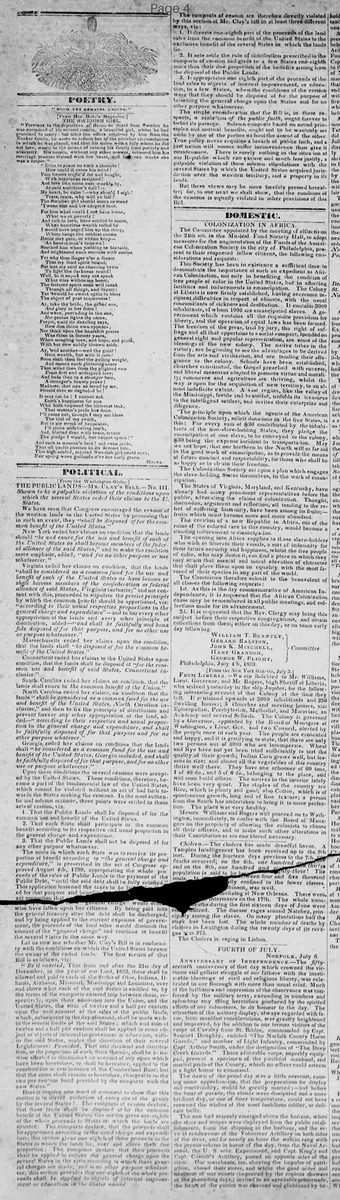
[From the Washington Globe.]
THE PUBLIC LANDS — MR. CLAY's BILL. — No. III.
Shown to be a palpable violation of the conditions upon which the several States ceded their claims to the U. States.
We have seen that Congress encouraged the cession of the western lands to the United States by promising that in such an event, they "shall be disposed of for the common benefit of the United States."
New York ceded her claims on condition that the lands should "be and enure for the use and benefit of such of the United States as shall become members of the federal alliance of the said States," and to make the condition more emphatic, added, "and for no other purpose or use whatsoever."
Virginia ceded her claims on condition, that the lands "shall be considered as a common fund for the use and benefit of such of the United States as have become or shall become members of the confederation or federal alliance of said States, Virginia inclusive;" and not content with this, proceeded to stipulate the precise principle by which the common benefit should be apportioned, viz: "according to their usual respective proportions in the general charge and expenditure" — and to bar every other appropriation of the lands and every other principle of distribution, added — "and shall be faithfully and bona fide disposed of for that purpose, and for no other use or purpose whatsoever."
Massachusetts ceded her claims upon the condition, that the lands shall "be disposed of for the common benefit of the United States."
Connecticut ceded her claims to the United States upon condition, that the lands shall be disposed of "for the common use and benefit of said States, Connecticut inclusive."
South Carolina ceded her claims on condition, that the lands shall enure to the common benefit of the Union."
North Carolina ceded her claims, on condition that the lands "shall be considered as a common fund for the use and benefit of the United States, North Carolina inclusive," and then to fix the principle of distribution and prevent forever any other appropriation of the land, added — "according to their respective and usual proportion in the general charge and expenditure, and shall be faithfully disposed of for that purpose and for no other purpose whatever."
Georgia ceded her claims on condition that the lands shall "be considered as a common fund for the use and benefit of the United States, Georgia included, and shall be faithfully disposed of for that purpose, and for no other use or purpose whatsoever."
Upon these conditions the several cessions were accepted by the United States. These conditions, therefore, became a part of the fundamental law of the United States, which cannot be violated without an act of bad faith towards the States making the cessions. In the most authentic and solemn manner, three points were settled in these acts of cession, viz.
I. That the Public Lands shall be disposed of for the common use and benefit of the United States.
2. That each State shall participate in the common benefit according to its respective and usual proportion in the general charge and expenditure.
3. That the Public Lands shall not be disposed of for any other purpose whatsoever.
The mode in which each State was to receive its proportion of benefit according to "the general charge and expenditure," is prescribed in the act of Congress approved August 4th, 1790, appropriating the whole proceeds of the sales of Public Lands to the payment of the Public Debt, "until the said debt shall be fully satisfied."
This application lessened the taxes to be laid for that purpose and benefited each State in proportion that would have fallen upon her citizens. By being paid into the general treasury after the debt shall be discharged, and by being applied to the current expenses of government, the proceeds of the land sales would diminish the amount of the "general charge" and continue to benefit the several states in the same way.
Let us now see whether Mr. Clay's Bill is in conformity with the conditions on which the United States became the owner of the ceded lands. The first section of that Bill is as follows, viz:
"Be it enacted, That from and after the 31st day of December, in the year of our Lord, 1832, there shall be allowed and paid to each of the States of Ohio, Indiana, Illinois, Alabama, Missouri, Mississippi and Louisiana, over and above what each of the said States is entitled to, by the terms of the compacts entered into between them, respectively, upon their admission into the Union, and the United States, the sum of twelve and a half per centum upon the net amount of the sales of the public lands, which, subsequent to the day aforesaid, shall be made within the several limits of the said States; which said sum of twelve and a half per centum shall be applied to some object or objects of internal improvement or education, within the said States, under the direction of their Several Legislatures: Provided, That said dividend and distribution, or the proportion of each State therein, shall be in no wise affected or diminished on account of any sums which have been heretofore, or shall be hereafter, applied to the construction or continuance of the Cumberland Road; but that the same shall remain as heretofore, chargeable on the two per centum fund provided by the compacts with the new States."
Does it require one word of comment to show that this section is in direct violation of every one of the grants by the several States? The compacts of cession declare, that these lands shall be disposed of for the common benefit of the United States; this section gives one-eighth of the whole proceeds to States in which the lands are situated: The compacts declare, that the proceeds shall be apportioned according to the usual charge and expenditure; this section gives one-eighth of those proceeds to the States in which the lands lie, over and above their due proportion: The compacts declare that their proceeds shall be applied to reduce the general charge upon the several States in the ratio according to which these general charges are made, and to no other purpose whatsoever, this section provides that one-eighth of the whole proceeds shall be applied to objects of internal improvement or education in the States named
The compacts of cession are therefore directly violated by this section of Mr. Clay's bill in at least three different ways, viz:
I. It diverts one-eighth part of the proceeds of the land sales from the common benefit of the United States to the exclusive benefit of the several States in which the lands lie.
2. It sets aside the rule of distribution prescribed in the compacts of cession and gives to a few States one-eighth more than their due proportion of the benefits arising from the disposal of the Public Lands.
3. It misappropriates one eighth part of the proceeds of the land sales to objects of internal improvement, or education, in a few States, when the conditions of the cession were that they should be disposed of for the purpose of lessening the general charge upon the States and for no other purpose whatsoever.
The single consideration that the Bill is, in these respects, a violation of the public faith, ought forever to forbid its passage. Solemn compacts based on sound principles and mutual benefits, ought not to be wantonly set aside by one of the parties without the assent of the other. True policy never requires a breach of public faith, and a just nation will sooner suffer inconvenience than give it countenance. There is surely nothing in the situation of our Republic which can excuse and much less justify, a palpable violation of those solemn stipulations with the several States by which the United States acquired jurisdiction over the western territory, and a property in its lands.
But these views may be more forcibly pressed hereafter; for, in our next we shall show, that the condition of the cessions is equally violated in other provisions of this Bill.
THE PUBLIC LANDS — MR. CLAY's BILL. — No. III.
Shown to be a palpable violation of the conditions upon which the several States ceded their claims to the U. States.
We have seen that Congress encouraged the cession of the western lands to the United States by promising that in such an event, they "shall be disposed of for the common benefit of the United States."
New York ceded her claims on condition that the lands should "be and enure for the use and benefit of such of the United States as shall become members of the federal alliance of the said States," and to make the condition more emphatic, added, "and for no other purpose or use whatsoever."
Virginia ceded her claims on condition, that the lands "shall be considered as a common fund for the use and benefit of such of the United States as have become or shall become members of the confederation or federal alliance of said States, Virginia inclusive;" and not content with this, proceeded to stipulate the precise principle by which the common benefit should be apportioned, viz: "according to their usual respective proportions in the general charge and expenditure" — and to bar every other appropriation of the lands and every other principle of distribution, added — "and shall be faithfully and bona fide disposed of for that purpose, and for no other use or purpose whatsoever."
Massachusetts ceded her claims upon the condition, that the lands shall "be disposed of for the common benefit of the United States."
Connecticut ceded her claims to the United States upon condition, that the lands shall be disposed of "for the common use and benefit of said States, Connecticut inclusive."
South Carolina ceded her claims on condition, that the lands shall enure to the common benefit of the Union."
North Carolina ceded her claims, on condition that the lands "shall be considered as a common fund for the use and benefit of the United States, North Carolina inclusive," and then to fix the principle of distribution and prevent forever any other appropriation of the land, added — "according to their respective and usual proportion in the general charge and expenditure, and shall be faithfully disposed of for that purpose and for no other purpose whatever."
Georgia ceded her claims on condition that the lands shall "be considered as a common fund for the use and benefit of the United States, Georgia included, and shall be faithfully disposed of for that purpose, and for no other use or purpose whatsoever."
Upon these conditions the several cessions were accepted by the United States. These conditions, therefore, became a part of the fundamental law of the United States, which cannot be violated without an act of bad faith towards the States making the cessions. In the most authentic and solemn manner, three points were settled in these acts of cession, viz.
I. That the Public Lands shall be disposed of for the common use and benefit of the United States.
2. That each State shall participate in the common benefit according to its respective and usual proportion in the general charge and expenditure.
3. That the Public Lands shall not be disposed of for any other purpose whatsoever.
The mode in which each State was to receive its proportion of benefit according to "the general charge and expenditure," is prescribed in the act of Congress approved August 4th, 1790, appropriating the whole proceeds of the sales of Public Lands to the payment of the Public Debt, "until the said debt shall be fully satisfied."
This application lessened the taxes to be laid for that purpose and benefited each State in proportion that would have fallen upon her citizens. By being paid into the general treasury after the debt shall be discharged, and by being applied to the current expenses of government, the proceeds of the land sales would diminish the amount of the "general charge" and continue to benefit the several states in the same way.
Let us now see whether Mr. Clay's Bill is in conformity with the conditions on which the United States became the owner of the ceded lands. The first section of that Bill is as follows, viz:
"Be it enacted, That from and after the 31st day of December, in the year of our Lord, 1832, there shall be allowed and paid to each of the States of Ohio, Indiana, Illinois, Alabama, Missouri, Mississippi and Louisiana, over and above what each of the said States is entitled to, by the terms of the compacts entered into between them, respectively, upon their admission into the Union, and the United States, the sum of twelve and a half per centum upon the net amount of the sales of the public lands, which, subsequent to the day aforesaid, shall be made within the several limits of the said States; which said sum of twelve and a half per centum shall be applied to some object or objects of internal improvement or education, within the said States, under the direction of their Several Legislatures: Provided, That said dividend and distribution, or the proportion of each State therein, shall be in no wise affected or diminished on account of any sums which have been heretofore, or shall be hereafter, applied to the construction or continuance of the Cumberland Road; but that the same shall remain as heretofore, chargeable on the two per centum fund provided by the compacts with the new States."
Does it require one word of comment to show that this section is in direct violation of every one of the grants by the several States? The compacts of cession declare, that these lands shall be disposed of for the common benefit of the United States; this section gives one-eighth of the whole proceeds to States in which the lands are situated: The compacts declare, that the proceeds shall be apportioned according to the usual charge and expenditure; this section gives one-eighth of those proceeds to the States in which the lands lie, over and above their due proportion: The compacts declare that their proceeds shall be applied to reduce the general charge upon the several States in the ratio according to which these general charges are made, and to no other purpose whatsoever, this section provides that one-eighth of the whole proceeds shall be applied to objects of internal improvement or education in the States named
The compacts of cession are therefore directly violated by this section of Mr. Clay's bill in at least three different ways, viz:
I. It diverts one-eighth part of the proceeds of the land sales from the common benefit of the United States to the exclusive benefit of the several States in which the lands lie.
2. It sets aside the rule of distribution prescribed in the compacts of cession and gives to a few States one-eighth more than their due proportion of the benefits arising from the disposal of the Public Lands.
3. It misappropriates one eighth part of the proceeds of the land sales to objects of internal improvement, or education, in a few States, when the conditions of the cession were that they should be disposed of for the purpose of lessening the general charge upon the States and for no other purpose whatsoever.
The single consideration that the Bill is, in these respects, a violation of the public faith, ought forever to forbid its passage. Solemn compacts based on sound principles and mutual benefits, ought not to be wantonly set aside by one of the parties without the assent of the other. True policy never requires a breach of public faith, and a just nation will sooner suffer inconvenience than give it countenance. There is surely nothing in the situation of our Republic which can excuse and much less justify, a palpable violation of those solemn stipulations with the several States by which the United States acquired jurisdiction over the western territory, and a property in its lands.
But these views may be more forcibly pressed hereafter; for, in our next we shall show, that the condition of the cessions is equally violated in other provisions of this Bill.
What sub-type of article is it?
Constitutional
Economic Policy
Infrastructure
What keywords are associated?
Public Lands
Clay Bill
State Cessions
Common Benefit
Internal Improvements
Public Faith
Land Sales Proceeds
What entities or persons were involved?
Mr. Clay
Congress
New York
Virginia
Massachusetts
Connecticut
South Carolina
North Carolina
Georgia
Ohio
Indiana
Illinois
Alabama
Missouri
Mississippi
Louisiana
Editorial Details
Primary Topic
Violation Of State Cession Conditions By Mr. Clay's Public Lands Bill
Stance / Tone
Strongly Opposed, Arguing Breach Of Public Faith
Key Figures
Mr. Clay
Congress
New York
Virginia
Massachusetts
Connecticut
South Carolina
North Carolina
Georgia
Ohio
Indiana
Illinois
Alabama
Missouri
Mississippi
Louisiana
Key Arguments
Cessions Required Public Lands Proceeds For Common Benefit Of All States
Proceeds To Be Apportioned By States' Proportions In General Charges
No Other Uses Allowed Beyond Reducing General Expenses
Clay's Bill Diverts 12.5% To Specific New States For Internal Improvements Or Education
Violates Distribution Rule By Giving Extra To Land Holding States
Breaches Solemn Compacts As Fundamental Law