Thank you for visiting SNEWPapers!
Sign up free
The New York Journal, And Weekly Register
New York, New York County, New York
What is this article about?
Proceedings of the New York House of Assembly from January 24-30, debating and amending the election bill, passing bills on courts and estates, nominating delegates to Congress including Haring, Smith, Yates, Benson, and Lansing, and resolving on tax assessment methods.
Clipping
OCR Quality
Full Text
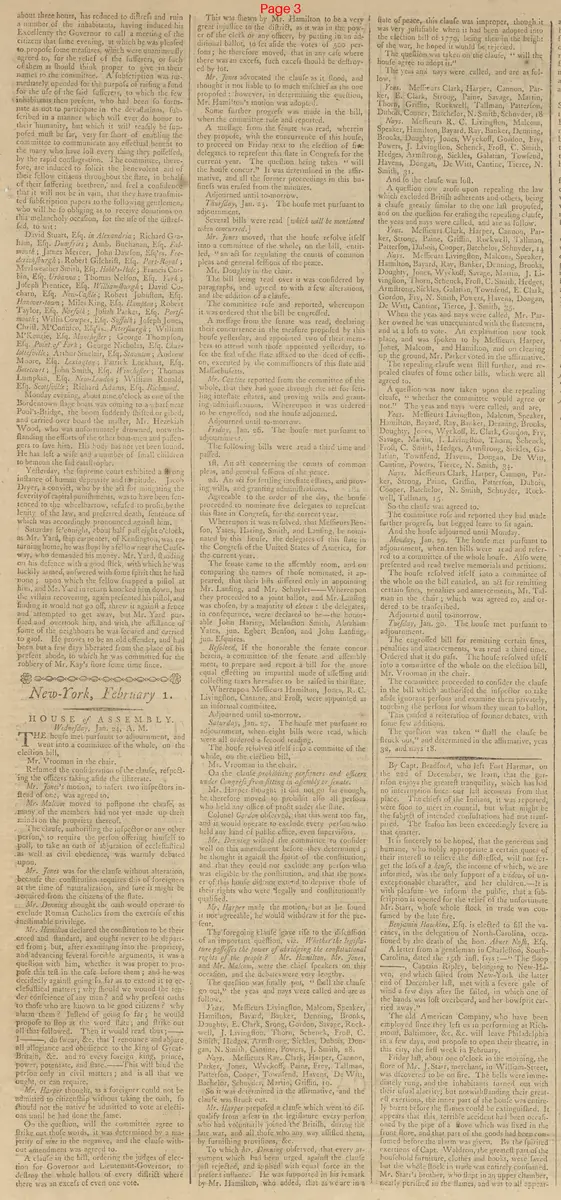
HOUSE of ASSEMBLY.
Wednesday, Jan. 24, A. M.
The house met pursuant to adjournment, and went into a committee of the whole, on the election bill, Mr. Vrooman in the chair.
Resumed the consideration of the clause, respecting the officers taking aside the illiterate.
Mr. Jones's motion, to insert two inspectors instead of one, was agreed to.
Mr. Malcolm moved to postpone the clause, as many of the members had not yet made up their minds on the propriety thereof.
The clause, authorizing the inspector or any other person, to require the person offering himself to poll, to take an oath of abjuration of ecclesiastical as well as civil obedience, was warmly debated upon.
Mr. Jones was for the clause without alteration, because the constitution requires this of foreigners at the time of naturalization, and sure it might be required from the citizens of the state.
Mr. Denning thought the oath would operate to exclude Roman Catholics from the exercise of this inestimable privilege.
Mr. Hamilton declared the constitution to be their creed and standard, and ought never to be departed from; but, after examining into the propriety, and advancing several forcible arguments, it was a question with him, whether it was proper to propose this test in the case before them; and he was decidedly against going so far as to extend it to ecclesiastical matters: why should we wound the tender conscience of any man? and why present oaths to those who are known to be good citizens? why alarm them? Instead of going so far; he would propose to stop at the word state; and strike out all that followed. Then it would read thus:--
I, --, do swear, &c. that I renounce and abjure all allegiance and obedience to the king of Great-Britain, &c. and to every foreign king, prince, power, potentate, and state.--This will bind the person only in civil matters; and is all that we ought, or can require.
Mr. Harper thought, as a foreigner could not be admitted to citizenship without taking the oath, so should not the native be admitted to vote at elections until he had done the same.
On the question, will the committee agree to strike out those words, it was determined by a majority of nine in the negative, and the clause without amendment was agreed to.
A clause in the bill, ordering the judges of election for Governor and Lieutenant-Governor, to destroy the whole ballots of every district where there was an excess of even one vote.
This was shown by Mr. Hamilton to be a very great injustice to the district, as it was in the power of the clerk or any officer, by putting in an additional ballot, to set aside the votes of 500 persons; he therefore moved, that in any case where there was an excess, such excess should be destroyed by lot.
Mr. Jones advocated the clause as it stood, and thought it not liable to so much mischief as the one proposed: however, in determining the question, Mr. Hamilton's motion was adopted.
Some further progress was made in the bill, when the committee rose and reported.
A message from the senate was read, wherein they propose, with the concurrence of this house, to proceed on Friday next to the election of five delegates to represent this state in Congress for the current year. The question being taken "will the house concur." It was determined in the affirmative, and all the former proceedings in this business was erased from the minutes.
Adjourned until to-morrow.
Thursday, Jan. 25. The house met pursuant to adjournment.
Several bills were read which will be mentioned when concurred.
Mr. Jones moved, that the house resolve itself into a committee of the whole, on the bill, entitled, "an act for regulating the courts of common pleas and general sessions of the peace."
Mr. Doughty in the chair.
The bill being read over it was considered by paragraphs, and agreed to with a few alterations, and the addition of a clause.
The committee rose and reported, whereupon it was ordered that the bill be engrossed.
A message from the senate was read, declaring their concurrence in the measure proposed by this house yesterday, and appointed two of their members to attend with those appointed yesterday, to see the seal of the state affixed to the deed of cession, executed by the commissioners of this state and Massachusetts.
Mr. Cantine reported from the committee of the whole, that they had gone through the act for settling intestate estates, and proving wills and granting administrations. Whereupon it was ordered to be engrossed, and the house adjourned.
Adjourned until to-morrow.
Friday, Jan. 26. The house met pursuant to adjournment.
The following bills were read a third time and passed.
1st. An act concerning the courts of common pleas, and general sessions of the peace.
2d. An act for settling intestate estates, and proving wills, and granting administrations.
Agreeable to the order of the day, the house proceeded to nominate five delegates to represent this state in Congress, for the current year.
Whereupon it was resolved, that Messieurs Benson, Yates, Haring, Smith, and Laning, be nominated by this house, the delegates of this state in the Congress of the United States of America, for the current year.
The senate came to the assembly room, and on comparing the names of those nominated, it appeared, that their lists differed only in appointing Mr. Lansing, and Mr. Schuyler--Whereupon they proceeded to a joint ballot, and Mr. Lansing was chosen, by a majority of eleven: the delegates, in consequence, were declared to be--the honorable John Haring, Melancton Smith, Abraham Yates, jun. Egbert Benson, and John Lansing, jun. Esquires.
Resolved, If the honorable the senate concur herein, a committee of the senate and assembly meet, to prepare and report a bill for the more equal effecting an impartial mode of assessing and collecting taxes hereafter to be raised in this state.
Whereupon Messieurs Hamilton, Jones, R. C. Livingston, Cantine, and Frost, were appointed as an informal committee.
Adjourned until to-morrow.
Saturday, Jan. 27. The house met pursuant to adjournment, when eight bills were read, which were all ordered a second reading.
The house resolved itself into a committee of the whole, on the election bill, Mr. Vrooman in the chair.
On the clause prohibiting pensioners and officers under Congress from sitting in assembly or senate.
Mr. Harper thought it did not go far enough, he therefore moved to prohibit also all persons who held any office of profit under the state.
Colonel Gordon observed, that this went too far, and it would operate to exclude every person who held any kind of public office, even supervisors.
Mr. Denning wished the committee to consider well on this amendment before they determined; he thought it against the spirit of the constitution, and that they could not exclude any person who was eligible by the constitution, and that the power of this house did not extend to deprive those of their rights who were legally and constitutionally qualified.
Mr. Harper made the motion, but as he found it not agreeable, he would withdraw it for the present.
The foregoing clause gave rise to the discussion of an important question, viz. Whether the legislature possesses the power of abridging the constitutional rights of the people? Mr. Hamilton, Mr. Jones, and Mr. Malcolm, were the chief speakers on this occasion, and the debates were very lengthy.
The question was finally put, "shall the clause go out," the yeas and nays were called and are as follow.
Yeas. Messieurs Livingston, Malcolm, Speaker, Hamilton, Bayard, Banker, Denning, Brooks, Doughty, E. Clark, Strong, Gordon, Savage, Rockwell, J. Livingston, Thorn, Schenck, Frost, C. Smith, Hedges, Armstrong, Sickles, Dubois, Dongan, N. Smith, Cantine, Powers, J. Smith, 28.
Nays. Messieurs Ray, Clark, Harper, Cannon, Parker, Jones, Wyckoff, Paine, Frey, Tallman, Patterson, Cooper, Townsend, Havens, De Witt, Bachelor, Schnyder, Martin, Griffin, 19.
So it was determined in the affirmative, and the clause was struck out.
Mr. Harper proposed a clause which went to disqualify from a seat in the legislature every person who had voluntarily joined the British, during the late war, and all those who any way assisted them, by furnishing provisions, &c.
To which Mr. Denning observed, that every argument which had been urged against the clause just rejected, and applied with equal force in the present instance. He was supported in his remark by Mr. Hamilton, who added, that as we are in a state of peace, this clause was improper, though it was very justifiable when it had been adopted into the election bill of 1779, being then in the height of the war, he hoped it would be rejected.
The question was taken on the clause, "will the house agree to adopt it."
The yeas and nays were called, and are as follow.
Yeas. Messieurs Clark, Harper, Cannon, Parker, E. Clark, Strong, Paine, Savage, Martin, Thorn, Griffin, Rockwell, Tallman, Patterson, Dubois, Cooper, Batchelor, N. Smith, Schnyder, 18
Nays. Messieurs R. C. Livingston, Malcolm, Speaker, Hamilton, Bayard, Ray, Banker, Denning, Brooks, Doughty, Jones, Wyckoff, Gordon, Fry, Powers, J. Livingston, Schenck, Frost, C. Smith, Hedges, Armstrong, Sickles, Galatian, Townsend, Havens, Dongan, De Witt, Cantine, Tierce, N. Smith, 31.
And so the clause was lost.
A question now arose upon repealing the law which excluded British adherents and others, being a clause greatly similar to the one last proposed, and on the question for erasing the repealing clause, the yeas and nays were called, and are as follow.
Yeas. Messieurs Clark, Harper, Cannon, Parker, Strong, Paine, Griffin, Rockwell, Tallman, Patterson, Dubois, Cooper, Batchelor, Schnyder, 14
Nays. Messieurs Livingston, Malcolm, Speaker, Hamilton, Bayard, Ray, Banker, Denning, Brooks, Doughty, Jones, Wyckoff, Savage, Martin, J. Livingston, Thorn, Schenck, Frost, C. Smith, Hedges, Armstrong, Sickles, Galatian, Townsend, E. Clark, Gordon, Fry, N. Smith, Powers, Havens, Dongan, De Witt, Cantine, Tierce, J. Smith, 35.
When the yeas and nays were called, Mr. Parker owned he was unacquainted with the statement, and at a loss to vote. An explanation now took place, and was spoken to by Messieurs Harper, Jones, Malcolm, and Hamilton, and on clearing up the ground, Mr. Parker voted in the affirmative.
The repealing clause went still further, and repealed clauses of some other bills, which were all agreed to.
A question was now taken upon the repealing clause, "whether the committee would agree or not." The yeas and nays were called, and are,
Yeas. Messieurs Livingston, Malcolm, Speaker, Hamilton, Bayard, Ray, Banker, Denning, Brooks, Doughty, Jones, Wyckoff, E. Clark, Gordon, Fry, Savage, Martin, J. Livingston, Thorn, Schenck, Frost, C. Smith, Hedges, Armstrong, Sickles, Galatian, Townsend, Havens, Dongan, De Witt, Cantine, Powers, Tierce, N. Smith, 34.
Nays. Messieurs Clark, Harper, Cannon, Parker, Strong, Paine, Griffin, Patterson, Dubois, Cooper, Batchelor, N. Smith, Schnyder, Rockwell, Tallman, 15.
So the clause was agreed to.
The committee rose and reported they had made further progress, but begged leave to sit again.
And the house adjourned until Monday.
Monday, Jan. 29. The house met pursuant to adjournment, when ten bills were read and referred to a committee of the whole house. Also were presented and read twelve memorials and petitions.
The house resolved itself into a committee of the whole on the bill entitled, an act for remitting certain fines, penalties and amercements, Mr. Tallman in the chair; which was agreed to, and ordered to be transcribed.
Adjourned until to-morrow.
Tuesday, Jan. 30. The house met pursuant to adjournment.
The engrossed bill for remitting certain fines, penalties and amercements, was read a third time.
Ordered that it do pass. The house resolved itself into a committee of the whole on the election bill, Mr. Vrooman in the chair.
The committee proceeded to consider the clause in the bill which authorized the inspector to take aside ignorant persons and examine them privately, touching the persons for whom they mean to ballot.
This caused a reiteration of former debates, with some few additions.
The question was taken "shall the clause be struck out," and determined in the affirmative, yeas 32, and nays 18.
What sub-type of article is it?
What keywords are associated?
What entities or persons were involved?
Where did it happen?
Domestic News Details
Primary Location
New York
Event Date
January 24 To 30
Key Persons
Outcome
election bill advanced with amendments including striking clauses on oaths and inspectors; bills passed for courts of common pleas, intestate estates, and remitting fines; delegates nominated and elected to congress; committee appointed for tax assessment bill.
Event Details
The House met in sessions from January 24 to 30, debating the election bill extensively, including clauses on oaths of abjuration, inspectors for illiterate voters, disqualifications for pensioners and British adherents, with votes recorded; passed bills on courts, estates, and fines; nominated and jointly elected five delegates to Congress; agreed to prepare a tax assessment bill.