Thank you for visiting SNEWPapers!
Sign up free
Story
November 27, 1891
Lawrence Democrat
Lawrenceburg, Lawrence County, Tennessee
What is this article about?
Humorous anecdote of young inventor Pinkney Lazenberry's quirky, often disastrous inventions, from splicing a dog's tail to a wind-powered cradle and a wheeled couch for his ague-afflicted father, Watts Lazenberry, highlighting family ingenuity and mishaps.
Clipping
OCR Quality
95%
Excellent
Full Text
[WRITTEN FOR THIS PAPER
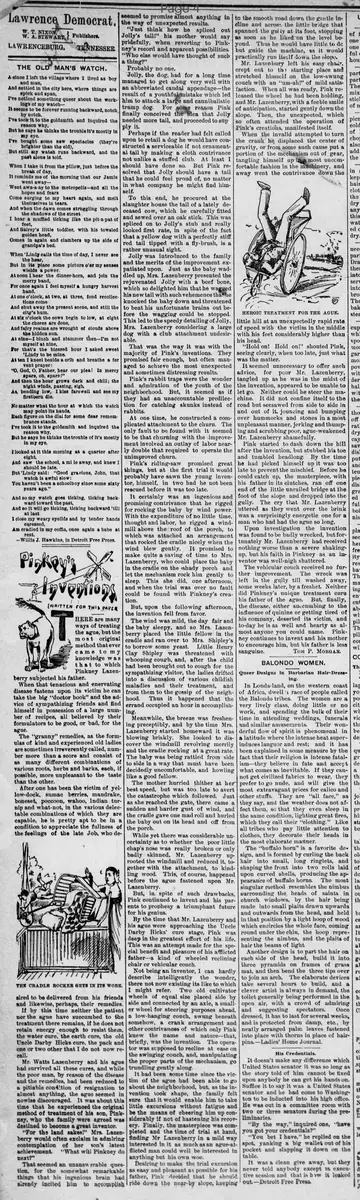
There are many ways of treating the ague, but the most original method that ever came to my knowledge was that to which Pinkney Lazenberry subjected his father.
When that tenacious and enervating disease fastens upon its victim he can take the big "doctor book" and the advice of sympathizing friends and find himself in possession of a large number of recipes, all believed by their formulators to be good, or bad, for the ague.
The "granny" remedies, as the formulas of kind and experienced old ladies are sometimes irreverently called, number more than a score and consist of as many different combinations of various roots, herbs and barks, each, if possible, more unpleasant to the taste than the other.
After one has been the victim of yellow-dock, sumac berries, mandrake, boneset, poccoon, wahoo, Indian turnip and what-not, in the various delectable combinations of which they are capable, he is pretty apt to be in a condition to appreciate the fullness of the feelings of the late Job, who desired to be delivered from his friends and likewise, perhaps, their remedies.
If by this time neither the patient nor the ague have succumbed to the treatment there remains, if he does not retain energy enough to resist them, the water cure, the earth cure, the old Uncle Darby Hicks cure, the pack and one or two other that I do not now recall.
Mr. Watts Lazenberry and his ague had survived all these cures, and while the poor man, by reason of the disease and the remedies, had been reduced to a pitiable condition of resignation to almost anything, the ague seemed in nowise discouraged. It was about this time that he experienced the original method of treatment of his son, Pinkney, who the family were agreed was destined to become a great inventor.
"For the land sakes!" Mrs. Lazenberry would often exclaim in admiring contemplation of her son's latest achievement. "What will Pinkney do next?"
That seemed an unanswerable question, for the somewhat remarkable things that his ingenious brain had already incited him to accomplish seemed to promise almost anything in the way of unexpected results.
"Just think how he spliced out Jolly's tail!" his mother would say pridefully, when reverting to Pinkney's record and apparent possibilities. "Who else would have thought of such a thing?"
Probably no one.
Jolly, the dog, had for a long time managed to get along very well with an abbreviated caudal appendage-the result of a youthful mistake which led him to attack a large and cannibalistic tramp dog. For some reason Pinkney finally conceived the idea that Jolly needed more tail, and proceeded to supply it.
Perhaps if the reader had felt called upon to retail a dog he would have constructed a serviceable if not ornamental tail by making a cloth contrivance not unlike a stuffed club. At least I should have done so. But Pink resolved that Jolly should have a tail that he could feel proud of, no matter in what company he might find himself.
To this end, he procured at the slaughter house the tail of a lately deceased cow, which he carefully fitted and sewed over an oak stick. This was spliced on to Jolly's stub and really looked first rate, in spite of the fact that a yellow dog with a perfectly stiff red tail tipped with a fly-brush, is a rather unusual sight.
Jolly was introduced to the family and the merits of the improvement expatiated upon. Just as the baby waddled up, Mrs. Lazenberry presented the rejuvenated Jolly with a beef bone, which so delighted him that he wagged his new tail with such vehemence that he knocked the baby down and threatened to beat his unfortunate brains out before the wagging could be stopped.
This led to the speedy detailing of Jolly, Mrs. Lazenberry considering a large dog with a club attachment undesirable.
That was the way it was with the majority of Pink's inventions. They promised fair enough, but often managed to achieve the most unexpected and sometimes distressing results.
Pink's rabbit traps were the wonder and admiration of the youth of the neighborhood. But, it seemed as if they had an unaccountable predilection for catching skunks instead of rabbits.
At one time, he constructed a complicated attachment to the churn. The only fault to be found with it seemed to be that churning with the improvement involved an outlay of labor nearly double that required to operate the unimproved churn.
Pink's riding-saw promised great things, but at the first trial it would probably have sawn the young inventor, himself, in two had he not been rescued before it was too late.
It certainly was an ingenious and promising contrivance that he rigged for rocking the baby by wind power. With the expenditure of no little time, thought and labor, he rigged a windmill above the roof of the porch, to which was attached an arrangement that rocked the cradle nicely when the wind blew gently. It promised to make quite a saving of time to Mrs. Lazenberry, who could place the baby in the cradle on the shady porch and let the mechanism rock him gently to sleep. This she did, one afternoon, and when the trial was over no fault could be found with Pinkney's creation.
But, upon the following afternoon, the invention fell from favor. The wind was mild, the day fair and the baby sleepy, and so Mrs. Lazenberry placed the little fellow in the cradle and ran over to Mrs. Shipley's to borrow some yeast. Little Henry Clay Shipley was threatened with whooping cough, and, after the child had been brought out to cough for the sympathizing visitor, the ladies drifted into a discussion of various childish maladies and their treatment, and from them to the gossip of the neighborhood. Thus it happened that the errand occupied an hour in accomplishing.
Meanwhile, the breeze was freshening perceptibly, and by the time Mrs. Lazenberry started homeward it was blowing briskly. She looked to discover the windmill revolving merrily and the cradle rocking at a great rate. The baby was being rattled from side to side in a way that must have been decidedly uncomfortable, and howling like a good fellow.
The mother hurried thither at her best speed, but was too late to avert the catastrophe which followed. Just as she reached the gate, there came a sudden and harder gust of wind, and the cradle gave one mad roll and hurled the baby out on its head and off from the porch.
While yet there was considerable uncertainty as to whether the poor little chap's nose was really broken or only badly skinned, Mr. Lazenberry uprooted the windmill and reduced it, together with the attachment, to kindling wood. This, of course, happened before the ague fastened upon Mr. Lazenberry.
But, in spite of such drawbacks, Pink continued to invent and his parents to prophesy a triumphant future for his genius.
By the time that Mr. Lazenberry and his ague were approaching the Uncle Darby Hicks' cure stage, Pink was deep in the greatest effort of his life. This was an attempt made for the special benefit and pleasure of his afflicted father--a kind of wheeled reclining chair or vehicular couch.
Not being an inventor, I can hardly describe intelligently the wonder, there not now existing its like to which I might refer. Two old cultivator wheels of equal size placed side by side and connected by an axle, a smaller wheel for steering purposes ahead, a low-hanging couch, swung beneath somehow, a crank arrangement and other contrivances of which only Pink knew the name and nature-that, briefly, was the invention. The operator was supposed to recline at ease on the swinging couch, and, manipulating the proper parts of the mechanism, go trundling gently along.
It had been some time since the victim of the ague had been able to go about the neighborhood, but, as the invention took shape, the family felt sure that it would enable him to take little excursions without fatigue and be the means of cheering him up considerably if not of hastening his recovery. Finally, the masterpiece was completed and the time of trial at hand, finding Mr. Lazenberry in a mild way interested in it as much as an ague-afflicted man could well be interested in anything but his own woe.
Desiring to make the trial excursion as easy and pleasant as possible for his father, Pink decided that he should ride down the near-by slope, keeping to the smooth road down the gentle incline and across the little bridge that spanned the gully at its foot, stopping as soon as he liked on the level beyond. Thus he would have little to do but guide the machine, as it would practically run itself down the hill.
Mr. Lazenberry left his easy chair, crept out to the starting place and stretched himself on the low-swung couch with an 'um-ah!' of mild satisfaction. When all was ready, Pink released the wheel he had been holding, and Mr. Lazenberry, with a feeble smile of anticipation, started gently down the slope. Then, the unexpected, which so often attended the operation of Pink's creations, manifested itself.
When the invalid attempted to turn the crank he displaced the center of gravity, or from some such cause put a portion of the mechanism out of gear, tangling himself up in a most uncomfortable fashion in the machinery, and away went the contrivance down the little hill at an unexpectedly rapid rate of speed with the victim in the middle with his feet considerably higher than his head.
"Hold on! Hold on!" shouted Pink, seeing clearly, when too late, just what was the matter.
It seemed unnecessary to offer such advice, for poor Mr. Lazenberry, tangled up as he was in the midst of the invention, appeared to be unable to let go. Neither could he steer the machine. It did not confine itself to the road but seesawed from side to side in and out of it, jouncing and bumping over hummocks and stones in a most unpleasant manner, jerking and thumping and scrubbing poor, ague-weakened Mr. Lazenberry shamefully.
Pink started to dash down the hill after the invention, but stubbed his toe and tumbled headlong. By the time he had picked himself up it was too late to prevent the mischief. Before he could catch up, the masterpiece, with his father in its clutches, ran off one end of the little unrailed bridge at the foot of the slope and dropped into the gully. The cry that Mr. Lazenberry uttered as they went over the brink was a surprisingly energetic one for a man who had had the ague so long.
Upon investigation the invention was found to be badly wrecked, but fortunately Mr. Lazenberry had received nothing worse than a severe shaking up, but his faith in Pinkney as an inventor was well-nigh shattered.
The vehicular couch received no further improvement. The wreck was left in the gully till washed away, some weeks later, by a freshet. Neither did Pinkney's unique treatment cure his father of the ague. But, finally, the disease, either succumbing to the influence of quinine or getting tired of his company, deserted its victim, and to-day he is as well and hearty as almost anyone you could name. Pinkney continues to invent and his mother to encourage him, but his father is less sanguine.
TOM P. MORGAN.
There are many ways of treating the ague, but the most original method that ever came to my knowledge was that to which Pinkney Lazenberry subjected his father.
When that tenacious and enervating disease fastens upon its victim he can take the big "doctor book" and the advice of sympathizing friends and find himself in possession of a large number of recipes, all believed by their formulators to be good, or bad, for the ague.
The "granny" remedies, as the formulas of kind and experienced old ladies are sometimes irreverently called, number more than a score and consist of as many different combinations of various roots, herbs and barks, each, if possible, more unpleasant to the taste than the other.
After one has been the victim of yellow-dock, sumac berries, mandrake, boneset, poccoon, wahoo, Indian turnip and what-not, in the various delectable combinations of which they are capable, he is pretty apt to be in a condition to appreciate the fullness of the feelings of the late Job, who desired to be delivered from his friends and likewise, perhaps, their remedies.
If by this time neither the patient nor the ague have succumbed to the treatment there remains, if he does not retain energy enough to resist them, the water cure, the earth cure, the old Uncle Darby Hicks cure, the pack and one or two other that I do not now recall.
Mr. Watts Lazenberry and his ague had survived all these cures, and while the poor man, by reason of the disease and the remedies, had been reduced to a pitiable condition of resignation to almost anything, the ague seemed in nowise discouraged. It was about this time that he experienced the original method of treatment of his son, Pinkney, who the family were agreed was destined to become a great inventor.
"For the land sakes!" Mrs. Lazenberry would often exclaim in admiring contemplation of her son's latest achievement. "What will Pinkney do next?"
That seemed an unanswerable question, for the somewhat remarkable things that his ingenious brain had already incited him to accomplish seemed to promise almost anything in the way of unexpected results.
"Just think how he spliced out Jolly's tail!" his mother would say pridefully, when reverting to Pinkney's record and apparent possibilities. "Who else would have thought of such a thing?"
Probably no one.
Jolly, the dog, had for a long time managed to get along very well with an abbreviated caudal appendage-the result of a youthful mistake which led him to attack a large and cannibalistic tramp dog. For some reason Pinkney finally conceived the idea that Jolly needed more tail, and proceeded to supply it.
Perhaps if the reader had felt called upon to retail a dog he would have constructed a serviceable if not ornamental tail by making a cloth contrivance not unlike a stuffed club. At least I should have done so. But Pink resolved that Jolly should have a tail that he could feel proud of, no matter in what company he might find himself.
To this end, he procured at the slaughter house the tail of a lately deceased cow, which he carefully fitted and sewed over an oak stick. This was spliced on to Jolly's stub and really looked first rate, in spite of the fact that a yellow dog with a perfectly stiff red tail tipped with a fly-brush, is a rather unusual sight.
Jolly was introduced to the family and the merits of the improvement expatiated upon. Just as the baby waddled up, Mrs. Lazenberry presented the rejuvenated Jolly with a beef bone, which so delighted him that he wagged his new tail with such vehemence that he knocked the baby down and threatened to beat his unfortunate brains out before the wagging could be stopped.
This led to the speedy detailing of Jolly, Mrs. Lazenberry considering a large dog with a club attachment undesirable.
That was the way it was with the majority of Pink's inventions. They promised fair enough, but often managed to achieve the most unexpected and sometimes distressing results.
Pink's rabbit traps were the wonder and admiration of the youth of the neighborhood. But, it seemed as if they had an unaccountable predilection for catching skunks instead of rabbits.
At one time, he constructed a complicated attachment to the churn. The only fault to be found with it seemed to be that churning with the improvement involved an outlay of labor nearly double that required to operate the unimproved churn.
Pink's riding-saw promised great things, but at the first trial it would probably have sawn the young inventor, himself, in two had he not been rescued before it was too late.
It certainly was an ingenious and promising contrivance that he rigged for rocking the baby by wind power. With the expenditure of no little time, thought and labor, he rigged a windmill above the roof of the porch, to which was attached an arrangement that rocked the cradle nicely when the wind blew gently. It promised to make quite a saving of time to Mrs. Lazenberry, who could place the baby in the cradle on the shady porch and let the mechanism rock him gently to sleep. This she did, one afternoon, and when the trial was over no fault could be found with Pinkney's creation.
But, upon the following afternoon, the invention fell from favor. The wind was mild, the day fair and the baby sleepy, and so Mrs. Lazenberry placed the little fellow in the cradle and ran over to Mrs. Shipley's to borrow some yeast. Little Henry Clay Shipley was threatened with whooping cough, and, after the child had been brought out to cough for the sympathizing visitor, the ladies drifted into a discussion of various childish maladies and their treatment, and from them to the gossip of the neighborhood. Thus it happened that the errand occupied an hour in accomplishing.
Meanwhile, the breeze was freshening perceptibly, and by the time Mrs. Lazenberry started homeward it was blowing briskly. She looked to discover the windmill revolving merrily and the cradle rocking at a great rate. The baby was being rattled from side to side in a way that must have been decidedly uncomfortable, and howling like a good fellow.
The mother hurried thither at her best speed, but was too late to avert the catastrophe which followed. Just as she reached the gate, there came a sudden and harder gust of wind, and the cradle gave one mad roll and hurled the baby out on its head and off from the porch.
While yet there was considerable uncertainty as to whether the poor little chap's nose was really broken or only badly skinned, Mr. Lazenberry uprooted the windmill and reduced it, together with the attachment, to kindling wood. This, of course, happened before the ague fastened upon Mr. Lazenberry.
But, in spite of such drawbacks, Pink continued to invent and his parents to prophesy a triumphant future for his genius.
By the time that Mr. Lazenberry and his ague were approaching the Uncle Darby Hicks' cure stage, Pink was deep in the greatest effort of his life. This was an attempt made for the special benefit and pleasure of his afflicted father--a kind of wheeled reclining chair or vehicular couch.
Not being an inventor, I can hardly describe intelligently the wonder, there not now existing its like to which I might refer. Two old cultivator wheels of equal size placed side by side and connected by an axle, a smaller wheel for steering purposes ahead, a low-hanging couch, swung beneath somehow, a crank arrangement and other contrivances of which only Pink knew the name and nature-that, briefly, was the invention. The operator was supposed to recline at ease on the swinging couch, and, manipulating the proper parts of the mechanism, go trundling gently along.
It had been some time since the victim of the ague had been able to go about the neighborhood, but, as the invention took shape, the family felt sure that it would enable him to take little excursions without fatigue and be the means of cheering him up considerably if not of hastening his recovery. Finally, the masterpiece was completed and the time of trial at hand, finding Mr. Lazenberry in a mild way interested in it as much as an ague-afflicted man could well be interested in anything but his own woe.
Desiring to make the trial excursion as easy and pleasant as possible for his father, Pink decided that he should ride down the near-by slope, keeping to the smooth road down the gentle incline and across the little bridge that spanned the gully at its foot, stopping as soon as he liked on the level beyond. Thus he would have little to do but guide the machine, as it would practically run itself down the hill.
Mr. Lazenberry left his easy chair, crept out to the starting place and stretched himself on the low-swung couch with an 'um-ah!' of mild satisfaction. When all was ready, Pink released the wheel he had been holding, and Mr. Lazenberry, with a feeble smile of anticipation, started gently down the slope. Then, the unexpected, which so often attended the operation of Pink's creations, manifested itself.
When the invalid attempted to turn the crank he displaced the center of gravity, or from some such cause put a portion of the mechanism out of gear, tangling himself up in a most uncomfortable fashion in the machinery, and away went the contrivance down the little hill at an unexpectedly rapid rate of speed with the victim in the middle with his feet considerably higher than his head.
"Hold on! Hold on!" shouted Pink, seeing clearly, when too late, just what was the matter.
It seemed unnecessary to offer such advice, for poor Mr. Lazenberry, tangled up as he was in the midst of the invention, appeared to be unable to let go. Neither could he steer the machine. It did not confine itself to the road but seesawed from side to side in and out of it, jouncing and bumping over hummocks and stones in a most unpleasant manner, jerking and thumping and scrubbing poor, ague-weakened Mr. Lazenberry shamefully.
Pink started to dash down the hill after the invention, but stubbed his toe and tumbled headlong. By the time he had picked himself up it was too late to prevent the mischief. Before he could catch up, the masterpiece, with his father in its clutches, ran off one end of the little unrailed bridge at the foot of the slope and dropped into the gully. The cry that Mr. Lazenberry uttered as they went over the brink was a surprisingly energetic one for a man who had had the ague so long.
Upon investigation the invention was found to be badly wrecked, but fortunately Mr. Lazenberry had received nothing worse than a severe shaking up, but his faith in Pinkney as an inventor was well-nigh shattered.
The vehicular couch received no further improvement. The wreck was left in the gully till washed away, some weeks later, by a freshet. Neither did Pinkney's unique treatment cure his father of the ague. But, finally, the disease, either succumbing to the influence of quinine or getting tired of his company, deserted its victim, and to-day he is as well and hearty as almost anyone you could name. Pinkney continues to invent and his mother to encourage him, but his father is less sanguine.
TOM P. MORGAN.
What sub-type of article is it?
Biography
Curiosity
Family Drama
What themes does it cover?
Family
Misfortune
Moral Virtue
What keywords are associated?
Young Inventor
Failed Inventions
Ague Treatment
Family Anecdotes
Humorous Mishaps
Dog Tail Splice
Wind Cradle
Wheeled Couch
What entities or persons were involved?
Pinkney Lazenberry
Watts Lazenberry
Mrs. Lazenberry
Jolly
Baby Lazenberry
Where did it happen?
Rural Neighborhood
Story Details
Key Persons
Pinkney Lazenberry
Watts Lazenberry
Mrs. Lazenberry
Jolly
Baby Lazenberry
Location
Rural Neighborhood
Story Details
Young inventor Pinkney creates quirky devices like a cow-tail for the dog Jolly, wind-powered cradle that hurls the baby, and a wheeled couch that crashes with his ague-sick father, leading to humorous mishaps but eventual recovery.