Thank you for visiting SNEWPapers!
Sign up free
Literary
March 31, 1827
Literary Cadet, And Saturday Evening Bulletin
Providence, Providence County, Rhode Island
What is this article about?
An elderly man, B. P. Bronzey, shares his story of unrequited love for Lucretia and submits a romantic poem by Mrs. Letitia Barbauld titled 'To Lucretia,' using dawn-to-noon metaphors for beauty and lost hope.
Clipping
OCR Quality
98%
Excellent
Full Text
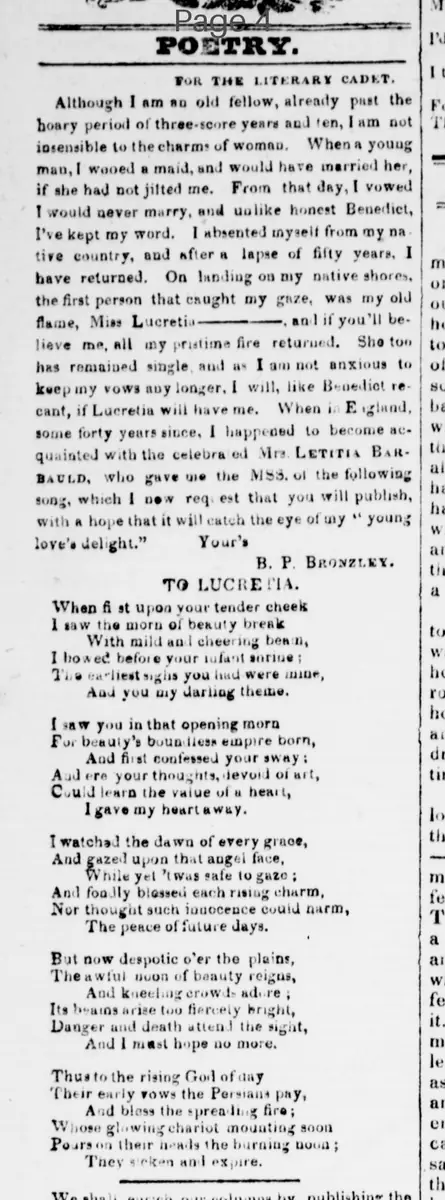
POETRY.
FOR THE LITERARY CADET.
Although I am an old fellow, already past the hoary period of three-score years and ten, I am not insensible to the charms of woman. When a young man, I wooed a maid, and would have married her if she had not jilted me. From that day, I vowed I would never marry, and unlike honest Benedict, I've kept my word. I absented myself from my native country, and after a lapse of fifty years, I have returned. On landing on my native shores, the first person that caught my gaze, was my old flame, Miss Lucretia ---, and if you'll believe me, all my pristine fire returned. She too has remained single, and as I am not anxious to keep my vows any longer, I will, like Benedict recant, if Lucretia will have me. When in England, some forty years since, I happened to become acquainted with the celebrated Mrs. Letitia Barbauld, who gave me the MSS. of the following song, which I now request that you will publish, with a hope that it will catch the eye of my "young love's delight."
Yours,
B. P. BRONZEY.
TO LUCRETIA.
When first upon your tender cheek
I saw the morn of beauty break
With mild and cheering beam,
I bowed before your infant shrine;
The earliest sighs you had were mine,
And you my darling theme.
I saw you in that opening morn
For beauty's boundless empire born,
And first confessed your sway:
And ere your thoughts, devoid of art,
Could learn the value of a heart,
I gave my heart away.
I watched the dawn of every grace,
And gazed upon that angel face,
While yet 'twas safe to gaze;
And fondly blessed each rising charm,
Nor thought such innocence could harm
The peace of future days.
But now despotic o'er the plains
The awful noon of beauty reigns,
And kneeling crowds adore;
Its beams arise too fiercely bright,
Danger and death attend the sight,
And I must hope no more.
Thus to the rising God of day
Their early vows the Persians pay,
And bless the spreading fire;
Whose glowing chariot mounting soon
Pours on their heads the burning noon;
They sicken and expire.
FOR THE LITERARY CADET.
Although I am an old fellow, already past the hoary period of three-score years and ten, I am not insensible to the charms of woman. When a young man, I wooed a maid, and would have married her if she had not jilted me. From that day, I vowed I would never marry, and unlike honest Benedict, I've kept my word. I absented myself from my native country, and after a lapse of fifty years, I have returned. On landing on my native shores, the first person that caught my gaze, was my old flame, Miss Lucretia ---, and if you'll believe me, all my pristine fire returned. She too has remained single, and as I am not anxious to keep my vows any longer, I will, like Benedict recant, if Lucretia will have me. When in England, some forty years since, I happened to become acquainted with the celebrated Mrs. Letitia Barbauld, who gave me the MSS. of the following song, which I now request that you will publish, with a hope that it will catch the eye of my "young love's delight."
Yours,
B. P. BRONZEY.
TO LUCRETIA.
When first upon your tender cheek
I saw the morn of beauty break
With mild and cheering beam,
I bowed before your infant shrine;
The earliest sighs you had were mine,
And you my darling theme.
I saw you in that opening morn
For beauty's boundless empire born,
And first confessed your sway:
And ere your thoughts, devoid of art,
Could learn the value of a heart,
I gave my heart away.
I watched the dawn of every grace,
And gazed upon that angel face,
While yet 'twas safe to gaze;
And fondly blessed each rising charm,
Nor thought such innocence could harm
The peace of future days.
But now despotic o'er the plains
The awful noon of beauty reigns,
And kneeling crowds adore;
Its beams arise too fiercely bright,
Danger and death attend the sight,
And I must hope no more.
Thus to the rising God of day
Their early vows the Persians pay,
And bless the spreading fire;
Whose glowing chariot mounting soon
Pours on their heads the burning noon;
They sicken and expire.
What sub-type of article is it?
Poem
What themes does it cover?
Love Romance
What keywords are associated?
Romantic Poem
Enduring Love
Beauty Metaphor
Lost Hope
Lucretia
What entities or persons were involved?
Mrs. Letitia Barbauld (Mss. Given To B. P. Bronzey)
Literary Details
Title
To Lucretia
Author
Mrs. Letitia Barbauld (Mss. Given To B. P. Bronzey)
Subject
Expression Of Enduring Love For Lucretia Through Metaphors Of Beauty's Dawn And Noon
Key Lines
When First Upon Your Tender Cheek
I Saw The Morn Of Beauty Break
But Now Despotic O'er The Plains
The Awful Noon Of Beauty Reigns
Thus To The Rising God Of Day