Thank you for visiting SNEWPapers!
Sign up free
Literary
June 4, 1804
Jenks' Portland Gazette
Portland, Cumberland County, Maine
What is this article about?
Excerpt from Shakespeare's Hamlet featuring Polonius's advice to his son Laertes on conduct, friendship, caution in quarrels, dress, borrowing, and self-truthfulness, presented as moral precepts in verse.
Clipping
OCR Quality
98%
Excellent
Full Text
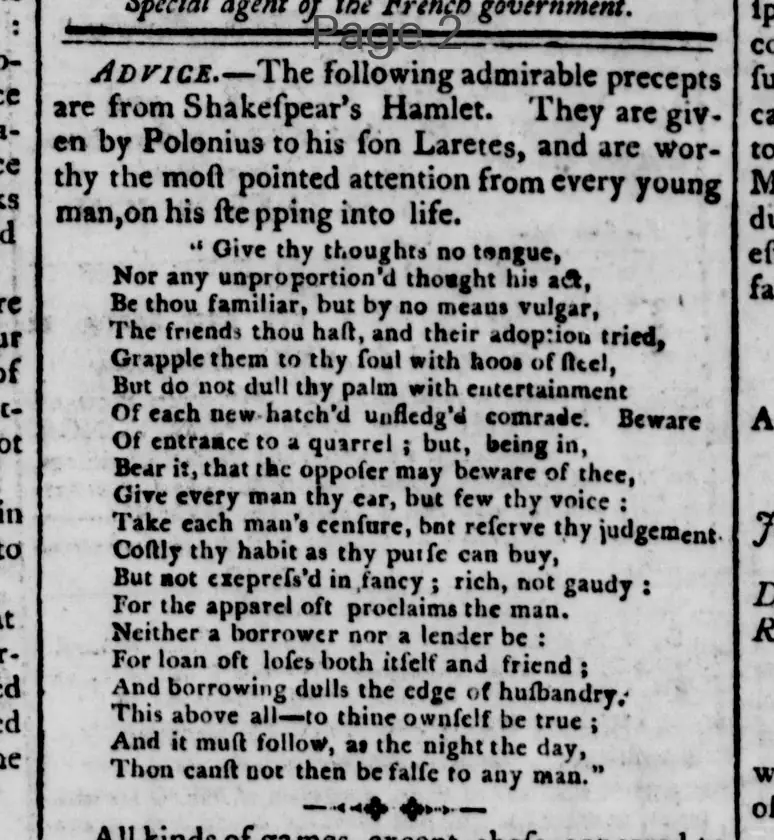
ADVICE.—The following admirable precepts are from Shakespear's Hamlet. They are given by Polonius to his son Laertes, and are worthy the most pointed attention from every young man, on his stepping into life.
"Give thy thoughts no tongue,
Nor any unproportion'd thought his act,
Be thou familiar, but by no means vulgar,
The friends thou hast, and their adoption tried,
Grapple them to thy soul with hooks of steel,
But do not dull thy palm with entertainment
Of each new-hatch'd unfledged comrade. Beware
Of entrance to a quarrel; but, being in,
Bear it, that the opposer may beware of thee,
Give every man thy ear, but few thy voice:
Take each man's censure, but reserve thy judgement.
Costly thy habit as thy purse can buy,
But not express'd in fancy; rich, not gaudy:
For the apparel oft proclaims the man.
Neither a borrower nor a lender be:
For loan oft loses both itself and friend;
And borrowing dulls the edge of husbandry.
This above all to thine own self be true;
And it must follow, as the night the day,
Thou canst not then be false to any man."
"Give thy thoughts no tongue,
Nor any unproportion'd thought his act,
Be thou familiar, but by no means vulgar,
The friends thou hast, and their adoption tried,
Grapple them to thy soul with hooks of steel,
But do not dull thy palm with entertainment
Of each new-hatch'd unfledged comrade. Beware
Of entrance to a quarrel; but, being in,
Bear it, that the opposer may beware of thee,
Give every man thy ear, but few thy voice:
Take each man's censure, but reserve thy judgement.
Costly thy habit as thy purse can buy,
But not express'd in fancy; rich, not gaudy:
For the apparel oft proclaims the man.
Neither a borrower nor a lender be:
For loan oft loses both itself and friend;
And borrowing dulls the edge of husbandry.
This above all to thine own self be true;
And it must follow, as the night the day,
Thou canst not then be false to any man."
What sub-type of article is it?
Soliloquy
Poem
What themes does it cover?
Moral Virtue
Friendship
Temperance
What keywords are associated?
Moral Precepts
Friendship Loyalty
Self Conduct
Temperance
Honesty
What entities or persons were involved?
Shakespear's Hamlet
Literary Details
Title
Advice.
Author
Shakespear's Hamlet
Subject
Polonius To His Son Laertes
Key Lines
Give Thy Thoughts No Tongue,
Grapple Them To Thy Soul With Hooks Of Steel,
Neither A Borrower Nor A Lender Be:
This Above All To Thine Own Self Be True;
Thou Canst Not Then Be False To Any Man.